
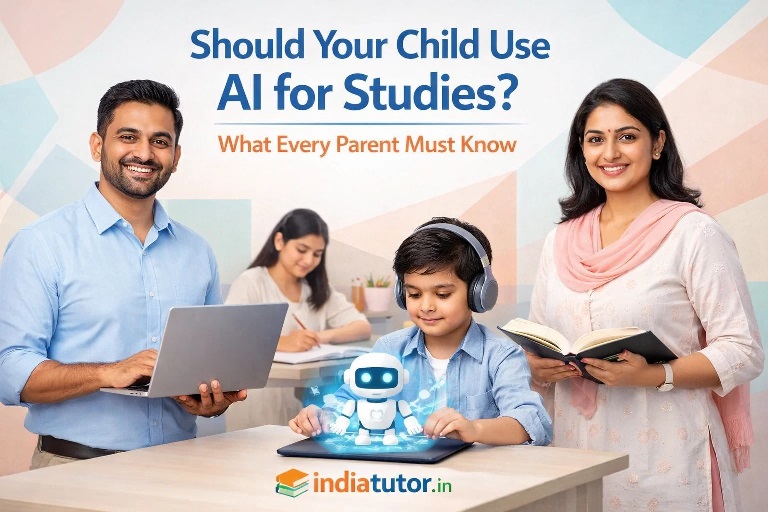
Artificial Intelligence (AI) is rapidly becoming part of everyday learning. Students use tools like ChatGPT and other AI-powered platforms to find information, understand concepts, solve problems, generate ideas, and complete assignments.
For many parents, this raises an important question: Should children use AI for studies, or will it negatively affect learning?
The answer is not a simple yes or no. AI can be a valuable educational tool when used correctly. However, over dependence on it can create learning gaps and weaken essential academic skills.
This guide explains the benefits, risks, and best practices every parent should understand.
What Is AI in Education?
AI refers to computer systems that can generate responses, explain concepts, answer questions, summarize content, and assist with learning tasks.
Students commonly use AI for:
-
- Homework assistance
- Understanding difficult topics
- Language improvement
- Project research
- Exam preparation
- Practice questions
- Writing support
Instead of searching through multiple websites, many students now ask AI tools directly for explanations and solutions.
AI Is Already Being Used by Students Worldwide
AI adoption among students has grown dramatically in a short period.
A 2025 survey of over 1,000 students found that 92% had used AI in some form, while 88% had used generative AI tools for academic work. The most common uses included concept explanation, article summarization, and research support.
Another international survey reported that 58% of students globally use AI for studies, while the figure reached 63% among students in India.
These numbers show that AI is no longer a future trend. It is already part of modern education.
Benefits of AI for Students
When used appropriately, AI can support learning in several ways.
Faster Understanding of Difficult Topics
Children often hesitate to ask questions repeatedly in a classroom. AI tools can explain the same concept multiple times using different examples.
This can be particularly useful in subjects such as Mathematics, Science, and English.
Personalized Learning Support
Every student learns at a different pace.
AI can provide explanations based on a child’s current understanding, helping learners revisit concepts whenever needed.
Better Exam Preparation
Students can generate quizzes, practice questions, revision notes, and summaries.
This makes revision more organized and helps learners identify weak areas.
Improved Confidence
Some children feel uncomfortable asking questions in front of classmates.
AI provides a private environment where students can explore doubts without fear of judgment.
How to Use AI Tools for Homework Without Cheating
The Risks Parents Should Not Ignore
Although AI offers advantages, it also comes with significant challenges.
AI Can Give Incorrect Answers
AI systems do not always provide accurate information.
Studies show that many students worry about receiving inaccurate or misleading responses from AI tools.
A child who blindly accepts every answer may end up learning incorrect concepts.
Reduced Critical Thinking
Learning happens when students analyze, calculate, reason, and solve problems independently.
If AI performs all the thinking, students may miss opportunities to develop problem-solving abilities and analytical skills. Researchers have identified concerns that excessive dependence can reduce active mental engagement.
Homework Without Learning
One of the biggest concerns among educators is that students may use AI to complete assignments without understanding the material.
A finished homework sheet does not always mean genuine learning has taken place.
Privacy Concerns
Many AI platforms collect user inputs.
Students should avoid sharing personal details, school records, passwords, contact information, or sensitive data while using AI tools.
10 Smart Ways Students Can Use AI to Score Higher in Exams
When AI Helps Learning
AI can be extremely useful when students use it as a guide rather than a shortcut.
Good Uses of AI
-
- Explaining difficult concepts
- Creating practice tests
- Improving grammar and writing
- Summarizing lengthy chapters
- Brainstorming project ideas
- Revising lessons before exams
In these situations, AI supports learning rather than replacing it.
When AI Hurts Learning
Parents should watch for signs that AI is becoming a substitute for effort.
Warning Signs
-
- Copying answers directly into assignments
- Completing homework without reading the explanation
- Using AI instead of textbooks
- Avoiding independent thinking
- Relying on AI for every academic task
These habits can affect long-term academic growth.
How to Use AI for Notes, Summaries & Revision Faster Than Ever
How Parents Can Guide Children to Use AI Responsibly
Parents do not need to ban AI. Instead, they should help children develop healthy habits.
Encourage Verification
Teach children to compare AI responses with textbooks, school notes, and trusted educational resources.
Ask for Explanations
Instead of checking only whether homework is completed, ask children to explain what they learned.
This helps confirm real understanding.
Set Clear Rules
Children should know that AI can assist with learning but should not complete their entire assignment.
Promote Independent Problem Solving
Encourage students to attempt questions on their own before seeking AI assistance.
The struggle to solve a problem is often where learning happens.
AI for Competitive Exams: Smarter Prep for JEE, NEET & Olympiads
Why Human Teachers and Tutors Still Matter
AI can explain information, but it cannot fully replace experienced educators.
Emotional Support
Teachers understand a student’s strengths, weaknesses, motivation levels, and learning style.
Personalized Feedback
A tutor can identify specific mistakes and provide targeted guidance that AI may miss.
Accountability
Regular interaction with a teacher encourages discipline, consistency, and academic responsibility.
Real-World Learning
Human educators help students develop communication skills, confidence, creativity, and critical thinking.
These qualities remain essential regardless of technological advances.
Will AI Replace Teachers or Make Smart Tutors Grow Stronger?
Should Parents Be Worried About AI?
The goal should not be to stop children from using AI.
Instead, parents should focus on teaching responsible use.
Technology has always changed education. Calculators, computers, and the internet were once viewed with concern. Today, they are standard learning tools.
AI is likely to follow a similar path.
Children who learn how to use AI wisely may gain valuable advantages in academics and future careers. However, students who depend on it for every task may struggle to build the knowledge and thinking skills needed for long-term success.
Screen Time vs Smart Time: Teaching Kids to Use AI Productively
My Thoughts
AI can be a powerful learning companion when used correctly. It can explain concepts, support revision, and improve study efficiency. At the same time, parents must ensure that technology enhances learning rather than replacing it.
The best approach is balance: combine the convenience of AI with the guidance of teachers, tutors, textbooks, and independent thinking. This helps students gain both technological skills and strong academic foundations.
Looking for experienced tutors who can help your child use technology effectively while building strong subject knowledge? Register on IndiaTutor.in and connect directly with qualified tutors across India for online and home tuition classes.
Tutors can also create a profile on IndiaTutor.in to reach students and parents worldwide, receive direct enquiries, and grow their teaching practice without paying commissions.
AI in Education: Threat or Opportunity for Indian Students?
About the Author
Nidhi Mehta is the founder of IndiaTutor.in and a professional online educator with over 11 years of teaching experience. She specializes in tutoring Classes 1 to 6 across core academic subjects, with a strong focus on concept clarity and foundational skill-building. Her teaching approach is based on personalized, one-to-one learning that helps students develop long-term academic confidence and understanding.


