
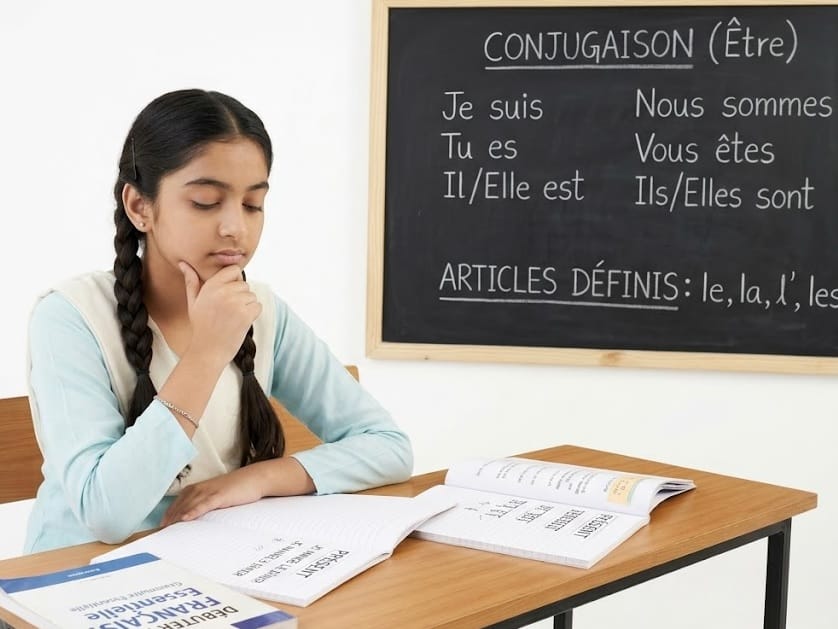
French is one of the most widely studied foreign languages in the world, with more than 300 million speakers across continents. According to the Organisation Internationale de la Francophonie, French is expected to be spoken by over 700 million people by 2050 due to population growth in Africa. For students in India, French is commonly introduced as a third language in CBSE and ICSE schools, often starting from middle grades.
Understanding grammar is the foundation of mastering French. Unlike English, French follows stricter rules for gender, verb endings, and sentence structure. Students who build a strong grammar base early tend to perform better in exams and communication tasks. The Common European Framework of Reference for Languages (CEFR) categorizes beginner proficiency as A1 and A2 levels, where grammar accuracy plays a major role in scoring well.
This article breaks down essential French grammar basics in a simple and practical way so students can improve step by step.
Sentence Structure in French
French sentence formation is logical but different from English in subtle ways. Most basic sentences follow Subject-Verb-Object order, but placement can shift in questions and negative sentences.
Basic sentence pattern
A simple structure looks like:
Subject + Verb + Object
Example:
Je mange une pomme (I eat an apple)
Here:
Je = I
mange = eat
une pomme = an apple
Questions in French
Questions can be formed in three main ways:
-
- Rising intonation: Tu parles français?
- Est-ce que form: Est-ce que tu parles français?
- Inversion: Parles-tu français?
Negative sentences
Negation uses two parts: ne + verb + pas
Example:
Je ne comprends pas (I do not understand)
In spoken French, ne is often dropped, but in exams it is mandatory.
Top Benefits of Learning French Alongside School Studies
Nouns and Articles in French
French nouns are always gendered. Every noun is either masculine or feminine, which affects articles and adjectives.
Gender of nouns
There is no strict rule for all words, but common patterns help:
-
- Words ending in -tion are usually feminine (la nation)
- Words ending in -age are usually masculine (le garage)
Articles in French
Articles change depending on gender and number.
Definite articles
-
- le (masculine singular)
- la (feminine singular)
- les (plural for both genders)
Example:
le livre (the book)
la table (the table)
les livres (the books)
Indefinite articles
-
- un (masculine singular)
- une (feminine singular)
- des (plural)
Example:
un stylo (a pen)
une chaise (a chair)
Research from language learning studies published in applied linguistics journals shows that gender agreement errors are among the most common mistakes for beginner French learners, especially those whose native languages do not use grammatical gender, such as English or Hindi.
How French Can Improve Career Opportunities in India and Abroad
Verbs and Conjugation Rules
French verbs change based on subject, tense, and group classification. This is one of the most important grammar areas for students.
Three verb groups
French verbs are divided into:
-
- -ER verbs (parler, aimer)
- -IR verbs (finir, choisir)
- -RE verbs (vendre, prendre)
Present tense example
Parler (to speak):
-
- Je parle
- Tu parles
- Il/elle parle
- Nous parlons
- Vous parlez
- Ils/elles parlent
Notice how endings change depending on subject. This pattern is consistent in regular verbs, making it easier to predict once learned.
Importance of verb accuracy
Educational assessments across European language programs indicate that verb conjugation errors account for nearly 40 percent of total grammar mistakes in beginner-level writing tests. This shows why consistent practice is essential.
How to Memorize French Vocabulary Faster
Adjectives and Agreement Rules
In French, adjectives must agree with the noun they describe in gender and number.
Basic rule
Masculine singular: petit garçon (small boy)
Feminine singular: petite fille (small girl)
Plural: petits garçons / petites filles
Placement of adjectives
Most adjectives come after the noun:
une voiture rouge (a red car)
However, common adjectives like beau, petit, grand often come before:
un petit chien (a small dog)
This shift in placement is a frequent confusion point for students transitioning from English.
Pronouns in French Grammar
Pronouns help avoid repetition and make sentences smoother.
Subject pronouns
-
- je (I)
- tu (you informal)
- il/elle (he/she)
- nous (we)
- vous (you formal or plural)
- ils/elles (they)
Object pronouns
Object pronouns replace nouns:
-
- me
- te
- le/la
- nous
- vous
- les
Example:
Je vois Marie → Je la vois (I see her)
Mastering pronouns improves both writing quality and spoken fluency.
How Parents Can Support French Learning at Home
Tenses Overview in School French
French uses multiple tenses, but students typically focus on a few key ones in school exams.
Present tense (Présent)
Used for current actions:
Je vais à l’école (I go to school)
Past tense (Passé composé)
Used for completed actions:
J’ai mangé (I ate)
Future tense (Futur proche)
Used for near future:
Je vais étudier (I am going to study)
A study on language acquisition patterns shows that learners who practice all three basic tenses together develop stronger communication skills than those who focus only on memorization.
Common Mistakes Students Make in French Grammar
Mixing gender articles
Many students incorrectly say le table instead of la table.
Forgetting verb endings
Dropping correct endings like -s, -ent affects marks in exams.
Direct translation from English
Word-for-word translation leads to unnatural sentences.
Incorrect pronoun usage
Using full nouns repeatedly instead of replacing them with pronouns reduces fluency.
Negation errors
Missing either ne or pas in written exams leads to loss of marks.
Common Mistakes Parents Make When Helping Children Learn French
Effective Ways to Practice French Grammar
Daily short practice
Even 15 to 20 minutes daily improves retention more than long weekly sessions.
Reading simple French texts
Children’s books and graded readers help reinforce sentence structure.
Writing small paragraphs
Writing about daily routine helps apply grammar in real context.
Listening practice
French songs, podcasts, and beginner dialogues improve understanding of sentence flow.
Speaking practice
Speaking aloud improves confidence and reduces hesitation.
Language learning research consistently shows that active recall methods, such as speaking and writing without looking at notes, improve grammar retention significantly compared to passive reading.
Why French Grammar Matters for Academic Success
In CBSE and ICSE examinations, grammar accuracy directly affects marks in writing, reading comprehension, and translation sections. Even small errors in agreement or conjugation can reduce overall scores. Students who build a strong grammar foundation early tend to perform better in higher classes where complexity increases.
French grammar is not about memorization alone. It is about recognizing patterns and applying them correctly in real situations. Once students understand these patterns, learning becomes easier and more enjoyable.
My Thoughts
French grammar forms the backbone of language learning. From sentence structure to verb conjugation, each concept builds toward clearer communication and better exam performance. Students who practice consistently and understand rules instead of memorizing blindly gain a long-term advantage.
For beginners, starting with small daily steps is more effective than trying to learn everything at once. Over time, grammar becomes intuitive and natural.
Private tutoring can further strengthen this journey by offering personalized attention, correcting mistakes in real time, and providing structured practice plans based on individual learning speed. A tutor can simplify difficult grammar topics, improve confidence in speaking and writing, and help students prepare effectively for school exams. One-to-one guidance ensures that doubts are cleared immediately, which accelerates progress and builds a strong foundation in French.
Looking for expert French tutors?
Find French Tutors on IndiaTutor.in
About the Author
Nidhi Mehta is the founder of IndiaTutor.in and a professional online educator with over 11 years of teaching experience. She specializes in tutoring Classes 1 to 6 across core academic subjects, with a strong focus on concept clarity and foundational skill-building. Her teaching approach is based on personalized, one-to-one learning that helps students develop long-term academic confidence and understanding.


