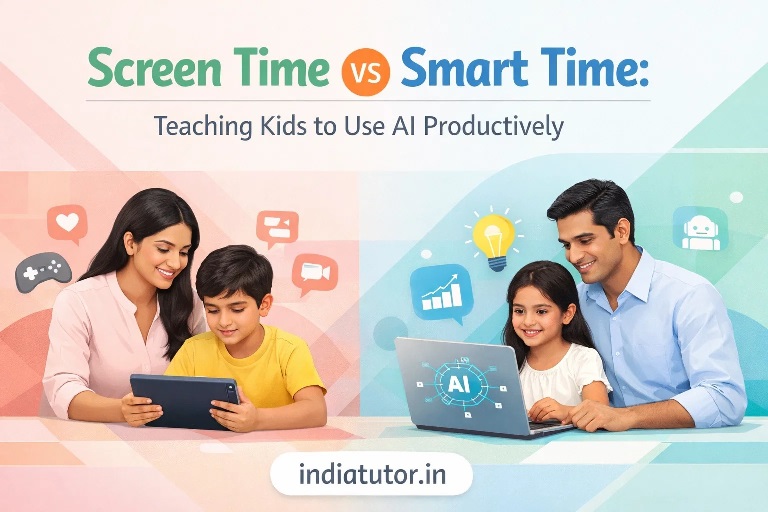
For years, parents and teachers have worried about one thing: screen time. From mobile phones to tablets and laptops, children today spend more time in front of screens than any previous generation. But in 2026, the conversation is changing. It is no longer just about how much time children spend on screens. It is about how they use that time. The real question is: are they wasting time, or are they building skills?
Welcome to the era of smart time.
Artificial Intelligence tools such as ChatGPT, Google Gemini, and Microsoft Copilot are now easily accessible to students. Many Indian parents feel confused. Should children be allowed to use AI? Will it make them lazy? Will it reduce their thinking ability? Or can it actually help them learn better?
For online tutors in India, especially those teaching CBSE, ICSE, IB, IGCSE and NRI students, this is not a future issue. It is happening right now.
Understanding the Difference Between Screen Time and Smart Time
Screen time becomes a problem when it is passive. Endless scrolling, gaming without learning, watching random videos, and copying homework answers without understanding the concept are examples of unhealthy screen habits.
Smart time, on the other hand, is intentional. It is when a student uses technology to solve problems, understand concepts, explore creativity, practice communication, or improve skills. The device remains the same. The difference lies in the purpose.
If a Class 6 student uses AI to understand fractions better with examples, that is smart time. If the same student uses AI to copy homework answers without reading them, that is screen time.
The shift is not about removing devices. It is about teaching responsible and productive usage.
Why AI Is Not the Enemy
Many parents and tutors initially resist AI because they fear it will replace thinking. However, calculators did not destroy mathematics. The internet did not destroy reading. Similarly, AI will not destroy learning. It will change how we learn.
AI can act as a personal assistant for students. It can explain difficult topics in simple language, generate practice questions, summarize chapters, help with essay structure, and even improve vocabulary. For Indian students preparing for competitive exams or studying abroad, AI tools can offer instant doubt solving, which saves time.
The problem arises only when students depend on AI blindly. If they use it without understanding, they miss the learning process. That is where tutors play a crucial role.
The Role of Online Tutors in the AI Age
Online tutors in India are in a powerful position. Instead of banning AI, tutors can teach students how to use it intelligently.
First, tutors can show students how to ask better questions. AI gives better answers when questions are clear and detailed. Teaching students how to frame questions improves their thinking ability.
Second, tutors can encourage AI-assisted learning instead of AI-dependent learning. For example, ask students to attempt a question first. Then allow them to use AI to check their answer or explore alternative methods.
Third, tutors can focus more on conceptual clarity. If a student submits an AI-generated answer, a good tutor can ask follow-up questions to test real understanding.
This approach builds critical thinking rather than reducing it.
Teaching Digital Responsibility Alongside AI Skills
Smart time is not only about productivity. It is also about ethics and responsibility.
Students must understand that copying AI answers and presenting them as their own is not honest learning. Tutors and parents should clearly explain academic integrity. AI should be used as a guide, not as a shortcut.
It is also important to teach students about data privacy. They should avoid sharing personal information, school details, or sensitive data on public AI platforms.
Digital literacy is becoming as important as reading and writing. Indian tutors who integrate AI awareness into their teaching will stay ahead in the competitive online tutoring market.
Turning AI Into a Learning Partner
AI can be especially powerful in the Indian education context where class sizes are large and personalized attention is limited.
For primary students, AI can generate extra practice worksheets in maths or grammar. For middle school students, it can help with science experiments explanations or history timelines. For senior students, it can assist in research, essay drafting, coding practice, and interview preparation.
For NRI families who hire Indian online tutors, AI can bridge time gaps. Students can revise concepts using AI between live sessions. This makes online tutoring more effective and result-oriented.
Tutors can also use AI to create lesson plans, quizzes, and revision material quickly. This saves preparation time and allows them to focus more on student interaction.
Addressing Common Concerns of Parents
Indian parents often worry that AI will reduce writing skills. The solution is not to stop AI but to design tasks wisely. Tutors can ask students to first write answers in their own words and then compare them with AI suggestions. This improves editing skills and language awareness.
Another concern is reduced memory power. However, modern education is shifting from memorization to application. AI can actually help students practice more questions in less time, strengthening understanding.
Parents should also set clear time limits. A structured study schedule that includes AI learning, offline reading, physical activity, and family time ensures balance.
Preparing Students for the Future
The future job market will require AI familiarity. Whether a student becomes a doctor, engineer, designer, entrepreneur, or teacher, AI tools will be part of daily work.
Teaching children to avoid AI completely may leave them unprepared. Teaching them to use AI wisely prepares them for leadership.
For IndiaTutor.in and its community of online tutors, this is a huge opportunity. Tutors who guide students in productive AI usage will build trust with parents. They will stand out in search results as modern, forward-thinking educators.
Smart time is not about more technology. It is about better use of technology.
Practical Tips for Tutors to Promote Smart Time
Start every session by clarifying learning goals. Encourage students to think first, then use AI as support. Review AI-generated content together and identify mistakes or improvements. Teach students how to verify information from textbooks and reliable sources. Promote discussion instead of blind acceptance.
When tutors combine human mentorship with AI assistance, learning becomes deeper and more interactive.
Transform Screen Time into Smart Time
Screen time is unavoidable in today’s digital world. But it does not have to be harmful. The real power lies in transforming screen time into smart time.
AI is not replacing teachers. It is reshaping education. Indian online tutors who understand this shift can create smarter learners, confident parents, and stronger academic results.
The goal is simple. Do not fear the screen. Teach students to use it wisely.