

How Parents Can Help Children Prepare for Social Studies Exams

How Parents Can Help Children Prepare for Social Studies Exams

Social Studies is often misunderstood as a subject that simply requires memorization. In reality, it helps students understand history, geography, civics, economics, society, governance, and the world around them. Strong Social Studies skills improve critical thinking, awareness, analytical ability, and communication.

Many students struggle with Social Studies because of its vast syllabus and the amount of information they need to remember. However, with the right guidance at home, children can prepare effectively and perform well in examinations.

This guide explains practical ways parents can support Social Studies learning and help children approach exams with confidence.

Why Social Studies Is Important for Students

Social Studies teaches students how societies function, how governments work, how economies operate, and how historical events shape the present.

According to studies published by educational organizations, students who develop strong social science knowledge often show better analytical thinking and decision-making skills. These abilities are valuable not only for examinations but also for future careers and everyday life.

Subjects such as History, Geography, Political Science, Civics, and Economics encourage students to understand concepts rather than simply memorize facts.

Best Study Techniques for Social Studies That Actually Work

Understand the Challenges Your Child Faces

Before helping with preparation, parents should understand why many students find Social Studies difficult.

Large Volume of Content

Unlike subjects that focus on formulas or calculations, Social Studies contains numerous chapters, dates, events, definitions, locations, and concepts.

Students may feel overwhelmed when they see a lengthy syllabus.

Difficulty Connecting Topics

Children sometimes memorize information without understanding how different topics relate to one another.

For example, a student may learn about the Industrial Revolution but fail to understand its impact on economics, migration, and modern society.

Lack of Revision

Many students postpone revision until the last few weeks before exams. This often results in stress and poor retention.

Recognizing these challenges allows parents to provide targeted support.

Create a Realistic Study Plan

A structured study schedule can significantly improve preparation.

Divide the Syllabus into Smaller Sections

Instead of asking children to complete an entire subject at once, break chapters into manageable portions.

For example:

    • Monday: History chapter
    • Tuesday: Geography chapter
    • Wednesday: Civics revision
    • Thursday: Map practice
    • Friday: Question solving

Smaller goals make studying less intimidating and easier to manage.

Start Early

Research on learning retention suggests that information reviewed repeatedly over time is remembered better than material studied during last-minute cramming sessions.

Encourage preparation several weeks before examinations.

Common Social Studies Learning Problems and How to Address Them

Focus on Understanding Rather Than Memorization

One of the biggest mistakes students make is trying to memorize every sentence.

Discuss Topics at Home

Parents can ask simple questions such as:

    • Why did this historical event happen?
    • What caused this geographical change?
    • How does the government provide public services?

These conversations help children think critically and understand concepts more deeply.

Use Real-Life Examples

Connecting lessons to daily life makes learning more meaningful.

For instance:

    • Inflation can be explained through rising prices of household goods.
    • Democratic processes can be linked to elections.
    • Environmental topics can be related to local pollution issues.

Practical examples improve comprehension and recall.

Encourage Active Learning Techniques

Passive reading is often ineffective for Social Studies preparation.

Create Mind Maps

Mind maps help students organize information visually.

A chapter on the Freedom Movement, for example, can include branches for major leaders, events, causes, and outcomes.

Visual learning often improves retention.

Make Summary Notes

Encourage children to write short summaries after completing each chapter.

These notes become valuable revision tools before exams.

Use Flashcards

Flashcards work particularly well for:

    • Important dates
    • Historical events
    • Definitions
    • Geographic terms
    • Constitutional articles

Regular review strengthens memory.

How to Memorize Important Historical Dates and Events in Social Studies

Help Children Improve Map Skills

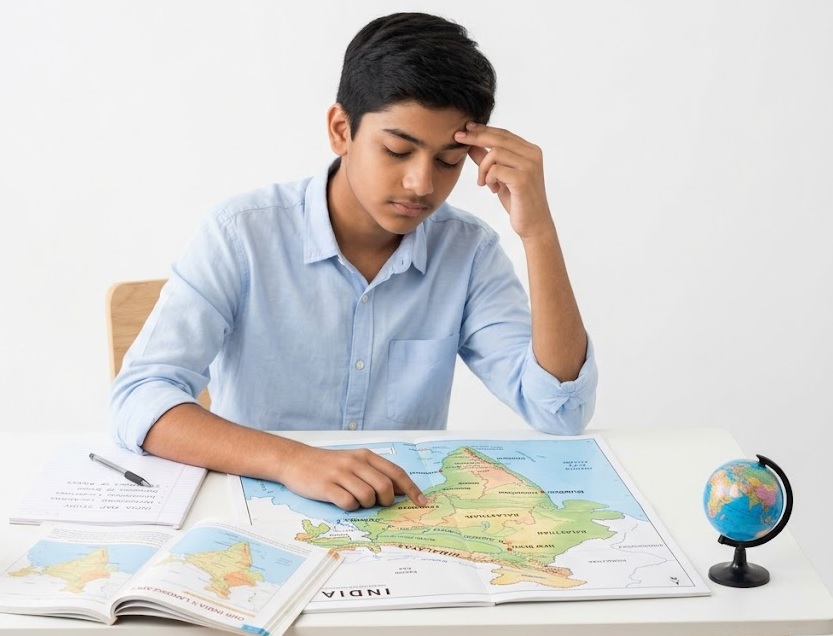
Map-based questions frequently appear in Social Studies examinations.

Practice Regularly

Students should identify:

    • States and capitals
    • Rivers
    • Mountains
    • Important cities
    • Historical locations

Just ten to fifteen minutes of map practice several times a week can improve confidence significantly.

Use Wall Maps

Displaying maps in study areas allows students to become familiar with geographical locations through repeated exposure.

Teach Effective Answer-Writing Techniques

Knowledge alone is not enough. Students must learn how to present answers properly.

Read Questions Carefully

Children should understand exactly what is being asked before writing.

Words such as:

    • Explain
    • Describe
    • Compare
    • Discuss
    • Evaluate

require different types of responses.

Use Headings and Points

Examiners often find structured answers easier to read.

Encourage children to use:

Short Introductions

A brief opening statement provides context.

Clear Main Points

Important information should be organized logically.

Relevant Examples

Examples strengthen explanations and demonstrate understanding.

Practice Previous Year Questions

Solving sample papers helps students understand exam patterns and improves time management.

How to Remember Important Maps and Locations in Social Studies

Make Revision a Continuous Process

Many students revise only once before exams.

Weekly Revision Sessions

Schedule one day each week for reviewing previously studied chapters.

Frequent revision strengthens long-term memory.

Monthly Assessments

Parents can conduct informal quizzes at home.

Simple tests help identify areas that need additional attention.

Educational research consistently shows that retrieval practice, where students recall information without looking at notes, improves learning outcomes more effectively than repeated reading alone.

Reduce Exam Anxiety

Stress can negatively affect performance even when students know the material.

Maintain a Positive Environment

Avoid comparing children with classmates, siblings, or friends.

Every student learns at a different pace.

Celebrate Progress

Recognize effort, consistency, and improvement rather than focusing only on marks.

Positive reinforcement increases motivation.

Encourage Healthy Habits

Good sleep, proper nutrition, hydration, and physical activity contribute to better concentration and memory.

Experts recommend that school-age children receive approximately 9 to 11 hours of sleep depending on age.

How to Choose the Right Social Studies Tuition Classes for Your Child

Use Educational Resources Wisely

Technology can support Social Studies learning when used appropriately.

Educational Videos

Documentaries and educational videos can make historical events and geographical concepts easier to understand.

Interactive Learning Platforms

Many online resources offer quizzes, timelines, maps, and practice exercises that reinforce classroom learning.

Digital Timelines

Creating timelines helps students understand the sequence of important events and historical developments.

Identify Weak Areas Early

Some students perform well in History but struggle with Geography. Others may find Civics or Economics challenging.

Track Performance Chapter by Chapter

Maintain a simple record of:

    • Test scores
    • Practice paper results
    • Difficult topics
    • Revision status

This helps parents focus support where it is most needed.

Ask Teachers for Feedback

Regular communication with school teachers can provide valuable insights into academic strengths and areas requiring improvement.

Build Confidence Before the Exam

Confidence plays a major role in exam success.

Conduct Mock Tests

Simulating exam conditions helps students become comfortable with time limits and question formats.

Review Mistakes

Instead of focusing only on scores, analyze errors and discuss how they can be corrected.

Learning from mistakes is one of the most effective ways to improve performance.

Avoid Last-Minute Pressure

The final day before an exam should be used for light revision rather than learning entirely new topics.

A calm mind often performs better than an exhausted one.

My Thoughts

Parents do not need to be experts in History, Geography, Civics, or Economics to help children succeed in Social Studies. Providing encouragement, creating structure, supporting revision, and promoting understanding can make a significant difference in academic performance.

For students who need additional guidance, a private Social Studies tutor can provide personalized instruction, identify learning gaps, and create customized study plans. One-to-one attention often helps children understand difficult topics more clearly, improve answer-writing skills, and build confidence before examinations. Professional tutoring can also reduce stress for parents while ensuring consistent academic support throughout the school year.

Looking for expert Social Studies tutors?

Find Social Studies Tutors on IndiaTutor.in

About the Author

Nidhi Mehta is the founder of IndiaTutor.in and a professional online educator with over 11 years of teaching experience. She specializes in tutoring Classes 1 to 6 across core academic subjects, with a strong focus on concept clarity and foundational skill-building. Her teaching approach is based on personalized, one-to-one learning that helps students develop long-term academic confidence and understanding.
Visit her profile    Visit About Us Page

How to Remember Important Maps and Locations in Social Studies

How to Remember Important Maps and Locations in Social Studies

Social Studies is one of the most interesting school subjects because it helps students understand countries, continents, rivers, mountains, trade routes, civilizations, and historical events. However, many students find map-based questions challenging. Remembering locations, directions, borders, capitals, rivers, and physical features can seem difficult, especially before exams.

The good news is that map learning is not about memorizing everything repeatedly. It is about understanding patterns, building visual memory, and using smart learning techniques. With the right approach, students can quickly identify important places and score better in Geography, History, and Social Science examinations.

Why Maps Are Important in Social Studies

Maps help students visualize information that would otherwise be difficult to understand through text alone. Whether studying climate, population, natural resources, transportation, or historical events, maps provide a clear picture of how places are connected.

Research published in educational psychology journals has shown that visual learning can improve information retention by up to 65% compared to text-only learning. Since maps are highly visual, they help students remember information more effectively.

In CBSE, ICSE, and various state board examinations, map-based questions frequently appear in Social Studies assessments. Knowing how to identify locations accurately can help students secure valuable marks.

Best Study Techniques for Social Studies That Actually Work

Understanding Before Memorizing

One common mistake students make is trying to memorize locations without understanding their significance.

For example, instead of simply remembering that the Ganga River flows through northern India, understand why major cities developed along its banks. When students connect locations with real-world importance, memory becomes stronger.

Ask Simple Questions

Whenever studying a map, ask yourself:

    • Why is this place important?
    • What happened here?
    • What resources are found here?
    • Why do people live in this region?
    • How does this location affect trade or transportation?

These questions create meaningful connections that improve recall.

Start With Large Areas First

Trying to remember dozens of places at once can be overwhelming.

Begin with major geographical divisions before moving to smaller details.

Learn Continents and Oceans

Students should first become familiar with:

    • Asia
    • Africa
    • Europe
    • North America
    • South America
    • Australia
    • Antarctica

Similarly, learn the major oceans:

    • Pacific Ocean
    • Atlantic Ocean
    • Indian Ocean
    • Arctic Ocean
    • Southern Ocean

Once these are clear, locating countries and cities becomes much easier.

Move From Big to Small

A useful sequence is:

    1. Continents
    2. Countries
    3. States
    4. Cities
    5. Rivers
    6. Mountains
    7. Historical locations

This step-by-step method reduces confusion.

Common Social Studies Learning Problems and How to Address Them

Use Blank Maps for Practice

One of the most effective techniques is repeated practice using blank maps.

Print or photocopy outline maps and label them regularly. Educational studies suggest that active recall strengthens memory significantly more than passive reading.

How to Practice

Day 1:
Mark 10 locations.

Day 2:
Mark the same locations without looking at your notes.

Day 3:
Add 5 new locations.

Continue this process until you can identify all important places confidently.

Students often notice major improvement after just one week of consistent practice.

Create Memory Associations

The human brain remembers stories and associations better than isolated facts.

Example 1

To remember that Mumbai is located on India’s western coast, connect it with its role as a major port city and financial center.

Example 2

To remember that the Himalayas are in northern India, imagine them acting as a giant wall protecting the country.

Such mental images make learning easier and more enjoyable.

How to Memorize Important Historical Dates and Events in Social Studies

Learn Through Colors

Color coding is an excellent way to organize geographical information.

Suggested Color System

Rivers

Use blue.

Mountains

Use brown.

Plains

Use green.

Deserts

Use yellow.

Important Cities

Use red dots.

This method helps the brain identify patterns quickly.

Divide Maps Into Regions

Instead of learning an entire country at once, divide it into sections.

North India

Focus on:

    • Jammu and Kashmir
    • Himachal Pradesh
    • Punjab
    • Haryana
    • Uttarakhand

South India

Focus on:

    • Tamil Nadu
    • Kerala
    • Karnataka
    • Andhra Pradesh
    • Telangana

East and West India

Study each region separately before combining them.

Smaller sections feel more manageable and improve accuracy.

How Parents Can Help Children Prepare for Social Studies Exams  

Use Mnemonics for Better Recall

Mnemonics are memory aids that simplify learning.

Example

To remember countries bordering India:

Create memorable phrases using the first letters of neighboring countries.

Students can also create their own mnemonics for rivers, mountain ranges, capitals, and states.

Personalized memory tricks often work better than ready-made ones.

Study Historical Locations Through Stories

Many students struggle with History map work because locations seem unrelated.

Instead of memorizing places mechanically, connect them with historical events.

Example

When studying the Indian Independence Movement:

    • Dandi is linked to the Salt March.
    • Amritsar is associated with the Jallianwala Bagh tragedy.
    • Champaran is connected to Gandhi’s early movements.

Stories make places meaningful and easier to remember.

Use Digital Maps and Interactive Tools

Technology has made map learning more engaging than ever.

Students can use online maps and educational applications to explore locations virtually.

Benefits of Interactive Learning

    • Better visual understanding
    • Immediate feedback
    • Improved engagement
    • Faster revision

Many students find interactive maps easier to remember than textbook diagrams.

Practice Map-Based Questions Regularly

Knowing locations is only one part of exam preparation.

Students should also practice answering map-related questions.

Common Question Types

Identification Questions

Locate a place on the map.

Labeling Questions

Mark rivers, mountains, states, or cities.

Explanation Questions

Describe the importance of a specific location.

Matching Questions

Match locations with events or features.

Regular practice helps students become familiar with exam patterns.

How to Choose the Right Social Studies Tuition Classes for Your Child

Build a Map Revision Schedule

Consistency matters more than long study sessions.

Weekly Plan

Monday

States and capitals.

Tuesday

Major rivers.

Wednesday

Mountain ranges and plateaus.

Thursday

Important cities and ports.

Friday

Historical locations.

Saturday

Practice maps.

Sunday

Full revision.

Studying maps for just 15 to 20 minutes daily is often more effective than several hours of last-minute preparation.

Common Mistakes Students Should Avoid

Memorizing Without Understanding

Learning locations without knowing their significance leads to quick forgetting.

Ignoring Direction

Always identify north, south, east, and west before studying a map.

Studying Too Many Places Together

Focus on small groups of locations.

Lack of Revision

Even well-learned locations can be forgotten without regular review.

Avoiding Practice Maps

Reading maps is not enough. Students must actively label and mark locations themselves.

Exam-Day Tips for Map Questions

Before the exam:

    • Revise major locations.
    • Review frequently asked map work.
    • Practice blank maps.
    • Focus on accuracy rather than speed.

During the exam:

    • Read instructions carefully.
    • Label clearly.
    • Avoid overcrowding the map.
    • Double-check markings before submission.

Small mistakes in labeling can cost marks even when students know the correct answer.

My Thoughts

Learning maps and locations in Social Studies does not have to be difficult. By understanding geographical concepts, using visual memory techniques, practicing with blank maps, creating associations, and revising regularly, students can improve both confidence and exam performance. Consistent practice turns map work into a skill that becomes easier over time.

Students who continue facing difficulties with map reading, geographical concepts, or Social Studies preparation may benefit from individual academic support. A private tutor can identify weak areas, provide personalized explanations, and create targeted practice plans. One-to-one guidance often helps students learn faster, build confidence, and perform better in school examinations. With the right support and regular effort, mastering maps can become much easier and more enjoyable.

Looking for expert Social Studies tutors?

Find Social Studies Tutors on IndiaTutor.in

About the Author

Nidhi Mehta is the founder of IndiaTutor.in and a professional online educator with over 11 years of teaching experience. She specializes in tutoring Classes 1 to 6 across core academic subjects, with a strong focus on concept clarity and foundational skill-building. Her teaching approach is based on personalized, one-to-one learning that helps students develop long-term academic confidence and understanding.

Visit her profile    Visit About Us Page

error: Content is protected !!

Found this helpful? Share it in 2 seconds!

Link copied to clipboard