

Effective Psychology Study Techniques for Better Results

Effective Psychology Study Techniques for Better Results

Psychology is one of the most fascinating subjects because it helps us understand how people think, feel, learn, and behave. However, many students find Psychology challenging because it involves theories, experiments, researchers, terminology, and the ability to apply concepts to real-life situations.

A common mistake students make is treating Psychology as a subject that requires only memorization. While remembering definitions and theories is important, true success comes from understanding concepts and applying them correctly in exams.

If you want to improve your Psychology grades, strengthen your understanding, and prepare effectively for tests and board examinations, these proven study techniques can help you achieve better results.

Why Students Struggle with Psychology

Many students enjoy learning about human behavior but face difficulties when preparing for exams. Some of the most common challenges include:

    • Remembering psychological theories and researchers
    • Understanding complex concepts
    • Writing detailed answers
    • Connecting theory with real-life examples
    • Managing large amounts of information
    • Revising effectively before examinations

Research published by the American Psychological Association suggests that active learning methods improve retention and understanding significantly more than passive reading alone. This means students who engage with the material perform better than those who simply reread textbooks.

The Role of Psychology in Everyday Life

Understanding Psychology Instead of Memorizing It

One of the most effective Psychology study techniques is focusing on understanding rather than rote learning.

When studying a theory, ask yourself:

    • What does this theory explain?
    • Why was it developed?
    • How does it apply in daily life?
    • Can I think of an example around me?

Example

Instead of memorizing that B.F. Skinner developed Operant Conditioning, understand how rewards and punishments influence behavior.

A student studies harder because good grades bring praise from parents. This is a real-life example of positive reinforcement.

Connecting concepts with everyday experiences makes them easier to remember during examinations.

Create a Structured Study Plan

Psychology contains multiple chapters, theories, and case studies. Without planning, students often feel overwhelmed.

How to Create an Effective Schedule

Divide your syllabus into manageable sections.

For example:

Monday

Learning and Memory

Tuesday

Motivation and Emotion

Wednesday

Personality

Thursday

Psychological Disorders

Friday

Research Methods

Weekend

Revision and practice questions

Short daily study sessions are generally more effective than long, irregular study marathons.

A study published in the journal Psychological Science found that spaced learning improves long-term retention compared to cramming before examinations.

Is Psychology a Good Career Choice in India?

Use Active Recall for Better Memory

Active recall is one of the most powerful learning techniques available.

Instead of repeatedly reading your notes, test yourself.

How to Use Active Recall

After reading a topic:

    1. Close your book.
    2. Write down everything you remember.
    3. Check for missing information.
    4. Repeat until you can explain the topic confidently.

This process strengthens memory and improves exam performance.

Example

After studying Piaget’s Cognitive Development Theory, try writing the four developmental stages without looking at your notes.

You will quickly identify areas that need more attention.

Make Psychology Notes Easy to Review

Many students create lengthy notes that become difficult to revise later.

Instead, focus on concise summaries.

Include the Following

Key Concepts

Important terms and definitions.

Psychologists

Names of researchers and their contributions.

Experiments

Major studies and findings.

Applications

Real-world examples of concepts.

Exam Points

Frequently asked questions and important topics.

Well-organized notes can save hours during revision.

How to Build Critical Thinking Skills Through Psychology  

Use Mind Maps and Visual Learning Techniques

Psychology involves many interconnected concepts.

Mind maps help students visualize relationships between ideas.

Example

For Personality Theories:

    • Freud
    • Jung
    • Adler
    • Humanistic Approach
    • Trait Theory

By placing these concepts on a single page, students can understand connections more easily.

Research suggests that visual learning tools improve information processing and recall, especially for complex subjects.

Learn Through Real-Life Examples

Psychology becomes easier when linked to situations you observe every day.

Examples

Classical Conditioning

Feeling hungry when hearing a food delivery notification.

Social Influence

Choosing a product because friends recommend it.

Observational Learning

Learning a skill by watching someone else perform it.

Real-life examples improve understanding and help students write stronger exam answers.

Practice Writing Psychology Answers

Many students understand concepts but lose marks because of poor answer presentation.

Structure Your Answers Properly

Definition

Start with a clear explanation.

Explanation

Describe the concept in detail.

Example

Include a practical illustration.

Conclusion

Summarize the main idea.

This format demonstrates understanding and helps examiners follow your reasoning.

Example

When answering a question on motivation, define motivation first, explain major theories, provide examples, and conclude with its significance in behavior.

How to Improve Memory Retention for Psychology Subjects

Use Flashcards for Terminology

Psychology includes many technical terms.

Flashcards are excellent for quick revision.

What to Include

Front Side:
Term or theory

Back Side:
Definition, researcher, and application

Review flashcards regularly during short study breaks.

Studies have shown that retrieval practice through flashcards improves memory retention significantly.

Revise Psychological Experiments Effectively

Students often struggle to remember famous studies.

Instead of memorizing every detail, focus on:

    • Researcher’s name
    • Objective
    • Method
    • Findings
    • Importance

Example

Stanley Milgram’s Obedience Study

Objective:
To examine obedience to authority.

Finding:
Many participants followed authority figures even when uncomfortable.

Importance:
Helped explain obedience in social situations.

This approach simplifies revision and improves recall.

Study Research Methods Carefully

Research methods are among the most important areas in Psychology.

Students should understand:

    • Observation
    • Surveys
    • Interviews
    • Experiments
    • Case studies

Why This Topic Matters

Research methods help psychologists gather reliable information and evaluate behavior scientifically.

Many examination questions are based on methodology, making this an essential scoring area.

Improve Concentration While Studying

Effective learning requires focus.

Practical Tips

Eliminate Distractions

Keep mobile phones away during study sessions.

Use Study Intervals

Study for 25 to 30 minutes and take short breaks.

Create a Dedicated Study Area

A quiet environment improves concentration.

Set Clear Goals

Know exactly what you want to accomplish before each session.

Research indicates that multitasking reduces learning efficiency and memory performance.

How to Score Full Marks in Psychology

Use Group Discussions Wisely

Discussing Psychology topics with classmates can improve understanding.

Benefits

    • Clarifies difficult concepts
    • Exposes students to different perspectives
    • Improves communication skills
    • Strengthens memory through explanation

Teaching a concept to another student is often one of the best ways to learn it yourself.

Solve Previous Year Question Papers

Past papers help students understand:

    • Question patterns
    • Frequently tested topics
    • Marking schemes
    • Time management requirements

How to Practice

Attempt papers under exam conditions.

After completion:

    • Check answers
    • Identify mistakes
    • Improve weak areas

Students who regularly solve previous papers often feel more confident during examinations.

Prioritize Sleep and Mental Well-Being

Many students sacrifice sleep during exam preparation.

However, sleep plays a critical role in learning and memory consolidation.

According to research from Harvard Medical School, adequate sleep helps strengthen newly learned information and improves recall.

Healthy Study Habits

    • Sleep 7 to 9 hours daily
    • Stay hydrated
    • Exercise regularly
    • Take short breaks
    • Maintain a balanced routine

A healthy mind learns more effectively than an exhausted one.

Common Mistakes Psychology Students Should Avoid

Passive Reading

Simply reading chapters repeatedly is not enough.

Ignoring Revision

Without revision, information is forgotten quickly.

Memorizing Without Understanding

This limits the ability to answer application-based questions.

Avoiding Difficult Topics

Weak areas should receive extra attention.

Last-Minute Preparation

Cramming increases stress and reduces retention.

Recognizing these mistakes can help students study more efficiently.

My Thoughts

Psychology is not just a subject for examinations. It is a fascinating field that helps us understand ourselves and others. Students who focus on understanding concepts, applying theories to real situations, practicing answer writing, and revising consistently often achieve stronger academic results.

For students who need additional support, a private Psychology tutor can provide personalized guidance, explain difficult concepts clearly, identify weak areas, and create a structured study plan. One-to-one attention often helps students build confidence, improve answer-writing skills, and perform better in school, board exams, and competitive academic environments.

Looking for expert Psychology tutors?

Find Psychology Tutors on IndiaTutor.in

About the Author

Nidhi Mehta is the founder of IndiaTutor.in and a professional online educator with over 11 years of teaching experience. She specializes in tutoring Classes 1 to 6 across core academic subjects, with a strong focus on concept clarity and foundational skill-building. Her teaching approach is based on personalized, one-to-one learning that helps students develop long-term academic confidence and understanding.

Visit her profile    Visit About Us Page

How to Build Critical Thinking Skills Through Psychology

How to Build Critical Thinking Skills Through Psychology

In a world filled with information, opinions, advertisements, and social media content, the ability to think clearly has become more important than ever. Students are no longer expected to simply memorize facts. Schools, colleges, employers, and competitive examinations increasingly value critical thinking skills.

Psychology offers a powerful way to develop these abilities. By understanding how people think, learn, make decisions, and solve problems, students can become more thoughtful, analytical, and independent learners.

For parents, helping children develop critical thinking is one of the most valuable investments in their future. It improves academic performance, strengthens decision-making, and prepares students for real-life challenges.

What Is Critical Thinking?

Critical thinking is the ability to evaluate information objectively, analyze evidence, identify assumptions, and make reasoned judgments.

A student with strong critical thinking skills does not automatically accept information as true. Instead, they ask questions such as:

    • Is this information reliable?
    • What evidence supports this claim?
    • Are there alternative explanations?
    • What factors might influence the outcome?

Critical thinking encourages curiosity, logical reasoning, and problem-solving rather than passive acceptance.

Why Is Critical Thinking Important for Students?

Students use critical thinking every day, often without realizing it.

They evaluate information while studying, compare different viewpoints in essays, solve mathematical problems, conduct experiments, and make choices about friendships, activities, and future careers.

According to the World Economic Forum, analytical thinking consistently ranks among the most important skills needed for future careers. Employers increasingly seek individuals who can assess situations, solve problems, and make informed decisions.

Students who develop these abilities often perform better academically because they understand concepts more deeply instead of relying solely on memorization.

The Role of Psychology in Everyday Life

How Psychology Helps Develop Critical Thinking

Psychology is the scientific study of behavior and mental processes. Unlike subjects that focus primarily on facts and formulas, psychology encourages students to explore why people think and behave in certain ways.

Understanding Different Perspectives

One of the most valuable lessons psychology teaches is that human behavior can often be explained in multiple ways.

For example, if a student performs poorly in an examination, psychology encourages looking beyond simple conclusions.

Possible explanations might include:

    • Lack of preparation
    • Test anxiety
    • Poor sleep
    • Family stress
    • Learning difficulties
    • Health issues

This approach helps students avoid jumping to conclusions and encourages balanced analysis.

Evaluating Evidence

Psychology relies heavily on research and scientific investigation.

Students learn how researchers collect data, test theories, and analyze findings before drawing conclusions.

For example, when reading about memory improvement techniques, psychology students are encouraged to ask:

    • How was the study conducted?
    • How many participants were involved?
    • Were the results consistent?
    • Can the findings be applied to everyone?

These habits help students become careful consumers of information.

Recognizing Cognitive Biases

Human thinking is not always rational. Psychology helps students identify common mental shortcuts and biases that can influence judgment.

Confirmation Bias

People often seek information that supports their existing beliefs while ignoring evidence that challenges them.

For instance, a student who believes they are “bad at mathematics” may focus only on mistakes and overlook improvements.

Recognizing confirmation bias helps students become more objective thinkers.

Availability Bias

People sometimes judge situations based on information that comes easily to mind rather than considering all available evidence.

For example, hearing about one negative experience with online learning may lead someone to assume all online education is ineffective.

Psychology teaches students to examine broader evidence before making decisions.

Is Psychology a Good Career Choice in India?

The Science Behind Critical Thinking

Research suggests that critical thinking can be developed through practice and education.

A study published in the journal Educational Research Review found that structured teaching methods focused on reasoning and analysis can significantly improve critical thinking abilities.

Psychological research also shows that metacognition—thinking about one’s own thinking—plays an important role in learning success.

Students who regularly reflect on questions such as:

    • What do I already know?
    • What am I missing?
    • Why did I make this mistake?
    • How can I improve next time?

often become stronger learners and problem-solvers.

Practical Ways Parents Can Build Critical Thinking Skills

Parents play a major role in helping children become independent thinkers.

Encourage Questions

Many children are naturally curious. Instead of providing immediate answers to every question, encourage discussion.

When a child asks why something happens, respond with questions such as:

    • What do you think?
    • Why might that be?
    • What evidence supports your idea?

This helps children learn how to reason through problems.

Discuss Real-Life Situations

Daily events provide excellent opportunities for critical thinking.

For example:

    • Why do companies advertise products in certain ways?
    • How do news headlines influence opinions?
    • Why do people disagree on important issues?

These conversations help children analyze information more carefully.

Teach Children to Examine Sources

Students are exposed to enormous amounts of information online.

Parents can encourage children to evaluate:

    • Who created the content?
    • Is the source trustworthy?
    • Is evidence provided?
    • Are there alternative viewpoints?

These skills are increasingly important in the digital age.

How to Improve Memory Retention for Psychology Subjects

Psychology Activities That Improve Thinking Skills

Analyze Human Behavior

Ask children to observe everyday situations and discuss possible explanations.

For example:

    • Why do people form habits?
    • Why do some students stay motivated while others struggle?
    • Why do people experience stage fright?

There may be multiple valid answers, encouraging flexible thinking.

Explore Famous Psychological Experiments

Learning about well-known psychology studies introduces students to scientific reasoning.

Examples include research on memory, learning, obedience, motivation, and social behavior.

Discussing these studies helps students evaluate methods, evidence, and conclusions.

Keep a Reflection Journal

A reflection journal encourages students to analyze their own thoughts and decisions.

Questions might include:

    • What was the most important thing I learned today?
    • What challenge did I face?
    • How did I solve it?
    • What would I do differently next time?

Reflection strengthens self-awareness and decision-making abilities.

Effective Psychology Study Techniques for Better Results

Common Mistakes That Limit Critical Thinking

Focusing Only on Memorization

Many students spend hours memorizing information without understanding underlying concepts.

While memory remains important, true learning requires analysis, application, and interpretation.

Accepting Information Without Verification

Not everything found online is accurate.

Students should learn to verify information using reliable sources before accepting claims as fact.

Avoiding Different Opinions

Exposure to different viewpoints helps students develop balanced perspectives.

Listening respectfully to alternative opinions strengthens reasoning abilities.

Fear of Making Mistakes

Critical thinking often involves testing ideas and revising conclusions.

Students who view mistakes as learning opportunities tend to develop stronger problem-solving skills.

How to Score Full Marks in Psychology

Long-Term Benefits of Critical Thinking

The advantages of critical thinking extend far beyond academics.

Students with strong analytical skills often:

    • Make better decisions
    • Solve problems more effectively
    • Communicate ideas clearly
    • Adapt to new situations
    • Become independent learners
    • Perform better in higher education
    • Succeed in professional environments

These skills remain valuable throughout life.

How Psychology Education Supports Future Success

Psychology encourages students to examine evidence, understand human behavior, evaluate arguments, and think logically.

Whether a student plans to pursue psychology, business, law, medicine, engineering, education, or any other field, critical thinking remains an essential skill.

By helping children understand how people think and make decisions, psychology provides practical tools that can improve learning, relationships, and future career opportunities.

For students who find psychological concepts challenging or want to strengthen analytical skills, a private tutor can provide structured guidance and personalized support. One-to-one tutoring allows students to explore ideas in greater depth, ask questions freely, and receive immediate feedback. A skilled psychology tutor can also help students connect theory with real-world examples, improve examination performance, and build confidence in independent thinking.

Looking for expert Psychology tutors?

Find Psychology Tutors on IndiaTutor.in

About the Author

Nidhi Mehta is the founder of IndiaTutor.in and a professional online educator with over 11 years of teaching experience. She specializes in tutoring Classes 1 to 6 across core academic subjects, with a strong focus on concept clarity and foundational skill-building. Her teaching approach is based on personalized, one-to-one learning that helps students develop long-term academic confidence and understanding.

Visit her profile    Visit About Us Page

Is Psychology a Good Career Choice in India?

Is Psychology a Good Career Choice in India

Psychology has emerged as one of the most discussed and sought-after subjects among students in recent years. Growing awareness about mental health, human behavior, workplace well-being, and emotional intelligence has created new opportunities for psychology graduates across multiple industries.

Many students and parents often ask, “Is Psychology a good career choice in India?” The answer depends on your interests, career goals, and willingness to pursue specialized education. However, one thing is certain: psychology is no longer limited to counseling clinics and hospitals. Today, psychologists contribute to education, healthcare, business, sports, technology, research, and public policy.

This article explores the scope, career opportunities, salary prospects, challenges, and future growth of psychology in India.

What Is Psychology?

Psychology is the scientific study of human behavior, emotions, thoughts, learning, memory, personality, and mental processes. It helps us understand why people think, feel, and act in certain ways.

Students who study psychology learn about topics such as:

    • Human development
    • Learning and memory
    • Social behavior
    • Personality
    • Mental health
    • Motivation
    • Emotional intelligence
    • Psychological disorders
    • Research methods

The subject combines theory, observation, analysis, and practical application.

The Role of Psychology in Everyday Life

Why Is Psychology Becoming Popular in India?

India has witnessed a significant increase in awareness regarding mental health over the past decade. Educational institutions, corporations, healthcare organizations, and government bodies are increasingly recognizing the importance of psychological well-being.

According to the World Health Organization, mental health conditions affect millions of people globally, creating a growing need for trained professionals who can provide support, research, and intervention.

The COVID-19 pandemic further highlighted the importance of mental wellness. Anxiety, stress, burnout, and emotional challenges became major concerns for students, employees, and families. As a result, demand for qualified psychology professionals has increased substantially.

Key Reasons Behind Growing Demand

    • Increased awareness of mental health
    • Rising workplace stress
    • Expansion of counseling services
    • Greater focus on student well-being
    • Growing acceptance of therapy
    • Demand for behavioral experts in organizations
    • Increased research opportunities

Is Psychology a Good Subject for Students?

Psychology is an excellent choice for students who enjoy understanding people, solving problems, observing behavior, and helping others.

The subject develops valuable skills such as:

    • Critical thinking
    • Communication
    • Research and analysis
    • Problem-solving
    • Observation
    • Empathy
    • Decision-making

These skills remain useful regardless of the career path students eventually choose.

Who Should Consider Psychology?

Psychology may be a good fit if you:

    • Enjoy studying human behavior
    • Like reading and analyzing situations
    • Have strong listening skills
    • Want to work with people
    • Are interested in mental health
    • Enjoy research and learning

Students from Arts, Humanities, Science, and even Commerce backgrounds can pursue psychology at higher levels.

How to Build Critical Thinking Skills Through Psychology  

Career Opportunities in Psychology

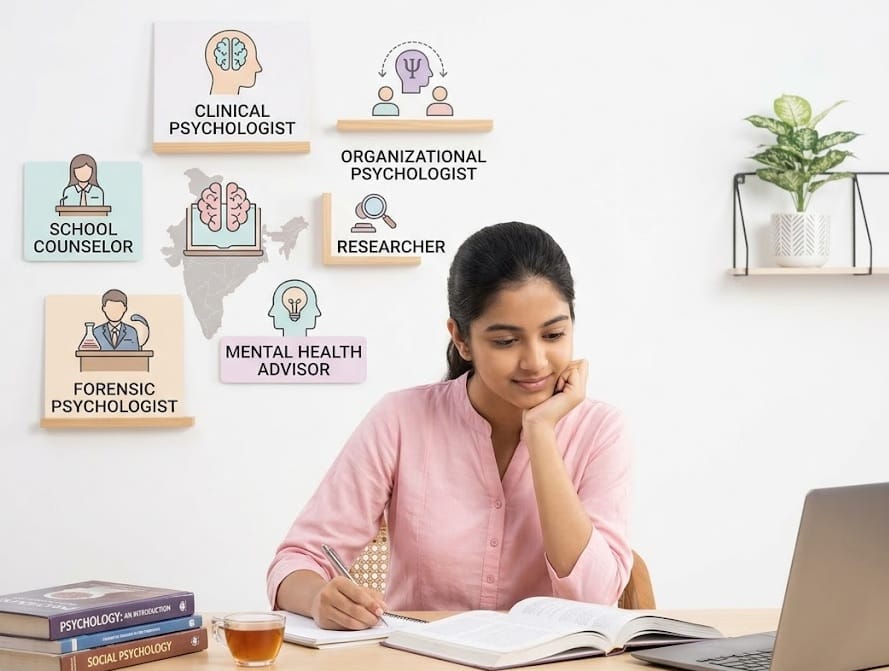
One of the biggest misconceptions is that psychology only leads to counseling careers. In reality, psychology graduates work across a wide range of industries.

Clinical Psychologist

Clinical psychologists assess, diagnose, and help individuals dealing with emotional, behavioral, and psychological difficulties.

They often work in:

    • Hospitals
    • Mental health centers
    • Rehabilitation facilities
    • Private practice

Counseling Psychologist

Counseling psychologists help people manage everyday challenges such as stress, anxiety, relationships, academic pressure, and career concerns.

They commonly work in:

    • Schools
    • Colleges
    • Universities
    • Community organizations
    • Private counseling centers

Educational Psychologist

Educational psychologists focus on learning, development, and student performance.

Their work may involve:

    • Learning difficulties
    • Academic interventions
    • Student assessments
    • Educational research

Industrial and Organizational Psychologist

Businesses increasingly rely on psychology professionals to improve workplace performance.

Responsibilities include:

    • Employee engagement
    • Leadership development
    • Recruitment
    • Workplace well-being
    • Organizational behavior analysis

Sports Psychologist

Athletes often work with sports psychologists to improve focus, confidence, motivation, and performance under pressure.

As sports participation grows in India, opportunities in this field continue to expand.

Research Psychologist

Research psychologists study behavior and mental processes through scientific investigation.

They work in:

    • Universities
    • Research institutions
    • Government projects
    • Private organizations

Human Resources Professional

Many psychology graduates build successful careers in human resource management because they understand motivation, behavior, communication, and workplace dynamics.

How to Improve Memory Retention for Psychology Subjects

What Is the Educational Pathway?

Students interested in psychology typically follow this route:

Bachelor’s Degree

A Bachelor of Arts (BA) or Bachelor of Science (BSc) in Psychology is the first step.

Master’s Degree

Specialization generally begins at the postgraduate level.

Popular options include:

    • Clinical Psychology
    • Counseling Psychology
    • Applied Psychology
    • Industrial Psychology
    • Educational Psychology

Advanced Qualifications

Certain professional roles require additional training, internships, supervised practice, or doctoral-level qualifications.

Students should carefully research the educational requirements of their preferred career path.

Effective Psychology Study Techniques for Better Results

What Is the Salary Potential?

Salary depends on qualifications, specialization, location, skills, and experience.

Entry-Level Professionals

Fresh graduates may start with modest salaries while gaining experience.

Experienced Specialists

Professionals with advanced qualifications and expertise can earn significantly higher compensation.

Fields such as organizational psychology, corporate training, behavioral consulting, and specialized mental health services often provide attractive earning opportunities.

Private practice also allows experienced professionals to build independent careers.

Challenges Students Should Know About

Like every profession, psychology comes with challenges.

Higher Education Is Often Necessary

Many specialized positions require postgraduate education and practical training.

Continuous Learning Is Important

Psychology is an evolving discipline. Professionals must stay updated with new research, techniques, and developments.

Emotional Demands

Those working directly with clients may encounter emotionally challenging situations and must maintain professional boundaries.

Despite these challenges, many psychologists find the profession deeply meaningful and rewarding.

How to Score Full Marks in Psychology

Future Scope of Psychology in India

The future of psychology in India appears promising.

Several factors support long-term growth:

Mental Health Awareness

More individuals are seeking professional support than ever before.

Expansion of Educational Services

Schools and universities increasingly recognize the importance of student counseling and psychological support.

Corporate Wellness Programs

Organizations are investing in employee well-being, resilience, and productivity initiatives.

Digital Counseling Platforms

Online counseling and teletherapy have made psychological services more accessible across the country.

Research and Data-Driven Decision Making

Governments, institutions, and businesses are increasingly using behavioral science to improve outcomes.

These trends indicate growing opportunities for psychology graduates in the coming years.

Is Psychology a Good Career Choice in India?

For students interested in human behavior, mental health, communication, research, and helping others, psychology can be an excellent career choice.

The subject offers intellectual challenge, diverse career paths, meaningful work, and growing employment opportunities. While advanced education is often necessary for specialized roles, the long-term prospects remain encouraging.

Rather than focusing only on salary, students should consider whether they genuinely enjoy understanding people and solving real-world problems. Those with passion, dedication, and the right qualifications can build successful and fulfilling careers in psychology.

How Can a Private Psychology Tutor Help?

Many students find psychology interesting but struggle with theories, research methods, case studies, and answer writing. A private psychology tutor can simplify difficult concepts, explain topics using real-life examples, and provide personalized guidance based on the student’s learning style.

Individual attention often helps students improve confidence, strengthen conceptual understanding, and perform better in school, college, and competitive examinations. A qualified psychology tutor can also assist with assignment preparation, exam strategies, revision planning, and career guidance, helping students achieve their academic goals more effectively.

Looking for expert Psychology tutors?

Find Psychology Tutors on IndiaTutor.in

About the Author

Nidhi Mehta is the founder of IndiaTutor.in and a professional online educator with over 11 years of teaching experience. She specializes in tutoring Classes 1 to 6 across core academic subjects, with a strong focus on concept clarity and foundational skill-building. Her teaching approach is based on personalized, one-to-one learning that helps students develop long-term academic confidence and understanding.

Visit her profile    Visit About Us Page

error: Content is protected !!

Found this helpful? Share it in 2 seconds!

Link copied to clipboard