Finding students online is no longer just about being a qualified teacher. Parents and students have thousands of tutors to choose from, and your online profile is often the first impression they have of you. A well-written, complete, and trustworthy tutor profile can significantly improve your chances of receiving genuine enquiries.
Whether you teach school subjects, competitive exams, languages, music, coding, or any other skill, your profile should answer one important question: Why should a parent choose you over hundreds of other tutors?
This guide explains how to create an online tutor profile that attracts attention, builds trust, and encourages parents to contact you.
Why Your Tutor Profile Matters
According to research by the [“organization”,”Nielsen Norman Group”,”User experience research organization”], visitors typically spend only a few seconds scanning a webpage before deciding whether to continue reading. This means your tutor profile needs to communicate value quickly and clearly.
A complete profile helps parents understand:
-
- What subjects you teach
- Which classes and boards you cover
- Your qualifications and teaching experience
- Your teaching style
- Whether you are the right tutor for their child
Parents usually compare several tutors before making contact. A professional profile can make that decision much easier.
How to Build Credibility as a New Online Teacher
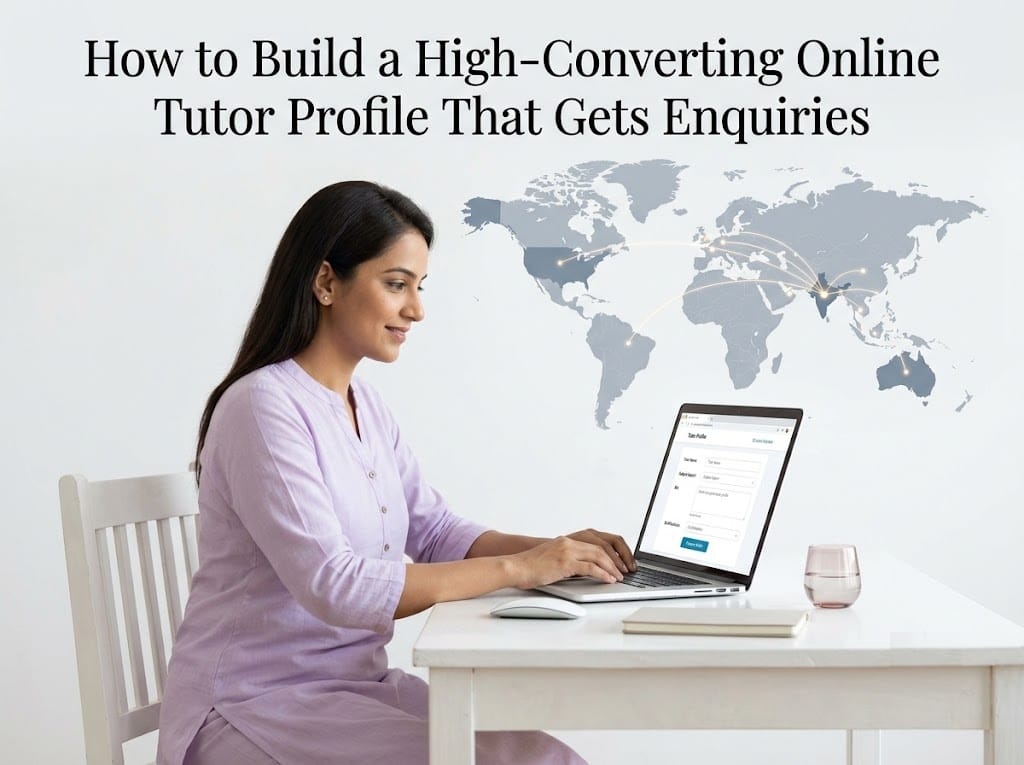
What Makes a Tutor Profile High-Converting?
A high-converting profile is one that encourages visitors to take the next step, whether that is sending an enquiry, making a phone call, or requesting a trial class.
Several factors influence this decision.
A Clear and Informative Title
Your title should immediately explain what you teach.
Instead of writing:
“Experienced Teacher”
Write something more specific such as:
“Online Mathematics Tutor for CBSE Class 6–12”
or
“English Language Tutor for School Students and Adults”
A descriptive title also helps search engines understand your page, improving your chances of appearing in relevant search results.
Write an Honest Introduction
The first paragraph should briefly introduce yourself.
Include information such as:
-
- Your teaching experience
- Subjects taught
- Classes or age groups
- Teaching mode
- What students can expect
Keep it natural and easy to understand.
For example:
“I have been teaching Mathematics for more than 10 years and conduct personalised online classes for students from Class 6 to 12 across CBSE, ICSE, State Boards, and international curricula. My lessons focus on concept clarity, regular practice, and confidence building.”
Parents appreciate clarity more than exaggerated claims.
Highlight Your Qualifications
Qualifications establish credibility.
Mention relevant degrees, certifications, teacher training, or professional experience.
Examples include:
-
- B.Ed.
- M.Sc. Mathematics
- M.A. English
- IIT Graduate
- Certified Language Trainer
- Former School Teacher
If you have specialised training in online teaching or educational technology, include that as well.
Explain Your Teaching Experience
Experience is more than the number of years you have taught.
Describe:
-
- Subjects handled
- Boards covered
- Student age groups
- Online teaching experience
- Exam preparation experience
For example, instead of writing:
“10 years experience.”
Write:
“I have taught over 500 students from CBSE, ICSE, IGCSE, IB, and State Boards, helping learners improve conceptual understanding and examination performance.”
Specific information builds confidence.
Simple Online Teaching Setup for Tutors at Home
Describe Your Teaching Method
Parents want to know how you teach.
Explain your approach in simple language.
You may mention:
Personalised Learning
Every student learns differently. Explain how you adapt lessons according to the student’s pace and strengths.
Concept-Based Teaching
Many parents prefer tutors who focus on understanding rather than memorisation.
Mention how you simplify difficult topics using examples, diagrams, activities, or real-life situations.
Regular Assessments
Weekly tests, assignments, revision sessions, and progress reports reassure parents that learning is being monitored.
Doubt Support
Mention whether students can ask questions outside class hours or receive additional revision support before examinations.
Mention Boards, Curriculum, and Subjects Clearly
Avoid making parents search for basic information.
Create a clear list of:
-
- Subjects
- Classes
- Boards
- Competitive exams
- Languages
For example:
-
- Mathematics
- Science
- English
- CBSE
- ICSE
- State Boards
- IGCSE
- IB
- Olympiads
- JEE Foundation
This also improves keyword relevance for search engines.
Best Strategies for Student Enquiries for Online Tutors
Add a Professional Profile Photograph
A profile photo creates trust.
Research published by the [“organization”,”Baymard Institute”,”E-commerce usability research organization”] has consistently shown that trust signals strongly influence user decisions online. While tutors are different from online stores, the same principle applies: genuine identity builds confidence.
Choose a recent photograph that is:
-
- Clear
- Well-lit
- Professionally dressed
- Friendly
- Looking towards the camera
Avoid group photographs, selfies, heavy filters, or distracting backgrounds.
Showcase Your Achievements
Achievements provide social proof.
You may include:
-
- Student success stories
- Board examination results
- Olympiad winners
- Scholarship selections
- Years of teaching
- Awards
- School or institutional recognition
Use factual information.
Instead of saying:
“My students always score excellent marks.”
Write:
“Several of my students have scored above 90% in CBSE board examinations.”
Specific statements are more believable.
Include Keywords Naturally
Many parents search online using phrases like:
-
- Online Maths Tutor
- CBSE Science Teacher
- English Tutor Near Me
- Online Tuition for Class 10
- Physics Tutor for NEET Foundation
Use these naturally throughout your profile.
Avoid repeating the same keyword multiple times. Search engines today reward useful and natural writing rather than keyword stuffing.
According to [“company”,”Google”,”Search engine company”], content created primarily for people generally performs better than content written only for search engines.
Keep Your Information Updated
An outdated profile may discourage enquiries.
Review your profile regularly.
Update:
-
- Experience
- Qualifications
- New subjects
- New boards
- Student achievements
- Availability
- Teaching methods
Fresh content also helps search engines recognise that your page remains active.
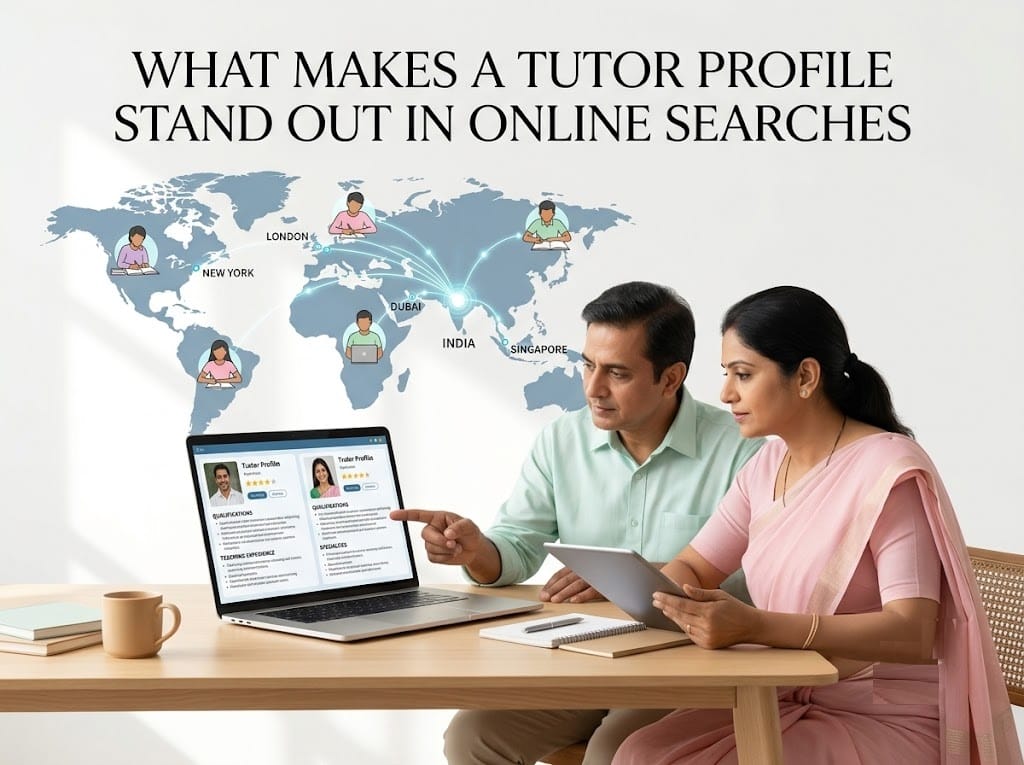
What Makes a Tutor Profile Stand Out in Online Searches
Build Trust Through Transparency
Parents appreciate honesty.
Clearly mention:
-
- Teaching mode
- Available timings
- Languages spoken
- Areas of expertise
- Trial class availability
- Years of experience
If you specialise in helping weak students, gifted learners, or examination preparation, explain that clearly.
Trust often leads to enquiries.
Write in Simple Language
Avoid educational jargon.
Parents from different educational backgrounds should easily understand your profile.
Instead of using complicated terminology, write naturally.
Simple writing increases readability and keeps visitors engaged for longer.
Common Mistakes That Reduce Enquiries
Many tutors unknowingly make small mistakes that discourage parents.
Incomplete Information
Missing qualifications, subjects, or experience create uncertainty.
Very Short Profiles
One or two sentences rarely provide enough information for parents to make a decision.
Grammar and Spelling Errors
Poor writing may affect credibility.
Review your profile carefully before publishing.
Overusing Promotional Claims
Avoid phrases such as:
-
- Best tutor in India
- Guaranteed 100% marks
- Number one teacher
Parents generally trust factual information more than exaggerated promises.
Poor Profile Images
Blurry or casual photographs reduce professionalism.
Think Like a Parent
Before publishing your profile, ask yourself these questions.
Does the profile clearly explain what I teach?
Does it show why I am qualified?
Does it explain how I teach?
Does it answer common parent questions?
Does it build confidence?
If the answer is yes, your profile is already stronger than many tutor profiles available online.
Small Improvements Can Make a Big Difference
You do not need to rewrite your entire profile every month.
Even small updates can improve performance.
Examples include:
-
- Adding a recent achievement
- Updating experience
- Improving your introduction
- Uploading a better photograph
- Including additional subjects
- Mentioning new teaching tools
These improvements make your profile more informative and useful.
My Thoughts
A high-converting tutor profile is built on trust, clarity, and relevance. Parents are not simply looking for qualifications; they are looking for a teacher who understands their child’s learning needs and communicates professionalism from the very first interaction. By presenting accurate information, explaining your teaching approach, highlighting your experience, and keeping your profile updated, you make it easier for families to choose you with confidence.
If you are looking to expand your reach and connect directly with students across India and abroad, listing your profile on IndiaTutor.in can help increase your online visibility. Your profile becomes easier for parents to discover through search, allowing them to contact you directly without intermediary commissions. With affordable listing plans, nationwide exposure, and a platform dedicated exclusively to tutors, IndiaTutor.in offers a practical way to grow your teaching career and reach more genuine student enquiries.
Want to Teach Students in India and Abroad?
Register your Tutor Profile on IndiaTutor.in
About the Author
Nidhi Mehta is the founder of IndiaTutor.in and a professional online educator with over 11 years of teaching experience. She specializes in tutoring Classes 1 to 6 across core academic subjects, with a strong focus on concept clarity and foundational skill-building. Her teaching approach is based on personalized, one-to-one learning that helps students develop long-term academic confidence and understanding.