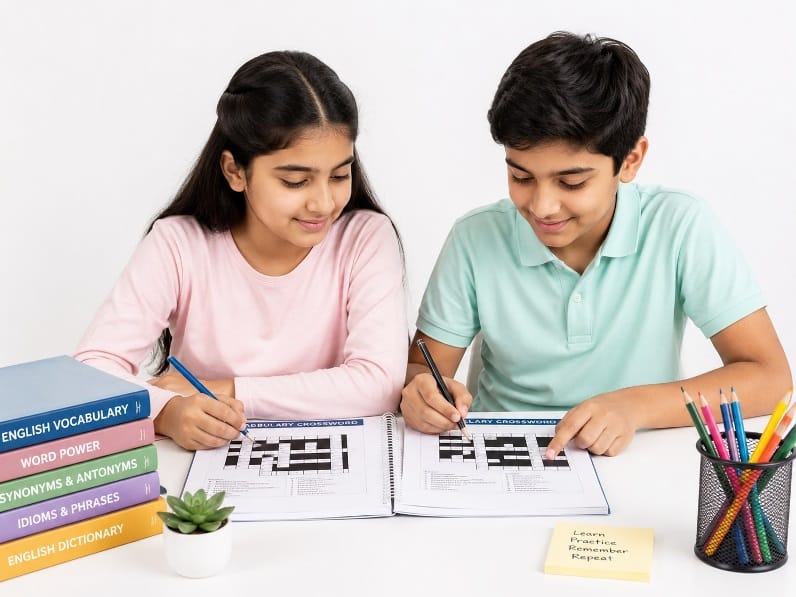

Learning French vocabulary becomes much easier when students use the right memory techniques instead of repeated rote learning. Many learners feel stuck because words seem to disappear quickly after revision. This happens due to how human memory works, not due to lack of ability. With structured methods, vocabulary can be retained for much longer and recalled faster during exams and conversations.
Why French Vocabulary Is Hard to Retain
The forgetting pattern in human memory
Psychologist Hermann Ebbinghaus discovered the forgetting curve, which shows that people forget nearly 50% of new information within one hour and up to 70% within 24 hours if there is no revision. This is why French words learned in one session often fade quickly.
Language exposure gap
Most students in India do not hear French regularly outside the classroom. Research in second-language acquisition suggests that a new word needs multiple exposures, usually between 6 to 10 encounters, before it becomes part of long-term memory. Without repetition, retention drops sharply.
Pronunciation and spelling mismatch
French words often look different from how they sound. For example, “beaucoup” is pronounced quite differently from its spelling. This mismatch increases cognitive load and makes memorization slower for beginners.
How Memory Actually Stores French Words
Short-term and long-term memory
New vocabulary first enters short-term memory. If it is not revised or used, it disappears. Long-term memory develops only when information is repeatedly recalled and used in context.
A study published in cognitive psychology research shows that spaced repetition improves long-term retention significantly compared to one-time study sessions.
Active recall strengthens memory
Active recall means retrieving information without looking at notes. Studies in learning science show that students using active recall can improve retention by nearly 50% compared to passive reading methods.
For example, instead of repeatedly reading “chien = dog,” students should try recalling the meaning without looking at the answer.
Top Benefits of Learning French Alongside School Studies
Effective Techniques to Memorize French Vocabulary Faster
Spaced Repetition System
How spaced repetition works
Spaced repetition involves revising words at increasing time intervals such as Day 1, Day 2, Day 4, Day 7, and Day 15. Each revision strengthens memory connections.
Why it is scientifically proven
Memory research shows that spaced repetition can improve retention by 30% to 200% depending on consistency. Digital tools like Anki are built on this principle and are widely used by language learners globally.
Association Method for Strong Memory Links
Visual connection technique
The brain processes images faster than text. According to dual coding theory, combining words with visuals improves recall.
For example, for the word “pomme,” imagining a bright red apple falling helps create a strong mental link.
Personal connection strategy
Words connected to personal life are easier to remember. For example:
“école” can be linked to your classroom
“ami” can be linked to your best friend
Studies show contextual and personal associations improve recall accuracy by up to 40%.
How French Can Improve Career Opportunities in India and Abroad
Grouping Words into Categories
Thematic learning approach
Instead of learning random vocabulary, grouping words improves memory:
Food group: pain, fromage, lait
School group: professeur, élève, classe
Travel group: train, billet, gare
Why clustering works
The brain stores information in semantic networks. When one word is recalled, related words become easier to access, reducing effort during revision.
Learning Vocabulary in Sentences
Context-based learning
Learning isolated words is less effective than learning them in sentences. For example:
Word: parler
Sentence: Je parle français avec mon ami
Research-backed benefit
Applied linguistics studies show contextual learning improves vocabulary retention by 25% to 35% compared to memorizing word lists alone.
French Grammar Basics Every Student Should Know
Listening and Speaking Practice
Audio exposure method
Listening helps the brain connect sound with meaning. Even 10 to 15 minutes of daily French audio can significantly improve retention.
Speaking activation
Speaking engages multiple brain areas including auditory and motor functions. This multi-sensory involvement improves recall speed and fluency over time.
Writing Practice for Strong Retention
Handwriting advantage
Writing vocabulary by hand improves memory because it activates motor memory. Educational studies show handwritten learning improves retention by 20% to 30% compared to typing.
Practical method
Students should write 10 new words daily and use each in a sentence. Revision of previous words should be included before adding new ones.
Memory Tricks for Faster Recall
Mnemonics Technique
Creating funny associations
Mnemonics help students remember difficult words by linking them to familiar ideas.
Example:
“chat” (cat) can be remembered as a cat wearing a hat
Why it works
Unusual or humorous associations are stored more strongly in memory, making recall faster during exams.
How Parents Can Support French Learning at Home
Flashcard Learning System
How flashcards help
Flashcards combine active recall and spaced repetition. One side contains the French word and the other side contains meaning and example.
Effectiveness
Research shows flashcard-based learning improves vocabulary retention significantly faster than passive reading because it forces repeated retrieval.
Daily Study Plan for Faster Learning
Structured 30-minute routine
10 minutes learning new words
10 minutes revision of old vocabulary
10 minutes sentence formation or speaking practice
Weekly revision cycle
At the end of each week, students should revise all learned vocabulary without looking at answers. This strengthens long-term memory pathways.
Common Mistakes Parents Make When Helping Children Learn French
Common Mistakes Students Make
Overloading vocabulary
Learning too many words at once reduces retention. Research shows that 10 to 20 words per day is optimal for long-term memory formation.
Ignoring revision cycles
Without repetition, vocabulary disappears quickly due to the forgetting curve.
Passive reading only
Simply reading word lists does not activate memory pathways. Active recall and usage are necessary for retention.
Why Consistency Improves Results
Language learning studies consistently show that short daily practice is more effective than long irregular sessions. Even 15 minutes of daily vocabulary practice can produce noticeable improvement within 2 to 4 weeks if done consistently.
My Thoughts
Memorizing French vocabulary faster depends on using scientifically proven learning methods rather than repetition alone. Techniques such as spaced repetition, association, grouping, active recall, and sentence usage align with how the brain naturally stores information. Students who apply these methods consistently develop stronger recall speed, better exam performance, and improved confidence in speaking.
Private tutoring can further enhance this process by providing structured learning plans, correcting pronunciation in real time, and testing vocabulary regularly. A tutor also ensures that students revise at the right intervals and avoid common mistakes, which leads to faster progress and more stable long-term retention.
Looking for expert French tutors?
Find French Tutors on IndiaTutor.in
About the Author
Nidhi Mehta is the founder of IndiaTutor.in and a professional online educator with over 11 years of teaching experience. She specializes in tutoring Classes 1 to 6 across core academic subjects, with a strong focus on concept clarity and foundational skill-building. Her teaching approach is based on personalized, one-to-one learning that helps students develop long-term academic confidence and understanding.