Sanskrit is one of the oldest languages in the world, and its vocabulary structure is very different from modern languages. Many students find it challenging because words often change form based on grammar rules, tense, gender, and usage context.
A study published in language acquisition research by cognitive linguists shows that students learning inflected languages like Sanskrit require nearly 30–40% more repetition compared to non-inflected languages such as English or Hindi. This is because each root word can generate multiple derived forms.
Another reason for difficulty is limited daily exposure. According to UNESCO language learning reports, students retain only 10–20% of new vocabulary when it is not revised within 48 hours. Sanskrit, being less spoken in daily life, needs structured revision support at home.
Parents play a critical role in helping children build consistency, repetition habits, and emotional comfort with the subject.
Understanding How Memory Works in Vocabulary Learning
The Forgetting Curve and Its Impact
German psychologist Hermann Ebbinghaus introduced the forgetting curve, which explains how memory declines over time without reinforcement. His research shows that:
-
- 50% of new information is forgotten within 1 hour
- Around 70% is lost within 24 hours
- Only repeated revision helps long-term retention
This is especially important for Sanskrit vocabulary, where students often learn many new words in a single session.
Spaced Repetition Improves Retention
Research in cognitive psychology shows that spaced repetition can improve memory retention by up to 200–400%. Instead of memorizing all words at once, revising them at intervals (Day 1, Day 3, Day 7, Day 14) significantly strengthens recall.
Parents who help structure revision schedules can dramatically improve their child’s performance.
How Learning Sanskrit Helps Improve Memory and Concentration
Practical Ways Parents Can Help Children Memorize Sanskrit Vocabulary
Create a Daily 15-Minute Revision Routine
Consistency matters more than long study hours. Studies from learning behavior research suggest that short daily sessions improve retention by 35% compared to long weekly sessions.
Parents can:
-
- Assign 10–15 Sanskrit words daily
- Revise yesterday’s words first
- Keep sessions short and distraction-free
This prevents overload and improves memory strength.
Use Visual Association Techniques
Memory improves when words are linked with images or real-life associations. According to educational psychology research, visual learning increases retention by 65%.
Examples:
-
- “जलम् (Jalam)” → imagine drinking water
- “गजः (Gajah)” → visualize an elephant
- “पुष्पम् (Pushpam)” → think of a flower garden
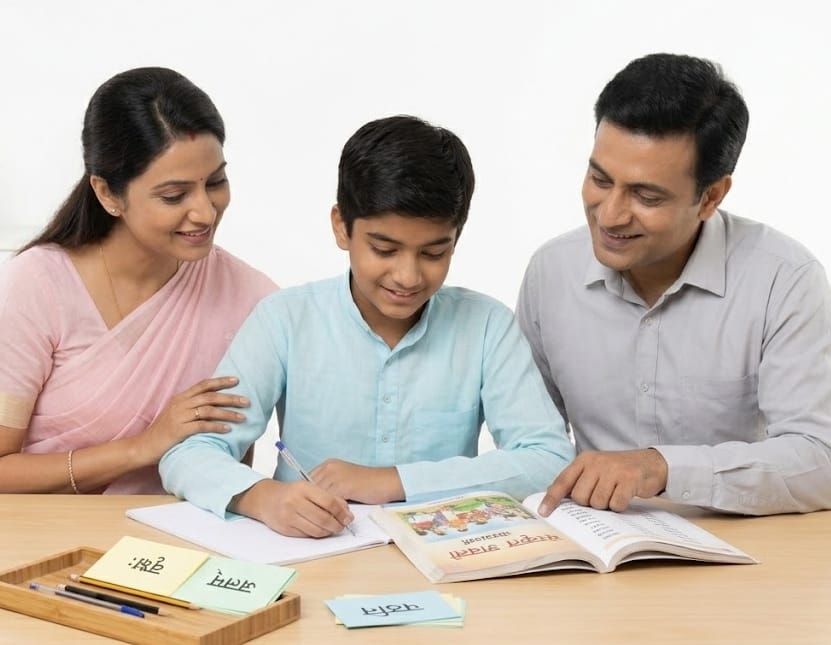
Parents can encourage children to draw simple sketches or use flashcards with images.
Encourage Writing Instead of Only Reading
A 2014 study in the Journal of Educational Psychology found that writing improves recall by nearly 20–30% compared to reading alone.
Parents can ask children to:
-
- Write each Sanskrit word 5–10 times
- Use words in simple sentences
- Maintain a vocabulary notebook
This strengthens both spelling and conceptual understanding.
Connect Words With Daily Life Examples
When children connect Sanskrit vocabulary with daily activities, learning becomes meaningful.
For example:
-
- गृहम् (Griham) → house
- विद्यालयः (Vidyalayah) → school
- मित्रम् (Mitram) → friend
Parents can point out these words during conversations or study time.
Most Common Mistakes Students Make While Learning Sanskrit
Effective Techniques to Improve Long-Term Memory
Chunking Method for Easier Learning
Chunking means grouping similar words together. Research from MIT cognitive science studies shows that chunking can improve memory efficiency by up to 50%.
Parents can group:
-
- Animals: सिंहः, गजः, अश्वः
- Objects: पुस्तकम्, कलमः, दर्पणम्
- Actions: गच्छति, पठति, लिखति
This reduces cognitive overload.
Use of Storytelling Method
Story-based learning increases recall because the brain remembers narratives better than isolated facts.
Example:
A simple story like “A boy goes to school, meets his friend, and reads a book” can include multiple Sanskrit words:
-
- बालकः (boy)
- विद्यालयः (school)
- मित्रम् (friend)
- पुस्तकं (book)
Studies show storytelling can improve memory retention by 60% in young learners.
Flashcards for Active Recall
Active recall is one of the most powerful learning methods. Instead of passive reading, students test themselves repeatedly.
Parents can:
-
- Create flashcards with Sanskrit on one side and meaning on the other
- Shuffle cards daily
- Conduct quick 5-minute quizzes
Research from learning science confirms that active recall improves exam performance significantly compared to passive revision.
Easy Tricks to Learn Sanskrit Vocabulary Faster
Common Mistakes Parents Should Avoid
Overloading Too Many Words at Once
Many parents push children to memorize 30–50 words in one sitting. This leads to cognitive overload and low retention. Studies show that optimal learning occurs when only 8–12 new items are introduced per session for school students.
Ignoring Revision Cycles
Without revision, most vocabulary is forgotten within days. Parents often assume once learned means remembered, but memory needs reinforcement.
Making Learning Stressful
Emotional stress reduces memory performance. Neuroscience research shows that stress hormones like cortisol can reduce recall ability by up to 25%. Learning should remain calm and encouraging.
Role of Digital Tools in Sanskrit Vocabulary Learning
Modern learning tools can support traditional methods.
-
- Mobile flashcard apps help spaced repetition
- Audio pronunciation tools improve speaking clarity
- Online quizzes make revision engaging
A report from EdTech learning platforms shows that students using digital revision tools improve vocabulary retention by nearly 30% compared to traditional methods alone.
However, parental guidance is still necessary to ensure balanced usage.
How to Improve Sanskrit Reading and Comprehension Skills
How Parents Can Build Long-Term Interest in Sanskrit
Celebrate Small Progress
Recognition improves motivation. Even small achievements like learning 10 new words should be appreciated.
Encourage Regular Practice Instead of Exams Only
Sanskrit should not be treated as a last-minute subject. Regular exposure builds confidence over time.
Make Learning a Family Activity
Parents can revise words with children for 10 minutes daily. This builds emotional bonding and reduces resistance toward learning.
Sample Weekly Plan for Sanskrit Vocabulary Practice
A simple structure parents can follow:
-
- Monday: 10 new words + revision of previous week
- Tuesday: Writing practice + sentence formation
- Wednesday: Flashcard quiz
- Thursday: Story creation using words
- Friday: Oral revision session
- Saturday: Mixed test
- Sunday: Light revision and rest
This cycle ensures repetition, creativity, and reinforcement.
How Parents Can Make Sanskrit Learning Interesting
My Thoughts
Helping children memorize Sanskrit vocabulary is not about pressure or long study hours. It is about consistency, smart revision methods, and positive engagement. When parents combine psychological learning techniques like spaced repetition, visual memory, and active recall, students show significant improvement in retention and confidence.
A structured home environment can transform Sanskrit from a difficult subject into an easy and scoring one. However, many students still need personalized attention, especially when grammar rules and vocabulary forms become complex. In such cases, a private tutor can provide step-by-step guidance, personalized practice plans, and regular assessments. Tutors also help identify weak areas early and build strong foundational understanding, which parents may find difficult to manage alone due to time or subject complexity.
Tags: Sanskrit vocabulary learning, how to memorize Sanskrit words, Sanskrit for students, parent guide Sanskrit learning, improve Sanskrit vocabulary, Sanskrit study tips, vocabulary memory techniques, spaced repetition learning, study tips for children, Sanskrit tuition help
Looking for expert Sanskrit tutors?
Find Sanskrit Tutors on IndiaTutor.in
About the Author
Nidhi Mehta is the founder of IndiaTutor.in and a professional online educator with over 11 years of teaching experience. She specializes in tutoring Classes 1 to 6 across core academic subjects, with a strong focus on concept clarity and foundational skill-building. Her teaching approach is based on personalized, one-to-one learning that helps students develop long-term academic confidence and understanding.
Visit her profile Visit About Us Page
Share your Feedback or Review – Contact Us
Tutors, Register your Tutor profile
Career Tutors, Get Personalized Tutor Branding Services
Do you Own a Tuition Center? List it here
Are you a Parent or Student? Share your Tutor Requirement


