
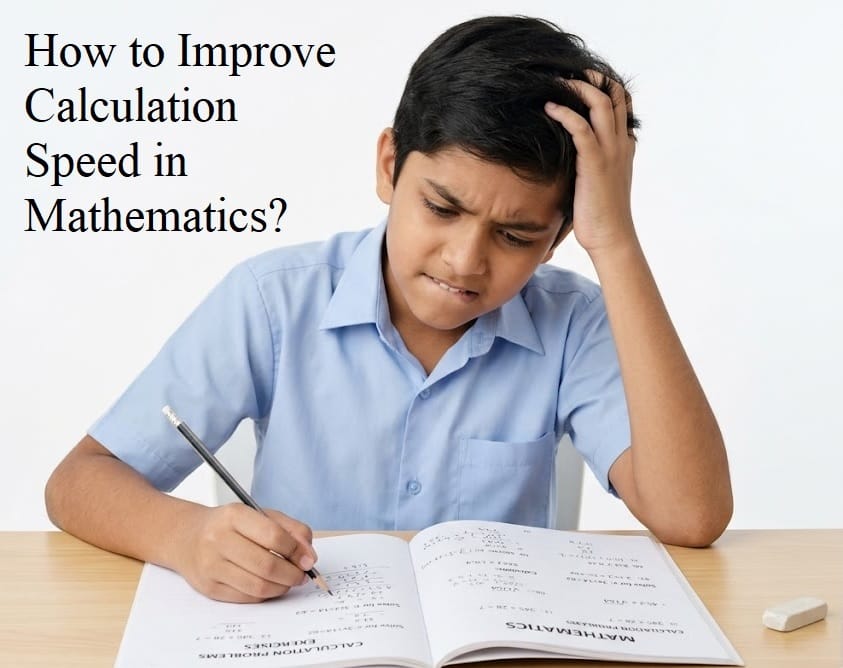
Mathematics is one of the most important subjects in a student’s academic journey. Whether preparing for school examinations, board exams, competitive tests, or entrance assessments, strong calculation skills can make a significant difference. Students who calculate quickly and accurately often complete exams faster, make fewer mistakes, and gain confidence when solving complex problems.
Many students believe that fast calculation is a natural talent. In reality, calculation speed is a skill that can be developed through the right techniques, regular practice, and a clear understanding of mathematical concepts. Research in education has consistently shown that students who practice arithmetic regularly improve both accuracy and problem-solving efficiency over time.
This guide explains practical ways to improve calculation speed in mathematics and helps students build stronger numerical abilities for academic success.
How to Overcome Fear of Mathematics
Why Calculation Speed Matters in Mathematics
Calculation speed is more than just solving sums quickly. It allows students to:
-
- Complete examinations within the allotted time.
- Reduce stress during tests.
- Improve confidence in solving mathematical problems.
- Focus more on concepts instead of lengthy calculations.
- Perform better in competitive examinations.
A student who spends less time on basic arithmetic can devote more attention to understanding advanced concepts such as algebra, geometry, trigonometry, and calculus.
Understand Concepts Before Memorizing Tricks
One of the biggest mistakes students make is trying to memorize shortcuts without understanding the underlying concepts.
Fast calculation begins with strong fundamentals. Students should have a clear understanding of:
-
- Addition and subtraction
- Multiplication and division
- Fractions and decimals
- Percentages
- Place value
- Number properties
When the basics are clear, calculations become faster and more accurate. Conceptual understanding also helps students apply techniques correctly in different situations.
Build Strong Number Sense
Number sense refers to the ability to understand relationships between numbers.
For example, instead of calculating 49 + 51 digit by digit, students can quickly recognize that the answer is 100.
Similarly, multiplying 25 by 4 can instantly be understood as 100.
Developing number sense helps students identify patterns and solve problems more efficiently.
Learn Multiplication Tables Thoroughly
Multiplication tables remain one of the most powerful tools for increasing calculation speed.
Students should memorize tables at least up to 20. Knowing multiplication facts instantly eliminates the need for repeated counting and reduces calculation time significantly.
Effective Ways to Learn Tables
-
- Practice tables daily.
- Use flashcards.
- Recite tables aloud.
- Solve multiplication drills regularly.
- Apply tables in real-world examples.
Students with strong multiplication recall often perform better in higher-level mathematics because multiplication forms the foundation of many advanced calculations.
How to Help Your Child Improve in Mathematics
Practice Mental Mathematics Daily
Mental mathematics trains the brain to perform calculations without relying on paper, calculators, or digital devices.
Even spending 10 to 15 minutes daily on mental arithmetic can improve speed over time.
Examples of Mental Math Practice
-
- Add prices while shopping.
- Calculate discounts mentally.
- Estimate total expenses.
- Solve simple arithmetic during travel.
- Practice multiplication and division in everyday situations.
Mental exercises strengthen concentration and improve numerical confidence.
Improve Accuracy Along with Speed
Fast calculations are useful only when answers are correct.
Many students focus exclusively on speed and make careless errors.
Common Causes of Mistakes
-
- Skipping steps
- Poor concentration
- Misreading numbers
- Rushing through questions
- Weak understanding of concepts
Developing a balance between speed and accuracy leads to better examination performance.
Signs Your Child Needs a Maths Tutor
Use Timed Practice Sessions
Timed practice helps students become comfortable working under exam conditions.
Create Daily Challenges
Examples include:
-
- Solve 20 addition problems in 3 minutes.
- Complete 15 multiplication questions in 2 minutes.
- Finish a worksheet within a set time limit.
Tracking progress helps students identify areas that need improvement.
Develop a Daily Mathematics Practice Routine
Consistency produces better results than occasional intensive study.
Sample 20-Minute Routine
First 5 Minutes
Practice multiplication tables.
Next 5 Minutes
Solve mental arithmetic questions.
Next 5 Minutes
Work on addition, subtraction, multiplication, and division exercises.
Final 5 Minutes
Review mistakes and understand corrections.
This simple routine can significantly improve calculation speed over a few months.
Why Some Children Struggle With Maths Despite Working Hard
Reduce Dependence on Calculators
While calculators are useful tools, excessive reliance can weaken mental calculation abilities.
Students should attempt basic arithmetic manually whenever possible.
Regular manual calculations strengthen memory, concentration, and numerical reasoning.
When to Use Calculators
Calculators are appropriate for advanced calculations, scientific computations, and verification. However, foundational arithmetic should be practiced independently.
Improve Concentration and Focus
Calculation speed depends heavily on concentration.
Students who lose focus frequently tend to make more errors and require additional time to solve problems.
Ways to Improve Focus
-
- Study in a quiet environment.
- Minimize distractions.
- Take short breaks during long study sessions.
- Maintain a healthy sleep schedule.
- Stay physically active.
Research suggests that adequate sleep improves memory retention and cognitive performance, both of which contribute to stronger mathematical abilities.
Solve a Variety of Problems
Practicing only one type of question limits growth.
Students should expose themselves to different categories, including:
-
- Arithmetic
- Algebra
- Geometry
- Fractions
- Percentages
- Word problems
A diverse practice routine develops flexibility and strengthens overall problem-solving skills.
11 Proven Strategies to Boost Mathematics Skills in Students
How Parents Can Help Improve Calculation Speed
Parents play an important role in developing mathematical confidence.
Encourage Daily Practice
Even 15 minutes of consistent practice can produce noticeable improvement.
Create Real-Life Learning Opportunities
Parents can involve children in:
-
- Shopping calculations
- Budget planning
- Measuring ingredients while cooking
- Calculating travel distances
These activities make mathematics practical and enjoyable.
Consider Personalized Guidance
Some students improve faster with one-to-one support from experienced mathematics tutors who can identify weaknesses and provide targeted practice strategies.
When a Mathematics Tutor Can Make a Difference
Students often struggle because classroom instruction moves at a fixed pace.
A qualified mathematics tutor can:
-
- Identify learning gaps.
- Improve conceptual understanding.
- Teach faster calculation techniques.
- Build confidence.
- Provide structured practice plans.
- Prepare students for school and competitive examinations.
Personalized guidance often helps students overcome difficulties more efficiently than self-study alone.
My Thoughts
Improving calculation speed in mathematics is a gradual process that combines conceptual understanding, regular practice, mental arithmetic, concentration, and consistent effort. Students who strengthen their numerical foundations and practice daily often see significant improvements in both speed and accuracy.
Rather than searching for instant shortcuts, focus on building strong mathematical habits. Over time, these habits lead to better examination performance, greater confidence, and stronger problem-solving abilities.
Looking for expert Mathematics tutors?
Find Math Tutors on IndiaTutor.in
About the Author
Nidhi Mehta is the founder of IndiaTutor.in and a professional online educator with over 11 years of teaching experience. She specializes in tutoring Classes 1 to 6 across core academic subjects, with a strong focus on concept clarity and foundational skill-building. Her teaching approach is based on personalized, one-to-one learning that helps students develop long-term academic confidence and understanding.
Visit her profile Visit About Us Page
Share your Feedback or Review – Contact Us
Tutors, Register your Tutor profile
Career Tutors, Get Personalized Tutor Branding Services
Do you Own a Tuition Center? List it here
Are you a Parent or Student? Share your Tutor Requirement


