
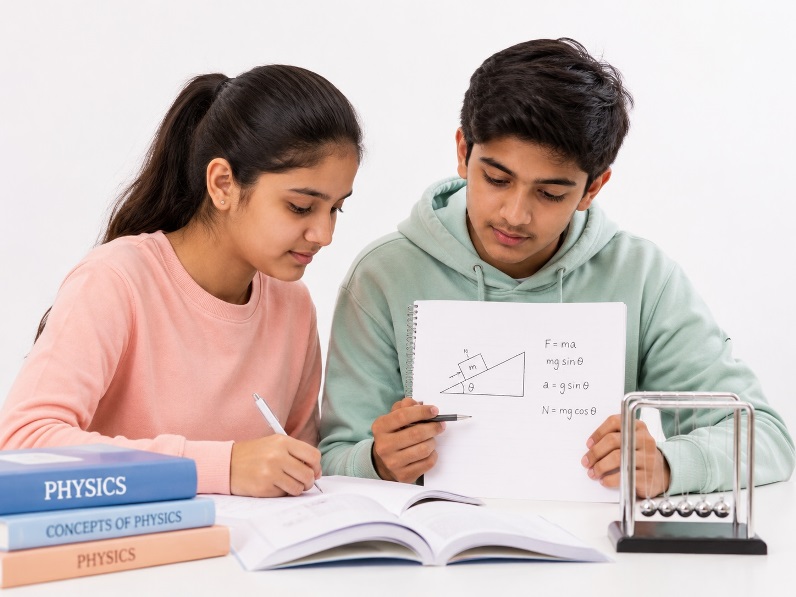
Physics is often considered one of the most challenging subjects in school. Many students understand the theory but struggle when faced with numerical questions and application-based problems. The good news is that problem-solving in Physics is a skill that can be developed through the right approach and consistent practice.
Whether you are preparing for CBSE board exams, ICSE examinations, JEE, NEET, or school assessments, improving your Physics problem-solving ability can significantly boost your confidence and academic performance.
Why Physics Problem-Solving Feels Difficult
Unlike subjects that rely heavily on memorization, Physics requires students to apply concepts to new situations. Every question may appear different even when it is based on the same principle.
According to educational research published by the American Association of Physics Teachers, students who focus only on formulas often perform worse than those who understand the underlying concepts. Successful learners spend more time analyzing the problem before attempting calculations.
For example, two questions may involve Newton’s Laws of Motion, but one could deal with a moving car while another involves an elevator. The concept remains the same, but the application changes.
Understanding this difference is the first step toward becoming better at solving Physics problems.
Why Good Students Suddenly Start Scoring Low in Physics
Build Strong Conceptual Understanding
Focus on the “Why” Behind Every Formula
Many students try to memorize equations without understanding their meaning. This approach often leads to confusion during exams.
Instead of memorizing formulas mechanically, ask questions such as:
- What does this formula represent?
- How was it derived?
- When should it be used?
- What are its limitations?
For instance, understanding why force equals mass multiplied by acceleration is more valuable than simply remembering the equation.
Connect Concepts with Real-Life Examples
Physics is everywhere around us.
- A cricket ball slowing down demonstrates friction.
- A ceiling fan shows rotational motion.
- A pressure cooker illustrates gas laws.
- A bicycle uses principles of force and momentum.
Relating concepts to daily experiences makes them easier to understand and remember.
Develop a Structured Approach to Solving Questions
Read the Question Carefully
Many mistakes occur because students rush through the problem statement.
Before attempting a solution:
- Read the question twice.
- Identify what information is given.
- Determine what needs to be found.
- Note all units mentioned.
Even a small oversight can lead to an incorrect answer.
Write Down Known and Unknown Quantities
Create a simple list.
Given:
- Mass = 5 kg
- Force = 20 N
Find:
- Acceleration = ?
This method organizes information and reduces confusion.
Draw Diagrams Whenever Possible
Visual representation helps simplify complex situations.
For topics such as:
- Motion
- Optics
- Electricity
- Magnetism
- Forces
A diagram can often reveal the correct solution path faster than calculations alone.
Research in science education has shown that students who regularly use diagrams tend to solve Physics problems more accurately than those who rely solely on text.
How to Build Strong Fundamentals in Physics
Learn to Identify the Right Concept
Stop Looking for Formulas First
One common mistake is immediately searching for an equation.
Instead, ask:
“What Physics principle applies here?”
For example:
- Is this a conservation of energy problem?
- Does Newton’s Second Law apply?
- Is this related to electric current?
- Is it a projectile motion question?
Once the concept becomes clear, selecting the appropriate equation becomes much easier.
Categorize Questions by Topic
Create separate notebooks or folders for:
Mechanics
Motion, force, work, power, energy, momentum
Electricity
Current, resistance, circuits, power consumption
Optics
Reflection, refraction, lenses, mirrors
Modern Physics
Atoms, nuclei, semiconductors
Grouping problems by topic helps students recognize recurring patterns.
Strengthen Mathematical Skills
Physics and Mathematics are closely connected.
A study conducted by the Organisation for Economic Co-operation and Development (OECD) found that students with stronger mathematical foundations generally perform better in science subjects.
Essential Math Skills for Physics
Students should be comfortable with:
- Algebra
- Fractions
- Ratios
- Percentages
- Graphs
- Scientific notation
- Basic trigonometry
Weak mathematical skills often create unnecessary obstacles during problem-solving.
Practice Unit Conversions
Questions frequently involve:
- Kilometers to meters
- Hours to seconds
- Grams to kilograms
A simple unit conversion error can cost valuable marks.
Physics Formulas Every Student Must Know
Practice Regularly and Consistently
Solve Problems Every Day
Improvement comes through repetition.
Even 20 to 30 minutes of daily problem-solving can produce significant results over time.
Educational psychologists often refer to this as deliberate practice, where focused repetition strengthens understanding and improves performance.
Start with Basic Questions
Do not jump directly to advanced numerical problems.
Follow this sequence:
- Conceptual questions
- Basic numericals
- Intermediate applications
- Higher-order thinking questions
This gradual progression builds confidence and accuracy.
Learn from Mistakes
Maintain an Error Notebook
Every time you make a mistake:
- Write down the question.
- Identify the reason for the error.
- Record the correct method.
Common mistakes include:
- Incorrect formula selection
- Unit conversion errors
- Calculation mistakes
- Misreading the question
Reviewing this notebook before exams can prevent repeated errors.
Analyze Incorrect Answers
Simply checking the correct solution is not enough.
Ask yourself:
- Where exactly did I go wrong?
- What should I have noticed?
- How can I avoid this mistake next time?
This habit develops deeper understanding.
Improve Your Physics Visualization Skills
Imagine What Is Happening
Physics becomes easier when you can visualize the situation.
For example:
When solving a projectile motion problem, mentally picture the object’s path.
When studying circuits, imagine how electric current flows through the components.
Visualization improves comprehension and reduces dependence on rote learning.
Use Simulations and Animations
Interactive learning tools can make abstract concepts more concrete.
Many students find it easier to understand:
- Electromagnetic fields
- Wave motion
- Atomic structure
- Optical phenomena
through visual demonstrations rather than static textbook diagrams.
How Parents Can Help Children Improve in Physics
Master Physics Formulas Effectively
Create a Formula Sheet
Maintain a chapter-wise formula summary.
Include:
- Formula
- Units
- Variables
- Practical applications
Regular revision helps improve recall during examinations.
Understand Formula Relationships
Many Physics equations are interconnected.
For example:
Speed, velocity, acceleration, force, momentum, work, and energy are closely related concepts.
Recognizing these connections strengthens problem-solving ability.
Use Previous Year Question Papers
Understand Exam Patterns
Past papers reveal:
- Frequently tested concepts
- Common numerical formats
- Important derivations
- Marking patterns
Students who regularly solve previous year papers often feel more comfortable during actual examinations.
Practice Under Time Limits
Timed practice helps develop:
- Speed
- Accuracy
- Confidence
- Exam temperament
This is particularly useful for board exams and competitive entrance tests.
Questions Parents Should Ask Before Hiring a Physics Tutor
Improve Problem-Solving Through Active Learning
Explain Solutions to Others
Teaching is one of the most effective learning techniques.
When you explain a concept to a friend, sibling, or classmate, your own understanding becomes clearer.
If you cannot explain a topic simply, you may need to revisit it.
Ask Questions Frequently
Curiosity plays an important role in mastering Physics.
Ask questions such as:
- Why does this happen?
- What would change if conditions were different?
- Can there be another method?
This habit develops analytical thinking.
Common Habits of High-Scoring Physics Students
Students who consistently perform well in Physics often:
- Study concepts before formulas.
- Practice questions daily.
- Review mistakes regularly.
- Use diagrams frequently.
- Solve previous year papers.
- Revise formulas weekly.
- Strengthen mathematical foundations.
- Seek help whenever concepts are unclear.
Success in Physics rarely comes from memorization alone. It comes from understanding, application, and consistent effort.
My Thoughts
Improving Physics problem-solving skills is a gradual process. There is no shortcut, but there is a proven path. Build conceptual clarity, strengthen mathematical fundamentals, practice regularly, and learn from every mistake. Over time, even difficult numerical problems become manageable.
Students who need additional support often benefit from working with a qualified private Physics tutor. One-to-one guidance can help identify learning gaps, explain difficult concepts in a personalized way, and provide structured practice. A good tutor can also improve confidence, reduce exam stress, and help students develop effective study habits that lead to better academic results.
Looking for expert Physics tutors?
Find Physics Tutors on IndiaTutor.in
About the Author
Nidhi Mehta is the founder of IndiaTutor.in and a professional online educator with over 11 years of teaching experience. She specializes in tutoring Classes 1 to 6 across core academic subjects, with a strong focus on concept clarity and foundational skill-building. Her teaching approach is based on personalized, one-to-one learning that helps students develop long-term academic confidence and understanding.
Visit her profile Visit About Us Page
Share your Feedback or Review – Contact Us
Tutors, Register your Tutor profile
Career Tutors, Get Personalized Tutor Branding Services
Do you Own a Tuition Center? List it here
Are you a Parent or Student? Share your Tutor Requirement


