

How to Learn Chemical Equations Without Memorizing Everything

How to Learn Chemical Equations Without Memorizing Everything

Chemical equations are one of the most important parts of Chemistry. Yet, many students struggle with them because they try to memorize dozens of reactions without understanding what is actually happening. After a few days, the equations are forgotten, and exam preparation becomes stressful.

The good news is that you do not need to memorize every equation by heart. When you understand the logic behind chemical reactions, remembering equations becomes much easier. Instead of treating Chemistry as a subject full of facts to memorize, you can learn it as a subject based on patterns and relationships.

This guide explains practical methods that help students learn chemical equations efficiently and retain them for longer periods.

Why Students Find Chemical Equations Difficult

Many students face problems with equations because they focus only on the final reaction instead of understanding the process behind it.

For example, students may try to memorize:

2H₂ + O₂ → 2H₂O

without understanding that hydrogen combines with oxygen to form water.

Research in educational psychology shows that information connected to meaning and understanding is retained much better than isolated facts. Studies suggest that active learning methods can improve retention rates significantly compared to passive memorization.

When students understand why a reaction occurs, recalling the equation becomes much easier during examinations.

Best Study Techniques for Learning Chemical Reactions Faster

Understand the Language of Chemical Equations

Before learning reactions, it is important to understand what an equation represents.

A chemical equation shows:

    • Reactants (substances that take part in a reaction)
    • Products (substances formed after the reaction)
    • Conditions required for the reaction
    • Relative amounts of substances involved

Example

Hydrogen + Oxygen → Water

Written chemically:

2H₂ + O₂ → 2H₂O

Once students understand this basic structure, equations begin to look less intimidating.

Learn the Reaction Type Instead of the Entire Equation

One of the most effective strategies is to identify reaction categories.

Thousands of reactions can be grouped into a few major types.

Combination Reactions

Two or more substances combine to form a single product.

Example:

CaO + H₂O → Ca(OH)₂

Pattern:

A + B → AB

Decomposition Reactions

A compound breaks into simpler substances.

Example:

CaCO₃ → CaO + CO₂

Pattern:

AB → A + B

Displacement Reactions

A more reactive element replaces a less reactive element.

Example:

Zn + CuSO₄ → ZnSO₄ + Cu

Pattern:

A + BC → AC + B

Double Displacement Reactions

Exchange of ions occurs between compounds.

Example:

AgNO₃ + NaCl → AgCl + NaNO₃

Pattern:

AB + CD → AD + CB

Learning these patterns reduces the number of equations students need to memorize individually.

How Chemistry Builds Careers Beyond Medicine and Engineering

Focus on Understanding Why Reactions Occur

When students know the reason behind a reaction, remembering it becomes natural.

Example: Rusting

Iron reacts with oxygen and moisture to form rust.

4Fe + 3O₂ + xH₂O → Iron Oxide

Instead of memorizing the equation blindly, think about what happens when iron is exposed to air and water for a long time.

The real-life connection strengthens memory.

Example: Burning of Magnesium

2Mg + O₂ → 2MgO

Students who have observed magnesium ribbon burning in a laboratory often remember this equation easily because they have seen the reaction.

Understanding creates stronger memory links than repetition alone.

Use Visual Learning Techniques

The human brain processes images faster than text.

Educational research indicates that visual learning can improve recall and understanding for many students.

Create Reaction Maps

Instead of maintaining long lists, create flowcharts.

For example:

Metal + Oxygen → Metal Oxide

Metal Oxide + Water → Base

This approach helps students see relationships between reactions.

Use Color Coding

Highlight:

    • Reactants in one color
    • Products in another
    • Catalysts separately

Visual organization improves revision speed and retention.

Step-by-Step Guide to Scoring Full Marks in Chemistry Numericals

Learn Through Real-Life Examples

Chemistry exists everywhere around us.

Connecting reactions to daily life makes them easier to remember.

Photosynthesis

Plants produce food using sunlight.

6CO₂ + 6H₂O → C₆H₁₂O₆ + 6O₂

Respiration

The body releases energy through respiration.

C₆H₁₂O₆ + 6O₂ → 6CO₂ + 6H₂O

Vinegar and Baking Soda

This common kitchen reaction demonstrates gas formation.

Understanding familiar examples makes equations meaningful rather than abstract.

Break Long Equations into Smaller Parts

Complex equations often scare students unnecessarily.

Instead of memorizing everything together, divide them into sections.

Example

H₂SO₄ + 2NaOH → Na₂SO₄ + 2H₂O

First identify:

  • Acid: H₂SO₄
  • Base: NaOH

Then recognize:

Acid + Base → Salt + Water

Once the pattern is understood, recalling the full equation becomes much easier.

Practice Writing Equations Regularly

Reading equations repeatedly is not enough.

Writing them improves retention significantly.

Effective Practice Method

Day 1:
Write five equations three times.

Day 3:
Write them again without looking.

Day 7:
Test yourself.

Day 15:
Revise once more.

This method uses spaced repetition, a scientifically proven learning technique that improves long-term memory.

Why Students Fear Chemistry and How Parents Can Help

Learn Common Chemical Formulae First

Many students struggle because they do not know chemical formulae properly.

If formulae are clear, equations become easier.

Important Formulae

    • Water: H₂O
    • Carbon Dioxide: CO₂
    • Sulphuric Acid: H₂SO₄
    • Hydrochloric Acid: HCl
    • Sodium Chloride: NaCl
    • Calcium Carbonate: CaCO₃

When formulae are familiar, students can often predict products correctly.

Use Mnemonics Carefully

Mnemonics can help remember specific details.

Example

To remember reactivity series:

“Please Stop Calling Me A Careless Zebra Instead Try Learning How Copper Saves Gold”

This helps students recall:

Potassium, Sodium, Calcium, Magnesium, Aluminium, Carbon, Zinc, Iron, Tin, Lead, Hydrogen, Copper, Silver, Gold

Understanding the reactivity series makes displacement reactions easier to learn.

However, mnemonics should support understanding, not replace it.

Solve Application-Based Questions

Many board exams now focus on concepts rather than direct recall.

Students should regularly solve questions such as:

    • Predict the products of a reaction.
    • Identify the reaction type.
    • Balance the equation.
    • Explain why the reaction occurs.

This develops deeper understanding and improves exam performance.

Master the Art of Balancing Equations

Balanced equations are easier to remember because they follow logical rules.

Example

Unbalanced:

H₂ + O₂ → H₂O

Balanced:

2H₂ + O₂ → 2H₂O

Always check whether the number of atoms on both sides is equal.

The Law of Conservation of Mass states that matter cannot be created or destroyed during a chemical reaction. This principle forms the basis of balancing equations and is a core concept in Chemistry.

How to Choose the Right Chemistry Tutor for CBSE Students

Create Your Own Chemistry Notebook

Maintain a separate notebook exclusively for reactions.

Divide it into sections:

Acids

Store all acid-related reactions together.

Bases

Group base-related reactions.

Metals

Keep metal reactions in one place.

Organic Chemistry

Maintain a dedicated section for organic reactions.

Organized notes make revision faster before tests and board examinations.

Common Mistakes Students Should Avoid

Memorizing Without Understanding

This often leads to forgetting reactions quickly.

Ignoring Reaction Patterns

Patterns help reduce workload significantly.

Avoiding Practice

Equations require regular writing practice.

Learning Everything at the Last Minute

Chemistry is easier when studied consistently over time.

Neglecting Formulae

Weak formula knowledge creates difficulties throughout the subject.

Smart Revision Strategy Before Exams

One month before exams:

Week 1

Revise reaction types.

Week 2

Practice balancing equations.

Week 3

Solve previous-year questions.

Week 4

Take mock tests and review mistakes.

Short daily revision sessions are generally more effective than long, infrequent study marathons.

My Thoughts

Learning chemical equations does not require endless memorization. When students understand reaction patterns, connect concepts to real-life examples, practice regularly, and organize their notes effectively, equations become much easier to remember. Chemistry rewards understanding far more than rote learning.

For students who continue to struggle, a private Chemistry tutor can provide personalized explanations, identify weak areas, and create a study plan based on individual learning needs. One-to-one guidance often helps students grasp difficult concepts faster, build confidence, and improve academic performance. Regular support from an experienced tutor can transform Chemistry from a challenging subject into one of a student’s strongest areas.

Looking for expert Chemistry tutors?

Find Chemistry Tutors on IndiaTutor.in

About the Author

Nidhi Mehta is the founder of IndiaTutor.in and a professional online educator with over 11 years of teaching experience. She specializes in tutoring Classes 1 to 6 across core academic subjects, with a strong focus on concept clarity and foundational skill-building. Her teaching approach is based on personalized, one-to-one learning that helps students develop long-term academic confidence and understanding.
Visit her profile    Visit About Us Page

How Chemistry Builds Careers Beyond Medicine and Engineering

How Chemistry Builds Careers Beyond Medicine and Engineering

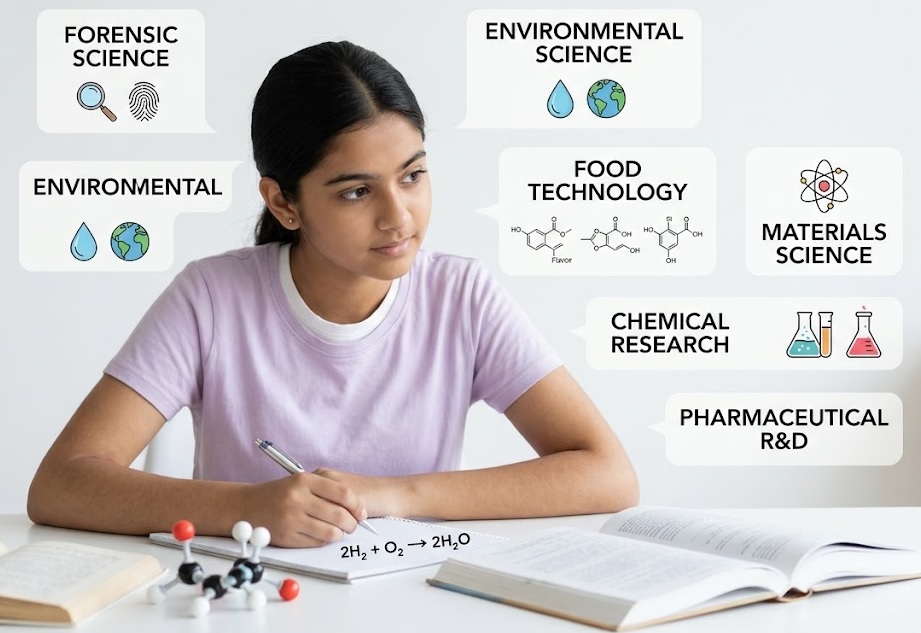
For many students, Chemistry is often viewed as a subject mainly useful for becoming a doctor, pharmacist, or engineer. While these are popular career choices, Chemistry opens doors to a much wider range of professions across industries such as healthcare, environmental science, food production, cosmetics, energy, research, manufacturing, and technology.

Chemistry is known as the “central science” because it connects physics, biology, environmental science, and engineering. It helps us understand how substances interact, transform, and affect the world around us. From developing life-saving medicines to creating sustainable fuels and improving food safety, Chemistry plays a crucial role in modern society.

Students who enjoy understanding how things work at a molecular level can find exciting and rewarding career opportunities beyond traditional professional paths.

Why Chemistry Remains an Important Subject

Chemistry influences nearly every aspect of daily life. Medicines, fertilizers, cleaning products, cosmetics, batteries, plastics, paints, and even drinking water treatment depend on chemical knowledge.

According to industry reports, the global chemical industry generates annual revenues exceeding $5 trillion. The sector supports millions of jobs worldwide and continues to grow due to increasing demand for healthcare products, sustainable materials, renewable energy solutions, and advanced manufacturing.

This means students with strong Chemistry knowledge can contribute to solving real-world challenges while building stable and rewarding careers.

Best Study Techniques for Learning Chemical Reactions Faster

How Chemistry Skills Are Valuable Across Industries

Studying Chemistry develops several transferable skills that employers value.

Analytical Thinking

Students learn to analyze data, identify patterns, and solve complex problems systematically.

Attention to Detail

Chemical experiments require precision, accuracy, and careful observation.

Research and Investigation

Chemistry teaches students how to design experiments, collect evidence, and draw conclusions.

Mathematical Application

Many Chemistry concepts involve calculations, data interpretation, and quantitative reasoning.

Critical Decision-Making

Students learn how scientific evidence supports informed decisions.

These abilities are useful in many industries, even outside laboratory environments.

How to Learn Chemical Equations Without Memorizing Everything

Career Opportunities Beyond Medicine and Engineering

Chemical Scientist

Chemical scientists conduct research to develop new materials, products, and technologies. They work in research institutions, government laboratories, universities, and private companies.

Their work may include developing better batteries, improving industrial processes, or creating environmentally friendly materials.

Environmental Scientist

Environmental scientists use Chemistry to study pollution, water quality, waste management, and climate-related issues.

Governments and private organizations increasingly hire professionals who can help reduce environmental impact and support sustainability initiatives.

Food Scientist

Food scientists ensure food products are safe, nutritious, and high quality.

They analyze ingredients, improve shelf life, develop new products, and monitor food safety standards.

The food processing industry continues to expand globally, creating strong demand for professionals with Chemistry backgrounds.

Cosmetic Chemist

Cosmetic chemists develop skincare products, shampoos, perfumes, makeup products, and personal care formulations.

This career combines science with creativity. Professionals test ingredients, improve product performance, and ensure safety standards are met.

Many global beauty brands invest heavily in research and product innovation.

Pharmaceutical Research Professional

While becoming a doctor is one option, Chemistry graduates can also work in pharmaceutical research and development.

These professionals help discover new drugs, improve existing treatments, and conduct clinical research.

According to industry estimates, developing a new medicine often requires years of scientific research involving large teams of chemists, biologists, and healthcare experts.

Forensic Scientist

Forensic scientists apply Chemistry to criminal investigations.

They analyze evidence such as toxic substances, drugs, fibers, paints, and biological samples to support law enforcement agencies.

Television shows have increased awareness of this profession, but the real work involves extensive scientific analysis and laboratory testing.

Materials Scientist

Materials scientists study metals, polymers, ceramics, composites, and advanced materials.

Their work contributes to industries such as electronics, aerospace, automotive manufacturing, renewable energy, and consumer products.

Modern technologies including smartphones, electric vehicles, and solar panels rely on advanced materials developed through chemical research.

Quality Control and Quality Assurance Specialist

Manufacturing companies depend on quality professionals to ensure products meet safety and performance standards.

Industries including pharmaceuticals, food processing, chemicals, cosmetics, and consumer goods hire Chemistry graduates for these roles.

Agricultural Scientist

Agricultural science combines Chemistry with crop production and soil management.

Professionals develop fertilizers, improve soil health, analyze nutrient levels, and support sustainable farming practices.

As food demand increases globally, agricultural innovation becomes increasingly important.

Patent Analyst

Students with scientific knowledge and strong communication skills may work as patent analysts.

They evaluate inventions, review scientific documentation, and help protect intellectual property rights.

This career blends science, law, and business.

Step-by-Step Guide to Scoring Full Marks in Chemistry Numericals

Emerging Fields Where Chemistry Is Creating New Opportunities

Renewable Energy

The transition toward clean energy is creating demand for professionals who understand batteries, hydrogen fuel systems, and energy storage technologies.

Chemistry plays a major role in improving solar panels, fuel cells, and next-generation energy solutions.

Nanotechnology

Nanotechnology involves working with materials at extremely small scales.

Researchers use Chemistry to create advanced medical devices, electronics, coatings, and materials with unique properties.

Biotechnology

Biotechnology combines Chemistry and Biology to develop innovative healthcare and agricultural solutions.

Applications include genetic research, diagnostics, vaccines, and biopharmaceutical products.

Sustainable Manufacturing

Companies worldwide are investing in greener production methods.

Chemists help reduce waste, improve resource efficiency, and develop environmentally friendly alternatives to traditional materials.

Can Chemistry Lead to Entrepreneurship?

Absolutely.

Many successful businesses have been built around chemical knowledge.

Examples include:

Manufacturing Businesses

Entrepreneurs develop products such as detergents, paints, cleaning agents, adhesives, fertilizers, and industrial chemicals.

Cosmetic Brands

Many skincare and beauty companies were founded by individuals with scientific backgrounds.

Food Innovation Startups

Chemistry knowledge can support product development, food preservation, and quality enhancement.

Environmental Solutions

Businesses focused on recycling, water treatment, and sustainable materials often require chemical expertise.

Students interested in business can combine scientific knowledge with entrepreneurship to create innovative ventures.

Why Students Fear Chemistry and How Parents Can Help

Educational Pathways After Studying Chemistry

Students can pursue several educational routes depending on their interests.

After Class 12

    • B.Sc. Chemistry
    • B.Sc. Environmental Science
    • B.Sc. Biotechnology
    • B.Pharm
    • Food Technology
    • Agricultural Science
    • Industrial Chemistry

Postgraduate Options

    • M.Sc. Chemistry
    • M.Sc. Analytical Chemistry
    • M.Sc. Environmental Chemistry
    • M.Sc. Materials Science
    • M.Sc. Biochemistry
    • M.Sc. Nanotechnology

Higher education often opens opportunities in research, teaching, product development, and leadership positions.

Why Students Should Not Ignore Chemistry

Some students view Chemistry only as an examination subject. However, understanding Chemistry develops scientific literacy and practical problem-solving abilities that remain valuable throughout life.

Industries continuously seek professionals who can analyze information, innovate, and improve products and processes. Chemistry provides a strong foundation for these capabilities.

Even students who eventually move into business, management, education, law, or entrepreneurship benefit from the analytical mindset developed through studying scientific subjects.

How to Choose the Right Chemistry Tutor for CBSE Students

My Thoughts

Chemistry is much more than a pathway to medicine or engineering. It supports careers in environmental protection, food science, cosmetics, pharmaceuticals, forensic investigation, renewable energy, materials development, agriculture, research, and entrepreneurship.

Students who build strong Chemistry fundamentals today can access a wide range of opportunities in the future. The subject encourages curiosity, develops critical thinking, and prepares learners to solve real-world challenges.

For students struggling with concepts, reactions, equations, or numerical problems, a private Chemistry tutor can provide personalized guidance, targeted practice, and individual attention. One-to-one support often helps students strengthen weak areas, improve confidence, and develop effective study habits. With the right mentorship, Chemistry can become more understandable, enjoyable, and rewarding.

Looking for expert Chemistry tutors?

Find Chemistry Tutors on IndiaTutor.in

About the Author

Nidhi Mehta is the founder of IndiaTutor.in and a professional online educator with over 11 years of teaching experience. She specializes in tutoring Classes 1 to 6 across core academic subjects, with a strong focus on concept clarity and foundational skill-building. Her teaching approach is based on personalized, one-to-one learning that helps students develop long-term academic confidence and understanding.

Visit her profile    Visit About Us Page

error: Content is protected !!

Found this helpful? Share it in 2 seconds!

Link copied to clipboard