
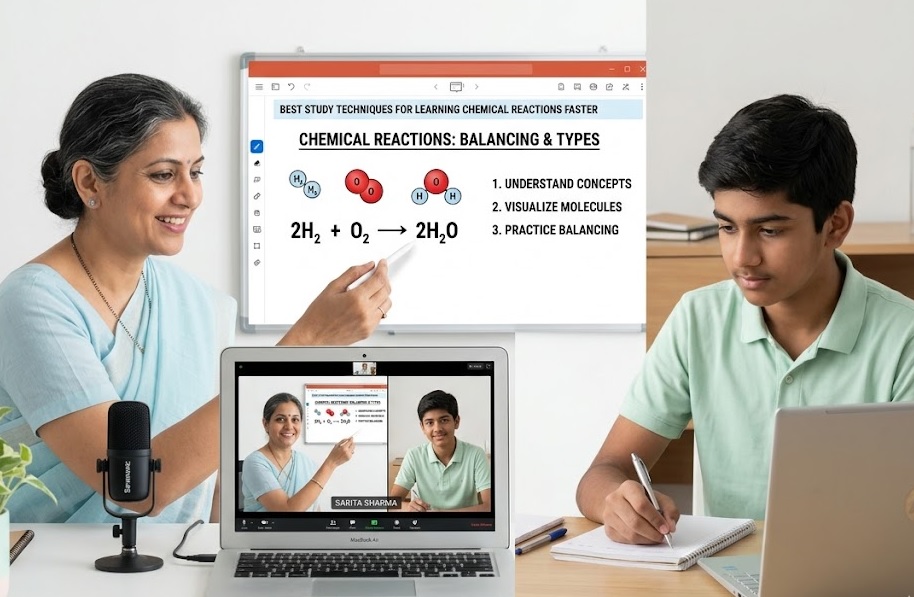
Chemical reactions are one of the most important topics in Chemistry. Whether you are studying in Class 9, 10, 11, or 12, understanding reactions helps you perform better in school exams, board examinations, Olympiads, and competitive tests such as JEE and NEET.
Many students find chemical reactions difficult because there are hundreds of equations, symbols, reactants, products, and conditions to remember. As a result, they often try to memorize everything. Unfortunately, this approach usually leads to confusion and poor retention.
The good news is that learning chemical reactions does not have to be difficult. Research in cognitive science shows that students remember concepts longer when they understand patterns, actively recall information, and revise at regular intervals. By using the right techniques, you can learn reactions faster and remember them for much longer.
Why Students Struggle with Chemical Reactions
Before discussing study techniques, it is important to understand why many learners find reactions challenging.
Some common reasons include:
- Memorizing without understanding concepts
- Ignoring reaction patterns
- Lack of regular revision
- Studying reactions in isolation
- Not practicing equation writing
- Focusing only on theory
A study published in the journal Educational Psychology found that students who actively engaged with learning materials retained significantly more information than those who relied only on passive reading.
How Chemistry Builds Careers Beyond Medicine and Engineering
Understand the Logic Behind Every Reaction
The first step toward mastering chemical reactions is understanding why a reaction occurs.
Instead of trying to memorize:
Hydrochloric Acid + Sodium Hydroxide → Sodium Chloride + Water
Learn that this is a neutralization reaction where an acid reacts with a base to produce salt and water.
When you understand the reason behind the transformation, remembering the equation becomes much easier.
Ask These Questions
Whenever you learn a new reaction, ask:
- What type of reaction is it?
- Why does it happen?
- What are the products formed?
- What conditions are required?
- Where is it used in real life?
This method helps build conceptual clarity.
Group Similar Reactions Together
One of the biggest mistakes students make is studying reactions randomly.
The human brain remembers information better when it is organized into categories.
Create Reaction Families
Group reactions under headings such as:
Combination Reactions
Examples:
- Calcium Oxide + Water
- Hydrogen + Oxygen
Decomposition Reactions
Examples:
- Thermal decomposition
- Electrolytic decomposition
- Photolytic decomposition
Displacement Reactions
Examples:
- Zinc with Copper Sulphate
- Iron with Copper Sulphate
Redox Reactions
Examples involving oxidation and reduction.
Studying reactions in groups helps you identify similarities and reduces the amount of information your brain must process.
How to Learn Chemical Equations Without Memorizing Everything
Use Visual Learning Techniques
Scientists estimate that the brain processes visual information much faster than text.
Instead of maintaining long lists of reactions, create visual notes.
Use Flow Charts
For example:
Metal + Oxygen → Metal Oxide
Metal Oxide + Water → Base
This simple chain helps connect multiple concepts.
Create Color-Coded Notes
Use different colors for:
- Reactants
- Products
- Catalysts
- Conditions
Visual separation improves recall during examinations.
Practice Active Recall
Many students repeatedly read reactions from textbooks and assume they have learned them.
Unfortunately, recognition is not the same as recall.
Active recall forces the brain to retrieve information from memory.
Research from cognitive psychology has consistently shown that retrieval practice improves long-term retention.
How to Use Active Recall
Read a reaction once.
Close the book.
Write it from memory.
Check for mistakes.
Repeat after a few hours.
For example:
Can you write the reaction between magnesium and oxygen without looking at your notes?
If yes, you have learned it.
If not, more practice is needed.
Step-by-Step Guide to Scoring Full Marks in Chemistry Numericals
Follow Spaced Repetition
Students often study reactions only once before examinations.
This creates short-term memory rather than long-term understanding.
Spaced repetition is a learning method where revision occurs at increasing intervals.
Recommended Revision Schedule
- Day 1: Learn the reaction
- Day 2: Revise
- Day 5: Review again
- Day 10: Test yourself
- Day 20: Quick revision
- Day 30: Final review
Studies show that spaced repetition can significantly improve retention compared with cramming.
Learn Through Reaction Patterns
Chemistry contains many predictable patterns.
Recognizing these patterns reduces memorization.
Example 1: Metal Reactions
Many metals react with oxygen to form metal oxides.
Examples:
- Magnesium + Oxygen → Magnesium Oxide
- Calcium + Oxygen → Calcium Oxide
Example 2: Acid Reactions
Many acids react with metals to produce:
Acid + Metal → Salt + Hydrogen Gas
Examples:
- Hydrochloric Acid + Zinc
- Sulphuric Acid + Magnesium
Once you understand the pattern, learning additional reactions becomes easier.
Write Reactions Every Day
Chemistry is similar to mathematics.
Reading alone is not enough.
Writing reactions regularly improves speed and accuracy.
Daily Practice Routine
Spend 15 minutes each day:
- Write five reactions from memory
- Balance equations
- Identify reaction types
- Name reactants and products
This simple exercise strengthens memory pathways.
Why Students Fear Chemistry and How Parents Can Help
Connect Reactions to Real Life
The brain remembers information better when it is meaningful.
Try linking reactions with everyday examples.
Rusting of Iron
Iron reacts with oxygen and moisture.
This reaction explains why iron gates and vehicles rust.
Photosynthesis
Plants convert carbon dioxide and water into glucose using sunlight.
This is one of the most important chemical reactions on Earth.
Combustion
Burning LPG, petrol, diesel, wood, and candles involves combustion reactions.
Real-life connections make concepts easier to remember.
Create Flashcards
Flashcards are among the most effective revision tools.
Use physical cards or digital applications.
Front Side
Reactants
Example:
Calcium Carbonate →
Back Side
Products
Calcium Oxide + Carbon Dioxide
Flashcards encourage quick recall and make revision more engaging.
Learn Conditions and Catalysts Separately
Students often remember reactants and products but forget important conditions.
For example:
- Temperature
- Pressure
- Catalyst
- Light
These details frequently appear in board examinations and competitive tests.
Create a Separate Conditions Sheet
Maintain one notebook page dedicated to:
- Haber Process conditions
- Contact Process conditions
- Catalysts used in industrial reactions
- Electrolysis requirements
This improves accuracy during exams.
Teach Someone Else
One of the best ways to test understanding is to explain a concept to another person.
Educational researchers often refer to this as the “Protégé Effect.”
Students who teach others generally develop deeper understanding.
What You Can Do
Explain a reaction to:
- A friend
- A sibling
- A parent
- A study partner
If you can explain a reaction clearly, you probably understand it well.
How to Choose the Right Chemistry Tutor for CBSE Students
Solve Previous Year Questions
Examiners often repeat similar concepts in different formats.
Practicing past papers helps identify important reactions.
Benefits
- Improves confidence
- Reveals weak areas
- Increases speed
- Familiarizes students with question patterns
Many high-scoring students spend considerable time analyzing previous examination questions.
Avoid Common Mistakes
Learning Without Understanding
Memorization alone rarely works for long.
Ignoring Regular Revision
Even well-learned reactions fade without practice.
Skipping Balancing Practice
Balancing equations strengthens understanding.
Studying Large Lists at Once
Small, focused study sessions are more effective.
Waiting Until Exams Approach
Daily practice produces better results than last-minute preparation.
Build a Personal Reaction Notebook
A dedicated notebook can become your most valuable revision resource.
Include:
- Important reactions
- Reaction types
- Conditions
- Exceptions
- Common mistakes
- Short notes
Before exams, this notebook can save hours of revision time.
My Thoughts
Learning chemical reactions faster is not about memorizing hundreds of equations. Success comes from understanding concepts, identifying patterns, practicing active recall, revising at regular intervals, and applying knowledge through problem-solving.
Students who consistently spend even 15 to 20 minutes daily reviewing reactions often perform much better than those who rely on marathon study sessions before examinations.
For students who continue to struggle, a private Chemistry tutor can provide personalized explanations, identify weak areas, and create a structured study plan. One-to-one guidance also allows students to ask questions freely and receive immediate feedback. With expert support, difficult reaction mechanisms, equations, and concepts often become much easier to understand and remember.
Looking for expert Chemistry tutors?
Find Chemistry Tutors on IndiaTutor.in
About the Author
Nidhi Mehta is the founder of IndiaTutor.in and a professional online educator with over 11 years of teaching experience. She specializes in tutoring Classes 1 to 6 across core academic subjects, with a strong focus on concept clarity and foundational skill-building. Her teaching approach is based on personalized, one-to-one learning that helps students develop long-term academic confidence and understanding.
Visit her profile Visit About Us Page
Share your Feedback or Review – Contact Us
Tutors, Register your Tutor profile
Career Tutors, Get Personalized Tutor Branding Services
Do you Own a Tuition Center? List it here
Are you a Parent or Student? Share your Tutor Requirement


