

How to Choose the Right Chemistry Tutor for CBSE Students

How to Choose the Right Chemistry Tutor for CBSE Students

Chemistry is one of the most important subjects in the CBSE curriculum, especially for students preparing for Class 10 and Class 12 board examinations. It forms the foundation for careers in medicine, engineering, pharmacy, biotechnology, environmental science, and several other fields. Yet, many students struggle with balancing chemical equations, understanding reactions, solving numericals, and remembering concepts from organic and inorganic chemistry.

According to CBSE board result trends over the years, Chemistry often becomes a deciding factor in overall Science performance. A student who develops a strong understanding of the subject can significantly improve both board exam scores and confidence in science-related subjects.

For many families, hiring a Chemistry tutor becomes an effective way to provide personalized academic support. However, choosing the right tutor requires more than simply checking qualifications. Parents should evaluate teaching ability, communication skills, subject expertise, and compatibility with their child’s learning style.

Why Students Often Need Additional Help in Chemistry

Chemistry combines theory, practical applications, mathematical calculations, and memorization. Unlike some subjects where students can rely mainly on reading, Chemistry requires conceptual understanding and regular practice.

Common challenges faced by CBSE students include:

    • Understanding chemical bonding and molecular structures
    • Learning organic chemistry reactions
    • Solving numerical problems in physical chemistry
    • Remembering chemical equations and formulas
    • Managing time during examinations
    • Applying concepts to board exam questions

A study published by the Organisation for Economic Co-operation and Development (OECD) has repeatedly highlighted that personalized instruction and targeted academic support can improve student learning outcomes significantly compared to one-size-fits-all classroom teaching.

Best Study Techniques for Learning Chemical Reactions Faster

Signs Your Child May Benefit from a Chemistry Tutor

Before beginning the search, parents should determine whether extra academic support is genuinely required.

Falling Examination Scores

A consistent decline in Chemistry marks often indicates gaps in understanding that may require individual attention.

Lack of Confidence

Some students avoid answering Chemistry questions even when they know the concepts. Confidence issues can negatively impact performance during tests and practical examinations.

Difficulty Understanding Classroom Lessons

In many schools, teachers must complete extensive syllabi within limited time. Students who miss a concept may find it difficult to catch up later.

Fear of Chemistry

When students begin viewing Chemistry as a difficult or confusing subject, their motivation often decreases. Early intervention can prevent long-term academic struggles.

Look for Strong Subject Knowledge

The first requirement of an effective Chemistry tutor is mastery of the subject.

Verify Academic Qualifications

A tutor should ideally have a degree in Chemistry, Chemical Engineering, Pharmacy, Biotechnology, or a related scientific field.

For higher secondary students, especially those in Classes 11 and 12, advanced subject expertise becomes increasingly important.

Check Experience with CBSE Curriculum

Chemistry tutoring is most effective when the tutor understands the specific requirements of the CBSE syllabus.

A tutor familiar with CBSE can guide students on:

    • NCERT textbook concepts
    • Board exam question patterns
    • Internal assessments
    • Practical examinations
    • Sample papers and previous-year questions

How Chemistry Builds Careers Beyond Medicine and Engineering

Evaluate Teaching Skills, Not Just Degrees

Many highly qualified individuals struggle to explain concepts clearly.

Ask for a Demo Session

A trial class helps parents evaluate teaching effectiveness before making a commitment.

During the session, observe whether the tutor:

    • Explains concepts in simple language
    • Encourages questions
    • Uses examples from daily life
    • Checks understanding regularly
    • Creates a comfortable learning environment

Focus on Concept Clarity

The best Chemistry tutors teach students how and why reactions occur rather than encouraging rote memorization.

For example, instead of asking a student to memorize a reaction, an effective tutor explains the underlying principles so the student can apply the concept independently.

Consider Experience with Similar Students

Every learner has different strengths and weaknesses.

For Students Struggling with Basics

Choose a tutor experienced in helping average or below-average learners strengthen fundamentals.

For High Performers

Students aiming for 90% and above often require advanced problem-solving strategies, exam techniques, and deeper conceptual discussions.

For Competitive Exam Aspirants

If your child is preparing for entrance examinations alongside CBSE boards, select a tutor familiar with both academic and competitive exam requirements.

How to Learn Chemical Equations Without Memorizing Everything

Assess Communication and Patience

Strong communication skills are essential for effective teaching.

Look for Clear Explanations

Complex topics such as chemical equilibrium, thermodynamics, and electrochemistry should be explained in a manner that is easy to understand.

Observe Patience Levels

Students learn at different speeds. A tutor should remain supportive when concepts need multiple explanations.

Research in educational psychology consistently shows that positive teacher-student relationships contribute significantly to academic success and student engagement.

Check Reviews and References

Past student experiences often provide valuable insights.

Request Testimonials

Feedback from previous students and parents can reveal:

    • Teaching quality
    • Reliability
    • Professionalism
    • Student improvement

Look for Consistent Results

One successful student may be a coincidence. Multiple positive outcomes across different learners often indicate teaching effectiveness.

Ensure Regular Assessments

Assessment is an important part of learning.

Weekly Practice Tests

Regular quizzes help identify weak areas before they become major problems.

Progress Tracking

A good Chemistry tutor should monitor:

    • Topic completion
    • Assignment performance
    • Test scores
    • Concept retention

Parents should receive periodic updates regarding academic progress.

Step-by-Step Guide to Scoring Full Marks in Chemistry Numericals

Verify Availability and Scheduling Flexibility

Consistency plays a major role in subject mastery.

Suitable Class Frequency

For most CBSE students, two to three sessions per week provide sufficient support. Students preparing for board examinations may require additional sessions.

Revision Support

The tutor should be available for doubt-solving and revision during examination periods.

Online vs Home Chemistry Tuition

Parents often wonder which option is better.

Online Chemistry Tuition

Benefits include:

    • Access to experienced tutors from different cities
    • Flexible scheduling
    • Recorded lessons in some cases
    • Reduced travel time

Home Tuition

Advantages include:

    • Face-to-face interaction
    • Fewer digital distractions
    • Personalized learning environment

The right choice depends on the student’s learning preferences, schedule, and comfort level.

Why Students Fear Chemistry and How Parents Can Help

Questions Parents Should Ask Before Hiring a Chemistry Tutor

Before making a final decision, ask the following questions:

About Qualifications

    • What is your educational background?
    • How long have you been teaching Chemistry?

About Teaching Approach

    • How do you explain difficult concepts?
    • How do you handle weak students?

About Assessments

    • How frequently do you conduct tests?
    • How do you measure improvement?

About Communication

    • Will parents receive progress updates?
    • How can students clear doubts between classes?

The answers often reveal more about a tutor’s effectiveness than qualifications alone.

Red Flags Parents Should Avoid

Certain warning signs may indicate that a tutor is not the right fit.

Overemphasis on Memorization

Chemistry requires understanding, not just recall.

Lack of Structure

A tutor without a clear study plan may struggle to deliver consistent results.

No Performance Tracking

Without assessments, it becomes difficult to measure progress.

Unrealistic Guarantees

Be cautious of anyone promising perfect marks or guaranteed results. Academic success depends on multiple factors including effort, consistency, and learning habits.

My Thoughts

Choosing the right Chemistry tutor for a CBSE student involves careful evaluation of subject expertise, teaching ability, communication skills, and experience with the curriculum. A thoughtful selection process can help students develop stronger concepts, improve examination performance, and build confidence in the subject.

A private Chemistry tutor provides personalized attention that is difficult to achieve in large classrooms. Individual guidance helps identify learning gaps quickly, adapt teaching methods to the student’s needs, and create a focused study plan. With regular support, students often gain better conceptual clarity, stronger problem-solving skills, and improved academic confidence, making Chemistry a subject they understand rather than fear.

Looking for expert Chemistry tutors?

Find Chemistry Tutors on IndiaTutor.in

About the Author

Nidhi Mehta is the founder of IndiaTutor.in and a professional online educator with over 11 years of teaching experience. She specializes in tutoring Classes 1 to 6 across core academic subjects, with a strong focus on concept clarity and foundational skill-building. Her teaching approach is based on personalized, one-to-one learning that helps students develop long-term academic confidence and understanding.


Visit her profile    Visit About Us Page

Why Students Fear Chemistry and How Parents Can Help

Why Students Fear Chemistry and How Parents Can Help

Chemistry is one of the most important subjects in school education. It forms the foundation for careers in medicine, pharmacy, biotechnology, engineering, environmental science, and many other fields. Despite its importance, chemistry is also one of the subjects that students often struggle with the most.

Many parents notice a sudden drop in confidence when their child begins studying chemistry in higher classes. A student who performs well in other subjects may suddenly find science difficult, confusing, and overwhelming. This fear can affect academic performance, exam results, and overall interest in learning.

Understanding why students fear chemistry is the first step toward helping them overcome these challenges. With the right support, every student can build confidence and develop a better understanding of the subject.

Best Study Techniques for Learning Chemical Reactions Faster

Why Do Students Fear Chemistry?

Chemistry combines concepts from physics, mathematics, and biology. Unlike many subjects that focus mainly on theory, chemistry requires students to understand concepts, remember formulas, solve numerical problems, and visualize processes that cannot be seen with the naked eye.

This combination often creates anxiety among learners.

The Subject Introduces Many New Concepts

Students encounter unfamiliar terms such as atoms, molecules, ions, valency, molarity, equilibrium, and oxidation. These concepts can seem abstract because they cannot be observed directly.

For example, a student can easily understand a plant or an animal because they can see them. Understanding atomic structure requires imagination and conceptual thinking, which may be difficult for some learners.

Chemistry Requires Strong Foundations

Chemistry is a cumulative subject. New chapters build upon previously learned concepts.

A student who does not fully understand chemical bonding may struggle with organic chemistry later. Similarly, weak knowledge of mole concepts can create difficulties in stoichiometry and numerical calculations.

Research in educational psychology consistently shows that gaps in foundational knowledge can significantly affect future learning outcomes.

Fear of Chemical Equations and Formulae

Many students believe chemistry is only about memorizing reactions and formulas. When they encounter long equations and complicated symbols, they often feel intimidated.

For instance:

2H₂ + O₂ → 2H₂O

While this equation appears simple to an experienced learner, beginners may feel overwhelmed by symbols, numbers, and unfamiliar notation.

Numerical Problems Create Anxiety

Physical chemistry includes calculations involving mole concepts, concentration, gas laws, and thermodynamics.

Students who already struggle with mathematics may find these topics especially challenging.

According to several educational surveys conducted in India, mathematics-related anxiety often affects performance in chemistry because both subjects require logical problem-solving skills.

How Chemistry Builds Careers Beyond Medicine and Engineering

Common Reasons Students Lose Confidence in Chemistry

Lack of Conceptual Understanding

Memorization without understanding creates short-term success but often leads to long-term difficulties.

Students may remember definitions before exams but forget them shortly afterward because they never fully understood the underlying concepts.

Fast Classroom Pace

School teachers must complete large syllabi within limited timeframes.

As a result, some students may hesitate to ask questions or may not receive enough individual attention. A single missed concept can create confusion in future lessons.

Negative Past Experiences

Poor marks in a test, difficulty answering questions in class, or repeated mistakes can reduce confidence.

Over time, students may begin believing they are “bad at chemistry,” even when they simply need additional guidance.

Exam Pressure

Board examinations, entrance tests, and competitive exams place significant pressure on students.

The fear of losing marks often makes chemistry seem even more difficult than it actually is.

Signs Your Child May Be Struggling with Chemistry

Parents should watch for early warning signs.

Avoiding Chemistry Homework

Students may postpone assignments, delay revision, or spend very little time studying chemistry compared to other subjects.

Complaints About Difficult Chapters

Frequent statements such as “I don’t understand anything” or “Chemistry is impossible” may indicate deeper learning challenges.

Falling Test Scores

Consistently low marks despite effort often suggest conceptual gaps rather than lack of intelligence.

Reduced Interest in Science

Students who once enjoyed science may begin avoiding laboratory work, practical activities, or science-related discussions.

How to Learn Chemical Equations Without Memorizing Everything

How Parents Can Help Students Overcome Fear of Chemistry

Parents do not need advanced chemistry knowledge to support their children effectively.

Focus on Understanding Instead of Marks

Many students become anxious when every conversation revolves around scores.

Instead of asking only about marks, ask questions such as:

    • Which topic did you learn today?
    • What was interesting in class?
    • Which concept feels difficult?

These conversations encourage learning rather than performance pressure.

Encourage Questions

Curiosity plays an important role in science education.

Children should feel comfortable asking questions without fear of criticism.

Some examples include:

    • Why does ice float on water?
    • Why does iron rust?
    • How do medicines work?

Connecting chemistry to everyday life makes learning more meaningful.

Break Large Topics into Smaller Parts

Complex chapters become easier when divided into manageable sections.

For example, instead of studying an entire chapter in one session, students can focus on:

    • Definitions
    • Important concepts
    • Examples
    • Practice questions

Small achievements build confidence over time.

Create a Consistent Study Routine

Educational research shows that regular revision improves retention significantly more than last-minute cramming.

Even 30 to 45 minutes of focused chemistry study several times per week can produce noticeable improvements.

Use Visual Learning Resources

Many chemistry concepts become easier when students use:

    • Diagrams
    • Animations
    • Videos
    • Molecular models
    • Practical demonstrations

Visual learning helps students understand abstract ideas more effectively.

Step-by-Step Guide to Scoring Full Marks in Chemistry Numericals

Making Chemistry Relevant to Everyday Life

One reason students fear chemistry is that they do not see its practical importance.

Parents can highlight chemistry in daily activities.

Cooking

Baking, boiling, fermentation, and food preservation all involve chemical changes.

Cleaning Products

Detergents, soaps, and disinfectants work because of chemical reactions.

Medicines

Every medicine contains chemical compounds designed to produce specific effects in the body.

Environment

Air pollution, water treatment, and climate science rely heavily on chemistry.

When students recognize chemistry around them, the subject feels less intimidating and more interesting.

Helping Students Prepare for Chemistry Exams

Begin Revision Early

Starting preparation weeks before examinations reduces stress and allows time for concept clarification.

Practice Previous Year Questions

Past papers help students understand question patterns and improve time management.

Create Formula Sheets

Condensed notes containing important reactions, equations, and concepts simplify revision.

Analyze Mistakes

Instead of focusing only on marks, students should identify why errors occurred and learn how to avoid them in future tests.

How to Choose the Right Chemistry Tutor for CBSE Students

Building Long-Term Confidence in Chemistry

Confidence develops gradually through consistent effort and positive experiences.

Parents can help by:

    • Celebrating small improvements
    • Encouraging persistence
    • Avoiding comparisons with other students
    • Recognizing effort as well as results
    • Maintaining realistic expectations

Studies on student motivation show that positive reinforcement often leads to better academic outcomes than criticism or pressure.

When Additional Support May Be Needed

Sometimes students require more personalized instruction than a classroom environment can provide.

A qualified private chemistry tutor can identify learning gaps, explain difficult concepts at the student’s pace, and provide targeted practice. Individual attention often helps students ask questions more freely and build confidence. Personalized lessons can improve understanding, strengthen problem-solving skills, and make chemistry less stressful. For many students, the right tutor transforms chemistry from a feared subject into one they can approach with confidence and success.

Looking for expert Chemistry tutors?

Find Chemistry Tutors on IndiaTutor.in

About the Author

Nidhi Mehta is the founder of IndiaTutor.in and a professional online educator with over 11 years of teaching experience. She specializes in tutoring Classes 1 to 6 across core academic subjects, with a strong focus on concept clarity and foundational skill-building. Her teaching approach is based on personalized, one-to-one learning that helps students develop long-term academic confidence and understanding.
Visit her profile    Visit About Us Page

How to Learn Chemical Equations Without Memorizing Everything

How to Learn Chemical Equations Without Memorizing Everything

Chemical equations are one of the most important parts of Chemistry. Yet, many students struggle with them because they try to memorize dozens of reactions without understanding what is actually happening. After a few days, the equations are forgotten, and exam preparation becomes stressful.

The good news is that you do not need to memorize every equation by heart. When you understand the logic behind chemical reactions, remembering equations becomes much easier. Instead of treating Chemistry as a subject full of facts to memorize, you can learn it as a subject based on patterns and relationships.

This guide explains practical methods that help students learn chemical equations efficiently and retain them for longer periods.

Why Students Find Chemical Equations Difficult

Many students face problems with equations because they focus only on the final reaction instead of understanding the process behind it.

For example, students may try to memorize:

2H₂ + O₂ → 2H₂O

without understanding that hydrogen combines with oxygen to form water.

Research in educational psychology shows that information connected to meaning and understanding is retained much better than isolated facts. Studies suggest that active learning methods can improve retention rates significantly compared to passive memorization.

When students understand why a reaction occurs, recalling the equation becomes much easier during examinations.

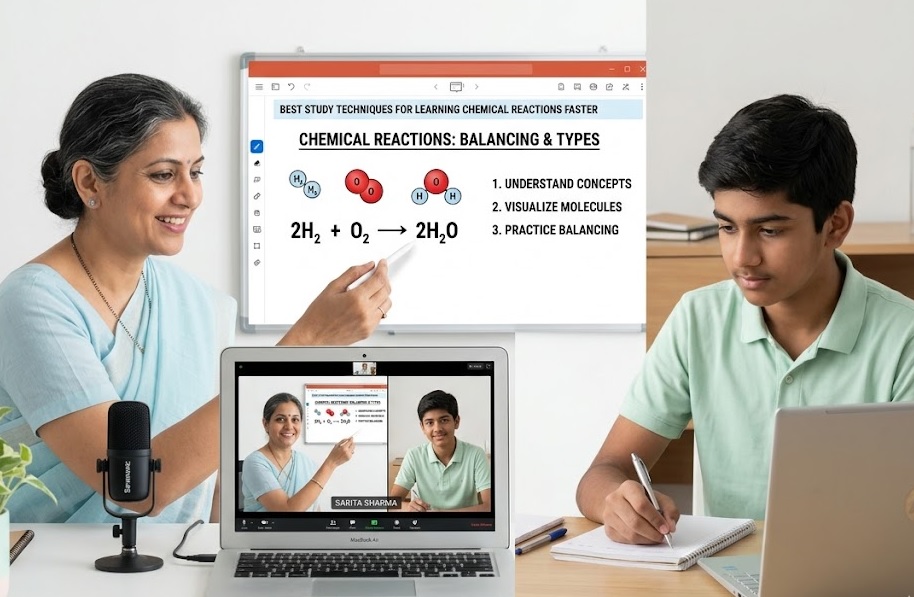
Best Study Techniques for Learning Chemical Reactions Faster

Understand the Language of Chemical Equations

Before learning reactions, it is important to understand what an equation represents.

A chemical equation shows:

    • Reactants (substances that take part in a reaction)
    • Products (substances formed after the reaction)
    • Conditions required for the reaction
    • Relative amounts of substances involved

Example

Hydrogen + Oxygen → Water

Written chemically:

2H₂ + O₂ → 2H₂O

Once students understand this basic structure, equations begin to look less intimidating.

Learn the Reaction Type Instead of the Entire Equation

One of the most effective strategies is to identify reaction categories.

Thousands of reactions can be grouped into a few major types.

Combination Reactions

Two or more substances combine to form a single product.

Example:

CaO + H₂O → Ca(OH)₂

Pattern:

A + B → AB

Decomposition Reactions

A compound breaks into simpler substances.

Example:

CaCO₃ → CaO + CO₂

Pattern:

AB → A + B

Displacement Reactions

A more reactive element replaces a less reactive element.

Example:

Zn + CuSO₄ → ZnSO₄ + Cu

Pattern:

A + BC → AC + B

Double Displacement Reactions

Exchange of ions occurs between compounds.

Example:

AgNO₃ + NaCl → AgCl + NaNO₃

Pattern:

AB + CD → AD + CB

Learning these patterns reduces the number of equations students need to memorize individually.

How Chemistry Builds Careers Beyond Medicine and Engineering

Focus on Understanding Why Reactions Occur

When students know the reason behind a reaction, remembering it becomes natural.

Example: Rusting

Iron reacts with oxygen and moisture to form rust.

4Fe + 3O₂ + xH₂O → Iron Oxide

Instead of memorizing the equation blindly, think about what happens when iron is exposed to air and water for a long time.

The real-life connection strengthens memory.

Example: Burning of Magnesium

2Mg + O₂ → 2MgO

Students who have observed magnesium ribbon burning in a laboratory often remember this equation easily because they have seen the reaction.

Understanding creates stronger memory links than repetition alone.

Use Visual Learning Techniques

The human brain processes images faster than text.

Educational research indicates that visual learning can improve recall and understanding for many students.

Create Reaction Maps

Instead of maintaining long lists, create flowcharts.

For example:

Metal + Oxygen → Metal Oxide

Metal Oxide + Water → Base

This approach helps students see relationships between reactions.

Use Color Coding

Highlight:

    • Reactants in one color
    • Products in another
    • Catalysts separately

Visual organization improves revision speed and retention.

Step-by-Step Guide to Scoring Full Marks in Chemistry Numericals

Learn Through Real-Life Examples

Chemistry exists everywhere around us.

Connecting reactions to daily life makes them easier to remember.

Photosynthesis

Plants produce food using sunlight.

6CO₂ + 6H₂O → C₆H₁₂O₆ + 6O₂

Respiration

The body releases energy through respiration.

C₆H₁₂O₆ + 6O₂ → 6CO₂ + 6H₂O

Vinegar and Baking Soda

This common kitchen reaction demonstrates gas formation.

Understanding familiar examples makes equations meaningful rather than abstract.

Break Long Equations into Smaller Parts

Complex equations often scare students unnecessarily.

Instead of memorizing everything together, divide them into sections.

Example

H₂SO₄ + 2NaOH → Na₂SO₄ + 2H₂O

First identify:

  • Acid: H₂SO₄
  • Base: NaOH

Then recognize:

Acid + Base → Salt + Water

Once the pattern is understood, recalling the full equation becomes much easier.

Practice Writing Equations Regularly

Reading equations repeatedly is not enough.

Writing them improves retention significantly.

Effective Practice Method

Day 1:
Write five equations three times.

Day 3:
Write them again without looking.

Day 7:
Test yourself.

Day 15:
Revise once more.

This method uses spaced repetition, a scientifically proven learning technique that improves long-term memory.

Why Students Fear Chemistry and How Parents Can Help

Learn Common Chemical Formulae First

Many students struggle because they do not know chemical formulae properly.

If formulae are clear, equations become easier.

Important Formulae

    • Water: H₂O
    • Carbon Dioxide: CO₂
    • Sulphuric Acid: H₂SO₄
    • Hydrochloric Acid: HCl
    • Sodium Chloride: NaCl
    • Calcium Carbonate: CaCO₃

When formulae are familiar, students can often predict products correctly.

Use Mnemonics Carefully

Mnemonics can help remember specific details.

Example

To remember reactivity series:

“Please Stop Calling Me A Careless Zebra Instead Try Learning How Copper Saves Gold”

This helps students recall:

Potassium, Sodium, Calcium, Magnesium, Aluminium, Carbon, Zinc, Iron, Tin, Lead, Hydrogen, Copper, Silver, Gold

Understanding the reactivity series makes displacement reactions easier to learn.

However, mnemonics should support understanding, not replace it.

Solve Application-Based Questions

Many board exams now focus on concepts rather than direct recall.

Students should regularly solve questions such as:

    • Predict the products of a reaction.
    • Identify the reaction type.
    • Balance the equation.
    • Explain why the reaction occurs.

This develops deeper understanding and improves exam performance.

Master the Art of Balancing Equations

Balanced equations are easier to remember because they follow logical rules.

Example

Unbalanced:

H₂ + O₂ → H₂O

Balanced:

2H₂ + O₂ → 2H₂O

Always check whether the number of atoms on both sides is equal.

The Law of Conservation of Mass states that matter cannot be created or destroyed during a chemical reaction. This principle forms the basis of balancing equations and is a core concept in Chemistry.

How to Choose the Right Chemistry Tutor for CBSE Students

Create Your Own Chemistry Notebook

Maintain a separate notebook exclusively for reactions.

Divide it into sections:

Acids

Store all acid-related reactions together.

Bases

Group base-related reactions.

Metals

Keep metal reactions in one place.

Organic Chemistry

Maintain a dedicated section for organic reactions.

Organized notes make revision faster before tests and board examinations.

Common Mistakes Students Should Avoid

Memorizing Without Understanding

This often leads to forgetting reactions quickly.

Ignoring Reaction Patterns

Patterns help reduce workload significantly.

Avoiding Practice

Equations require regular writing practice.

Learning Everything at the Last Minute

Chemistry is easier when studied consistently over time.

Neglecting Formulae

Weak formula knowledge creates difficulties throughout the subject.

Smart Revision Strategy Before Exams

One month before exams:

Week 1

Revise reaction types.

Week 2

Practice balancing equations.

Week 3

Solve previous-year questions.

Week 4

Take mock tests and review mistakes.

Short daily revision sessions are generally more effective than long, infrequent study marathons.

My Thoughts

Learning chemical equations does not require endless memorization. When students understand reaction patterns, connect concepts to real-life examples, practice regularly, and organize their notes effectively, equations become much easier to remember. Chemistry rewards understanding far more than rote learning.

For students who continue to struggle, a private Chemistry tutor can provide personalized explanations, identify weak areas, and create a study plan based on individual learning needs. One-to-one guidance often helps students grasp difficult concepts faster, build confidence, and improve academic performance. Regular support from an experienced tutor can transform Chemistry from a challenging subject into one of a student’s strongest areas.

Looking for expert Chemistry tutors?

Find Chemistry Tutors on IndiaTutor.in

About the Author

Nidhi Mehta is the founder of IndiaTutor.in and a professional online educator with over 11 years of teaching experience. She specializes in tutoring Classes 1 to 6 across core academic subjects, with a strong focus on concept clarity and foundational skill-building. Her teaching approach is based on personalized, one-to-one learning that helps students develop long-term academic confidence and understanding.

Visit her profile    Visit About Us Page

Best Study Techniques for Learning Chemical Reactions Faster

Best Study Techniques for Learning Chemical Reactions Faster

Chemical reactions are one of the most important topics in Chemistry. Whether you are studying in Class 9, 10, 11, or 12, understanding reactions helps you perform better in school exams, board examinations, Olympiads, and competitive tests such as JEE and NEET.

Many students find chemical reactions difficult because there are hundreds of equations, symbols, reactants, products, and conditions to remember. As a result, they often try to memorize everything. Unfortunately, this approach usually leads to confusion and poor retention.

The good news is that learning chemical reactions does not have to be difficult. Research in cognitive science shows that students remember concepts longer when they understand patterns, actively recall information, and revise at regular intervals. By using the right techniques, you can learn reactions faster and remember them for much longer.

Why Students Struggle with Chemical Reactions

Before discussing study techniques, it is important to understand why many learners find reactions challenging.

Some common reasons include:

    • Memorizing without understanding concepts
    • Ignoring reaction patterns
    • Lack of regular revision
    • Studying reactions in isolation
    • Not practicing equation writing
    • Focusing only on theory

A study published in the journal Educational Psychology found that students who actively engaged with learning materials retained significantly more information than those who relied only on passive reading.

How Chemistry Builds Careers Beyond Medicine and Engineering

Understand the Logic Behind Every Reaction

The first step toward mastering chemical reactions is understanding why a reaction occurs.

Instead of trying to memorize:

Hydrochloric Acid + Sodium Hydroxide → Sodium Chloride + Water

Learn that this is a neutralization reaction where an acid reacts with a base to produce salt and water.

When you understand the reason behind the transformation, remembering the equation becomes much easier.

Ask These Questions

Whenever you learn a new reaction, ask:

    • What type of reaction is it?
    • Why does it happen?
    • What are the products formed?
    • What conditions are required?
    • Where is it used in real life?

This method helps build conceptual clarity.

Group Similar Reactions Together

One of the biggest mistakes students make is studying reactions randomly.

The human brain remembers information better when it is organized into categories.

Create Reaction Families

Group reactions under headings such as:

Combination Reactions

Examples:

  • Calcium Oxide + Water
  • Hydrogen + Oxygen

Decomposition Reactions

Examples:

  • Thermal decomposition
  • Electrolytic decomposition
  • Photolytic decomposition

Displacement Reactions

Examples:

  • Zinc with Copper Sulphate
  • Iron with Copper Sulphate

Redox Reactions

Examples involving oxidation and reduction.

Studying reactions in groups helps you identify similarities and reduces the amount of information your brain must process.

How to Learn Chemical Equations Without Memorizing Everything

Use Visual Learning Techniques

Scientists estimate that the brain processes visual information much faster than text.

Instead of maintaining long lists of reactions, create visual notes.

Use Flow Charts

For example:

Metal + Oxygen → Metal Oxide

Metal Oxide + Water → Base

This simple chain helps connect multiple concepts.

Create Color-Coded Notes

Use different colors for:

    • Reactants
    • Products
    • Catalysts
    • Conditions

Visual separation improves recall during examinations.

Practice Active Recall

Many students repeatedly read reactions from textbooks and assume they have learned them.

Unfortunately, recognition is not the same as recall.

Active recall forces the brain to retrieve information from memory.

Research from cognitive psychology has consistently shown that retrieval practice improves long-term retention.

How to Use Active Recall

Read a reaction once.

Close the book.

Write it from memory.

Check for mistakes.

Repeat after a few hours.

For example:

Can you write the reaction between magnesium and oxygen without looking at your notes?

If yes, you have learned it.

If not, more practice is needed.

Step-by-Step Guide to Scoring Full Marks in Chemistry Numericals

Follow Spaced Repetition

Students often study reactions only once before examinations.

This creates short-term memory rather than long-term understanding.

Spaced repetition is a learning method where revision occurs at increasing intervals.

Recommended Revision Schedule

    • Day 1: Learn the reaction
    • Day 2: Revise
    • Day 5: Review again
    • Day 10: Test yourself
    • Day 20: Quick revision
    • Day 30: Final review

Studies show that spaced repetition can significantly improve retention compared with cramming.

Learn Through Reaction Patterns

Chemistry contains many predictable patterns.

Recognizing these patterns reduces memorization.

Example 1: Metal Reactions

Many metals react with oxygen to form metal oxides.

Examples:

  • Magnesium + Oxygen → Magnesium Oxide
  • Calcium + Oxygen → Calcium Oxide

Example 2: Acid Reactions

Many acids react with metals to produce:

Acid + Metal → Salt + Hydrogen Gas

Examples:

  • Hydrochloric Acid + Zinc
  • Sulphuric Acid + Magnesium

Once you understand the pattern, learning additional reactions becomes easier.

Write Reactions Every Day

Chemistry is similar to mathematics.

Reading alone is not enough.

Writing reactions regularly improves speed and accuracy.

Daily Practice Routine

Spend 15 minutes each day:

    • Write five reactions from memory
    • Balance equations
    • Identify reaction types
    • Name reactants and products

This simple exercise strengthens memory pathways.

Why Students Fear Chemistry and How Parents Can Help

Connect Reactions to Real Life

The brain remembers information better when it is meaningful.

Try linking reactions with everyday examples.

Rusting of Iron

Iron reacts with oxygen and moisture.

This reaction explains why iron gates and vehicles rust.

Photosynthesis

Plants convert carbon dioxide and water into glucose using sunlight.

This is one of the most important chemical reactions on Earth.

Combustion

Burning LPG, petrol, diesel, wood, and candles involves combustion reactions.

Real-life connections make concepts easier to remember.

Create Flashcards

Flashcards are among the most effective revision tools.

Use physical cards or digital applications.

Front Side

Reactants

Example:

Calcium Carbonate →

Back Side

Products

Calcium Oxide + Carbon Dioxide

Flashcards encourage quick recall and make revision more engaging.

Learn Conditions and Catalysts Separately

Students often remember reactants and products but forget important conditions.

For example:

    • Temperature
    • Pressure
    • Catalyst
    • Light

These details frequently appear in board examinations and competitive tests.

Create a Separate Conditions Sheet

Maintain one notebook page dedicated to:

    • Haber Process conditions
    • Contact Process conditions
    • Catalysts used in industrial reactions
    • Electrolysis requirements

This improves accuracy during exams.

Teach Someone Else

One of the best ways to test understanding is to explain a concept to another person.

Educational researchers often refer to this as the “Protégé Effect.”

Students who teach others generally develop deeper understanding.

What You Can Do

Explain a reaction to:

    • A friend
    • A sibling
    • A parent
    • A study partner

If you can explain a reaction clearly, you probably understand it well.

How to Choose the Right Chemistry Tutor for CBSE Students

Solve Previous Year Questions

Examiners often repeat similar concepts in different formats.

Practicing past papers helps identify important reactions.

Benefits

    • Improves confidence
    • Reveals weak areas
    • Increases speed
    • Familiarizes students with question patterns

Many high-scoring students spend considerable time analyzing previous examination questions.

Avoid Common Mistakes

Learning Without Understanding

Memorization alone rarely works for long.

Ignoring Regular Revision

Even well-learned reactions fade without practice.

Skipping Balancing Practice

Balancing equations strengthens understanding.

Studying Large Lists at Once

Small, focused study sessions are more effective.

Waiting Until Exams Approach

Daily practice produces better results than last-minute preparation.

Build a Personal Reaction Notebook

A dedicated notebook can become your most valuable revision resource.

Include:

    • Important reactions
    • Reaction types
    • Conditions
    • Exceptions
    • Common mistakes
    • Short notes

Before exams, this notebook can save hours of revision time.

My Thoughts

Learning chemical reactions faster is not about memorizing hundreds of equations. Success comes from understanding concepts, identifying patterns, practicing active recall, revising at regular intervals, and applying knowledge through problem-solving.

Students who consistently spend even 15 to 20 minutes daily reviewing reactions often perform much better than those who rely on marathon study sessions before examinations.

For students who continue to struggle, a private Chemistry tutor can provide personalized explanations, identify weak areas, and create a structured study plan. One-to-one guidance also allows students to ask questions freely and receive immediate feedback. With expert support, difficult reaction mechanisms, equations, and concepts often become much easier to understand and remember.

Looking for expert Chemistry tutors?

Find Chemistry Tutors on IndiaTutor.in

About the Author

Nidhi Mehta is the founder of IndiaTutor.in and a professional online educator with over 11 years of teaching experience. She specializes in tutoring Classes 1 to 6 across core academic subjects, with a strong focus on concept clarity and foundational skill-building. Her teaching approach is based on personalized, one-to-one learning that helps students develop long-term academic confidence and understanding.

Visit her profile    Visit About Us Page

error: Content is protected !!

Found this helpful? Share it in 2 seconds!

Link copied to clipboard