

How Parents Can Help Children Improve in Physics

How Parents Can Help Children Improve in Physics

Physics is one of the most important subjects in school, yet it is also one of the most challenging for many students. From understanding motion and forces to solving numerical problems, Physics requires logical thinking, mathematical skills, and conceptual clarity. It is common for students to feel overwhelmed, especially when they encounter difficult topics in higher classes.

Parents often believe that helping with Physics requires strong subject knowledge. In reality, parents can play a major role in improving their child’s performance even without being Physics experts. The right guidance, encouragement, and learning environment can significantly impact a student’s confidence and academic results.

Research published by the Organization for Economic Co-operation and Development (OECD) has consistently shown that parental involvement in education is associated with better academic performance, improved motivation, and stronger learning habits. Small actions at home can make a meaningful difference in how students approach Physics.

Why Many Students Struggle With Physics

Before helping a child improve, it is important to understand the challenges they face.

Physics Is Concept-Based

Unlike subjects that rely heavily on memorization, Physics focuses on understanding principles and applying them to different situations. Students who try to memorize answers often struggle when questions are presented differently.

Mathematics and Physics Are Closely Connected

Many Physics problems involve calculations, formulas, graphs, and equations. Weak mathematical foundations can make Physics appear much harder than it actually is.

Concepts Build on Previous Learning

Physics topics are interconnected. Difficulty understanding one chapter can create problems in future lessons. For example, a student who struggles with motion may find force and energy chapters more difficult later.

Fear of Numericals

Many students become anxious when they see lengthy calculations or word problems. This fear can reduce confidence and discourage regular practice.

Why Good Students Suddenly Start Scoring Low in Physics

Create a Positive Attitude Toward Physics

A child’s mindset often determines how effectively they learn.

Avoid Saying Physics Is Difficult

Many students hear statements such as “Physics is very hard” from friends, relatives, or even adults. Such messages can create unnecessary fear before the student even begins studying.

Instead, encourage your child by explaining that Physics is a subject that becomes easier with practice and understanding.

Celebrate Effort, Not Just Marks

Children who are praised only for high scores may become afraid of making mistakes. Focus on progress, consistency, and effort.

For example, if your child improves from 50% to 65%, acknowledge the improvement and discuss what helped them succeed.

Encourage Conceptual Learning

Physics becomes interesting when students understand how concepts relate to everyday life.

Connect Physics to Daily Activities

Many Physics principles can be observed at home.

Examples include:

    • Why a football slows down after being kicked
    • How a bicycle remains balanced while moving
    • Why seat belts are important in vehicles
    • How fans, refrigerators, and mobile phones work

Discussing such examples helps children realize that Physics is not limited to textbooks.

Ask Questions Instead of Giving Answers

When your child studies a topic, ask simple questions such as:

    • Why do you think this happens?
    • Can you explain this concept in your own words?
    • Where can you see this principle in real life?

This approach strengthens understanding and critical thinking.

How to Build Strong Fundamentals in Physics

Build Strong Study Habits

Consistent study routines often produce better results than last-minute preparation.

Create a Dedicated Study Schedule

Students who study Physics regularly tend to retain concepts more effectively.

Even 30 to 45 minutes of focused practice each day can produce significant improvements over time.

Break Large Topics Into Smaller Sections

Complex chapters become less intimidating when divided into manageable parts.

For example:

Day 1

Understand theory and definitions.

Day 2

Study formulas and derivations.

Day 3

Solve basic numerical questions.

Day 4

Attempt higher-level problems.

This method reduces stress and improves retention.

How to Improve Physics Problem-Solving Skills

Support Mathematical Skills

Success in Physics often depends on comfort with numbers.

Strengthen Basic Mathematics

Students should be comfortable with:

    • Fractions
    • Percentages
    • Algebra
    • Graphs
    • Unit conversions

Weaknesses in these areas frequently lead to mistakes in Physics calculations.

Encourage Formula Practice

Many students know formulas but struggle to identify when to use them.

Creating a formula notebook can help. Encourage your child to review important equations regularly and solve a few related questions every week.

Promote Active Learning

Passive reading is rarely enough for mastering Physics.

Encourage Problem Solving

Studies in science education have shown that students learn Physics more effectively through active problem-solving than through reading alone.

After studying a concept, students should solve questions that test different applications of the topic.

Use Multiple Learning Resources

Different explanations can improve understanding.

Useful resources include:

    • School textbooks
    • Educational videos
    • Interactive simulations
    • Practice worksheets
    • Physics learning apps

Exposure to different teaching styles often helps students grasp difficult concepts more quickly.

Physics Formulas Every Student Must Know

Help Manage Exam Stress

Many students understand Physics but perform poorly due to anxiety.

Conduct Mini Practice Tests

Regular practice tests help students become familiar with exam conditions.

Research suggests that retrieval practice, where students recall information from memory, improves long-term retention significantly compared to repeated reading.

Teach Time Management

Students should learn how much time to spend on:

    • Theory questions
    • Numericals
    • Diagrams
    • Revision

Good time management can improve overall exam performance.

Encourage Questions and Curiosity

Curiosity is one of the strongest drivers of learning.

Create an Open Learning Environment

Children should feel comfortable asking questions without fear of criticism.

When students hesitate to ask questions, misunderstandings often remain unresolved and accumulate over time.

Explore Interesting Physics Topics

Introduce fascinating subjects such as:

    • Space exploration
    • Black holes
    • Electricity
    • Robotics
    • Renewable energy

Interesting topics can spark enthusiasm and increase engagement with the subject.

Monitor Progress Without Creating Pressure

Parental support should motivate rather than overwhelm.

Track Learning Goals

Set realistic weekly targets.

Examples include:

    • Completing one chapter
    • Solving twenty numerical problems
    • Revising formulas
    • Improving test scores

Small achievements build confidence and momentum.

Focus on Continuous Improvement

Every child learns at a different pace. Comparing children with classmates, siblings, or relatives often damages motivation.

Instead, focus on individual growth and consistent progress.

Make Learning More Interactive

Physics can become enjoyable when students participate actively.

Perform Simple Home Experiments

Safe household activities can demonstrate important concepts.

Examples include:

    • Magnet experiments
    • Balloon electricity demonstrations
    • Reflection using mirrors
    • Water pressure activities

Practical experiences often improve conceptual understanding.

Encourage Group Discussions

Discussing topics with friends or family members helps students organize their thoughts and identify gaps in understanding.

Teaching others is also a highly effective way to reinforce learning.

Recognize When Additional Support Is Needed

Sometimes students require personalized guidance despite parental efforts.

Common signs include:

    • Consistently low Physics marks
    • Difficulty understanding classroom lessons
    • Lack of confidence in solving problems
    • Avoiding Physics homework
    • Anxiety before tests

Early intervention can prevent learning gaps from becoming larger.

Questions Parents Should Ask Before Hiring a Physics Tutor

My Thoughts

Parents do not need advanced Physics knowledge to help their children succeed. By creating a positive learning environment, encouraging regular practice, supporting conceptual understanding, and promoting curiosity, parents can significantly improve their child’s confidence and performance.

For students who need additional academic support, a private Physics tutor can provide personalized attention, identify learning gaps, and explain concepts at the student’s pace. One-to-one guidance often helps students ask questions more freely, improve problem-solving skills, and develop stronger exam strategies. With the right support system at home and expert academic assistance when needed, students can build confidence and achieve better results in Physics.

Looking for expert Physics tutors?

Find Physics Tutors on IndiaTutor.in

About the Author

Nidhi Mehta is the founder of IndiaTutor.in and a professional online educator with over 11 years of teaching experience. She specializes in tutoring Classes 1 to 6 across core academic subjects, with a strong focus on concept clarity and foundational skill-building. Her teaching approach is based on personalized, one-to-one learning that helps students develop long-term academic confidence and understanding.

Visit her profile    Visit About Us Page

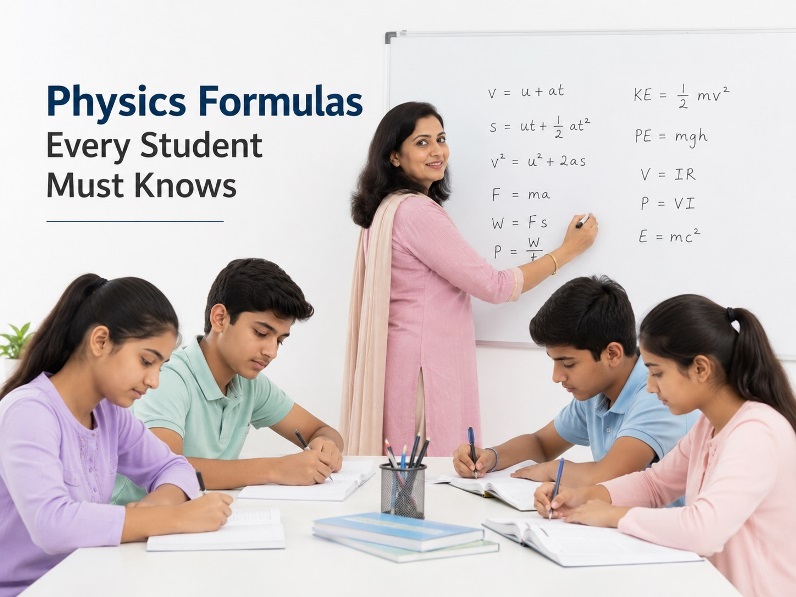
Physics Formulas Every Student Must Know

Physics Formulas Every Student Must Know

Physics is often described as the science of understanding how the world works. From the movement of vehicles on a road to the electricity powering our homes, Physics explains countless everyday phenomena. However, many students find the subject challenging because it involves applying formulas to solve numerical problems.

A strong understanding of Physics formulas can significantly improve performance in school exams, competitive tests, and practical applications. According to educational research, students who regularly practice formula-based problem solving tend to achieve higher scores in Physics assessments because they develop stronger analytical and mathematical skills.

This guide covers the most important Physics formulas every student should know, along with their meaning and practical examples.

Why Good Students Suddenly Start Scoring Low in Physics

Why Are Physics Formulas Important?

Physics formulas act as shortcuts that connect concepts with calculations. Instead of memorizing lengthy explanations, students can use formulas to quickly determine unknown values and solve problems efficiently.

Benefits of learning formulas include:

    • Faster problem-solving abilities
    • Improved accuracy in numerical questions
    • Better understanding of scientific principles
    • Increased confidence during examinations
    • Stronger preparation for engineering and medical entrance tests

Understanding the logic behind a formula is always more valuable than simply memorizing it.

Motion and Kinematics Formulas

Motion is one of the first major topics students encounter in Physics.

Speed Formula

Speed = Distance ÷ Time

This formula helps determine how fast an object is moving.

Example:

If a car travels 120 kilometers in 2 hours:

Speed = 120 ÷ 2 = 60 km/h

Velocity Formula

Velocity = Displacement ÷ Time

Unlike speed, velocity includes direction.

For example, if a student walks 100 meters north in 20 seconds:

Velocity = 100 ÷ 20 = 5 m/s north

Acceleration Formula

Acceleration = Change in Velocity ÷ Time

Acceleration measures how quickly velocity changes.

Example:

A bicycle increases its speed from 5 m/s to 15 m/s in 5 seconds.

Acceleration = (15 − 5) ÷ 5 = 2 m/s²

Equations of Motion

Students in higher classes frequently use these equations:

  • v = u + at
  • s = ut + ½at²
  • v² = u² + 2as

Where:

  • u = Initial velocity
  • v = Final velocity
  • a = Acceleration
  • t = Time
  • s = Displacement

These equations appear regularly in Class 9, 10, 11, and 12 Physics examinations.

Force and Newton’s Laws

Force explains why objects move, stop, or change direction.

Force Formula

Force = Mass × Acceleration

F = ma

This formula was developed by Sir Isaac Newton and remains one of the most important equations in Physics.

Example:

If a 10 kg object accelerates at 3 m/s²:

Force = 10 × 3 = 30 Newtons

Weight Formula

Weight = Mass × Gravitational Acceleration

W = mg

On Earth, g is approximately 9.8 m/s².

Example:

Weight of a 50 kg person:

50 × 9.8 = 490 Newtons

Understanding the difference between mass and weight is essential for examination success.

Work, Energy and Power Formulas

These concepts explain how energy is transferred and used.

Work Done Formula

Work = Force × Distance

W = F × d

Example:

If a student pushes a box with a force of 20 N over 5 meters:

Work = 20 × 5 = 100 Joules

Kinetic Energy Formula

Kinetic Energy = ½mv²

Kinetic energy is the energy possessed by a moving object.

Example:

A ball with a mass of 2 kg moving at 4 m/s:

KE = ½ × 2 × 4²

KE = 16 Joules

Potential Energy Formula

Potential Energy = mgh

This represents stored energy due to height.

Example:

A 5 kg object placed 10 meters above ground:

PE = 5 × 9.8 × 10

PE = 490 Joules

Power Formula

Power = Work Done ÷ Time

Power measures how quickly work is completed.

The standard unit of power is Watt.

Momentum and Impulse

Momentum plays a major role in collisions and moving objects.

Momentum Formula

Momentum = Mass × Velocity

p = mv

Example:

A 4 kg football moving at 8 m/s:

Momentum = 4 × 8

Momentum = 32 kg m/s

Impulse Formula

Impulse = Force × Time

Impulse equals the change in momentum.

This formula is frequently used in sports-related Physics examples.

Gravitation Formulas

Gravity influences everything around us.

Universal Law of Gravitation

F = G(m₁m₂)/r²

Where:

  • G = Gravitational constant
  • m₁ and m₂ = Masses
  • r = Distance between objects

This formula explains why planets revolve around the Sun and why objects fall toward Earth.

Gravitational Potential Energy

PE = mgh

Students often encounter this formula in numerical questions involving height and energy.

Heat and Thermodynamics Formulas

Thermodynamics examines heat transfer and temperature changes.

Heat Energy Formula

Q = mcΔT

Where:

  • Q = Heat energy
  • m = Mass
  • c = Specific heat capacity
  • ΔT = Temperature change

This equation is commonly used in practical laboratory experiments.

Celsius to Kelvin Conversion

K = °C + 273

Temperature conversion questions frequently appear in school assessments.

Electricity Formulas Every Student Must Know

Electricity is one of the most scoring sections in Physics.

Ohm’s Law

V = IR

Where:

  • V = Voltage
  • I = Current
  • R = Resistance

This simple relationship forms the foundation of electrical calculations.

Electric Power Formula

P = VI

Power can also be expressed as:

  • P = I²R
  • P = V²/R

Students often use these formulas when solving circuit problems.

Electrical Energy Formula

Energy = Power × Time

Electricity bills are calculated using this principle.

Light and Optics Formulas

Optics helps explain vision, lenses, and mirrors.

Mirror Formula

1/f = 1/v + 1/u

Where:

  • f = Focal length
  • v = Image distance
  • u = Object distance

Magnification Formula

Magnification = Image Height ÷ Object Height

This formula helps determine image size produced by mirrors and lenses.

Optics questions frequently appear in board examinations because they combine theory with numerical application.

Wave and Sound Formulas

Waves are important for understanding sound, communication systems, and modern technology.

Wave Speed Formula

Wave Speed = Frequency × Wavelength

v = fλ

Example:

If frequency is 200 Hz and wavelength is 2 meters:

Wave Speed = 200 × 2

Wave Speed = 400 m/s

Frequency Formula

Frequency = Number of Vibrations ÷ Time

Understanding frequency is important when studying sound and electromagnetic waves.

How to Build Strong Fundamentals in Physics

Tips for Remembering Physics Formulas

Understand the Concept First

Students who understand the meaning behind a formula remember it longer than those who rely solely on memorization.

Create a Formula Notebook

Maintain a dedicated notebook containing important equations, units, and examples.

Practice Numericals Daily

Research consistently shows that repeated problem-solving improves long-term retention and examination performance.

Use Flashcards

Formula flashcards allow quick revision before tests and examinations.

Learn Units Alongside Formulas

Many calculation mistakes occur because students forget units. Always memorize the formula together with its SI unit.

How to Improve Physics Problem-Solving Skills

Common Mistakes Students Should Avoid

Memorizing Without Understanding

Knowing when to use a formula is more important than memorizing dozens of equations.

Ignoring Units

Incorrect units can lead to wrong answers even when calculations are correct.

Skipping Practice

Physics is a subject that improves through application rather than passive reading.

Not Revising Regularly

Formulas become easier to remember when reviewed consistently throughout the academic year.

How Parents Can Help Children Improve in Physics

My Thoughts

Physics formulas are powerful tools that simplify complex scientific concepts and make problem-solving more efficient. Students who understand the meaning, application, and limitations of these equations develop stronger analytical abilities and often perform better in examinations. Rather than attempting to memorize every formula at once, focus on understanding one topic at a time and practicing regularly.

Students who struggle with Physics can benefit greatly from personalized guidance. A private Physics tutor can identify learning gaps, explain difficult concepts using simple examples, and provide targeted practice based on individual needs. One-to-one support often helps students build confidence, improve problem-solving skills, and achieve better academic results in a shorter period of time.

Questions Parents Should Ask Before Hiring a Physics Tutor

Looking for expert Physics tutors?

Find Physics Tutors on IndiaTutor.in

About the Author

Nidhi Mehta is the founder of IndiaTutor.in and a professional online educator with over 11 years of teaching experience. She specializes in tutoring Classes 1 to 6 across core academic subjects, with a strong focus on concept clarity and foundational skill-building. Her teaching approach is based on personalized, one-to-one learning that helps students develop long-term academic confidence and understanding.

Visit her profile    Visit About Us Page

How to Build Strong Fundamentals in Physics

How to Build Strong Fundamentals in Physics

Physics is often considered one of the most challenging subjects in school. Many students struggle with formulas, numerical problems, derivations, and complex concepts. However, the difficulty usually does not come from Physics itself. It often arises when students try to memorize answers without understanding the basic principles behind them.

Strong fundamentals make Physics easier, more enjoyable, and far less stressful. Whether you are studying in Class 9, 10, 11, or 12, developing a solid foundation can improve your grades, boost confidence, and prepare you for competitive examinations such as JEE, NEET, and Olympiads.

Why Fundamentals Matter in Physics

Physics is a subject where one concept builds upon another. If a student does not fully understand motion, it becomes difficult to learn force. Without understanding force, topics such as work, energy, momentum, and rotational mechanics become harder.

Research published in educational journals consistently shows that students who focus on conceptual understanding perform better in problem-solving tasks than those who rely only on memorization. Studies also suggest that active learning techniques can improve academic performance by up to 20% compared to passive study methods.

A strong foundation helps students:

    • Understand new topics more quickly
    • Solve numerical problems accurately
    • Retain concepts for longer periods
    • Perform better in examinations
    • Reduce dependence on rote learning

Why Good Students Suddenly Start Scoring Low in Physics

Common Reasons Students Develop Weak Basics

Before improving fundamentals, it is important to identify the reasons behind weak understanding.

Learning Formulas Without Understanding

Many students memorize equations without knowing what each variable represents. This creates confusion when applying formulas in unfamiliar situations.

Skipping Earlier Concepts

Physics follows a logical sequence. Missing one chapter can create gaps that affect future learning.

Lack of Practice

Reading theory alone is not enough. Physics requires regular application through problem-solving.

Fear of Mathematics

Physics and Mathematics are closely connected. Difficulty with algebra, graphs, ratios, and basic calculations often affects performance in Physics.

Start with Understanding Concepts

The first step towards strong fundamentals is understanding the idea behind every topic.

Ask “Why” Instead of “What”

Instead of memorizing definitions, try to understand the reason behind them.

For example:

A student can memorize that an object falls due to gravity. However, understanding how gravitational force acts on objects creates deeper learning.

Whenever you learn a new concept, ask:

    • Why does this happen?
    • What causes this effect?
    • How is it used in real life?

This habit develops scientific thinking and improves retention.

Connect Physics to Everyday Life

Physics is everywhere around us.

Examples include:

    • Seat belts demonstrate inertia.
    • Fans illustrate rotational motion.
    • Mobile phones use electromagnetic waves.
    • Pressure cookers work because of pressure and temperature relationships.

Relating concepts to daily experiences makes learning more meaningful.

How to Improve Physics Problem-Solving Skills

Build a Strong Mathematical Foundation

Many Physics problems require calculations.

Focus on Basic Mathematics Skills

Students should become comfortable with:

    • Fractions
    • Percentages
    • Algebra
    • Ratios and proportions
    • Scientific notation
    • Graph interpretation

For example, understanding speed requires confidence in division and unit conversion.

Practice Unit Conversion

Unit conversion is one of the most overlooked skills in Physics.

Examples include:

    • Kilometers to meters
    • Hours to seconds
    • Grams to kilograms

Regular practice reduces mistakes in numerical questions.

Master One Topic Before Moving Ahead

Many learners rush through chapters to complete the syllabus quickly.

This approach often creates confusion later.

Create a Sequential Learning Plan

Study topics in logical order.

For example:

Motion → Force → Work and Energy → Momentum

Each chapter builds on previous knowledge.

Use the 80 Percent Rule

Before starting a new chapter, ensure you understand at least 80 percent of the current topic.

This improves long-term learning and reduces revision time.

Physics Formulas Every Student Must Know

Develop Strong Problem-Solving Skills

Physics is not just about reading. It is about applying knowledge.

Solve Questions Daily

Educational psychologists often emphasize the importance of deliberate practice.

Even solving five to ten problems daily can significantly improve performance over time.

Follow a Structured Method

Whenever solving a numerical question:

Step 1: Read Carefully

Identify what information is given.

Step 2: Write Known Values

List all available data clearly.

Step 3: Identify the Required Quantity

Understand what needs to be calculated.

Step 4: Select the Appropriate Formula

Choose the equation that connects known and unknown values.

Step 5: Calculate Systematically

Avoid skipping steps.

This process reduces careless mistakes and improves accuracy.

How Parents Can Help Children Improve in Physics

Learn Physics Visually

Many concepts become easier when seen rather than memorized.

Draw Diagrams

Diagrams help students understand:

    • Forces
    • Electric circuits
    • Light rays
    • Motion

Visual representation improves comprehension and recall.

Use Graphs Frequently

Graphs play an important role in Physics.

Students should learn to interpret:

    • Distance-time graphs
    • Velocity-time graphs
    • Force-displacement graphs

Understanding graphical relationships often simplifies complex problems.

Focus on Understanding Formulas

Formulas should not be treated as isolated equations.

Learn Their Meaning

For example:

Speed = Distance ÷ Time

Understanding the relationship between distance and time is more valuable than simply memorizing the formula.

Know the Units

Every formula involves units.

Checking units often helps identify errors during calculations.

This technique is commonly used by scientists and engineers.

Make Effective Notes

Well-organized notes improve revision and retention.

Create Concept Summaries

After completing a topic, write:

    • Key definitions
    • Important formulas
    • Common mistakes
    • Real-world examples

Use Your Own Words

Writing explanations in your own language improves understanding.

Research in cognitive science shows that self-explanation enhances learning and memory formation.

Revise Regularly

One of the biggest reasons students forget Physics is irregular revision.

Follow a Revision Schedule

A simple revision pattern can be:

    • Review within 24 hours
    • Revise after one week
    • Revisit after one month

This method strengthens memory and reduces forgetting.

Practice Old Questions

Previous year papers reveal common question patterns and important concepts.

They also improve exam confidence.

Learn from Mistakes

Mistakes are valuable learning opportunities.

Maintain an Error Notebook

Whenever you make a mistake:

    • Write the question
    • Identify the reason
    • Record the correct method

Over time, this notebook becomes a powerful revision tool.

Analyze Wrong Answers

Ask yourself:

    • Was it a concept mistake?
    • Was it a calculation error?
    • Was it due to misunderstanding the question?

This approach helps prevent repetition of similar errors.

Questions Parents Should Ask Before Hiring a Physics Tutor

Strengthen Conceptual Learning Through Experiments

Physics is an experimental science.

Perform Simple Activities at Home

Examples include:

    • Observing pendulum motion
    • Measuring shadows during the day
    • Exploring reflection using mirrors
    • Investigating magnets

Hands-on learning improves understanding and develops curiosity.

Participate in School Laboratory Sessions

Practical activities connect theory with observation and make concepts easier to remember.

Build Consistency Instead of Studying for Long Hours

Many students believe success comes from studying for several hours continuously.

In reality, consistency matters more.

Study Physics Daily

Even 30 to 45 focused minutes each day can produce better results than studying only before examinations.

Set Small Goals

Examples include:

    • Complete ten numerical questions
    • Revise one concept
    • Learn two formulas

Small achievements create momentum and build confidence.

Develop a Growth Mindset

Students often say, “I am not good at Physics.”

This belief can become a barrier to progress.

Scientific research on learning shows that intelligence and skills improve through effort, practice, and effective strategies.

Every expert physicist was once a beginner.

Improvement comes from persistence, curiosity, and regular practice.

My Thoughts

Building strong fundamentals in Physics is not about memorizing hundreds of formulas or solving difficult questions immediately. It starts with understanding concepts, strengthening mathematical skills, practicing regularly, and connecting theory with real-life experiences. Small daily efforts can create remarkable improvements over time.

Students who receive personalized guidance often progress faster because their doubts are addressed immediately and study plans are tailored to their learning style. A private Physics tutor can identify weak areas, explain difficult concepts in simpler ways, and provide focused practice. One-to-one support also helps build confidence, improve problem-solving abilities, and achieve better academic results in school and competitive examinations.

Looking for expert Physics tutors?

Find Physics Tutors on IndiaTutor.in

About the Author

Nidhi Mehta is the founder of IndiaTutor.in and a professional online educator with over 11 years of teaching experience. She specializes in tutoring Classes 1 to 6 across core academic subjects, with a strong focus on concept clarity and foundational skill-building. Her teaching approach is based on personalized, one-to-one learning that helps students develop long-term academic confidence and understanding.

Visit her profile    Visit About Us Page

error: Content is protected !!

Found this helpful? Share it in 2 seconds!

Link copied to clipboard