

How to Build Critical Thinking Skills Through Psychology

How to Build Critical Thinking Skills Through Psychology

In a world filled with information, opinions, advertisements, and social media content, the ability to think clearly has become more important than ever. Students are no longer expected to simply memorize facts. Schools, colleges, employers, and competitive examinations increasingly value critical thinking skills.

Psychology offers a powerful way to develop these abilities. By understanding how people think, learn, make decisions, and solve problems, students can become more thoughtful, analytical, and independent learners.

For parents, helping children develop critical thinking is one of the most valuable investments in their future. It improves academic performance, strengthens decision-making, and prepares students for real-life challenges.

What Is Critical Thinking?

Critical thinking is the ability to evaluate information objectively, analyze evidence, identify assumptions, and make reasoned judgments.

A student with strong critical thinking skills does not automatically accept information as true. Instead, they ask questions such as:

    • Is this information reliable?
    • What evidence supports this claim?
    • Are there alternative explanations?
    • What factors might influence the outcome?

Critical thinking encourages curiosity, logical reasoning, and problem-solving rather than passive acceptance.

Why Is Critical Thinking Important for Students?

Students use critical thinking every day, often without realizing it.

They evaluate information while studying, compare different viewpoints in essays, solve mathematical problems, conduct experiments, and make choices about friendships, activities, and future careers.

According to the World Economic Forum, analytical thinking consistently ranks among the most important skills needed for future careers. Employers increasingly seek individuals who can assess situations, solve problems, and make informed decisions.

Students who develop these abilities often perform better academically because they understand concepts more deeply instead of relying solely on memorization.

The Role of Psychology in Everyday Life

How Psychology Helps Develop Critical Thinking

Psychology is the scientific study of behavior and mental processes. Unlike subjects that focus primarily on facts and formulas, psychology encourages students to explore why people think and behave in certain ways.

Understanding Different Perspectives

One of the most valuable lessons psychology teaches is that human behavior can often be explained in multiple ways.

For example, if a student performs poorly in an examination, psychology encourages looking beyond simple conclusions.

Possible explanations might include:

    • Lack of preparation
    • Test anxiety
    • Poor sleep
    • Family stress
    • Learning difficulties
    • Health issues

This approach helps students avoid jumping to conclusions and encourages balanced analysis.

Evaluating Evidence

Psychology relies heavily on research and scientific investigation.

Students learn how researchers collect data, test theories, and analyze findings before drawing conclusions.

For example, when reading about memory improvement techniques, psychology students are encouraged to ask:

    • How was the study conducted?
    • How many participants were involved?
    • Were the results consistent?
    • Can the findings be applied to everyone?

These habits help students become careful consumers of information.

Recognizing Cognitive Biases

Human thinking is not always rational. Psychology helps students identify common mental shortcuts and biases that can influence judgment.

Confirmation Bias

People often seek information that supports their existing beliefs while ignoring evidence that challenges them.

For instance, a student who believes they are “bad at mathematics” may focus only on mistakes and overlook improvements.

Recognizing confirmation bias helps students become more objective thinkers.

Availability Bias

People sometimes judge situations based on information that comes easily to mind rather than considering all available evidence.

For example, hearing about one negative experience with online learning may lead someone to assume all online education is ineffective.

Psychology teaches students to examine broader evidence before making decisions.

Is Psychology a Good Career Choice in India?

The Science Behind Critical Thinking

Research suggests that critical thinking can be developed through practice and education.

A study published in the journal Educational Research Review found that structured teaching methods focused on reasoning and analysis can significantly improve critical thinking abilities.

Psychological research also shows that metacognition—thinking about one’s own thinking—plays an important role in learning success.

Students who regularly reflect on questions such as:

    • What do I already know?
    • What am I missing?
    • Why did I make this mistake?
    • How can I improve next time?

often become stronger learners and problem-solvers.

Practical Ways Parents Can Build Critical Thinking Skills

Parents play a major role in helping children become independent thinkers.

Encourage Questions

Many children are naturally curious. Instead of providing immediate answers to every question, encourage discussion.

When a child asks why something happens, respond with questions such as:

    • What do you think?
    • Why might that be?
    • What evidence supports your idea?

This helps children learn how to reason through problems.

Discuss Real-Life Situations

Daily events provide excellent opportunities for critical thinking.

For example:

    • Why do companies advertise products in certain ways?
    • How do news headlines influence opinions?
    • Why do people disagree on important issues?

These conversations help children analyze information more carefully.

Teach Children to Examine Sources

Students are exposed to enormous amounts of information online.

Parents can encourage children to evaluate:

    • Who created the content?
    • Is the source trustworthy?
    • Is evidence provided?
    • Are there alternative viewpoints?

These skills are increasingly important in the digital age.

How to Improve Memory Retention for Psychology Subjects

Psychology Activities That Improve Thinking Skills

Analyze Human Behavior

Ask children to observe everyday situations and discuss possible explanations.

For example:

    • Why do people form habits?
    • Why do some students stay motivated while others struggle?
    • Why do people experience stage fright?

There may be multiple valid answers, encouraging flexible thinking.

Explore Famous Psychological Experiments

Learning about well-known psychology studies introduces students to scientific reasoning.

Examples include research on memory, learning, obedience, motivation, and social behavior.

Discussing these studies helps students evaluate methods, evidence, and conclusions.

Keep a Reflection Journal

A reflection journal encourages students to analyze their own thoughts and decisions.

Questions might include:

    • What was the most important thing I learned today?
    • What challenge did I face?
    • How did I solve it?
    • What would I do differently next time?

Reflection strengthens self-awareness and decision-making abilities.

Effective Psychology Study Techniques for Better Results

Common Mistakes That Limit Critical Thinking

Focusing Only on Memorization

Many students spend hours memorizing information without understanding underlying concepts.

While memory remains important, true learning requires analysis, application, and interpretation.

Accepting Information Without Verification

Not everything found online is accurate.

Students should learn to verify information using reliable sources before accepting claims as fact.

Avoiding Different Opinions

Exposure to different viewpoints helps students develop balanced perspectives.

Listening respectfully to alternative opinions strengthens reasoning abilities.

Fear of Making Mistakes

Critical thinking often involves testing ideas and revising conclusions.

Students who view mistakes as learning opportunities tend to develop stronger problem-solving skills.

How to Score Full Marks in Psychology

Long-Term Benefits of Critical Thinking

The advantages of critical thinking extend far beyond academics.

Students with strong analytical skills often:

    • Make better decisions
    • Solve problems more effectively
    • Communicate ideas clearly
    • Adapt to new situations
    • Become independent learners
    • Perform better in higher education
    • Succeed in professional environments

These skills remain valuable throughout life.

How Psychology Education Supports Future Success

Psychology encourages students to examine evidence, understand human behavior, evaluate arguments, and think logically.

Whether a student plans to pursue psychology, business, law, medicine, engineering, education, or any other field, critical thinking remains an essential skill.

By helping children understand how people think and make decisions, psychology provides practical tools that can improve learning, relationships, and future career opportunities.

For students who find psychological concepts challenging or want to strengthen analytical skills, a private tutor can provide structured guidance and personalized support. One-to-one tutoring allows students to explore ideas in greater depth, ask questions freely, and receive immediate feedback. A skilled psychology tutor can also help students connect theory with real-world examples, improve examination performance, and build confidence in independent thinking.

Looking for expert Psychology tutors?

Find Psychology Tutors on IndiaTutor.in

About the Author

Nidhi Mehta is the founder of IndiaTutor.in and a professional online educator with over 11 years of teaching experience. She specializes in tutoring Classes 1 to 6 across core academic subjects, with a strong focus on concept clarity and foundational skill-building. Her teaching approach is based on personalized, one-to-one learning that helps students develop long-term academic confidence and understanding.
Visit her profile    Visit About Us Page

How to Build Strong Science Fundamentals From an Early Age

How to Build Strong Science Fundamentals From an Early Age

Science is much more than a school subject. It teaches children how to observe, question, think logically, solve problems, and understand the world around them. Strong science fundamentals developed during childhood can help students perform better in school, build confidence in learning, and prepare for future academic and career opportunities.

Many parents worry when their children begin struggling with Science in middle school. In most cases, the problem does not start in Class 6 or Class 7. Weak foundations often develop years earlier when basic concepts are not properly understood.

The good news is that parents can play a major role in helping children develop scientific thinking from an early age. By creating the right learning environment, encouraging curiosity, and focusing on understanding rather than memorization, children can build a lifelong interest in Science.

Why Early Science Learning Matters

Young children are naturally curious. They constantly ask questions about how things work, why events happen, and what causes changes in their surroundings. Science education helps channel this curiosity into meaningful learning.

Recent research published in Scientific Reports highlighted the growing importance of introducing scientific inquiry skills during early childhood. Researchers found that early exposure to science activities supports cognitive development and strengthens problem-solving abilities. Children who regularly engage in exploration and questioning develop stronger learning habits that benefit them throughout their academic journey.

Science learning at a young age also supports language development, observation skills, reasoning, and decision-making abilities.

Focus on Curiosity Before Content

One of the biggest mistakes parents make is focusing only on facts and definitions.

Children do not need to memorize complex scientific terms during their early years. Instead, they should learn how to ask questions and investigate answers.

When a child asks:

    • Why does rain fall?
    • Why do plants grow?
    • Why does ice melt?
    • Why does the moon change shape?

Use these questions as learning opportunities.

Encouraging curiosity helps children develop scientific thinking naturally. Research on inquiry-based science learning has shown significant improvements in children’s critical thinking and understanding of scientific concepts when learning is driven by exploration and questioning.

Encourage the “Why” Habit

Whenever your child asks a question, avoid giving immediate answers every time.

Instead ask:

    • What do you think?
    • Why do you believe that?
    • How can we find out?

These conversations teach children to think independently rather than simply memorize information.

Make Science Part of Daily Life

Science is everywhere. Parents do not need expensive laboratory equipment or advanced experiments to introduce scientific concepts.

Simple household activities can become valuable learning experiences.

In the Kitchen

Cooking introduces concepts such as:

    • Heat transfer
    • States of matter
    • Chemical changes
    • Measurement

Ask children what happens when water boils or why dough rises.

In the Garden

Gardening teaches:

    • Plant life cycles
    • Photosynthesis
    • Ecosystems
    • Weather effects

Children learn best when they can see changes happening in real life.

During Outdoor Activities

Nature walks provide opportunities to observe:

    • Insects
    • Trees
    • Birds
    • Clouds
    • Soil

Observation is one of the most important scientific skills children can develop.

Why Science Marks Drop in Middle School and High School

Build Understanding Instead of Memorization

Many students struggle with Science later because they rely heavily on rote learning.

Scientific concepts are interconnected. If a child memorizes facts without understanding them, future topics become difficult.

For example:

A student who understands how plants make food will find biology easier in higher classes.

A child who understands force and motion early will grasp Physics concepts more easily later.

Parents should encourage children to explain concepts in their own words rather than repeat textbook definitions.

Use Visual Learning Techniques

Visual learning helps children understand abstract concepts more effectively.

Useful methods include:

    • Diagrams
    • Charts
    • Models
    • Educational videos
    • Science animations

Studies have shown that children often retain information better when concepts are presented visually and interactively rather than through passive reading alone.

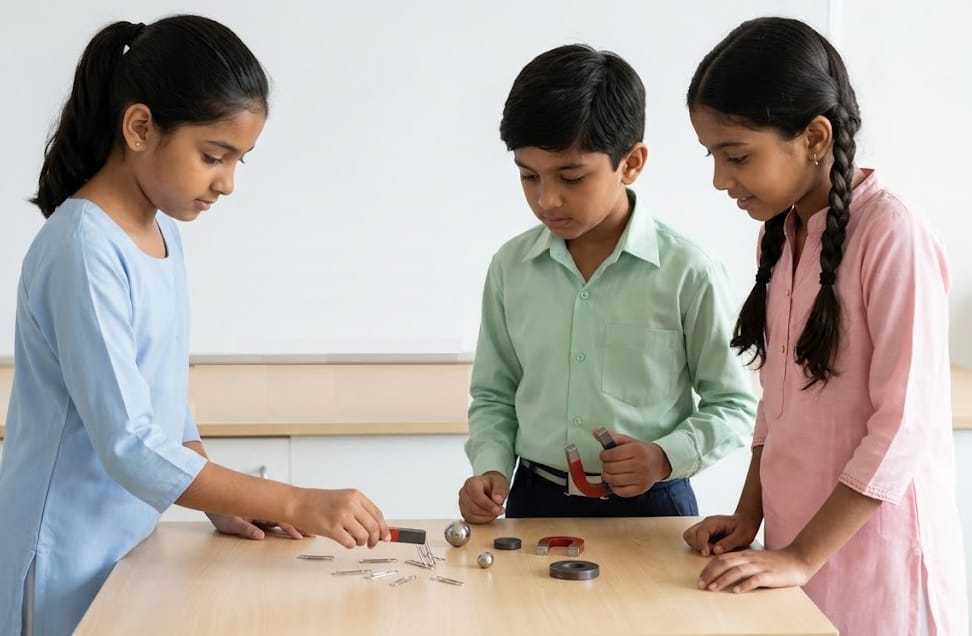
Promote Hands-On Experiments

Children remember experiences far longer than textbook explanations.

Simple experiments make learning exciting and memorable.

Examples include:

    • Growing beans in cotton
    • Creating a volcano model
    • Observing shadows throughout the day
    • Testing which objects float or sink
    • Building simple machines

Research continues to support project-based and hands-on learning approaches for improving scientific literacy, problem-solving skills, and concept retention among young learners.

Learning Through Play

Educational experts increasingly recommend play-based science activities during early childhood.

Activities involving building blocks, construction toys, puzzles, and exploration games strengthen observation, reasoning, and analytical thinking.

These experiences lay the groundwork for future STEM learning.

Why Practical Understanding Is Important in Science

Develop Critical Thinking Skills

Strong Science students do more than remember information. They analyze situations and evaluate evidence.

Parents can nurture critical thinking by asking open-ended questions such as:

    • What do you notice?
    • What changed?
    • Why do you think that happened?
    • What could happen next?

Research on scientific inquiry in early education shows that open-ended learning experiences help children become more engaged and independent learners.

Allow Children to Make Mistakes

Children learn valuable lessons when experiments do not go as expected.

Failure often teaches more than success.

Allow children to test ideas, make predictions, and learn from outcomes. This process strengthens resilience and problem-solving ability.

Encourage Reading Beyond School Textbooks

Many children only read Science content required for exams.

Parents can broaden learning through:

    • Children’s science magazines
    • Science storybooks
    • Nature books
    • Age-appropriate documentaries
    • Educational websites

Reading beyond the curriculum exposes children to new ideas and helps them connect classroom concepts with real-world applications.

How to Score Better Marks in Science Without Studying Longer Hours  

Use Technology Wisely

Modern technology offers excellent opportunities for science learning when used appropriately.

Interactive simulations, educational apps, virtual science labs, and age-appropriate videos can make difficult topics easier to understand.

Recent studies have found that thoughtfully designed digital learning experiences can support language development, cognitive growth, and engagement when combined with active parental involvement.

Balance Screen Time with Real Experiences

Technology should support learning, not replace hands-on exploration.

The best learning happens when digital tools complement practical experiences.

Create a Positive Attitude Toward Science

Children often develop fears about Science because they believe it is difficult.

Parents can help by:

    • Praising effort rather than marks
    • Celebrating curiosity
    • Avoiding negative comments about Science
    • Encouraging questions
    • Making learning enjoyable

A positive mindset can significantly influence academic performance over time.

Avoid Comparing Children

Every child learns at a different pace.

Comparisons often reduce confidence and motivation.

Instead, focus on individual progress and celebrate small improvements.

10 Best Ways to Memorize Scientific Terms and Definitions

Signs Your Child Has Strong Science Foundations

Children with strong Science fundamentals often:

    • Ask thoughtful questions
    • Enjoy exploring new ideas
    • Connect concepts with daily life
    • Solve problems independently
    • Show curiosity about how things work
    • Understand concepts instead of memorizing answers
    • Participate actively during discussions

These qualities often predict long-term success in Science learning.

Common Mistakes Parents Should Avoid

Prioritizing Marks Over Understanding

High scores achieved through memorization rarely create lasting knowledge.

Ignoring Curiosity

Children’s questions are opportunities for learning, not distractions.

Delaying Science Exposure

Science learning should begin early through observation and exploration.

Overloading Children with Information

Too much content can reduce interest.

Focus on gradual understanding rather than covering large amounts of material.

How to Develop Interest in Science from an Early Age

My Thoughts

Building strong Science fundamentals from an early age is not about teaching advanced theories. It is about helping children observe, question, investigate, and think logically. When curiosity is encouraged and concepts are understood clearly, Science becomes enjoyable rather than intimidating.

For parents seeking additional support, private online Science tuition can provide personalized guidance tailored to a child’s learning style. An experienced tutor can identify gaps in understanding, simplify difficult concepts, and build confidence through one-on-one attention. Online tuition also offers flexibility, structured learning plans, and regular feedback, helping students develop stronger foundations and perform better in school over time.

Looking for expert Science tutors?

Find Science Tutors on IndiaTutor.in

About the Author

Nidhi Mehta is the founder of IndiaTutor.in and a professional online educator with over 11 years of teaching experience. She specializes in tutoring Classes 1 to 6 across core academic subjects, with a strong focus on concept clarity and foundational skill-building. Her teaching approach is based on personalized, one-to-one learning that helps students develop long-term academic confidence and understanding.

Visit her profile    Visit About Us Page

error: Content is protected !!

Found this helpful? Share it in 2 seconds!

Link copied to clipboard