Science is much more than facts, formulas, and textbook definitions. It is a way of understanding how the world works. From the food we eat and the medicines we use to the technology that powers our daily lives, science is everywhere. Yet many students struggle with the subject because they focus only on memorizing information instead of understanding how scientific concepts apply in real situations.
Practical understanding helps students connect classroom learning with everyday experiences. It makes lessons more meaningful, improves retention, and develops important problem-solving abilities. For parents, encouraging practical learning can play a significant role in helping children perform better academically and develop lifelong curiosity.
What Does Practical Understanding in Science Mean?
Practical understanding refers to learning scientific concepts through observation, experimentation, application, and critical thinking rather than relying solely on memorization.
For example, a student may memorize that plants require sunlight for photosynthesis. However, observing how plants grow differently under varying light conditions creates a deeper understanding of the concept.
Similarly, learning about electricity becomes far more effective when students build simple circuits rather than only reading about them in a textbook.
When students see science in action, abstract theories become easier to understand and remember.
How to Develop Interest in Science from an Early Age
Why Memorization Alone Is Not Enough
Many students prepare for exams by repeatedly reading notes and memorizing answers. While this approach may help in short-term recall, it often fails when students face application-based questions.
Modern school examinations increasingly assess understanding, analysis, and problem-solving skills rather than simple recall.
International assessments such as the Programme for International Student Assessment (PISA) evaluate how effectively students can apply science knowledge to real-life situations. The assessment focuses on scientific reasoning, critical thinking, and practical problem solving rather than rote learning.
Students who understand concepts practically are generally better equipped to answer higher-order questions and tackle unfamiliar problems.
Benefits of Practical Learning in Science
Improves Concept Clarity
Scientific concepts often involve processes that are difficult to visualize through text alone.
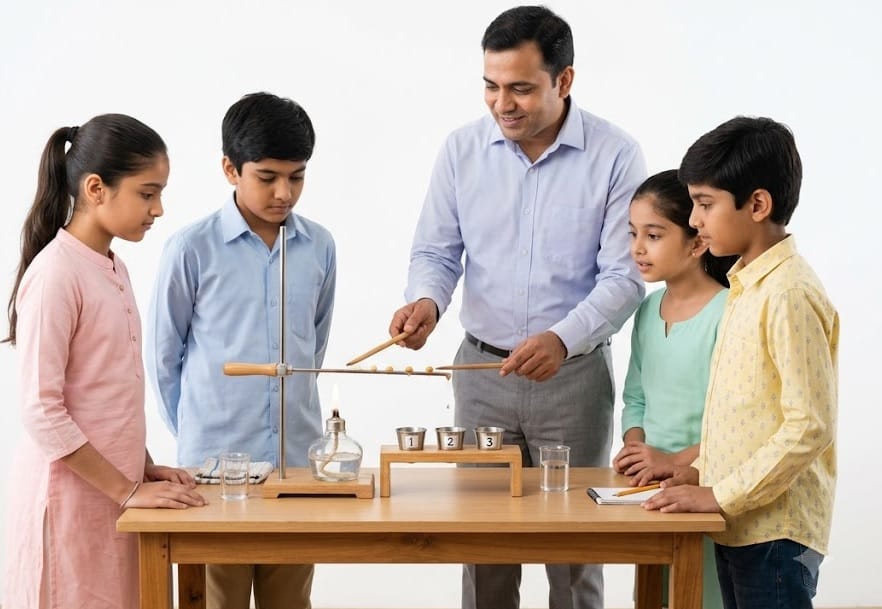
Experiments, demonstrations, simulations, and hands-on activities help students observe these processes directly. This improves comprehension and reduces confusion.
Whether learning about chemical reactions, gravity, ecosystems, or electricity, practical experiences make lessons easier to understand.
Strengthens Memory Retention
Students tend to remember experiences longer than information they simply read.
Research in science education has shown that hands-on experiments and active learning approaches improve understanding and retention compared to passive learning methods. Recent studies continue to highlight the educational value of practical science activities in enhancing student engagement and learning outcomes.
When students actively participate in learning, they are more likely to retain concepts for future examinations and higher studies.
Develops Critical Thinking Skills
Science is fundamentally about asking questions and finding evidence-based answers.
Practical learning encourages students to:
- Observe carefully
- Form hypotheses
- Analyze results
- Draw conclusions
- Evaluate evidence
These skills help students become independent thinkers and confident learners.
Builds Problem-Solving Ability
Many science questions require students to apply knowledge in unfamiliar situations.
Practical understanding helps students recognize patterns and connections between concepts, making it easier to solve complex problems.
This skill becomes particularly important in board examinations and competitive entrance tests.
Increases Student Engagement
Children naturally enjoy discovering how things work.
Hands-on activities, experiments, interactive models, and scientific investigations create excitement and make learning more enjoyable.
Students who enjoy learning are more likely to remain motivated and consistent in their studies.
Why Science Marks Drop in Middle School and High School
The Link Between Practical Learning and Academic Success
One common misconception is that practical learning is separate from examination preparation. In reality, strong conceptual understanding often leads to better academic performance.
Students who understand scientific principles can:
- Answer application-based questions accurately
- Write better explanations
- Interpret diagrams effectively
- Solve numerical problems confidently
- Retain information for longer periods
Studies examining practical science instruction have found positive relationships between experimental learning and academic achievement among school students.
As educational systems continue to emphasize competency-based learning, practical understanding becomes increasingly valuable.
How Modern Technology Is Transforming Science Learning
Technology has created new opportunities for practical science education beyond traditional laboratories.
Interactive Simulations
Digital simulations allow students to explore scientific phenomena that may be difficult or expensive to demonstrate physically.
Students can experiment with variables, observe outcomes, and gain deeper insight into scientific principles.
Research published in 2024 found that interactive multimedia, simulation-based learning, and blended approaches can significantly support science achievement among learners with different ability levels.
Educational Videos
Well-designed educational videos help students visualize processes that cannot easily be observed in classrooms.
Topics such as cell division, planetary motion, and molecular interactions become easier to understand through visual demonstrations.
Recent science education research highlights that both video-based learning and hands-on experiments contribute uniquely to science understanding when used appropriately.
Virtual Laboratories
Virtual labs provide opportunities for experimentation even when physical resources are limited.
Students can safely conduct experiments, test hypotheses, and develop investigative skills from home.
STEM-Based Learning
Science, Technology, Engineering, and Mathematics (STEM) education encourages project-based learning and practical application.
Hands-on STEM experiences using digital technologies help students develop creativity, collaboration, experimentation, and problem-solving skills.
How to Build Strong Science Fundamentals From an Early Age
Signs Your Child May Need More Practical Science Support
Parents should watch for indicators that a child may be relying too heavily on memorization.
Some common signs include:
- Difficulty explaining concepts in their own words
- Trouble answering application-based questions
- Forgetting lessons quickly after exams
- Lack of interest in science topics
- Fear of numerical or analytical questions
- Dependence on rote learning techniques
These challenges often indicate gaps in conceptual understanding rather than lack of effort.
How Parents Can Encourage Practical Learning at Home
Connect Science to Everyday Life
Simple discussions about weather, cooking, plants, health, or household appliances can spark scientific curiosity.
Encourage Questions
Children learn best when they are free to ask questions and explore answers.
Instead of providing immediate solutions, encourage investigation and reasoning.
Use Educational Resources
Science documentaries, educational videos, interactive apps, and simulations can complement classroom learning.
Support Small Experiments
Safe home experiments can make science more engaging and memorable.
Activities such as growing plants, observing water evaporation, or building simple models can reinforce classroom concepts.
Focus on Understanding Rather Than Marks Alone
When children prioritize understanding, improved academic performance often follows naturally.
How to Score Better Marks in Science Without Studying Longer Hours
The Future of Science Education
Educational systems worldwide are moving toward competency-based learning. Students are increasingly expected to analyze information, evaluate evidence, and apply knowledge to real-world situations.
Science literacy now involves much more than remembering facts. It includes understanding scientific processes, interpreting data, and making informed decisions based on evidence. OECD frameworks emphasize these practical scientific competencies as essential skills for modern learners.
As science continues to shape industries, careers, and society, practical understanding will remain one of the most valuable skills students can develop.
10 Best Ways to Memorize Scientific Terms and Definitions
My Thoughts
Practical understanding transforms science from a subject that students memorize into a subject they truly understand. It improves concept clarity, strengthens retention, develops analytical thinking, and prepares students for academic and real-world success.
For students who need additional support, private online science tuition can provide personalized guidance that is often difficult to achieve in large classrooms. An experienced tutor can identify learning gaps, explain concepts using real-life examples, conduct interactive sessions, and help students build confidence through structured practice. With one-on-one attention and customized teaching methods, online tuition can make science more engaging, understandable, and rewarding for learners of all levels.
Looking for expert Science tutors?
Find Science Tutors on IndiaTutor.in
About the Author
Nidhi Mehta is the founder of IndiaTutor.in and a professional online educator with over 11 years of teaching experience. She specializes in tutoring Classes 1 to 6 across core academic subjects, with a strong focus on concept clarity and foundational skill-building. Her teaching approach is based on personalized, one-to-one learning that helps students develop long-term academic confidence and understanding.
Visit her profile Visit About Us Page
Share your Feedback or Review – Contact Us
Tutors, Register your Tutor profile
Career Tutors, Get Personalized Tutor Branding Services
Do you Own a Tuition Center? List it here
Are you a Parent or Student? Share your Tutor Requirement


