

How to Help Your Child Improve in Mathematics

How to Help Your Child Improve in Mathematics

Mathematics is one of the most important subjects in a child’s academic journey. It develops logical thinking, problem-solving abilities, analytical skills, and confidence. Yet many students struggle with mathematics at different stages of their education. According to several educational studies, mathematics anxiety affects a significant percentage of school-age children, often leading to lower performance and reduced confidence in the classroom.

The good news is that parents play a crucial role in helping children build strong mathematical foundations. With the right approach, support, and learning environment, students can improve their understanding of mathematical concepts and achieve better academic results.

Why Mathematics Is Important for Every Child

Mathematics goes far beyond school examinations. It is used daily in budgeting, shopping, measuring, planning, technology, engineering, finance, and countless other aspects of life.

Students who develop strong mathematical skills often demonstrate:

    • Better logical reasoning abilities
    • Improved analytical thinking
    • Enhanced problem-solving skills
    • Greater confidence in handling challenges
    • Stronger performance in science and technology subjects

Research has consistently shown that mathematical competence is closely linked to future educational and career opportunities.

Understanding Why Children Struggle with Mathematics

Before helping your child improve, it is important to identify the root cause of the difficulty.

Weak Foundation in Basic Concepts

Many mathematical topics build upon previous knowledge. If a child has not fully understood concepts such as multiplication, fractions, decimals, or percentages, more advanced topics become increasingly difficult.

Mathematics Anxiety

Some students develop a fear of mathematics after repeated mistakes, poor test scores, or negative classroom experiences. This anxiety can affect concentration and performance.

Lack of Regular Practice

Unlike some subjects that rely heavily on memorization, mathematics requires consistent practice. Missing practice sessions often leads to slower progress.

Different Learning Styles

Every child learns differently. Some understand concepts through visual examples, while others benefit from practical demonstrations or step-by-step explanations.

Large Classroom Sizes

In many schools, teachers manage large groups of students. Individual learning gaps may not always receive sufficient attention.

Create a Positive Attitude Toward Mathematics

One of the most effective ways to help your child is by creating a positive learning environment.

Avoid Negative Statements

Children often absorb attitudes from adults around them. Avoid saying things such as:

    • Mathematics is difficult.
    • I was never good at maths.
    • Some people simply cannot learn mathematics.

Instead, encourage a growth mindset by emphasizing that mathematical ability improves through effort and practice.

Celebrate Small Achievements

Recognize progress, even when improvements seem minor. Completing difficult homework, solving a challenging problem, or improving test scores deserves encouragement.

Positive reinforcement builds confidence and motivation.

Strengthen Basic Mathematical Skills

A strong foundation supports future learning.

Focus on Core Concepts

Ensure your child understands:

    • Number sense
    • Addition and subtraction
    • Multiplication and division
    • Fractions
    • Decimals
    • Percentages

Gaps in these areas often create difficulties in higher-level mathematics.

Use Real-Life Examples

Mathematics becomes easier when connected to daily activities.

Examples include:

    • Calculating discounts while shopping
    • Measuring ingredients during cooking
    • Managing pocket money
    • Reading timetables
    • Comparing prices

Practical applications help children understand why mathematics matters.

Establish a Daily Mathematics Routine

Consistency is one of the biggest factors in improvement.

Set Aside Dedicated Practice Time

Even 20 to 30 minutes of focused mathematics practice each day can produce significant results over time.

Regular exposure helps reinforce concepts and improve retention.

Encourage Problem Solving

Instead of simply memorizing formulas, encourage children to understand why methods work.

Ask questions such as:

    • How did you reach that answer?
    • Can you solve it differently?
    • Why does this method work?

This approach develops deeper understanding.

Make Learning Interactive and Engaging

Children often learn better when mathematics feels interesting rather than intimidating.

Use Educational Games

Mathematics-based games can improve:

    • Mental calculation
    • Logical thinking
    • Pattern recognition
    • Strategic reasoning

Learning through play often reduces anxiety and increases engagement.

Use Visual Learning Techniques

Diagrams, charts, graphs, number lines, and illustrations help many students understand abstract concepts more effectively.

Visual explanations are particularly useful for geometry, fractions, and algebra.

Monitor School Performance Regularly

Parents should stay informed about their child’s academic progress.

Review Assignments and Assessments

Look beyond final marks.

Pay attention to:

    • Types of mistakes
    • Areas of confusion
    • Consistently weak topics
    • Improvement trends

Early identification allows timely intervention.

Communicate With Teachers

Teachers can provide valuable insights into classroom participation, understanding levels, and areas needing additional support.

Regular communication helps create a coordinated learning strategy.

Teach Effective Examination Strategies

Many students understand concepts but lose marks because of poor exam techniques.

Encourage Step-by-Step Solutions

Mathematics examinations often award marks for working methods, not just final answers.

Students should learn to:

    • Show calculations clearly
    • Write steps neatly
    • Check answers carefully
    • Avoid rushing through questions

Practice Time Management

Timed practice sessions help students become comfortable working under examination conditions.

This improves speed, accuracy, and confidence.

Help Children Develop a Growth Mindset

A growth mindset can significantly influence mathematical achievement.

Focus on Effort Rather Than Talent

Instead of praising intelligence alone, acknowledge persistence, practice, and determination.

For example:

    • You worked hard on this problem.
    • Your practice is paying off.
    • You improved because you kept trying.

This encourages resilience when facing difficult topics.

Normalize Mistakes

Errors are a natural part of learning mathematics.

Encourage children to view mistakes as opportunities to identify areas that need improvement.

Create a Distraction-Free Study Environment

The study environment directly affects concentration and productivity.

Organize a Dedicated Learning Space

An effective study area should have:

    • Good lighting
    • Comfortable seating
    • Minimal distractions
    • Necessary stationery and materials

A structured environment promotes focus.

Limit Digital Distractions

Mobile phones, social media, and gaming can reduce study efficiency.

Establish clear study periods where distractions are minimized.

Recognize When Additional Support Is Needed

Sometimes students require personalized guidance beyond school instruction.

Signs Your Child May Need Extra Help

Watch for indicators such as:

    • Consistently low mathematics scores
    • Difficulty completing homework independently
    • Avoidance of mathematical tasks
    • Growing frustration or anxiety
    • Lack of confidence in problem solving

Early intervention often prevents learning gaps from becoming larger.

How a Mathematics Tutor Can Help

Individualized support can make a significant difference in a student’s academic performance.

Personalized Learning Plans

A tutor can identify strengths, weaknesses, and learning gaps, then create targeted lessons that address specific needs.

One-to-One Attention

Students receive focused guidance, allowing questions to be answered immediately and concepts explained at an appropriate pace.

Improved Confidence

As understanding increases, confidence naturally grows. Students become more willing to participate in class and attempt challenging problems.

Better Academic Results

Regular tutoring often leads to stronger conceptual understanding, improved grades, and greater examination readiness.

Choosing the Right Mathematics Tutor

When selecting a tutor, parents should consider:

    • Subject expertise
    • Teaching experience
    • Communication skills
    • Student reviews and feedback
    • Ability to adapt teaching methods
    • Availability for regular sessions

A good tutor does more than teach formulas. They help students build confidence, discipline, and independent learning habits.

My Thoughts

Helping your child improve in mathematics does not require advanced mathematical knowledge from parents. What matters most is providing encouragement, creating consistent study habits, supporting conceptual understanding, and seeking additional guidance when necessary.

With patience, regular practice, positive reinforcement, and the right educational support, every child can strengthen their mathematical abilities and develop confidence in the subject. By addressing challenges early and focusing on long-term learning rather than short-term results, parents can help their children build skills that benefit them throughout their academic journey and beyond.

Looking for expert Mathematics tutors?

Find Math Tutors on IndiaTutor.in

About the Author

Nidhi Mehta is the founder of IndiaTutor.in and a professional online educator with over 11 years of teaching experience. She specializes in tutoring Classes 1 to 6 across core academic subjects, with a strong focus on concept clarity and foundational skill-building. Her teaching approach is based on personalized, one-to-one learning that helps students develop long-term academic confidence and understanding.
Visit her profile    Visit About Us Page

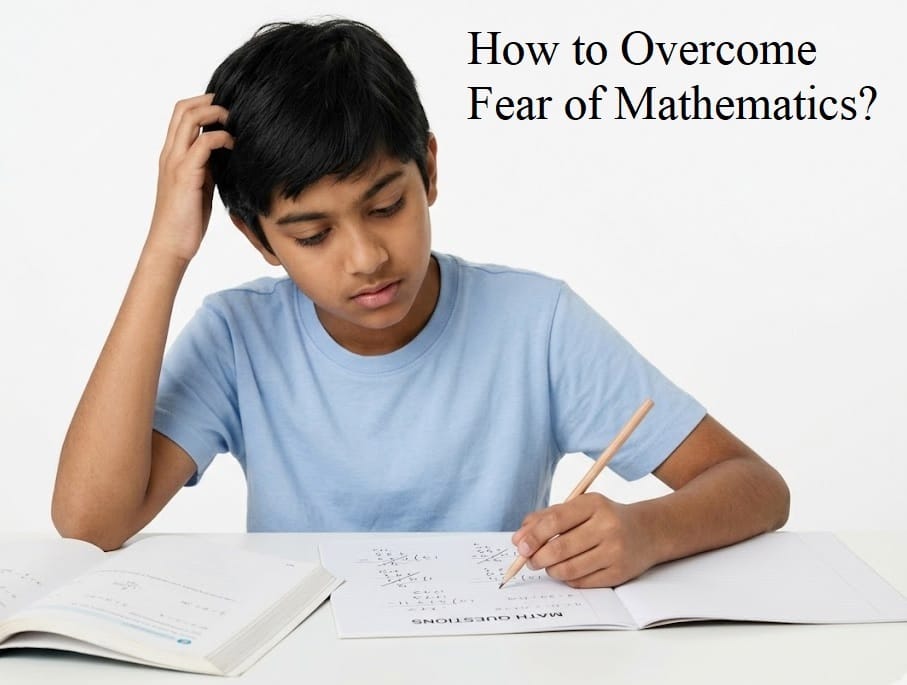
How to Overcome Fear of Mathematics

Mathematics is one of the most important subjects in a student’s academic journey. It develops logical thinking, problem-solving abilities, analytical skills, and confidence in handling real-world situations. Despite its importance, many students experience fear, anxiety, or stress when dealing with mathematical concepts and calculations.

Fear of Mathematics is more common than many people realize. Research published by the Organisation for Economic Co-operation and Development (OECD) found that a significant percentage of students report feeling nervous, helpless, or worried when solving mathematics problems. This anxiety can negatively affect performance, concentration, and overall confidence.

The good news is that mathematical fear is not permanent. With the right approach, guidance, and consistent practice, students can build confidence and improve their understanding of the subject. Parents and tutors also play a vital role in helping learners develop a positive attitude toward Mathematics.

Understanding the Fear of Mathematics

Mathematics anxiety refers to feelings of tension, nervousness, or worry when students encounter mathematical tasks. This fear may appear during classroom lessons, homework sessions, examinations, or even simple calculations.

Many students mistakenly believe that they are “not good at Maths.” In reality, most learners struggle because of gaps in understanding, ineffective learning methods, or negative experiences rather than a lack of ability.

Fear often grows when concepts are not understood properly and students continue moving to advanced topics without mastering the basics.

Common Reasons Students Fear Mathematics

Weak Foundation in Basic Concepts

Mathematics is a cumulative subject. New topics build upon previously learned concepts. If a student struggles with fractions, percentages, multiplication, or algebraic basics, advanced chapters become increasingly difficult.

Small learning gaps can gradually develop into larger challenges, leading to frustration and avoidance.

Negative Classroom Experiences

A poor classroom experience can significantly affect a student’s confidence. Being criticized for mistakes, feeling embarrassed while answering questions, or constantly comparing performance with classmates may create a negative association with the subject.

Pressure to Perform

Many students face pressure from examinations, parents, peers, or school expectations. When performance becomes the primary focus, learning often takes a back seat.

The fear of making mistakes can make students hesitant to attempt problems, reducing opportunities for improvement.

Lack of Practice

Mathematics requires regular engagement. Unlike subjects that rely heavily on memorization, mathematical skills improve through repeated application.

Students who avoid practice often find questions unfamiliar during tests, which increases anxiety.

Belief That Mathematics Is Difficult

One of the biggest obstacles is mindset. When students repeatedly hear statements such as “Maths is very hard” or “Only intelligent people can solve Mathematics,” they begin believing these assumptions.

These beliefs can become self-fulfilling and limit progress.

Signs That a Student Is Experiencing Mathematics Anxiety

Parents and tutors should look for common warning signs, including:

    • Avoiding mathematics homework
    • Complaining about headaches or stress before Maths classes
    • Becoming frustrated quickly during calculations
    • Showing low confidence despite understanding concepts
    • Freezing during examinations
    • Frequently saying “I can’t do Maths”

Identifying these signs early can help prevent long-term academic difficulties.

Why Building Confidence Matters

Confidence plays a major role in mathematical success. Studies have shown that students who believe they can solve problems are more likely to persist through challenges and achieve better academic outcomes.

Confidence encourages curiosity, reduces fear of mistakes, and improves overall learning efficiency.

When students view challenges as opportunities to learn rather than threats to avoid, performance often improves naturally.

Practical Strategies to Overcome Fear of Mathematics

Start With Simple Concepts

Students should begin with topics they can understand comfortably. Success with easier concepts creates momentum and gradually rebuilds confidence.

Instead of focusing immediately on difficult chapters, it is often better to strengthen basic skills first.

Small achievements can create significant psychological improvements.

Practice Every Day

Regular practice is one of the most effective ways to reduce anxiety.

Even 20 to 30 minutes of focused mathematical work each day can improve familiarity and confidence. Consistency is more valuable than occasional long study sessions.

Daily exposure helps students become comfortable with numbers, formulas, and problem-solving techniques.

Learn From Mistakes

Mistakes are a natural part of learning Mathematics.

Students should review incorrect answers carefully and identify where the error occurred. Understanding mistakes often provides deeper learning than solving questions correctly on the first attempt.

Successful mathematicians, scientists, and engineers learn through trial, error, and continuous improvement.

Break Problems Into Smaller Steps

Complex questions can appear intimidating at first glance.

A useful technique is dividing larger problems into smaller, manageable parts. Solving one step at a time makes the process less overwhelming and easier to understand.

This approach improves accuracy while reducing stress.

Focus on Understanding Rather Than Memorization

Many students attempt to memorize formulas without understanding their purpose.

Mathematics becomes much easier when learners understand why a formula works and how it applies to real situations.

Conceptual understanding improves long-term retention and problem-solving ability.

The Role of Parents in Reducing Mathematics Fear

Create a Positive Learning Environment

Parents can help by encouraging effort rather than focusing only on marks.

Praising persistence, improvement, and hard work promotes a growth mindset that supports academic success.

Children perform better when they feel supported rather than judged.

Avoid Negative Statements About Mathematics

Comments such as “I was never good at Maths” may unintentionally influence a child’s perception of the subject.

Positive language helps students develop confidence and resilience.

Parents should emphasize that mathematical skills can be learned through practice and patience.

Encourage Questions

Students should feel comfortable asking questions whenever they are confused.

Creating an environment where curiosity is welcomed helps prevent misunderstandings from accumulating over time.

Celebrate Progress

Improvement deserves recognition.

Whether a student masters multiplication tables, solves a challenging equation, or improves test scores, acknowledging progress can boost motivation and self-belief.

How Tutors Can Help Students Gain Confidence

A skilled tutor can make a significant difference in overcoming Mathematics anxiety.

Personalized Learning

Every student learns differently. Individualized instruction allows tutors to identify specific weaknesses and adapt teaching methods accordingly.

Customized support often leads to faster improvement.

Clarifying Difficult Concepts

Tutors can explain topics using different examples, visual methods, and practical applications that make concepts easier to understand.

Many students gain confidence when lessons are tailored to their learning style.

Building Consistent Study Habits

Regular tutoring sessions encourage discipline and structured learning.

Students often feel more prepared and less anxious when they follow a systematic study plan.

Providing Positive Reinforcement

Encouragement and constructive feedback help learners stay motivated during challenging topics.

Positive reinforcement can gradually replace fear with confidence.

Effective Study Habits for Mathematics Success

Maintain a Formula Notebook

Keeping important formulas, shortcuts, and examples in one place makes revision more efficient.

Solve Previous Question Papers

Past examination papers help students understand question patterns, improve speed, and reduce test anxiety.

Use Visual Learning Methods

Charts, diagrams, graphs, and illustrations can simplify complex concepts and improve comprehension.

Set Realistic Goals

Achievable goals provide direction and maintain motivation.

Instead of aiming to master an entire syllabus in a few days, students should focus on steady progress.

Long-Term Benefits of Overcoming Mathematics Fear

Students who develop confidence in Mathematics often experience improvements beyond academics.

Benefits include:

    • Stronger analytical thinking
    • Better decision-making skills
    • Enhanced problem-solving ability
    • Increased confidence in competitive examinations
    • Improved readiness for careers in science, technology, engineering, finance, and business

Mathematical skills continue to provide value throughout higher education and professional life.

My Thoughts

Fear of Mathematics is a challenge that many students face, but it can be overcome with patience, practice, and the right support system. Building strong foundations, maintaining consistent study habits, learning from mistakes, and receiving guidance from experienced educators can transform a student’s relationship with the subject.

Parents, teachers, and tutors all contribute to creating a positive learning environment where students feel confident enough to ask questions, explore concepts, and develop problem-solving skills. When fear is replaced with understanding, Mathematics becomes significantly more approachable and rewarding.

Looking for expert Mathematics tutors?

Find Math Tutors on IndiaTutor.in

About the Author

Nidhi Mehta is the founder of IndiaTutor.in and a professional online educator with over 11 years of teaching experience. She specializes in tutoring Classes 1 to 6 across core academic subjects, with a strong focus on concept clarity and foundational skill-building. Her teaching approach is based on personalized, one-to-one learning that helps students develop long-term academic confidence and understanding.

Visit her profile    Visit About Us Page

error: Content is protected !!

Found this helpful? Share it in 2 seconds!

Link copied to clipboard