Physics is one of the most challenging subjects for many students. While some children enjoy understanding how things work, others struggle with formulas, calculations, concepts, and numerical problems. As students move into higher classes, particularly Class 9 onwards, Physics becomes more demanding and often requires additional guidance outside school.
According to various education surveys conducted in India, Science and Mathematics consistently rank among the subjects where students seek the most academic support. Physics, in particular, requires conceptual understanding, logical reasoning, mathematical application, and regular practice.
Choosing the right Physics tutor can make a significant difference in a student’s confidence, understanding, and academic performance. However, not every tutor is the right fit for every learner. Before hiring a Physics tutor, parents should ask several important questions to ensure their child receives effective support.
Why Choosing the Right Physics Tutor Matters
A good tutor does much more than explain textbook chapters. They help students understand concepts, improve problem-solving abilities, identify weaknesses, prepare for examinations, and develop confidence.
Research published by educational organizations worldwide has shown that personalized learning and one-to-one academic support often lead to better student engagement and improved learning outcomes. Students who receive targeted instruction are generally able to address learning gaps more effectively than those relying solely on classroom teaching.
That is why asking the right questions before making a decision is important.
Why Good Students Suddenly Start Scoring Low in Physics
Questions Parents Should Ask Before Hiring a Physics Tutor
What Is Your Educational Background?
The first question should focus on the tutor’s qualifications.
Ask about:
- Educational degrees
- Specialization in Physics
- Teaching certifications
- Competitive exam experience
A tutor with a strong academic foundation is usually better equipped to explain difficult concepts accurately and clearly.
For example, a tutor with a Physics, Engineering, or Science background may have deeper subject knowledge than someone teaching multiple unrelated subjects.
How Many Years of Teaching Experience Do You Have?
Experience often helps tutors understand common student difficulties.
Ask questions such as:
- How long have you been teaching Physics?
- Which classes do you teach?
- Have you worked with students from my child’s board?
An experienced tutor is likely to recognize recurring mistakes and provide effective solutions.
However, experience alone should not be the deciding factor. Teaching ability and communication skills are equally important.
Which Curriculum Do You Teach?
Different education boards follow different syllabi and examination patterns.
Parents should confirm whether the tutor has experience with:
- CBSE
- ICSE
- State Boards
- IGCSE
- IB
- Cambridge Curriculum
A tutor familiar with the student’s specific curriculum can provide more relevant guidance and exam-focused preparation.
How Do You Explain Difficult Concepts?
Physics is built on concepts rather than memorization.
Ask the tutor how they teach topics such as:
- Motion
- Force
- Electricity
- Magnetism
- Waves
- Optics
Can You Give an Example Lesson?
Many tutors offer a trial class.
During the demonstration lesson, observe:
- Clarity of explanation
- Patience
- Communication style
- Student engagement
- Ability to simplify difficult ideas
A trial session often reveals more than qualifications listed on paper.
How to Build Strong Fundamentals in Physics
Understanding the Tutor’s Teaching Approach
How Do You Assess a Student’s Current Level?
Every student begins at a different stage.
Some may struggle with formulas.
Others may struggle with mathematical calculations.
A good tutor usually conducts an initial assessment to identify:
- Strengths
- Weak areas
- Learning gaps
- Academic goals
This helps create a more personalized learning plan.
How Do You Track Progress?
Parents should know how improvement will be measured.
Ask whether the tutor provides:
- Regular tests
- Practice assignments
- Performance reports
- Feedback sessions
Consistent monitoring helps students stay on track and allows parents to understand progress over time.
How Do You Help Students Who Lack Confidence?
Many students do not dislike Physics itself. They simply become discouraged after repeated mistakes or poor exam results.
Ask how the tutor handles:
- Fear of Physics
- Exam stress
- Low confidence
- Learning difficulties
An encouraging tutor can often help students rebuild confidence and develop a positive attitude toward the subject.
How to Improve Physics Problem-Solving Skills
Questions About Academic Results
Have Your Students Improved Their Scores?
While no tutor can guarantee marks, parents can ask for examples of past student improvement.
Questions may include:
- What kind of results have your students achieved?
- Have you taught board exam students?
- Do you have testimonials or reviews?
Past success does not guarantee future performance, but it can provide useful insight into teaching effectiveness.
Do You Prepare Students for Board Exams?
Board examinations require a different strategy than regular school tests.
Ask whether the tutor helps students with:
- Previous year question papers
- Sample papers
- Time management
- Answer-writing techniques
- Revision schedules
Board-focused preparation can significantly improve exam readiness.
Questions About Online and Home Tuition
What Technology Do You Use for Online Classes?
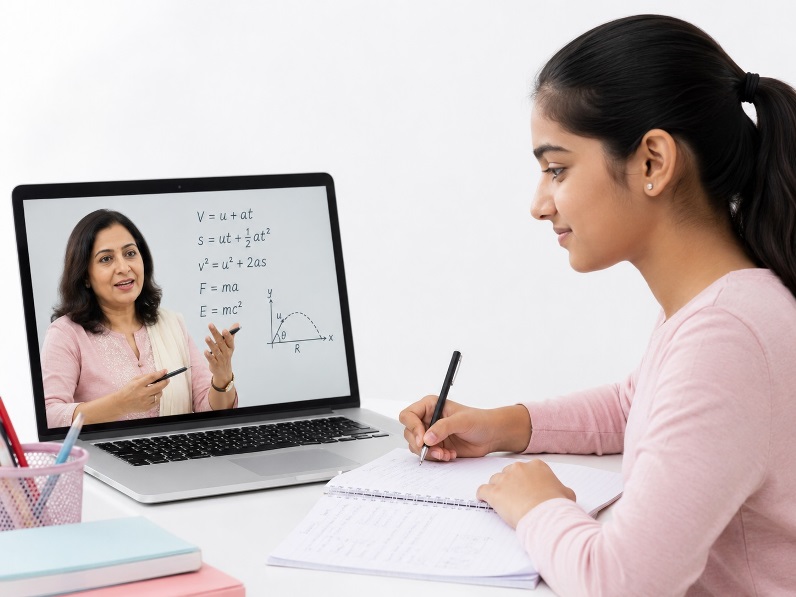
Online tutoring has grown rapidly in recent years.
Many students now prefer learning from home because of convenience and flexibility.
Ask whether the tutor uses:
- Digital whiteboards
- Interactive presentations
- Recorded sessions
- Online assessments
A well-organized online class can be just as effective as traditional face-to-face instruction.
What Is Your Class Schedule?
Parents should clearly understand:
- Class frequency
- Session duration
- Rescheduling policies
- Holiday arrangements
A structured timetable helps maintain consistency throughout the academic year.
Physics Formulas Every Student Must Know
Will My Child Receive Homework and Practice Material?
Physics requires regular practice.
Educational studies consistently show that students retain concepts better when they actively solve problems rather than simply reading theory.
Ask whether the tutor provides:
- Worksheets
- Numerical practice
- Revision exercises
- Mock tests
Practice plays a crucial role in long-term understanding.
Questions About Communication
How Often Will You Share Feedback?
Regular communication between parents and tutors creates a stronger support system for students.
Ask whether feedback is provided:
- Weekly
- Monthly
- After assessments
Updates can help parents understand where their child is improving and where additional attention may be needed.
How Accessible Are You Outside Class?
Students sometimes encounter difficulties while completing homework or preparing for exams.
Some tutors provide limited doubt-solving support through:
- Messaging apps
- Scheduled doubt sessions
Knowing the tutor’s availability can help set realistic expectations.
How Parents Can Help Children Improve in Physics
Red Flags Parents Should Watch For
Unrealistic Promises
Be cautious of tutors who guarantee:
- 100% marks
- Top ranks
- Instant improvement
Learning outcomes depend on multiple factors including effort, consistency, prior knowledge, and study habits.
Lack of Structure
A tutor should have a clear teaching plan.
Avoid situations where lessons appear random, unorganized, or inconsistent.
Poor Communication
If a tutor is difficult to reach before classes begin, communication challenges may continue later as well.
No Assessment System
Without tests, assignments, or progress reviews, it becomes difficult to measure improvement.
Final Checklist Before Hiring a Physics Tutor
Before making a final decision, parents should ensure the tutor:
- Has strong Physics knowledge
- Understands the student’s curriculum
- Explains concepts clearly
- Conducts assessments
- Tracks progress regularly
- Communicates effectively
- Encourages confidence
- Provides adequate practice material
- Has positive reviews or references
- Fits the student’s learning style
My Thoughts
Hiring a Physics tutor is an important educational decision. Asking thoughtful questions helps parents find a tutor who not only understands the subject but also understands the student. The right tutor can transform confusion into clarity and frustration into confidence.
Private Physics tutoring offers several advantages. Students receive personalized attention, lessons move at their own pace, and weak areas can be addressed more effectively. One-to-one guidance often leads to stronger conceptual understanding, better problem-solving skills, and improved exam performance. Most importantly, a skilled tutor can help students develop confidence and a genuine interest in Physics that benefits them throughout their academic journey.
Looking for expert Physics tutors?
Find Physics Tutors on IndiaTutor.in
About the Author
Nidhi Mehta is the founder of IndiaTutor.in and a professional online educator with over 11 years of teaching experience. She specializes in tutoring Classes 1 to 6 across core academic subjects, with a strong focus on concept clarity and foundational skill-building. Her teaching approach is based on personalized, one-to-one learning that helps students develop long-term academic confidence and understanding.