
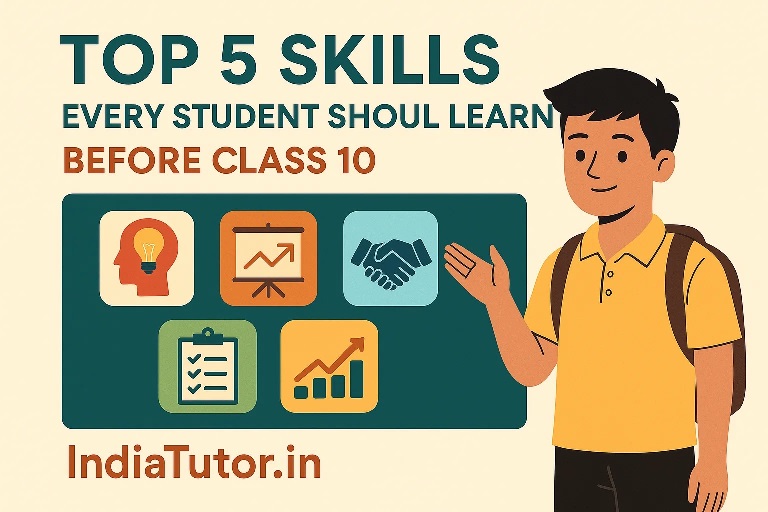
Class 10 is a turning point in a student’s academic journey. It is the stage where school performance starts to influence subject choices, confidence levels, and future career direction. According to multiple education studies, students who build strong foundational skills before Class 10 tend to perform significantly better in board examinations and higher secondary streams. One UNESCO report highlights that early skill development improves learning outcomes by improving comprehension, retention, and exam readiness.
Many parents focus only on syllabus completion, but academic success is strongly linked to learning abilities rather than rote memorization. The skills below help students perform better across all subjects, especially in core areas like Mathematics, Science, and languages.
Concept Understanding and Logical Thinking
A major gap seen in school students is the tendency to memorize instead of understanding concepts. This becomes a serious problem in higher classes where application-based questions dominate exam papers.
Concept understanding means knowing the “why” behind every topic instead of only learning formulas or definitions. Logical thinking helps students connect ideas and solve unfamiliar problems.
Research by Cambridge Assessment shows that students trained in conceptual learning perform up to 30% better in problem-solving assessments compared to students relying on memorization alone.
The Role of Sleep and Nutrition in Boosting Kids’ Focus
Why it matters
In subjects like Mathematics, students often struggle when questions are twisted or framed differently. Without conceptual clarity, even simple problems appear difficult. Logical thinking allows students to break problems into smaller steps and approach them systematically.
How students can develop it
Regular practice of “why-based questions”
Solving pattern variation problems
Discussing answers instead of copying solutions
Learning through real-life examples
This skill builds long-term academic confidence and reduces exam stress significantly.
Reading Comprehension and Language Interpretation
Reading comprehension is not limited to English or language subjects. It directly affects performance in Science, Social Studies, and even Mathematics word problems.
According to the National Assessment Survey, nearly 55% of students in middle school struggle to understand textbook passages properly, which impacts overall marks.
Importance in academics
Students who cannot interpret questions correctly often lose marks even when they know the answer. Misinterpretation is one of the most common reasons for poor exam performance.
Skill development methods
Daily reading of short passages
Summarizing paragraphs in simple language
Practicing question-based reading exercises
Learning keyword identification techniques
This skill improves attention, memory, and accuracy in answering questions under time pressure.
Importance of Reading Habits in Primary School Students
Numerical Ability and Basic Mathematical Fluency
Numerical ability is one of the strongest indicators of academic performance in higher classes. It is not limited to solving equations but includes quick calculations, estimation, and number sense.
Studies in cognitive learning show that students with strong numerical fluency solve exam papers up to 25% faster than others, giving them more time for revision and checking answers.
Core components
Speed in basic arithmetic operations
Understanding fractions, percentages, and ratios
Ability to estimate answers quickly
Strong mental calculation habits
Why early development is important
By Class 10, Mathematics becomes more application-based with algebra, geometry, and trigonometry. Without strong number sense, students struggle with multi-step problems.
How to improve
Daily mental math practice
Short timed quizzes
Real-life application problems like shopping calculations
Using step-by-step breakdown techniques
This skill directly improves confidence in Mathematics and Science subjects.
How Online Tuition Can Help Improve Student Confidence
Time Management and Study Discipline
One of the biggest differences between average and high-performing students is how they manage time. Effective time management helps students balance schoolwork, homework, revision, and extracurricular activities.
Educational psychology studies show that structured study routines improve retention rates by up to 40% compared to irregular study patterns.
Key elements
Daily study schedule
Prioritization of difficult subjects
Break-based learning system
Consistent revision cycles
Common mistakes students make
Studying only before exams
Spending too much time on one subject
Ignoring revision planning
Multitasking without focus
How to build discipline
Fixed study hours every day
Weekly revision planning
Using short study blocks (25–40 minutes)
Setting small achievable goals
Good time management reduces pressure during exams and improves overall academic balance.
How to Help Your Child Balance School, Homework, and Hobbies
Problem Solving and Analytical Skills
Problem solving is one of the most important life and academic skills. It helps students handle complex questions in exams and real-world situations.
According to OECD learning reports, students with strong analytical skills are more likely to excel in STEM subjects and competitive exams.
What this skill includes
Breaking problems into steps
Identifying patterns and relationships
Evaluating multiple solution methods
Applying logic under time constraints
Academic impact
In Mathematics and Science, questions are often designed to test reasoning rather than direct memory. Analytical thinking helps students interpret questions correctly and choose the right approach.
How to develop it
Practice case-based questions
Solve puzzles and logical reasoning tasks
Analyze mistakes after tests
Discuss alternate solutions with teachers or tutors
This skill builds academic independence and reduces dependency on rote learning.
How to Use AI for Notes, Summaries & Revision Faster Than Ever
Digital Literacy and Smart Learning Habits
Modern education increasingly relies on digital tools, online resources, and interactive learning platforms. UNESCO data shows that digital learning can improve student engagement and understanding when used correctly.
Importance in today’s education system
Students now access assignments, notes, and practice material online. Without digital literacy, they miss out on valuable learning resources.
Key components
Understanding online learning platforms
Using educational videos effectively
Safe and responsible internet usage
Researching information accurately
Smart learning habits
Watching concept-based tutorials instead of passive scrolling
Using online quizzes for practice
Downloading structured study material
Avoiding distraction-heavy usage of devices
This skill prepares students for higher education where digital tools are widely used.
10 Smart Ways Students Can Use AI to Score Higher in Exams
Why These Skills Matter Before Class 10
Class 10 is not just another academic year; it is a foundation for future specialization. Students who develop these five skills early tend to perform better in board exams and show stronger confidence in higher secondary education.
Education experts consistently emphasize that success is not only about studying harder but also about studying smarter. These skills create that balance by improving understanding, speed, discipline, and reasoning ability.
Parents who focus on skill-building instead of only marks often see long-term improvement in their child’s academic journey.
How to Choose the Right Tutor for your Child – A Parent’s Checklist
Build Strong Academic Support with IndiaTutor
Students who need guided learning, structured practice, and subject clarity benefit greatly from personalized tutoring support. IndiaTutor.in connects students with experienced tutors who focus on concept building, exam preparation, and skill development across subjects.
Search on indiatutor.in to connect with qualified tutors who can guide students with personalized learning plans, concept clarity, and structured preparation strategies. IndiaTutor.in helps students find trusted tutors for competitive exam success with direct communication and flexible learning support.
Search Tutors by Subject Search Tutors by Class Level
About the Author
Nidhi Mehta is the founder of IndiaTutor.in and a professional online educator with over 11 years of teaching experience. She specializes in tutoring Classes 1 to 6 across core academic subjects, with a strong focus on concept clarity and foundational skill-building. Her teaching approach is based on personalized, one-to-one learning that helps students develop long-term academic confidence and understanding.
Visit her profile Visit About Us Page
Share your Feedback or Review – Contact Us
Tutors, Register your Tutor profile
Career Tutors, Get Personalized Tutor Branding Services
Do you Own a Tuition Center? List it here
Are you a Parent or Student? Share your Tutor Requirement


