
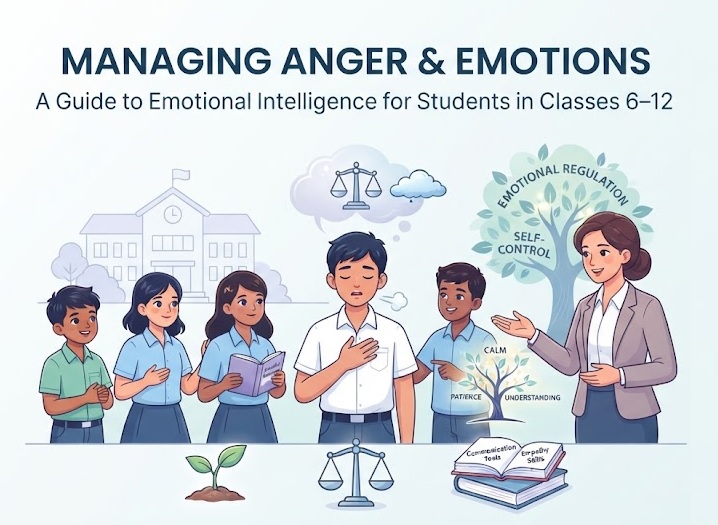
Managing Anger & Emotions

Managing Anger and Emotions

Every student experiences emotions every day. You may feel happy after scoring good marks, excited before a school trip, nervous before an exam, or angry when someone treats you unfairly. Emotions are a natural part of life, and they help us understand ourselves and the world around us.

Among all emotions, anger is one of the most misunderstood. Many people believe anger is bad, but that is not true. Anger is a normal human emotion. What matters is how we manage it. Learning to control anger and express emotions in a healthy way is an important life skill that helps students succeed in school, build better friendships, and enjoy happier lives.

This guide explains everything students in Classes 6 to 12 need to know about managing anger and emotions in simple language.

What Are Emotions?

Emotions are feelings that help us respond to different situations. They influence our thoughts, decisions, and actions.

Some common emotions include:

    • Happiness
    • Sadness
    • Anger
    • Fear
    • Excitement
    • Surprise
    • Disappointment
    • Worry
    • Pride
    • Love

Every emotion has a purpose. Feeling sad after losing something important or feeling nervous before an exam is completely normal.

There are no “good” or “bad” emotions. There are only healthy and unhealthy ways of expressing them.

What Is Anger?

Anger is your body’s natural response when you feel threatened, hurt, ignored, embarrassed, or treated unfairly.

For example, you may feel angry if:

    • Someone bullies you.
    • A friend breaks your trust.
    • You lose an important match.
    • Your parents misunderstand you.
    • Someone insults you online.
    • You are blamed for something you did not do.

Feeling angry does not make you a bad person. Everyone gets angry sometimes.

The real challenge is learning how to respond without hurting yourself or others.

Why Do Students Become Angry?

School life brings many challenges. Some common reasons include:

Academic Pressure

Homework, exams, competition, and high expectations can create stress.

Bullying

Being teased, excluded, or physically bullied often leads to frustration and anger.

Peer Pressure

Trying to fit in with friends or facing social rejection can affect emotions.

Family Problems

Arguments at home, financial stress, divorce, or lack of communication may make students feel upset.

Social Media

Negative comments, cyberbullying, unrealistic comparisons, and online conflicts can increase emotional stress.

Lack of Sleep

Students who do not get enough sleep often become more irritable and impatient.

What Happens Inside Your Body When You Get Angry?

Anger affects both the brain and the body.

When you become angry:

    • Your heart beats faster.
    • Your breathing speeds up.
    • Blood pressure increases.
    • Muscles become tense.
    • Stress hormones are released.
    • Clear thinking becomes more difficult.

Your brain prepares your body for a “fight or flight” response.

This is useful during real danger but not during everyday disagreements at school or home.

Signs That Anger Is Getting Out of Control

Everyone feels angry sometimes, but frequent or intense anger may become a problem.

Watch for these warning signs:

    • Shouting frequently
    • Fighting with classmates
    • Breaking things
    • Throwing objects
    • Using hurtful words
    • Holding grudges
    • Feeling angry most of the day
    • Hurting yourself
    • Thinking about hurting others

If these signs continue, it is important to seek help.

Why Managing Anger Is Important

Learning emotional control helps students in many ways.

Students who manage anger well often:

    • Make better decisions
    • Have stronger friendships
    • Perform better in school
    • Solve problems calmly
    • Feel more confident
    • Handle stress more effectively
    • Avoid unnecessary conflicts

Managing emotions is one of the most valuable life skills you can develop.

Healthy Ways to Manage Anger

Stop Before You React

Take a moment before speaking or acting.

A few seconds of thinking can prevent many problems.

Take Deep Breaths

Slow, deep breathing helps calm both your body and your mind.

Breathe in through your nose and slowly breathe out through your mouth.

Repeat several times.

Count Slowly

Counting from one to ten gives your brain time to think before reacting.

Walk Away

If an argument is becoming worse, politely leave the situation and return when you feel calmer.

Walking away is not weakness. It is self-control.

Drink Water

Something as simple as drinking water can help you slow down and relax.

Exercise

Physical activity reduces stress hormones and improves your mood.

Sports, walking, cycling, dancing, or yoga can all help.

Listen to Music

Soft, calming music helps many students relax after a stressful day.

Write Your Feelings

Keeping a journal allows you to express emotions without hurting anyone.

Writing often makes problems feel smaller.

Learn to Express Your Feelings

Instead of shouting or blaming others, use respectful language.

Try saying:

“I feel upset.”

“I didn’t like what happened.”

“I need some time to calm down.”

“I would like to talk about this.”

These simple sentences reduce misunderstandings and encourage healthy communication.

Think Before You Speak

Words can leave lasting emotional wounds.

Before speaking, ask yourself:

    • Is it true?
    • Is it necessary?
    • Is it kind?
    • Will it make the situation better?

Sometimes choosing silence is the wisest decision.

The Importance of Self-Control

Self-control means choosing your actions instead of letting emotions control you.

Strong people are not those who shout the loudest.

Strong people remain calm even during difficult situations.

Every time you stay calm, you strengthen your self-control.

Helping a Friend Who Is Angry

If someone you know is angry:

    • Stay calm.
    • Listen without interrupting.
    • Do not make fun of them.
    • Give them space if needed.
    • Encourage them to speak to a trusted adult.
    • Get immediate help if they talk about hurting themselves or someone else.

Sometimes simply listening is the greatest help you can offer.

How Sleep, Food, and Exercise Affect Emotions

Your body and mind work together.

Poor health habits often make emotions harder to control.

Healthy habits include:

    • Sleeping 8 to 10 hours each night
    • Eating balanced meals
    • Drinking enough water
    • Exercising regularly
    • Spending less time on screens
    • Taking short breaks while studying

Looking after your body helps your brain manage emotions better.

How Social Media Can Increase Anger

Social media can be fun, but it can also create unnecessary stress.

Students may become angry because of:

    • Online arguments
    • Negative comments
    • Cyberbullying
    • Comparing themselves with others
    • False information
    • Excessive screen time

If social media is affecting your emotions, take regular breaks and avoid responding when you are angry.

What Science Says About Emotions

Research from organizations such as the World Health Organization (WHO) and UNICEF highlights the importance of helping children and teenagers develop emotional and social skills.

Studies show that students with strong emotional skills often:

    • Build healthier friendships
    • Solve problems more effectively
    • Perform better academically
    • Experience less stress
    • Make safer decisions

Neuroscience also shows that the part of the brain responsible for planning, decision-making, and self-control continues developing throughout the teenage years. This means emotional control is a skill that improves with practice.

When Should You Ask for Help?

Sometimes anger becomes difficult to manage alone.

Talk to a trusted adult if:

    • You feel angry every day.
    • You often fight with others.
    • You break things when angry.
    • You hurt yourself.
    • You think about hurting others.
    • Anger is affecting your studies or friendships.

You can speak to:

    • Parents
    • Teachers
    • School counsellors
    • Relatives
    • Trusted family friends

Asking for help is a sign of courage and maturity.

Daily Habits That Help You Stay Calm

Small habits make a big difference.

Try to:

    • Smile more often.
    • Sleep well.
    • Eat healthy food.
    • Exercise every day.
    • Practice gratitude.
    • Read books.
    • Spend time outdoors.
    • Talk openly about your feelings.
    • Limit unnecessary screen time.
    • Be kind to yourself and others.

These habits improve both physical and emotional health.

Remember This Every Day

Before reacting, ask yourself:

“Will this matter one week from now?”

Many situations that feel huge today become much less important with time.

Choosing patience today can save you from regret tomorrow.

My Thoughts

Anger is a normal emotion, but it should never control your actions. Every student has the ability to learn patience, kindness, self-control, and emotional intelligence. These skills are just as important as mathematics, science, or languages because they help you succeed in every part of life.

You will not become calm overnight, and that is perfectly okay. Every time you pause before reacting, take a deep breath, speak respectfully, or ask for help, you are becoming stronger.

Remember, the strongest people are not those who never get angry. They are the ones who know how to manage their emotions wisely, solve problems peacefully, and treat others with respect.

Learning to manage your anger today will help you become a happier student, a better friend, and a more confident adult tomorrow.

Related Topics

Bullying & Cyberbullying

Smoking, Vaping, Alcohol & Drugs

Mental Health, Anxiety & Depression

Internet Safety & Social Media Safety

Self-Esteem, Confidence & Body Image

Exam Stress & Time Management

Peer Pressure

Online Gaming & Smartphone Addiction 

About the Author

Nidhi Mehta is the founder of IndiaTutor.in and a professional online educator with over 11 years of teaching experience. She specializes in tutoring Classes 1 to 6 across core academic subjects, with a strong focus on concept clarity and foundational skill-building. Her teaching approach is based on personalized, one-to-one learning that helps students develop long-term academic confidence and understanding.
Visit her profile    Visit About Us Page

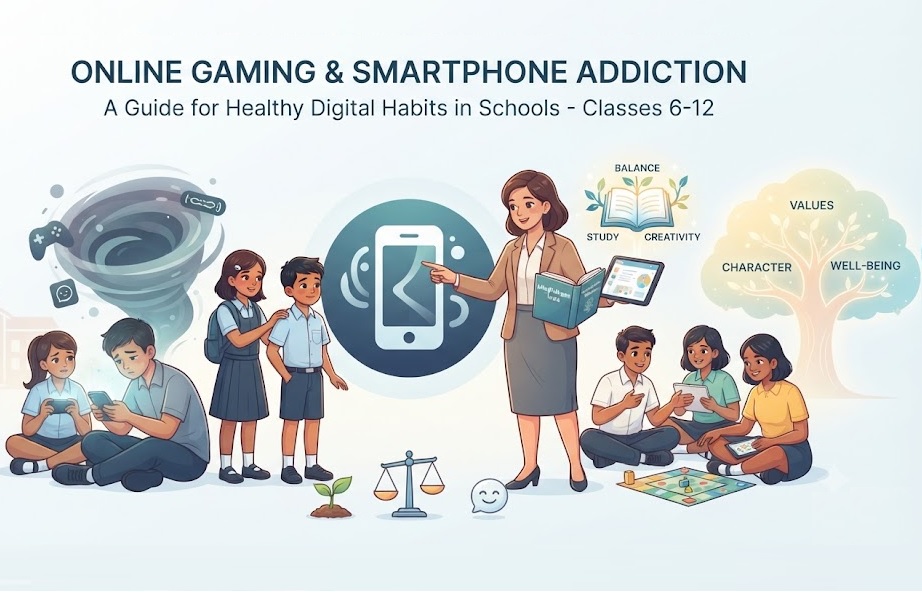
Online Gaming & Smartphone Addiction

Online Gaming & Smartphone Addiction

Technology has changed the way we learn, play, and connect with friends. Smartphones and online games can be fun, educational, and entertaining. They help us stay in touch with family, learn new skills, solve puzzles, and even improve creativity.

But what happens when “just five more minutes” turns into several hours every day?

For many students, excessive gaming and smartphone use can affect studies, sleep, health, friendships, and happiness. The good news is that with the right habits, you can enjoy technology without letting it control your life.

This guide explains everything Class 6 to 12 students, parents, and teachers should know about online gaming and smartphone addiction.

What Is Online Gaming & Smartphone Addiction?

Online gaming or smartphone addiction doesn’t mean you simply enjoy using your phone.

It becomes a problem when you:

    • Cannot stop playing or scrolling.
    • Feel restless or angry without your phone.
    • Ignore homework and studies.
    • Stay awake late every night.
    • Spend less time with family and friends.
    • Think about games or social media all day.

Technology should be a tool that helps you—not something that controls your daily life.

Why Are Online Games So Addictive?

Game developers spend years designing games that keep players interested.

Many games include:

    • Daily rewards
    • Bonus points
    • New levels
    • Special events
    • Leaderboards
    • Unlockable characters
    • Achievement badges
    • Surprise rewards
    • Multiplayer competitions

These features make players want to come back again and again.

That doesn’t mean games are “bad.” It simply means you need to know when to stop.

Why Smartphones Are Hard to Put Down

Smartphones constantly compete for your attention.

Every notification, message, like, or video encourages you to check your phone “just once.”

Soon:

One minute becomes ten.

Ten minutes become an hour.

Before you realize it, half the evening is gone.

Signs of Smartphone or Gaming Addiction

Ask yourself honestly.

Do you:

    • Check your phone immediately after waking up?
    • Spend several hours gaming every day?
    • Feel upset when someone asks you to stop?
    • Skip homework because of games?
    • Lose track of time while scrolling?
    • Think about games even during class?
    • Use your phone during meals?
    • Stay awake late using your phone?

If you answered “Yes” to several questions, it may be time to improve your digital habits.

How Too Much Screen Time Affects Your Health

Eye Problems

Looking at screens for long periods can cause:

    • Dry eyes
    • Blurred vision
    • Eye strain
    • Headaches

Following the 20-20-20 rule can help.

Every 20 minutes, look at something about 20 feet away for 20 seconds.

Poor Sleep

Using phones before bedtime is one of the biggest causes of poor sleep among teenagers.

The bright light from screens can make it harder for your brain to prepare for sleep.

Poor sleep can lead to:

    • Tiredness
    • Poor memory
    • Difficulty concentrating
    • Irritability
    • Lower academic performance

Less Physical Activity

Many students spend hours sitting while gaming.

This means:

    • Less exercise
    • Weight gain
    • Poor posture
    • Neck pain
    • Back pain

Even 30–60 minutes of outdoor play every day can make a big difference.

How Gaming Affects Your Brain

Your brain loves rewards.

Whenever you win a game, unlock a level, or receive points, your brain feels excited.

This is one reason games are so enjoyable.

However, spending too much time chasing these rewards may make it harder to enjoy everyday activities like reading, sports, or family time.

Balance is important.

Effects on Studies

Students who spend excessive time gaming often experience:

    • Poor concentration
    • Incomplete homework
    • Last-minute studying
    • Lower grades
    • Less interest in reading
    • Reduced classroom participation

Remember:

Every hour spent wisely today builds your future tomorrow.

Effects on Mental Health

Excessive smartphone use may increase feelings of:

    • Stress
    • Anxiety
    • Loneliness
    • Irritability
    • Mood swings

Social media can also make students compare themselves with others, leading to lower self-confidence.

Always remember:

People usually share only their best moments online—not their everyday struggles.

Effects on Friendships

Online friends can be enjoyable.

But real-life friendships are different.

Talking face-to-face, playing sports together, laughing, and helping each other create stronger and healthier relationships.

Don’t let screens replace real conversations.

Online Safety Every Student Must Know

Not everyone online is who they claim to be.

Never:

    • Share your home address.
    • Share passwords.
    • Share OTPs.
    • Share school details.
    • Send personal photos to strangers.
    • Meet online friends without informing your parents.

If someone makes you uncomfortable online, block them and tell a trusted adult immediately.

Beware of In-Game Purchases

Many games encourage players to buy:

    • Coins
    • Gems
    • Skins
    • Battle passes
    • Loot boxes
    • Power-ups

These small purchases can quickly become expensive.

Always ask your parents before spending money online.

What Does Science Say?

Research has found that excessive recreational screen time is linked with poorer sleep, reduced physical activity, and difficulties with attention in many children and teenagers.

The World Health Organization (WHO) also recognizes Gaming Disorder as a health condition when gaming becomes so excessive that it causes significant problems in daily life. This applies to a small number of people but highlights the importance of maintaining healthy gaming habits.

How Much Screen Time Is Healthy?

There isn’t one perfect number that suits everyone.

Instead, ask yourself:

    • Am I finishing my homework?
    • Am I sleeping well?
    • Am I exercising?
    • Am I spending time with family?
    • Am I enjoying hobbies beyond my phone?

If the answer is “Yes,” your digital life is likely in good balance.

Healthy Digital Habits Every Student Should Follow

Finish Important Work First

Complete homework before gaming.

It feels much better to play after your responsibilities are finished.

Create Screen-Free Time

Keep your phone away:

    • During meals
    • During study time
    • Before bedtime
    • During family conversations

Small habits make a big difference.

Enjoy Offline Activities

Try:

    • Reading
    • Cricket
    • Football
    • Badminton
    • Cycling
    • Drawing
    • Music
    • Dance
    • Gardening
    • Photography

The real world has many adventures waiting for you.

Sleep on Time

Aim for enough sleep every night.

A well-rested brain learns faster, remembers better, and feels happier.


What Should You Do If a Friend Is Addicted?

Don’t laugh or tease them.

Instead:

    • Talk kindly.
    • Invite them to play outside.
    • Encourage healthy habits.
    • Tell a trusted teacher or parent if you’re worried.

Sometimes a caring friend can make all the difference.

Tips for Parents

Parents can help by:

    • Setting reasonable screen-time rules.
    • Being good role models.
    • Encouraging outdoor games.
    • Having regular family conversations.
    • Keeping phones away during meals.
    • Avoiding punishment-only approaches.
    • Appreciating healthy digital habits.

Support works better than constant criticism.

Tips for Teachers

Teachers can help students by:

    • Discussing digital well-being in class.
    • Encouraging sports and extracurricular activities.
    • Teaching cyber safety.
    • Recognizing warning signs early.
    • Working closely with parents.
    • Creating awareness without fear.

Schools play an important role in helping students develop responsible digital habits.

Frequently Asked Questions (FAQs)

Is online gaming always bad?

No. Many games improve problem-solving, teamwork, creativity, and strategic thinking. Problems arise only when gaming begins affecting studies, sleep, health, or relationships.

How do I know if I use my phone too much?

If you cannot stop using it, neglect important responsibilities, or feel anxious without it, it’s time to reassess your habits.

Can smartphone addiction be reduced?

Yes. Setting time limits, keeping phones away during study and sleep, spending time outdoors, and enjoying offline hobbies can all help.

Should parents ban gaming completely?

Usually no. A balanced approach with clear rules, open communication, and age-appropriate limits is more effective than a complete ban.

My Thoughts

Technology is one of the greatest inventions of our time. It helps us learn, explore, communicate, and create. But like any powerful tool, it should be used wisely.

Your phone is meant to help you achieve your dreams—not distract you from them.

So the next time you pick up your phone, ask yourself one simple question:

“Am I using my phone… or is my phone using me?”

Remember this simple message:

Play games. Learn new things. Stay connected. But never let a screen become more important than your health, family, friends, and future.

Related Topics

Bullying & Cyberbullying

Smoking, Vaping, Alcohol & Drugs

Mental Health, Anxiety & Depression

Internet Safety & Social Media Safety

Self-Esteem, Confidence & Body Image

Exam Stress & Time Management

Peer Pressure

Respect, Kindness & Inclusion

Managing Anger & Emotions

About the Author

Nidhi Mehta is the founder of IndiaTutor.in and a professional online educator with over 11 years of teaching experience. She specializes in tutoring Classes 1 to 6 across core academic subjects, with a strong focus on concept clarity and foundational skill-building. Her teaching approach is based on personalized, one-to-one learning that helps students develop long-term academic confidence and understanding.
Visit her profile    Visit About Us Page

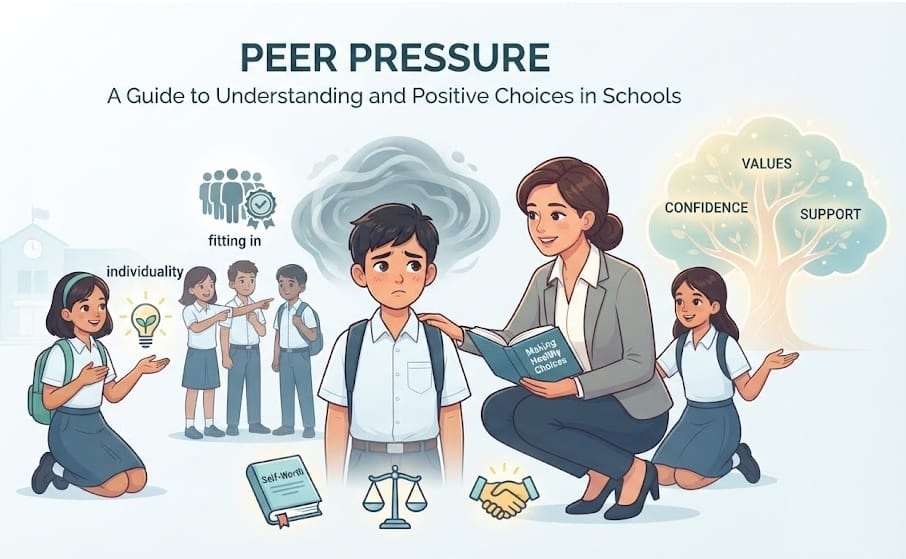
Peer Pressure

Peer Pressure

Peer pressure is a part of growing up. Every child and teenager wants to feel accepted by friends and classmates. While friendships can encourage learning, kindness, and confidence, they can also influence students to make choices they may not truly want to make. Understanding peer pressure helps students, parents, and teachers recognize its effects and respond in healthy ways.

Whether it is trying a harmful habit, dressing a certain way, or joining positive activities, peer pressure shapes many decisions during school years. Learning how to deal with it is an important life skill.

What Is Peer Pressure?

Peer pressure is the influence that people of the same age or social group have on one another. It can encourage someone to change their thoughts, behavior, or decisions to fit in with friends.

This influence is not always negative. Friends can inspire each other to study harder, participate in sports, volunteer, or develop good habits. Problems arise when students feel forced to do something that goes against their values or better judgment.

Why Is Peer Pressure So Powerful?

Children and teenagers naturally want to belong. Feeling accepted by classmates makes them feel safe and valued.

Researchers have found that adolescence is a period when the brain is still developing, especially the areas responsible for decision-making and self-control. At the same time, the brain becomes more sensitive to rewards and social approval. This combination makes teenagers more likely to be influenced by friends than adults.

According to the American Psychological Association, adolescents often place a high value on peer acceptance, making them more likely to adjust their behavior to match their social group.

Types of Peer Pressure

Positive Peer Pressure

Positive peer pressure encourages students to make better choices.

Examples include:

    • Joining a reading club.
    • Participating in sports.
    • Studying together before exams.
    • Helping classmates with homework.
    • Staying away from harmful habits.
    • Volunteering for community service.

Positive friendships help students build confidence, discipline, and leadership skills.

Negative Peer Pressure

Negative peer pressure pushes students toward unhealthy or risky behavior.

Examples include:

    • Cheating during examinations.
    • Skipping classes.
    • Bullying others.
    • Smoking or vaping.
    • Trying alcohol or drugs.
    • Spending excessive time on social media.
    • Taking dangerous online challenges.

Students often know these actions are wrong but may still participate because they fear rejection.

Direct and Indirect Peer Pressure

Direct Peer Pressure

This happens when someone openly asks or forces another person to do something.

Example:

“Everyone is doing it. Why aren’t you?”

Indirect Peer Pressure

Sometimes nobody says anything directly. Students simply observe what others are doing and feel they should behave the same way.

Example:

A student buys an expensive phone because many classmates own one, even though they never wanted it.

Common Situations Where Students Experience Peer Pressure

In School

Students may feel pressured to:

    • Score higher marks.
    • Join particular friend groups.
    • Wear fashionable clothes.
    • Participate in trends.
    • Cheat during exams.

Online

Social media has increased peer pressure significantly.

Students compare themselves with carefully edited photos and videos, leading to unrealistic expectations.

Common online pressures include:

    • Posting frequently.
    • Getting more followers.
    • Receiving likes and comments.
    • Participating in viral challenges.
    • Looking perfect in photographs.

A 2023 advisory from the U.S. Surgeon General highlighted growing concerns about the impact of excessive social media use on young people’s mental health.

Signs That a Student Is Facing Peer Pressure

Parents and teachers should watch for changes such as:

    • Sudden mood swings.
    • New friend groups.
    • Loss of confidence.
    • Anxiety before school.
    • Secretive behavior.
    • Declining academic performance.
    • Unexplained spending.
    • Changes in clothing or appearance.
    • Avoiding family conversations.

One sign alone does not always indicate peer pressure, but several changes together deserve attention.

How Peer Pressure Affects Students

Academic Performance

Students distracted by unhealthy friendships may lose interest in studies.

They may:

    • Miss assignments.
    • Skip classes.
    • Lose concentration.
    • Perform poorly in examinations.

Mental Health

Constant pressure to fit in can lead to:

    • Stress.
    • Anxiety.
    • Low self-esteem.
    • Loneliness.
    • Depression.

Physical Health

Negative peer pressure sometimes results in:

    • Lack of sleep.
    • Poor eating habits.
    • Substance use.
    • Risk-taking behavior.

Decision-Making

Students may stop making independent choices and simply follow others.

Over time, this weakens confidence and personal responsibility.

Real-Life Examples

Example 1

A student refuses to cheat during an exam even when classmates encourage it. Although teased initially, the student earns respect from teachers and develops self-confidence.

Example 2

A group of friends decides to prepare together for board examinations. Their shared discipline improves everyone’s performance.

Example 3

A teenager joins an online challenge simply because classmates are participating. The activity becomes dangerous and results in injury. This shows how online trends can become harmful when students stop thinking independently.

Why Some Students Are More Vulnerable

Several factors increase the likelihood of being influenced by peers.

Low Self-Confidence

Students who doubt themselves often seek approval from others.

Desire to Belong

Being accepted feels important during adolescence.

Fear of Missing Out

Also known as FOMO, this fear encourages students to follow trends even when they disagree with them.

Lack of Family Communication

Students who cannot openly discuss problems at home may depend more heavily on friends for guidance.

How Students Can Handle Peer Pressure

Learn to Say No

Saying “No” politely but confidently is an important life skill.

Simple responses include:

    • “I’m not comfortable doing that.”
    • “That’s not for me.”
    • “I’ll pass.”

Confidence grows with practice.

Choose Friends Carefully

Good friends:

    • Respect boundaries.
    • Encourage learning.
    • Celebrate achievements.
    • Support positive decisions.

Healthy friendships reduce harmful pressure.

Think Before Acting

Students should ask themselves:

    • Is this safe?
    • Is it legal?
    • Would my parents approve?
    • Could this affect my future?
    • Am I doing this because I truly want to?

These questions often prevent poor decisions.

Build Confidence

Students who believe in themselves are less likely to be influenced negatively.

Confidence develops through:

    • Sports.
    • Music.
    • Reading.
    • Public speaking.
    • Learning new skills.
    • Volunteering.

How Parents Can Help

Parents play a major role in reducing the effects of peer pressure.

Keep Communication Open

Talk daily without judging or criticizing.

Children are more likely to share problems when they feel heard.

Know Their Friends

Invite friends home and understand who your child spends time with.

Encourage Independent Thinking

Teach children that they do not need everyone’s approval.

Set Clear Expectations

Explain family values regarding honesty, respect, safety, and responsibility.

How Teachers Can Support Students

Schools have an important role in creating a positive environment.

Teachers can:

    • Encourage teamwork.
    • Recognize kindness.
    • Discuss peer pressure during classroom activities.
    • Promote anti-bullying programs.
    • Help students develop leadership skills.
    • Create opportunities for every child to participate.

Students who feel included are less likely to seek acceptance through unhealthy behavior.

Interesting Facts About Peer Pressure

Social Influence Begins Early

Children begin responding to peer influence in primary school, and it becomes stronger during adolescence.

Positive Friends Improve Results

Several educational studies show that students surrounded by motivated classmates often perform better academically because positive attitudes spread through social groups.

Peer Pressure Is Lifelong

Adults also experience peer pressure at work, in social circles, and online. Learning healthy decision-making during school helps throughout life.

Building Positive Peer Influence

Students can become role models by:

    • Including lonely classmates.
    • Standing against bullying.
    • Encouraging honest behavior.
    • Appreciating differences.
    • Supporting friends during difficult times.
    • Celebrating effort instead of popularity.

One confident student can influence an entire group in a positive direction.

Frequently Asked Questions

Is peer pressure always harmful?

No. Positive peer pressure encourages healthy habits, learning, teamwork, and responsible behavior.

At what age does peer pressure become stronger?

It usually becomes more noticeable during middle school and continues throughout the teenage years.

Can parents completely prevent peer pressure?

No, but strong communication, trust, and guidance greatly reduce its harmful effects.

Does social media increase peer pressure?

Yes. Constant comparison, online trends, and the desire for approval can increase pressure, especially among teenagers.

My Thoughts

Peer pressure is a normal part of growing up, but students should never feel that they must change who they are to gain acceptance. Strong values, supportive families, caring teachers, and positive friendships help young people make wise decisions even when faced with difficult situations.

The goal is not to avoid friendships but to build relationships that encourage honesty, kindness, confidence, and personal growth. When students learn to think independently and respect themselves, they become better prepared for school, college, careers, and life.

Related Topics

Bullying & Cyberbullying

Smoking, Vaping, Alcohol & Drugs

Mental Health, Anxiety & Depression

Internet Safety & Social Media Safety

Self-Esteem, Confidence & Body Image

Exam Stress & Time Management

Respect, Kindness & Inclusion

Online Gaming & Smartphone Addiction 

Managing Anger & Emotions

About the Author

Nidhi Mehta is the founder of IndiaTutor.in and a professional online educator with over 11 years of teaching experience. She specializes in tutoring Classes 1 to 6 across core academic subjects, with a strong focus on concept clarity and foundational skill-building. Her teaching approach is based on personalized, one-to-one learning that helps students develop long-term academic confidence and understanding.
Visit her profile    Visit About Us Page

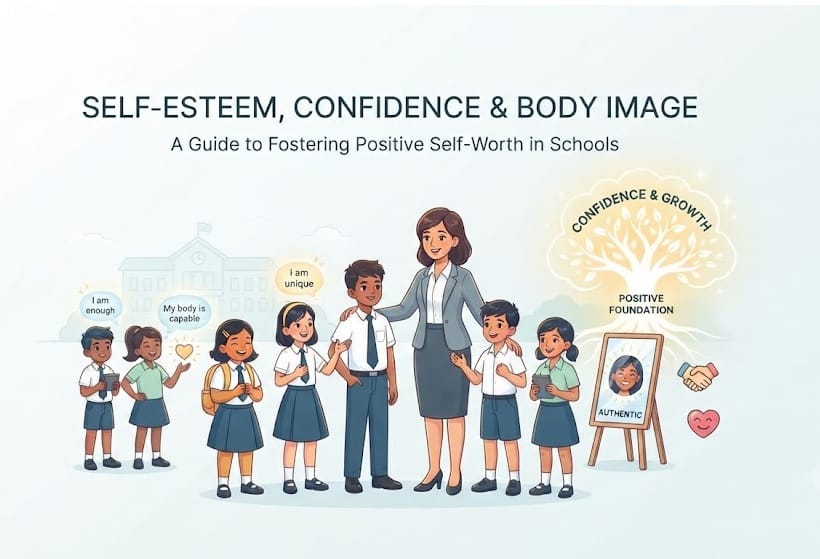
Self-Esteem, Confidence & Body Image

Self-Esteem, Confidence & Body Image

Every child deserves to feel good about who they are. Healthy self-esteem, genuine confidence, and a positive body image play a major role in academic success, friendships, emotional well-being, and future happiness. Unfortunately, many school students struggle with self-doubt, unrealistic beauty standards, peer pressure, and constant comparison through social media.

The encouraging news is that self-esteem and confidence are not fixed traits. They are skills that can be developed with support, encouragement, and healthy habits. Parents, teachers, and schools all have an important role in helping children appreciate themselves for who they are rather than how they look or how they compare with others.

What Is Self-Esteem?

Self-esteem is how a person feels about themselves. It is the opinion someone has about their own abilities, character, and worth.

A student with healthy self-esteem usually:

    • Believes they can learn from mistakes.
    • Accepts compliments comfortably.
    • Tries new activities without excessive fear.
    • Respects themselves and others.
    • Handles setbacks without giving up.

A student with low self-esteem may:

    • Think they are “not good enough.”
    • Fear failure constantly.
    • Avoid participating in class.
    • Compare themselves with everyone else.
    • Feel discouraged after small mistakes.

Healthy self-esteem does not mean believing you are better than others. It means recognizing your strengths while accepting that everyone has areas where they can improve.

What Is Confidence?

Confidence is the belief that you can successfully complete a task or overcome a challenge.

Confidence grows through experience. Every time students solve a difficult problem, deliver a presentation, play a sport, or learn a new skill, their confidence increases.

Confidence is not about never feeling nervous. Even successful athletes, scientists, artists, and public speakers feel anxious before important events. The difference is that they continue despite their fear.

Self-Esteem and Confidence Are Different

Although they are connected, they are not the same.

    • Self-esteem is how you value yourself.
    • Confidence is believing you can do something.

A student may feel confident in mathematics but insecure about making new friends. Another student may have excellent self-esteem but lack confidence in public speaking.

Both can improve over time.

Understanding Body Image

Body image is how people think and feel about their physical appearance.

A positive body image means appreciating your body for what it can do rather than judging it only by appearance.

Body image includes:

    • Height
    • Weight
    • Skin colour
    • Hair
    • Body shape
    • Facial features
    • Physical abilities

Every person’s body is unique. There is no single “perfect” appearance.

Why Body Image Matters

Children begin noticing physical differences from a young age. As they grow older, advertisements, movies, influencers, and social media often create unrealistic expectations.

Many online images are carefully edited using filters, lighting, makeup, and photo editing software. Comparing yourself with these unrealistic images can lead to disappointment and low confidence.

According to the World Health Organization (WHO), adolescence is a critical stage for developing lifelong mental and emotional health. Positive self-image during these years contributes to better well-being and healthier relationships.

Research from organizations such as the American Psychological Association has also shown that excessive social comparison, particularly through social media, can negatively affect self-esteem in teenagers.

Common Causes of Low Self-Esteem

Academic Pressure

Constant concern about marks, examinations, and competition may make students believe their value depends only on grades.

Bullying

Name-calling, teasing, exclusion, or cyberbullying can seriously damage confidence.

Social Media

Students often compare their everyday lives with carefully edited online content.

Family Expectations

Supportive families motivate children, but unrealistic expectations may create unnecessary pressure.

Physical Changes During Puberty

Rapid physical development during adolescence can make students feel uncomfortable or self-conscious.

Comparing with Others

Everyone develops different talents at different speeds. Constant comparison usually reduces motivation rather than increasing it.

Signs That a Student May Need Support

Parents and teachers should notice changes such as:

    • Frequently saying “I’m useless.”
    • Avoiding mirrors or photographs.
    • Refusing to participate in activities.
    • Giving up easily.
    • Constantly seeking approval.
    • Becoming unusually quiet.
    • Feeling embarrassed about appearance.
    • Avoiding school or social situations.

Early support can prevent these feelings from becoming more serious.

Building Healthy Self-Esteem

Celebrate Effort, Not Just Results

Praise hard work, improvement, and determination instead of focusing only on marks.

Instead of saying, “You got full marks.”

Try saying, “You worked consistently and your effort paid off.”

Accept Mistakes

Mistakes help people learn.

Thomas Edison reportedly tested thousands of ideas before successfully developing the practical electric light bulb. Success often follows persistence.

Encourage Independence

Allow children to solve age-appropriate problems themselves.

Small achievements build lasting confidence.

Set Realistic Goals

Large goals become easier when divided into smaller steps.

Completing each step creates motivation and confidence.

Developing Real Confidence

Learn New Skills

Confidence increases when students experience progress.

Examples include:

    • Reading regularly
    • Playing a musical instrument
    • Learning coding
    • Drawing
    • Public speaking
    • Sports
    • Science projects

Practice Positive Self-Talk

Replace negative thoughts with realistic ones.

Instead of:

“I always fail.”

Try:

“I didn’t do well this time, but I can improve.”

Prepare Well

Preparation reduces fear.

Students who revise regularly usually feel more confident during examinations than those who rely on last-minute studying.

Building a Positive Body Image

Appreciate What Your Body Can Do

Instead of focusing only on appearance, appreciate your body’s abilities.

Your body helps you:

    • Walk
    • Run
    • Dance
    • Play sports
    • Learn
    • Create
    • Explore the world

Avoid Appearance-Based Comparisons

Beauty standards change across cultures and over time.

Kindness, honesty, intelligence, creativity, and determination remain valuable throughout life.

Choose Healthy Habits

Good health supports both physical and emotional well-being.

Healthy habits include:

    • Nutritious food
    • Regular exercise
    • Adequate sleep
    • Drinking enough water
    • Limiting excessive screen time

How Parents Can Help

Parents influence children’s self-esteem every day.

Helpful habits include:

Listen Without Judging

Children should feel comfortable discussing worries without fear of criticism.

Encourage Interests

Support hobbies that genuinely interest the child instead of forcing activities.

Avoid Negative Labels

Words such as “lazy,” “stupid,” or “failure” can stay with children for years.

Instead, focus on behaviour that can improve.

Be a Positive Role Model

Children observe how adults talk about themselves.

Avoid constantly criticizing your own appearance or abilities.

How Teachers Can Build Confidence

Teachers shape students’ beliefs about themselves.

Effective approaches include:

Give Constructive Feedback

Highlight strengths while suggesting improvements.

Encourage Participation

Invite quieter students to contribute in supportive ways.

Recognize Different Talents

Not every child excels academically.

Some students shine in music, sports, leadership, art, technology, or kindness.

Prevent Bullying

Schools should maintain safe environments where every student feels respected.

Helping Students Handle Social Media

Students should remember:

    • Most online photos are carefully selected.
    • Filters and editing are common.
    • Likes do not measure personal worth.
    • Real life is different from social media.

Spending more time with family, friends, sports, books, and outdoor activities often improves emotional well-being.

When Professional Help May Be Needed

Sometimes low self-esteem becomes more serious.

Parents should consider speaking with a qualified mental health professional if a child:

    • Appears sad for several weeks.
    • Withdraws from friends and family.
    • Experiences severe anxiety.
    • Stops enjoying favourite activities.
    • Shows major changes in eating or sleeping habits.
    • Talks about hopelessness or self-harm.

Early intervention can make a significant difference.

Everyday Habits That Build Confidence

Students can strengthen self-esteem by:

    • Learning something new every week.
    • Reading daily.
    • Exercising regularly.
    • Speaking kindly to themselves.
    • Helping others.
    • Practising gratitude.
    • Limiting unhealthy comparisons.
    • Celebrating small achievements.
    • Asking questions in class.
    • Trying again after setbacks.

Small positive actions repeated consistently create lasting confidence.

My Thoughts

Every student has unique strengths, talents, and potential. Confidence does not come from looking perfect or being better than everyone else. It grows through learning, persistence, healthy relationships, and believing that mistakes are opportunities to improve.

Parents and teachers can make a lifelong difference by encouraging effort, respecting individuality, celebrating progress, and creating supportive environments where children feel valued.

When students develop healthy self-esteem, genuine confidence, and a positive body image, they are more likely to enjoy learning, build stronger friendships, overcome challenges, and grow into resilient, compassionate, and successful adults.

Related Topics

Bullying & Cyberbullying

Smoking, Vaping, Alcohol & Drugs

Mental Health, Anxiety & Depression

Internet Safety & Social Media Safety

Exam Stress & Time Management

Peer Pressure

Respect, Kindness & Inclusion

Online Gaming & Smartphone Addiction 

Managing Anger & Emotions

About the Author

Nidhi Mehta is the founder of IndiaTutor.in and a professional online educator with over 11 years of teaching experience. She specializes in tutoring Classes 1 to 6 across core academic subjects, with a strong focus on concept clarity and foundational skill-building. Her teaching approach is based on personalized, one-to-one learning that helps students develop long-term academic confidence and understanding.

Visit her profile    Visit About Us Page

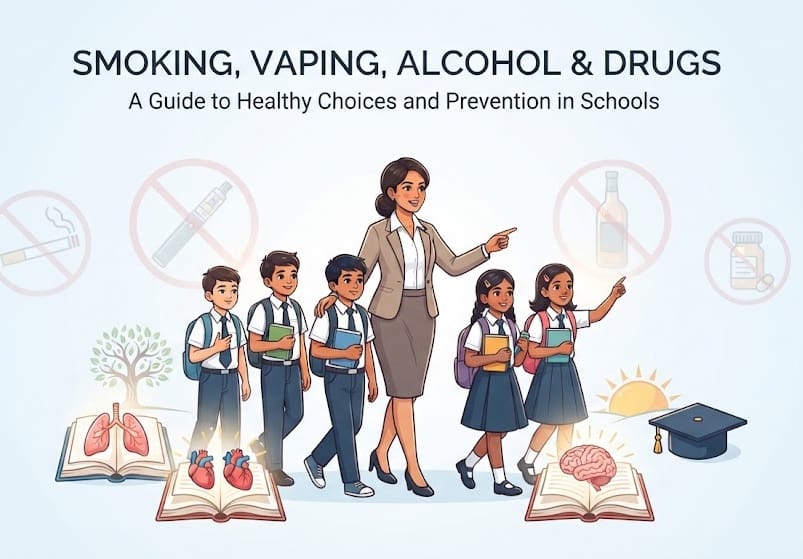
Smoking, Vaping, Alcohol & Drugs

Smoking, Vaping, Alcohol & Drugs

Young people today face many challenges while growing up. Along with academic pressure and social media influence, they may also come across cigarettes, e-cigarettes (vapes), alcohol, and illegal drugs. Curiosity, peer pressure, stress, and the desire to fit in can sometimes lead students to make choices that affect their health, education, and future.

The good news is that awareness and timely guidance can prevent most cases of substance use. This guide explains the dangers of smoking, vaping, alcohol, and drugs in simple language, helping students, parents, and teachers understand the risks and make informed decisions.

Why Students Experiment with Smoking, Vaping, Alcohol or Drugs

Most teenagers do not begin because they want to become addicted. Instead, they often start due to one or more of these reasons:

    • Curiosity
    • Friends encouraging them
    • Wanting to appear mature
    • Managing stress or anxiety
    • Social media influence
    • Celebrity culture
    • Lack of awareness about long-term consequences
    • Easy availability in some places

Research shows that the teenage brain is still developing until the mid-twenties. During this period, harmful substances can interfere with learning, decision-making, emotional control, and memory.

Understanding the Different Types

Smoking

Smoking involves burning tobacco and inhaling its smoke through cigarettes, bidis, cigars, or similar products.

Tobacco smoke contains more than 7,000 chemicals, including at least 70 known cancer-causing substances. According to the World Health Organization (WHO), tobacco kills more than 8 million people every year, including around 1.3 million deaths from second-hand smoke.

Vaping

Vaping uses electronic devices that heat a liquid into an aerosol. Many people mistakenly believe vaping is harmless because there is no burning tobacco.

However, vaping liquids often contain nicotine, heavy metals, chemicals, and flavoring agents that may harm the lungs and developing brain.

Nicotine addiction can develop quickly in teenagers.

Alcohol

Alcohol slows brain activity and affects judgment, balance, concentration, and reaction time.

Even occasional drinking during adolescence increases the risk of accidents, injuries, risky behaviour, and future alcohol dependence.

Illegal Drugs

Illegal drugs include substances such as cannabis, cocaine, heroin, methamphetamine, LSD, MDMA, and several synthetic drugs.

Some prescription medicines are also abused without medical supervision.

Different drugs affect the brain in different ways, but all carry serious physical and psychological risks.

How Smoking and Vaping Affect the Body

Damage to the Lungs

Smoking damages the tiny air sacs inside the lungs, making breathing difficult.

Students who smoke may experience:

    • Frequent cough
    • Breathlessness
    • Reduced sports performance
    • Chest infections
    • Long-term lung disease

Vaping has also been linked to serious lung injuries in some users.

Effects on the Brain

Nicotine changes the brain’s reward system.

Young users may develop:

    • Strong cravings
    • Poor concentration
    • Irritability
    • Mood swings
    • Difficulty quitting

Increased Risk of Cancer

Smoking significantly increases the risk of cancers affecting the lungs, mouth, throat, bladder, pancreas, and several other organs.

The earlier someone starts smoking, the greater the lifetime risk.

How Alcohol Affects Teenagers

Teenagers are more sensitive to alcohol than adults because their brains are still developing.

Possible consequences include:

    • Poor academic performance
    • Road accidents
    • Violence
    • Unsafe decisions
    • Memory loss
    • Depression
    • Increased risk-taking

Studies also suggest that early alcohol use is associated with a higher likelihood of addiction later in life.

Drug Abuse and Its Consequences

Drug use affects nearly every part of life.

Physical Health

Drug misuse can cause:

    • Heart problems
    • Breathing difficulties
    • Poor nutrition
    • Sleep disorders
    • Seizures
    • Overdose

Mental Health

Many substances increase the risk of:

    • Anxiety
    • Depression
    • Panic attacks
    • Hallucinations
    • Aggressive behaviour
    • Suicidal thoughts

Academic Performance

Students using addictive substances often experience:

    • Falling grades
    • Poor attendance
    • Lack of concentration
    • Missed assignments
    • Loss of motivation

Warning Signs Parents and Teachers Should Notice

Early detection can make a significant difference.

Common warning signs include:

Behavioural Changes

    • Sudden mood swings
    • Secretive behaviour
    • New friend groups
    • Loss of interest in hobbies
    • Frequent lying

Academic Changes

    • Declining marks
    • Skipping classes
    • Poor concentration
    • Increased disciplinary issues

Physical Signs

    • Red eyes
    • Persistent cough
    • Unusual smell on clothes
    • Weight loss
    • Frequent illness
    • Slurred speech

None of these signs alone proves substance use, but several occurring together deserve attention and supportive conversation.

The Role of Peer Pressure

Peer pressure is one of the biggest reasons students try harmful substances.

A friend may say:

    • “Everyone is doing it.”
    • “Try it just once.”
    • “Don’t be scared.”
    • “You’ll look cool.”

Students should remember that true friends respect personal choices.

Learning to politely refuse can prevent lifelong problems.

Simple responses include:

    • “No thanks.”
    • “I’m training for sports.”
    • “My parents would find out.”
    • “It’s not worth risking my health.”

Social Media and Online Influence

Many videos and advertisements make vaping or drinking appear fashionable.

However, these posts rarely show:

    • Addiction
    • Hospital visits
    • Health complications
    • Family stress
    • Financial loss
    • Legal consequences

Students should think critically before believing everything they see online.

What Schools Can Do

Schools play a major role in prevention.

Effective strategies include:

Awareness Programmes

Regular sessions help students understand real risks rather than relying on myths.

Counselling Support

Students facing stress should have access to trusted counsellors.

Positive Activities

Sports, music, debates, theatre, and clubs encourage healthy lifestyles.

Parent Involvement

Schools and parents working together create stronger protection for children.

How Parents Can Help

Parents do not need to wait until a problem develops.

Helpful steps include:

    • Talk openly without judging.
    • Listen carefully.
    • Know your child’s friends.
    • Encourage healthy hobbies.
    • Set clear family expectations.
    • Be a positive role model.
    • Celebrate achievements.

Children who feel emotionally supported are generally less likely to engage in risky behaviours.

If a Student Has Already Started

Do not panic.

Recovery is possible with early support.

Avoid punishment alone.

Instead:

    • Stay calm.
    • Have an honest conversation.
    • Seek professional guidance.
    • Inform the school if necessary.
    • Build a supportive environment.
    • Encourage healthier routines.

The sooner help begins, the better the outcome.

Important Facts Every Student Should Know

    • WHO estimates tobacco causes more than 8 million deaths every year worldwide.
    • About 1.3 million of these deaths occur among non-smokers exposed to second-hand smoke.
    • Most adult smokers begin before the age of 18.
    • The adolescent brain continues developing until around the mid-twenties, making teenagers especially vulnerable to addiction.
    • Nicotine can affect attention, learning, memory, and impulse control.
    • Early alcohol and drug use is linked with higher risks of dependence later in life.

Healthy Alternatives to Stress

Students can manage stress in healthier ways.

Try:

    • Regular exercise
    • Reading
    • Meditation
    • Deep breathing
    • Music
    • Drawing
    • Talking to family
    • Spending time outdoors
    • Joining school clubs
    • Seeking counselling when needed

Healthy habits improve both mental health and academic performance.

Frequently Asked Questions

Is vaping safer than smoking?

Vaping may expose users to fewer toxic substances than traditional cigarettes, but it is not harmless. Many vaping products contain nicotine and chemicals that can damage health, especially in young people.

Can someone become addicted after only a few uses?

Yes. Teenagers can develop nicotine dependence quickly because their brains are still developing.

Does alcohol improve confidence?

Alcohol may temporarily reduce inhibitions, but it also weakens judgment and increases risky behaviour.

What should students do if friends offer cigarettes or drugs?

Say no confidently, leave the situation if necessary, and seek support from trusted adults if the pressure continues.

My Thoughts

Smoking, vaping, alcohol, and drug use can have lasting effects on physical health, mental well-being, education, relationships, and future opportunities. The best protection is knowledge, supportive families, caring schools, and informed decision-making.

Students should remember that real confidence comes from making healthy choices, not from following harmful trends. Parents and teachers can make an enormous difference by listening, guiding, and creating an environment where young people feel safe asking for help.

Every positive choice made today helps build a healthier, brighter future tomorrow.

Related Topics

Bullying & Cyberbullying

Mental Health, Anxiety & Depression

Internet Safety & Social Media Safety

Self-Esteem, Confidence & Body Image

Exam Stress & Time Management

Peer Pressure

Respect, Kindness & Inclusion

Online Gaming & Smartphone Addiction 

Managing Anger & Emotions

About the Author

Nidhi Mehta is the founder of IndiaTutor.in and a professional online educator with over 11 years of teaching experience. She specializes in tutoring Classes 1 to 6 across core academic subjects, with a strong focus on concept clarity and foundational skill-building. Her teaching approach is based on personalized, one-to-one learning that helps students develop long-term academic confidence and understanding.

Visit her profile    Visit About Us Page

How to Develop Interest in Science from an Early Age

How to Develop Interest in Science from an Early Age

Science is one of the most important subjects children study during their school years. It helps them understand the world around them, ask meaningful questions, solve problems, and develop logical thinking. However, many children begin to see science as difficult, confusing, or boring as they progress through school. This often happens when learning becomes focused on memorization rather than curiosity and exploration.

Developing an interest in science from an early age can make a significant difference in a child’s academic performance and confidence. Children who enjoy science are more likely to stay engaged in learning, perform better in examinations, and develop valuable life skills that extend beyond the classroom.

Recent research published by the Organisation for Economic Co-operation and Development (OECD) shows that students who express curiosity about scientific topics tend to achieve higher academic outcomes compared to those who learn only for examinations. Studies also suggest that children begin forming attitudes toward science as early as primary school, making early exposure especially important.

Why Early Interest in Science Matters

Science is not just a school subject. It influences how children think, observe, analyze, and make decisions.

Children who develop scientific curiosity early often:

    • Ask more questions about the world around them
    • Become better problem-solvers
    • Improve observation skills
    • Develop stronger reasoning abilities
    • Build confidence in learning new concepts
    • Perform better in STEM-related subjects

According to UNESCO, careers related to science, technology, engineering, and mathematics continue to grow globally. Building a strong foundation during childhood can help students prepare for future educational and career opportunities.

Why Practical Understanding Is Important in Science

Understanding Why Some Children Lose Interest in Science

Before helping children develop interest, it is important to understand what causes disengagement.

Excessive Focus on Memorization

Many students associate science with lengthy definitions, diagrams, and textbook content. When learning becomes focused solely on remembering facts, curiosity often disappears.

Lack of Real-Life Connections

Children learn best when they can connect concepts to everyday experiences. If they cannot see how science applies to their lives, lessons may feel irrelevant.

Fear of Making Mistakes

Some students become hesitant to participate because they worry about giving incorrect answers. Science learning should encourage exploration rather than perfection.

Limited Hands-On Experiences

Scientific understanding grows through observation and experimentation. Without practical exposure, concepts may feel abstract and difficult to understand.

Why Science Marks Drop in Middle School and High School

Encourage Curiosity Every Day

Curiosity is the foundation of scientific thinking.

Parents can encourage curiosity by welcoming questions and discussing possible answers together.

Instead of immediately providing solutions, ask questions such as:

      • Why do you think that happened?
      • What do you notice?
      • What might happen if we change something?

These conversations teach children how scientists think and investigate.

Make Everyday Activities Scientific

Science is present everywhere.

Simple daily activities can become learning opportunities:

    • Cooking teaches chemistry and measurements
    • Gardening introduces plant biology
    • Weather observations explain environmental science
    • Household repairs demonstrate physics concepts

Children often become more interested when they discover that science exists beyond textbooks.

Create a Science-Friendly Environment at Home

A child’s surroundings can influence learning habits significantly.

Provide Science Books and Resources

Age-appropriate science books, magazines, and educational videos can spark interest in various topics.

Children who regularly engage with science-related content are exposed to new ideas and discoveries that may inspire further learning.

Encourage Observation

Observation is one of the most important scientific skills.

Ask children to:

    • Observe birds and insects
    • Track weather patterns
    • Notice changes in plants
    • Compare objects around them

Keeping a simple observation journal can make learning more engaging.

How to Build Strong Science Fundamentals From an Early Age

Use Experiments to Make Learning Fun

Hands-on experiences make science memorable.

Research from the National Science Teaching Association indicates that practical activities improve understanding and retention compared to passive learning methods.

Simple Home Experiments

Children do not need expensive equipment to enjoy science.

Safe activities may include:

    • Growing seeds in different conditions
    • Creating simple volcano models
    • Testing which objects float or sink
    • Exploring magnetism
    • Observing water evaporation

Experiments help transform scientific theories into real experiences.

Focus on Exploration Rather Than Results

The goal is not to achieve perfect outcomes.

Encourage children to discuss observations, predictions, and explanations. This process develops analytical thinking and scientific reasoning.

Connect Science to Your Child’s Interests

Every child has unique interests.

Science can be linked to hobbies and passions.

Examples include:

    • Sports enthusiasts can learn about motion and energy
    • Animal lovers can explore biology and ecosystems
    • Technology enthusiasts can study electronics and robotics
    • Space fans can discover astronomy

When science aligns with existing interests, motivation often increases naturally.

Use Modern Learning Tools

Technology has transformed science education.

Interactive resources provide engaging ways to explore complex concepts.

Educational Apps and Simulations

Many digital platforms allow students to:

    • Explore virtual laboratories
    • Conduct simulations
    • Visualize scientific processes
    • Practice problem-solving

Research shows that interactive learning tools can improve engagement and concept retention when used appropriately.

Educational Videos

Short visual explanations often help students understand topics more effectively than lengthy textbook descriptions.

Animations can simplify difficult concepts such as:

    • Human body systems
    • Chemical reactions
    • Planetary motion
    • Electricity

How to Score Better Marks in Science Without Studying Longer Hours  

Encourage Questions Instead of Providing Immediate Answers

Scientific thinking begins with questioning.

Children should feel comfortable asking:

    • Why?
    • How?
    • What if?
    • What happens next?

Rather than providing immediate solutions, guide them toward discovering answers independently.

This approach strengthens critical thinking and promotes lifelong learning habits.

Celebrate Scientific Thinking

Children respond positively to encouragement.

Recognize efforts such as:

    • Asking thoughtful questions
    • Completing experiments
    • Making observations
    • Solving science problems

Praise focused on effort and curiosity can increase motivation more effectively than praise focused solely on marks.

Help Children Learn From Mistakes

Scientific discoveries often emerge from trial and error.

Children should understand that mistakes are part of learning.

When experiments fail or answers are incorrect, encourage discussion about what can be learned from the experience.

This mindset builds resilience and confidence.

Make Science Discussions Part of Daily Life

Interesting conversations can strengthen scientific awareness.

Topics may include:

    • New inventions
    • Space missions
    • Environmental issues
    • Medical discoveries
    • Wildlife conservation

Recent surveys indicate that students who regularly discuss science topics with family members tend to show greater interest and confidence in the subject.

Visit Science Museums and Learning Centers

Educational outings provide valuable exposure.

Museums, planetariums, science exhibitions, and nature parks allow children to experience concepts in an engaging environment.

These experiences often leave lasting impressions and inspire further exploration.

10 Best Ways to Memorize Scientific Terms and Definitions

Build Strong Foundations Before Focusing on Marks

Many parents become concerned primarily about examination performance.

While academic achievement is important, genuine understanding should come first.

Children who develop conceptual clarity during primary and middle school often perform better in higher classes because they understand principles rather than memorizing information.

A strong foundation reduces future learning difficulties and builds long-term confidence.

The Role of Parents in Developing Scientific Interest

Parents play a critical role in shaping attitudes toward learning.

Children are more likely to value science when parents:

    • Show enthusiasm for learning
    • Encourage questions
    • Support exploration
    • Avoid excessive academic pressure
    • Provide opportunities for discovery

Small daily interactions often have a greater impact than expensive educational resources.

My Thoughts

Developing interest in science from an early age is not about creating future scientists. It is about helping children become curious, confident, and capable learners. By encouraging questions, connecting concepts to real life, providing hands-on experiences, and supporting exploration, parents can create a positive relationship with science that lasts for years.

For students who need additional guidance, private online science tuition can provide personalized support tailored to individual learning styles. An experienced tutor can simplify complex topics, strengthen conceptual understanding, identify learning gaps, and build confidence through one-on-one attention. Online tuition also offers flexibility, interactive learning methods, and consistent academic support that helps students develop both interest and success in science.

Looking for expert Science tutors?

Find Science Tutors on IndiaTutor.in

About the Author

Nidhi Mehta is the founder of IndiaTutor.in and a professional online educator with over 11 years of teaching experience. She specializes in tutoring Classes 1 to 6 across core academic subjects, with a strong focus on concept clarity and foundational skill-building. Her teaching approach is based on personalized, one-to-one learning that helps students develop long-term academic confidence and understanding.

Visit her profile    Visit About Us Page

error: Content is protected !!

Found this helpful? Share it in 2 seconds!

Link copied to clipboard