
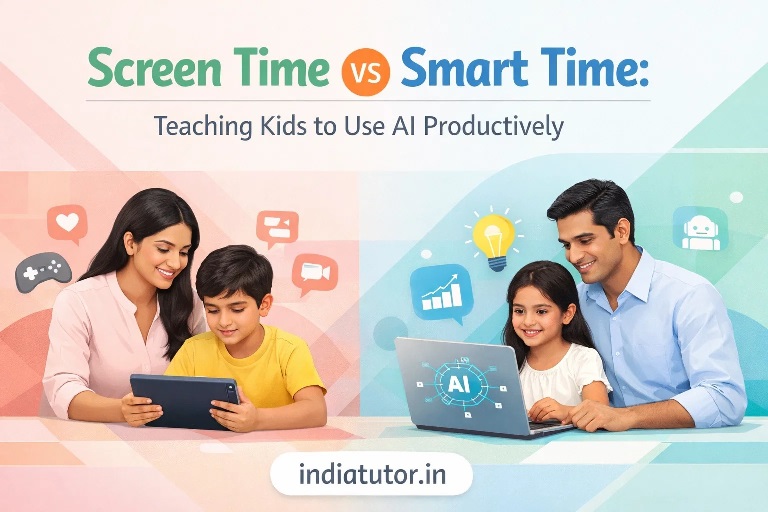
Digital devices have become a part of everyday life for children. Whether it is online classes, educational videos, games, or social media, screens are everywhere. For many parents, the challenge is no longer how to eliminate screen time but how to make it meaningful.
The rise of Artificial Intelligence (AI) has added a new dimension to this conversation. Children can now use AI tools to ask questions, learn concepts, improve writing, practice languages, and explore subjects in ways that were not possible a few years ago.
The real question is not how much time children spend on screens. It is how they spend that time. The difference between screen time and smart time can significantly influence learning outcomes, creativity, and future skills.
How Excessive Screen Time Affects Your Child’s Mind and Body
Understanding the Difference Between Screen Time and Smart Time
Screen time refers to the hours spent using digital devices. This includes watching videos, scrolling through social media, playing games, and browsing content.
Smart time focuses on purposeful digital engagement. It involves activities that encourage learning, problem-solving, critical thinking, creativity, and skill development.
Examples of Passive Screen Time
-
- Endless video consumption
- Social media scrolling
- Repetitive gaming with little educational value
- Watching content without interaction
Examples of Smart Time
-
- Using AI to solve academic doubts
- Learning coding or programming
- Practicing mathematics through interactive tools
- Researching school projects
- Improving communication and writing skills
- Creating presentations, stories, or artwork
The goal for parents is not to ban technology but to guide children toward productive digital habits.
How to Help Your Child Balance School, Homework, and Hobbies
Why This Matters More Than Ever
Children are spending more time online than previous generations. Studies show that screen exposure among young children has increased steadily over the last decade. UNICEF data highlights the growing presence of digital devices in children’s daily lives, making digital literacy an essential life skill.
At the same time, Artificial Intelligence is rapidly becoming part of education, workplaces, and everyday decision-making. UNESCO’s State of Education Report for India emphasizes that AI is transforming learning and creating new opportunities for students to access knowledge and personalized support.
Children who learn to use technology wisely today may be better prepared for future academic and professional environments.
How AI Can Help Children Learn Better
AI should not replace teachers, parents, or independent thinking. Instead, it can serve as a powerful learning assistant.
Personalized Learning Support
Every child learns at a different pace. AI tools can explain concepts multiple times, provide examples, and adapt explanations based on a student’s understanding.
For example, if a child struggles with fractions, an AI assistant can provide simpler explanations, additional exercises, and practical examples.
Instant Answers to Questions
Many students hesitate to ask questions in class. AI provides a safe space where learners can seek clarification without fear of judgment.
This can increase confidence and encourage curiosity.
Better Writing and Communication Skills
AI can help students:
-
- Improve grammar
- Expand vocabulary
- Organize ideas
- Practice essay writing
- Learn effective communication
When used responsibly, it becomes a valuable learning companion.
Research and Project Assistance
Students often spend hours searching for information online. AI can help summarize topics, generate ideas, and explain complex subjects in simpler language.
This allows learners to spend more time understanding concepts rather than searching for resources.
How to Use AI for Notes, Summaries & Revision Faster Than Ever
Teaching Children to Use AI Responsibly
While AI offers many benefits, guidance remains essential.
Teach Verification of Information
AI tools can occasionally provide inaccurate information. Children should learn to cross-check facts using textbooks, trusted educational resources, and teachers.
Encourage Thinking Before Asking
Students should first attempt to solve problems independently.
AI works best when it supports learning rather than replacing effort.
Focus on Learning, Not Shortcuts
Some learners may be tempted to use AI to complete assignments without understanding the material.
Parents and educators should encourage children to use AI for explanations, practice, and skill development rather than simply generating answers.
Discuss Online Safety
Children should understand:
-
- Not sharing personal information
- Protecting passwords
- Using trusted platforms
- Recognizing misleading content
Digital responsibility is just as important as digital literacy.
How to Help Kids Reduce Screen Time Without Arguments
Practical Ways Parents Can Turn Screen Time into Smart Time
Create Learning Goals
Instead of measuring only hours spent online, evaluate outcomes.
Ask questions such as:
-
- What did you learn today?
- What new skill did you practice?
- What problem did you solve?
Follow the 80-20 Rule
A useful approach is allocating most digital usage to productive activities while allowing some time for entertainment.
For example:
Productive Activities (80%)
-
- Homework support
- Reading
- Skill development
- Educational videos
- AI-assisted learning
Recreation (20%)
-
- Games
- Movies
- Social media
This creates balance without making children feel restricted.
Learn Together
Parents do not need to be technology experts.
Exploring AI tools together can create valuable learning opportunities and open conversations about responsible technology use.
Combine Digital and Offline Learning
If a child learns about planets using AI, encourage them to create a model of the solar system.
If they explore a science concept online, ask them to perform a simple experiment at home.
Connecting digital learning with real-world activities strengthens understanding.
Why Your Child Needs More Outdoor Playtime and Less Screen Time
The Role of Tutors in the AI Era
Many parents worry that AI will replace tutors. In reality, the opposite is often true.
AI can explain information, but experienced tutors provide:
-
- Personal mentorship
- Motivation
- Emotional support
- Accountability
- Customized learning strategies
A skilled tutor helps students understand concepts deeply, develop confidence, and apply knowledge effectively.
The most successful learners are likely to combine the strengths of technology with expert human guidance.
How Tutors Can Use AI Effectively
Forward-thinking educators are already using AI to:
-
- Create personalized lesson plans
- Generate practice questions
- Identify learning gaps
- Provide additional learning resources
- Improve student engagement
This allows tutors to focus more on teaching and less on repetitive administrative tasks.
How Tutors Can Use AI to Create Lesson Plans in Minutes
Preparing Children for an AI-Driven Future
Artificial Intelligence is not a passing trend. It is becoming part of education, business, healthcare, and countless other industries.
UNICEF notes that AI is increasingly influencing how children learn, access information, and interact with digital environments. More than one-third of children aged 9 to 11 in some studies already use AI tools such as ChatGPT to find information.
The students who thrive in the future will not necessarily be those who avoid technology. They will be the ones who learn how to use it thoughtfully, creatively, and responsibly.
10 Smart Ways Students Can Use AI to Score Higher in Exams
My Thoughts
The debate should no longer focus only on reducing screen time. The more important objective is transforming screen time into smart time.
When guided properly, AI can help children become better learners, stronger problem-solvers, and more confident thinkers. Parents, teachers, and tutors all have an important role in helping young learners develop healthy digital habits.
Technology works best when it supports human learning rather than replacing it. By teaching children to use AI productively, families can turn digital devices from distractions into powerful educational tools.
Looking for experienced tutors who can help students combine traditional learning with modern educational tools? Explore qualified tutors across subjects and classes at IndiaTutor.in.
Tutors can also register on IndiaTutor.in to showcase their expertise, connect directly with students and parents, and grow their teaching practice without paying commissions.
Will AI Replace Teachers or Make Smart Tutors Grow Stronger?
About the Author
Nidhi Mehta is the founder of IndiaTutor.in and a professional online educator with over 11 years of teaching experience. She specializes in tutoring Classes 1 to 6 across core academic subjects, with a strong focus on concept clarity and foundational skill-building. Her teaching approach is based on personalized, one-to-one learning that helps students develop long-term academic confidence and understanding.


