
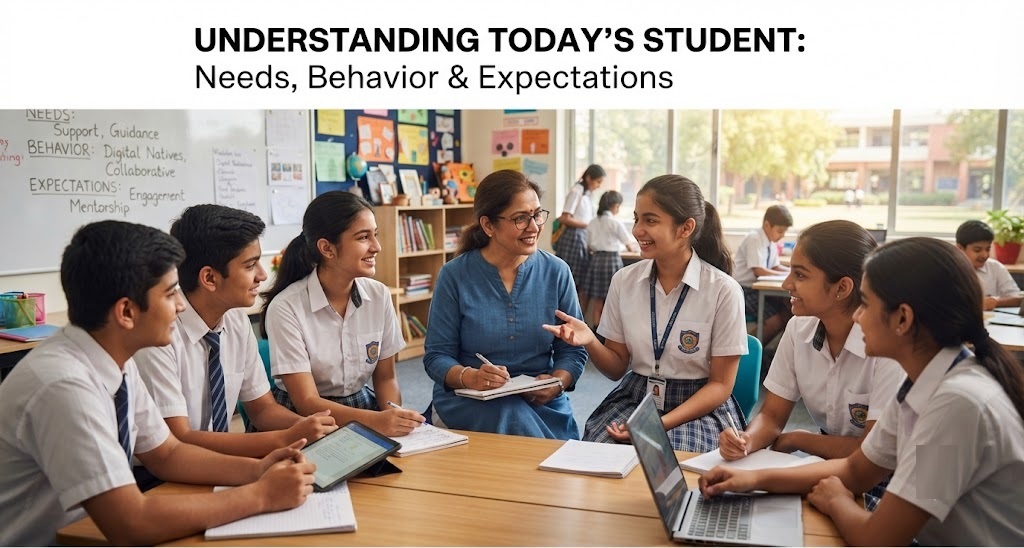
A school is often described as a place where children learn. But learning is only one part of what happens there.
Every day, students walk into classrooms carrying much more than books and notebooks. They bring their personalities, friendships, worries, ambitions, family experiences, digital lives, insecurities, curiosity and questions about the world. Two students sitting side by side may be experiencing the same lesson very differently.
This is why effective teaching today requires more than subject knowledge. Teachers need to understand how students think, what makes them feel safe, what motivates them, how they respond to authority, how technology is changing their habits, and what skills they will need beyond school.
India’s National Education Policy 2020 itself calls for school education to become more holistic, integrated, enjoyable and engaging, with greater emphasis on experiential learning, critical thinking, problem solving and student choice.
Better-trained teachers create better learning experiences
The following nine areas provide a practical framework for schools seeking to build classrooms that respond to the needs of today’s learners.
Use these short, practical presentations to start meaningful discussions about changing student needs and classroom challenges. Encourage teachers to reflect on their current teaching practices and share real classroom experiences. Use examples, case studies and simple activities to turn key ideas into practical classroom actions. End each session with 1–2 small changes teachers can try immediately in their classrooms.
1. Creating a Safe, Respectful & Inclusive Classroom
A child cannot learn comfortably in an environment where they are constantly worried about being laughed at, shouted at, embarrassed or ignored. Safety in school is therefore much broader than physical safety. Students also need emotional and psychological safety — the confidence that they can ask a question, make a mistake, express an opinion and seek help without being humiliated.
A respectful classroom does not mean a classroom without rules. It means that rules are enforced without damaging a student’s dignity. Teachers can be firm while remaining calm and respectful. Students should understand that mistakes are part of learning, differences are accepted and every child deserves to be treated fairly. Research on school connectedness shows that students who feel cared for, valued and supported are more likely to have better attendance and academic outcomes and less likely to experience several negative health and behavioral outcomes.
Inclusion also means noticing the student who rarely raises a hand, the child who takes longer to complete work, the student who struggles with language, and the high achiever who quietly feels overwhelmed. A genuinely inclusive classroom does not expect every child to learn, communicate or participate in exactly the same way.
A useful question for every school:
Would students describe our classrooms as places where they feel safe to be themselves and safe to make mistakes?
Teachers – Try This
-
- Learn and use students’ names.
- Let students ask questions without fear of embarrassment.
- Correct inappropriate behavior calmly and privately when possible.
- Thank students when they participate or ask questions.
- Treat mistakes as a normal part of learning.
2. Teacher Communication: How Words, Tone & Behavior Affect Students
Teachers communicate far more than the words they speak. A student’s experience is shaped by the teacher’s tone, facial expression, patience, body language and willingness to listen. A sentence such as “You can do better” can encourage one child and discourage another depending on how it is delivered.
Public criticism can be particularly damaging. Calling a student “lazy”, “weak”, “careless” or “naughty” turns a temporary problem into a personal identity. It tells the child what they supposedly are, rather than helping them understand what they can change. Constructive communication focuses on the task, behavior or strategy: “Your answer needs another step” is far more useful than “You never understand Maths.”
Listening is equally important. Sometimes a student who appears disinterested is actually confused. A child who refuses to participate may be afraid of making a mistake. A student who suddenly becomes disruptive may be dealing with something outside the lesson. OECD analysis of PISA 2022 data found that students who reported greater teacher support also tended to report stronger motivation, a greater sense of belonging and lower mathematics anxiety.
The goal is not to make every teacher “soft”. It is to make every teacher intentional about the effect of their communication.
Teachers – Try This
-
- Spend a few minutes listening before giving advice.
- Ask open questions instead of assuming what a student is thinking.
- Give clear instructions one step at a time.
- Check whether students have understood the task.
- Notice students who are unusually quiet or withdrawn.
3. Student Motivation: Helping Children Want to Learn
Motivation is often misunderstood as something students either have or do not have. In reality, the classroom environment can influence whether students become curious, persistent and willing to participate. A child may study because they love a subject, because they want to achieve a goal, because they want recognition or simply because they are afraid of punishment. These forms of motivation do not have the same long-term effect.
Students need to experience progress. They need to believe that effort can lead somewhere. They also benefit from having some appropriate choice and from understanding why a topic matters. Self-Determination Theory highlights three psychological needs particularly relevant to learning: autonomy, competence and relatedness — having some sense of choice, feeling capable and experiencing meaningful connection with others. OECD’s PISA 2022 findings similarly associate teacher support with students’ motivation and love of learning.
A teacher can transform a routine lesson by changing the question from “Did you finish the chapter?” to “What can you do with what you have learned?” Mathematics can be connected to shopping, sports or household decisions. Science can begin with a surprising observation. History can become a debate rather than a list of dates.
The objective is not merely to make students study. It is to help them discover reasons to learn.
Teachers – Try This
-
- Give students a clear reason for learning the topic.
- Connect lessons with real-life examples.
- Recognize effort and improvement, not only high marks.
- Give students small, achievable goals.
- Allow students to make simple choices during activities.
4. Positive Classroom Management Without Fear
Every classroom needs structure. Students need clear expectations, predictable routines and appropriate boundaries. The problem begins when discipline becomes primarily about fear, humiliation or punishment.
Effective classroom management starts before misbehavior occurs. Teachers can establish simple rules, explain why they exist, maintain consistency and use calm consequences when expectations are not met. When a student repeatedly interrupts, for example, the teacher can address the behavior without turning the entire class into an audience for a confrontation.
It is also important to ask why a behavior is occurring. A student who constantly talks may be seeking attention, struggling to remain engaged or having difficulty with the task. A student who refuses homework may lack understanding rather than motivation. Understanding the reason does not mean excusing inappropriate behavior; it means responding intelligently.
Positive management does not mean allowing everything. It means maintaining authority without making fear the foundation of the teacher-student relationship.
A useful principle is:
Correct the behavior without attacking the child.
Teachers – Try This
-
- Set 3–5 simple classroom expectations.
- Explain the reason behind each important rule.
- Praise specific positive behavior.
- Stay calm when correcting a student.
- Focus on the behavior that needs to change, not on labeling the child.
5. Recognizing Student Stress, Anxiety & Emotional Needs
Today’s students can face academic pressure, examinations, competition, friendship difficulties, family concerns and social pressures alongside the ordinary challenges of growing up. Teachers are not expected to become counselors or diagnose mental-health conditions. They can, however, become important adults who notice when something has changed.
A sudden decline in performance, repeated absence, withdrawal from friends, unusual irritability, loss of interest or a marked change in classroom participation may deserve attention. None of these signs automatically indicates a mental-health condition, but a noticeable change can be a reason to check in with the student and follow the school’s safeguarding or counseling procedures.
School connectedness is particularly important. The CDC defines it as students feeling that adults and peers at school care about them, support them and value them. Its evidence review links stronger school connectedness with better academic and attendance outcomes and lower risk across several areas of youth well-being.
The most helpful response may sometimes be surprisingly simple:
“I’ve noticed you’ve been quieter than usual. Is everything okay?”
The teacher’s job is not always to solve the problem. Sometimes it is to notice, listen, support and connect the student with the right person.
Teachers – Try This
-
- Notice sudden changes in participation, behavior or work.
- Give students a short opportunity to talk when appropriate.
- Avoid immediately assuming that poor work means laziness.
- Allow reasonable breaks during demanding activities.
- Know when a concern should be referred to the school’s appropriate support system.
6. Teaching Different Learners: One Classroom, Many Needs
Thirty students in one classroom do not represent thirty identical learners. They arrive with different levels of prior knowledge, language abilities, interests, confidence, learning speeds and experiences.
One student may understand a concept after one explanation. Another may need an example. A third may understand it perfectly but struggle to explain it in writing. Treating all three students as though they have exactly the same learning needs can create frustration for both teachers and students.
Differentiated teaching does not necessarily mean preparing thirty different lessons. Small changes can make a substantial difference: providing worked examples, varying questions by difficulty, using visual explanations, allowing discussion before written work, offering additional practice, or giving advanced learners opportunities to apply concepts more deeply.
Evidence-informed approaches such as meta cognition and self-regulation can also help students become more independent learners. The Education Endowment Foundation describes these approaches as helping students plan, monitor and evaluate their learning, and its current evidence summary reports substantial positive average effects when they are explicitly taught.
The important shift is from:
“Why can’t this child learn like everyone else?”
to:
“What might help this child learn this better?”
Teachers – Try This
-
- Explain an important concept in more than one way.
- Use examples, diagrams or demonstrations where useful.
- Give students opportunities to discuss and practice.
- Check understanding before moving to the next topic.
- Provide additional support without making students feel singled out.
7. Making Teaching More Engaging: From Textbook to Active Learning
A textbook is a valuable resource, but it does not have to become the entire classroom experience.
Students learn by listening, reading, questioning, explaining, practicing, discussing, applying and reflecting. A lesson can therefore move beyond “teacher explains, students copy, teacher asks questions” toward more active participation.
A Science teacher might ask students to predict the outcome of an experiment before revealing it. A History teacher might ask students to defend different viewpoints. A Mathematics teacher might present a real-world problem before teaching the formula needed to solve it. Students can work in pairs, explain their reasoning, create examples or teach a concept to their classmates.
This is not simply about making lessons entertaining. The evidence base supports carefully structured active approaches. The Education Endowment Foundation reports positive evidence for collaborative learning when tasks are deliberately designed so that students participate and think rather than simply sit together in groups.
India’s NEP 2020 also places strong emphasis on experiential, inquiry-driven, discussion-based and learner-centered pedagogy. Government guidance on experiential learning highlights connections between classroom content, students’ lives and the world around them.
Engagement is not noise or entertainment. It is intellectual participation.
Teachers – Try This
-
- Ask a question before explaining the answer.
- Give students time to think before calling for responses.
- Use pair discussions or small-group activities.
- Ask students to explain how they reached an answer.
- End the lesson with one question: “What did you learn today?”
8. The Modern Student: Smartphones, Social Media & AI
The modern student does not leave the digital world at the school gate. Smartphones, online videos, social media, gaming, search engines and AI tools have changed how young people access information, communicate and complete tasks.
For schools, the answer cannot simply be “technology is bad” or “technology will solve everything”. Students need guidance on how to use technology responsibly. They need to understand distraction, misinformation, privacy, online behavior, source evaluation and the difference between finding information and understanding it.
Generative AI adds another layer. Students can now use AI to explain a difficult concept, brainstorm ideas or receive feedback — but they can also use it to produce work they have not actually understood. UNESCO’s guidance on generative AI in education emphasizes a human-centered, age-appropriate and ethical approach, including privacy, safety and meaningful educational use.
Schools therefore need clear policies and teachers need practical training. Instead of only asking, “Did AI write this?”, educators should increasingly ask:
“Can the student explain what they submitted?”
The deeper goal is digital literacy: helping students become capable users of technology rather than passive consumers of it.
Teachers – Try This
-
- Ask students where they found important information.
- Teach them to check information before accepting it as true.
- Discuss when AI can help and when it should not replace their own work.
- Ask students to explain or defend work they submit.
- Remind students never to share sensitive personal information with online tools.
9. From Marks to Life: Preparing Students for the Real World
Academic achievement matters. Students need strong foundations in language, mathematics, science, social sciences and other subjects. But education cannot end with examination performance.
A student eventually has to communicate with other people, solve unfamiliar problems, manage time, make decisions, work in teams, deal with failure, adapt to change and continue learning without a teacher standing beside them. These abilities become increasingly important as students move into higher education, employment and adult life.
This direction is consistent with India’s NEP 2020, which calls for greater emphasis on critical thinking, creativity, problem solving, multidisciplinary learning, adaptability and learning how to learn. The policy also calls for ongoing professional development for teachers, including competency-based, experiential and other contemporary pedagogical approaches.
The question schools should therefore ask is not simply:
“What marks did our students achieve?”
It is also:
“What can our students do because they went to our school?”
Can they think independently? Can they communicate? Can they ask good questions? Can they recover from mistakes? Can they work with others? Can they distinguish reliable information from misinformation? Can they learn something new without being completely dependent on someone else?
These are not alternatives to academic excellence. They are part of preparing young people for life beyond the examination hall.
Teachers – Try This
-
- Connect at least one lesson to a real-world situation.
- Give students a problem to solve rather than only information to remember.
- Encourage them to explain their reasoning.
- Include opportunities for teamwork and communication.
- Ask students how they could use what they learned outside school.
The School of the Future Begins With Understanding the Student
Education is changing, but one fundamental truth has not changed: students learn from people as much as they learn from books.
A well-designed curriculum matters. Technology matters. Assessment matters. Infrastructure matters. But the daily experience of a child is shaped by the adults they encounter — the teacher who notices them, the teacher who encourages them after a poor result, the teacher who answers their question without making them feel foolish, and the teacher who believes that improvement is possible.
For school management, this means teacher development should go beyond subject-specific training. Teachers also need opportunities to understand student behavior, communication, motivation, inclusion, emotional well-being, classroom management, active learning and the changing digital environment.
For teachers, it means occasionally stepping back from the syllabus and asking a different set of questions:
Do my students feel safe here?
Do they feel respected?
Do they understand why they are learning?
Do they believe they can improve?
Do they know that mistakes are part of learning?
Am I preparing them only for the next examination — or also for the next stage of life?
The strongest schools are not necessarily those where every student behaves identically or every lesson follows the same pattern. They are schools where adults understand that children are different, learning is human, and education is ultimately about developing capable, confident and responsible people.
That is what it means to truly understand today’s student.
Teachers – Try This : One Small Change
-
- Choose one strategy from this article.
- Try it in one class.
- Observe how students respond.
- Ask yourself what worked and what did not.
- Improve the approach and try again.
Additional School Resources for Teachers
About the Author
Nidhi Mehta is the founder of IndiaTutor.in and a professional online educator with over 11 years of teaching experience. She specializes in tutoring Classes 1 to 6 across core academic subjects, with a strong focus on concept clarity and foundational skill-building. Her teaching approach is based on personalized, one-to-one learning that helps students develop long-term academic confidence and understanding.
Visit her profile Visit About Us Page
Share your Feedback or Review – Contact Us
Tutors, Register your Tutor profile
Career Tutors, Get Personalized Tutor Branding Services
Do you Own a Tuition Center? List it here
Are you a Parent or Student? Share your Tutor Requirement


