
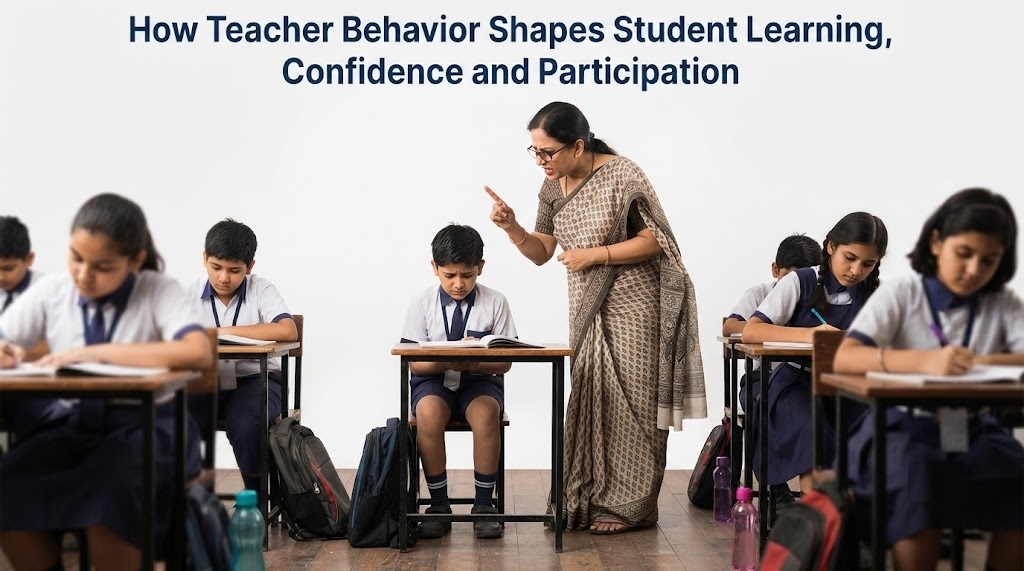
Education is more than teaching a syllabus or preparing students for exams. Its core purpose is to help students learn, understand, think independently, build confidence and grow into capable individuals. This article explains the key responsibilities of teachers, including understanding students, encouraging questions and curiosity, providing useful feedback, building independence and maintaining a safe, respectful learning environment. It also examines how rudeness, sarcasm, humiliation, favoritism and teacher ego can discourage students from speaking, asking questions and learning. Ultimately, effective teaching requires knowledge, patience, fairness, empathy and a genuine commitment to helping every student grow.
A teacher can know the subject extremely well and still fail at one of the most basic purposes of education: helping students learn.
Sometimes the problem is not the curriculum, the textbook, the examination system or even the student’s ability.
Sometimes the problem is the relationship between the teacher and the student.
A teacher’s words carry unusual weight because students often see the teacher as an authority on both the subject and, to some extent, on their own abilities.
A sarcastic comment that an adult considers harmless may remain with a child for years.
A public insult can make a student afraid to answer.
Repeatedly being compared with another student can create resentment or a belief that success belongs only to certain students.
Being ignored when asking for help can teach a student that asking questions is pointless.
And when students learn that speaking honestly will result in ridicule, punishment or dismissal, they eventually stop speaking.
That is a serious educational problem.
A teacher should never forget what the classroom is supposed to accomplish
The purpose of a classroom is not to demonstrate how clever the teacher is.
It is not to establish that the teacher has authority.
It is not to satisfy the teacher’s ego.
It is not to identify which students are “good” and which are “bad.”
It is not to make students afraid of making mistakes.
The purpose is to help students learn.
Authority is necessary. Discipline is necessary. Standards are necessary. Teachers sometimes have to say no, correct behavior and insist that students do their work.
But none of these requires humiliation, sarcasm, favoritism or contempt.
A teacher can be firm without being insulting.
A teacher can be demanding without being dismissive.
A teacher can correct a student without attacking the student’s character.
A teacher can maintain authority while still being approachable.
Never make a student afraid to ask a question
One of the simplest tests of a healthy learning environment is:
Can a student say, “I don’t understand”?
If the answer is no, something has gone wrong.
A student who does not understand needs to be able to say so.
A student who thinks the teacher has made a mistake should be able to ask about it respectfully.
A student who is struggling should be able to seek help.
A student who is worried about something affecting their studies should have an appropriate opportunity to speak.
Instead, students sometimes encounter responses such as:
“How can you not know this?”
“I explained this already.”
“Were you sleeping when I taught this?”
“Even a child could understand this.”
“You never pay attention.”
Such comments may produce silence, but silence is not understanding.
The student may stop asking questions. The teacher may interpret that silence as compliance or understanding.
The learning problem remains.
Sarcasm is not the same as humour
Teachers may sometimes use humour to make a classroom relaxed.
That can be positive.
But humor that depends upon embarrassing a student is different.
There is an enormous difference between laughing with students and making students the object of laughter.
A teacher should be particularly careful about comments concerning:
-
- intelligence
- appearance
- accent
- language ability
- family circumstances
- marks
- economic circumstances
- mistakes
- personality
- friendships
- confidence
- physical characteristics
A teacher may forget the comment five minutes later.
The student may not.
Do not use humiliation as a teaching method
Publicly embarrassing a student may produce immediate compliance.
The student may stop talking.
The class may become quiet.
The teacher may feel that discipline has been restored.
But the educational cost can be much greater.
The student may become:
-
- afraid of answering
- reluctant to ask questions
- unwilling to participate
- anxious about making mistakes
- resentful of the subject
- resentful of the teacher
- disconnected from learning
The apparent short-term success can therefore conceal a long-term problem.
Fear can silence a classroom. It cannot create genuine intellectual curiosity.
A teacher should examine the use of authority
Teachers have authority because education requires leadership.
But authority should be used to create conditions for learning, not to satisfy personal ego.
There is a significant difference between:
“You need to complete this work because it is important for your learning.”
and
“You will do it because I said so.”
The first establishes educational purpose.
The second makes the teacher’s personal authority the center of the interaction.
A teacher should continually ask:
Am I using my authority for the student’s benefit, or am I using the student’s dependence on me to reinforce my own authority?
That is an uncomfortable question.
It is also an important one.
Favoritism can quietly destroy trust
Students notice far more than adults sometimes realize.
They notice when one student is repeatedly praised.
They notice when another is constantly criticized.
They notice who gets opportunities.
They notice who is forgiven.
They notice whose questions receive patience.
They notice whose mistakes become jokes.
They notice when a teacher appears to have already decided who is intelligent and who is not.
A teacher may not consciously intend to favor anyone.
Yet patterns can emerge.
A useful professional practice is therefore to periodically examine:
-
- Who do I call on most often?
- Who receives the most encouragement?
- Whose mistakes do I correct most harshly?
- Who gets additional explanations?
- Who rarely speaks?
- Who appears increasingly withdrawn?
- Do I have different expectations for different students?
- Am I judging a student’s current performance or their potential?
Fairness is not simply treating everyone identically. It is ensuring that personal preferences do not determine educational opportunity.
Never decide that a child is “the problem”
A student who is struggling, withdrawn, disruptive or consistently underperforming may be experiencing something that the teacher cannot immediately see.
Perhaps the student has missed foundational learning.
Perhaps they do not understand the language being used.
Perhaps they are afraid of making mistakes.
Perhaps they are dealing with difficulties outside school.
Perhaps the work is too difficult.
Perhaps it is too easy.
Perhaps they have simply stopped believing that they can succeed.
The teacher does not need to diagnose every problem.
But the teacher should be willing to ask:
“What is happening here?”
rather than immediately deciding:
“What is wrong with this child?”
That change in perspective can completely alter the teacher’s response.
Give students a safe way to speak
“Tell me if you have a problem” is not always enough.
A student may be too embarrassed to speak publicly.
A teacher can create different channels:
-
- private conversations
- short one-to-one check-ins
- anonymous questions
- written reflections
- feedback forms
- appropriate communication with parents or counselors
- opportunities to ask questions after class
But there is an important boundary.
A teacher is not expected to become a student’s therapist, doctor or personal counselor.
The teacher’s responsibility is to listen appropriately, respond with care, maintain professional boundaries and refer serious concerns to the appropriate people or systems.
Listen before judging
Sometimes a teacher’s most valuable response is not an explanation.
It is:
“Tell me what happened.”
A student who is upset may not need an immediate lecture.
They may first need to be heard.
Listening does not mean agreeing with everything the student says.
It means giving the student an opportunity to explain before reaching a conclusion.
The teacher can then say:
“I understand what you are saying. Now let us look at what needs to happen next.”
That preserves both empathy and authority.
Respect must work in both directions
Students should respect teachers.
But respect cannot be a one-way requirement.
Teachers also need to respect students.
That means:
- listening to them
- speaking to them appropriately
- correcting them without humiliating them
- respecting legitimate questions
- acknowledging mistakes
- avoiding unnecessary sarcasm
- treating students fairly
- protecting their dignity
A teacher who says, “You must respect me,” while repeatedly disrespecting students sends a contradictory lesson.
Students learn from behavior.
The teacher must be willing to say, “I was wrong”
This can be surprisingly powerful.
If a teacher gives an incorrect answer, misunderstands a student’s statement or unfairly reacts to something, admitting it does not necessarily weaken authority.
It can strengthen trust.
“I misunderstood what you meant. You were actually asking about something different. Let me answer that properly.”
Or:
“I was too harsh in the way I spoke to you. I should have handled that differently.”
Students learn an important lesson:
Being an authority does not mean being incapable of making mistakes.
The most important question for teacher training
Every teacher should periodically ask themselves:
“If I were a student in my own classroom, would I feel comfortable asking a question?”
Then go further:
“Would I be comfortable admitting that I did not understand?”
“Would I be comfortable telling this teacher that I was struggling?”
“Would I expect to be treated fairly?”
“Would I feel that this teacher wanted me to succeed?”
“Would I leave the classroom wanting to learn more, or wanting simply to avoid being embarrassed?”
These questions can reveal problems that examination results alone cannot reveal.
The teacher’s job is not to make students smaller
A teacher may be more knowledgeable than the student.
That is the reason the student is there.
But knowledge should create responsibility, not superiority.
The teacher knows something the student does not yet know.
The teacher’s job is to build the bridge between the two.
Not to stand on one side of the bridge and mock the student for not already being there.
A truly effective teacher gradually helps the student cross that bridge until the student can walk independently.
That is the difference between displaying knowledge and educating someone.
A final thought for every teacher
Years after leaving school, students may forget a formula.
They may forget a chapter.
They may forget the exact date of an historical event.
But they may remember the teacher who made them believe:
“I can learn this.”
And they may also remember the teacher who made them believe:
“I am stupid.”
That is why teacher behaviour matters so much.
Every interaction is part of education.
A teacher’s words can open a student’s mind or close it.
A teacher’s response to a question can create curiosity or silence it.
A teacher’s reaction to a mistake can create resilience or fear.
A teacher’s fairness can create trust.
A teacher’s arrogance can destroy it.
The objective is not to produce students who are afraid of disappointing the teacher.
The objective is to help produce students who become curious enough to ask, confident enough to speak, secure enough to make mistakes, disciplined enough to learn, and strong enough to eventually think for themselves.
That is education.
And that should never be lost behind the teacher’s ego.
About the Author
Nidhi Mehta is the founder of IndiaTutor.in and a professional online educator with over 11 years of teaching experience. She specializes in tutoring Classes 1 to 6 across core academic subjects, with a strong focus on concept clarity and foundational skill-building. Her teaching approach is based on personalized, one-to-one learning that helps students develop long-term academic confidence and understanding.
Visit her profile Visit About Us Page
Share your Feedback or Review – Contact Us
Tutors, Register your Tutor profile
Career Tutors, Get Personalized Tutor Branding Services
Do you Own a Tuition Center? List it here
Are you a Parent or Student? Share your Tutor Requirement


