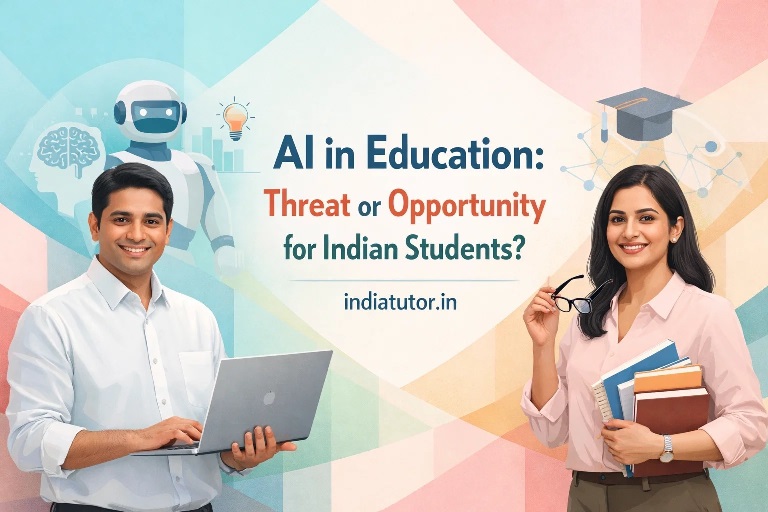
AI in Education: Threat or Opportunity for Indian Students?

AI in Education - Threat or Opportunity for Indian Students

Artificial Intelligence (AI) is rapidly changing how students learn, complete assignments, prepare for exams, and access educational support. From instant answers to personalized learning platforms, AI-powered tools have become part of everyday academic life. While some parents and teachers worry that technology may reduce critical thinking, others see it as a powerful resource that can improve learning outcomes.

So, is AI a threat or an opportunity for Indian students? The answer depends on how it is used.

Understanding AI in Education

Artificial Intelligence refers to computer systems that can perform tasks that normally require human intelligence. These tasks include answering questions, analyzing information, generating content, translating languages, and providing personalized recommendations.

Today, students use AI tools for:

    • Homework assistance
    • Exam preparation
    • Language learning
    • Research and note-taking
    • Doubt solving
    • Practice tests
    • Writing support

According to a report by the United Nations Educational, Scientific and Cultural Organization (UNESCO), AI has the potential to support personalized learning and improve access to quality education worldwide. At the same time, UNESCO emphasizes the importance of responsible and ethical use.

10 Smart Ways Students Can Use AI to Score Higher in Exams

Why AI Is Becoming Popular Among Indian Students

India has one of the world’s largest student populations. With increasing internet access and smartphone usage, digital learning tools have become more accessible than ever.

Several factors are driving AI adoption in education:

Easy Access to Information

Students can get explanations on complex topics within seconds. Instead of spending hours searching through multiple resources, they can receive structured answers quickly.

Personalized Learning Experience

Every student learns differently. AI tools can adapt to individual learning speeds, strengths, and weaknesses. This helps learners focus on areas where they need improvement.

Availability Around the Clock

Unlike traditional support systems, AI tools are available 24 hours a day. Students can ask questions whenever they study, whether early in the morning or late at night.

Cost-Effective Learning Support

Many AI-based educational resources are free or available at low cost, making additional academic assistance accessible to a wider audience.

AI for Competitive Exams: Smarter Prep for JEE, NEET & Olympiads 

How AI Can Benefit Indian Students

Better Concept Clarity

AI tools can explain difficult topics using different approaches. If a student does not understand one explanation, the same concept can be presented in a simpler manner.

Improved Learning Efficiency

Routine tasks such as summarizing chapters, generating practice questions, and creating study notes can be completed faster. This allows learners to spend more time understanding concepts.

Support for Rural and Remote Areas

Many students in smaller towns and villages have limited access to experienced teachers. AI can help bridge this gap by providing educational resources regardless of location.

Assistance for Different Learning Styles

Some students learn through examples, others through visual explanations or step-by-step instructions. AI systems can provide multiple formats that suit different preferences.

Enhanced Language Support

India is a multilingual country. AI-powered translation and language tools can help students understand content more effectively across languages.

How to Use AI for Notes, Summaries & Revision Faster Than Ever

The Concerns: Where AI Can Become a Threat

Despite its advantages, AI also raises important concerns.

Overdependence on Technology

When students rely entirely on AI-generated answers, they may stop developing independent problem-solving skills. Learning becomes less effective when technology does all the thinking.

Reduced Critical Thinking

Education is not just about finding answers. It is about understanding concepts, evaluating information, and forming logical conclusions. Excessive dependence on AI may weaken these abilities.

Inaccurate Information

AI tools are not perfect. They can sometimes provide outdated, incomplete, or incorrect information. Students must verify facts using reliable sources.

Academic Integrity Issues

Some learners use AI to complete assignments without understanding the subject. This creates concerns about originality, honesty, and genuine learning.

Data Privacy Challenges

Educational platforms often collect user information. Students and parents should understand how their data is being stored and used.

How to Use AI Tools for Homework Without Cheating

What Teachers and Tutors Should Know

AI is not replacing teachers. Instead, it is changing their role.

Human Guidance Remains Essential

Technology can provide information, but it cannot fully replace human mentorship, emotional support, motivation, and personalized encouragement.

Tutors Can Use AI to Improve Teaching

AI can help educators:

    • Create lesson plans
    • Generate worksheets
    • Design quizzes
    • Identify learning gaps
    • Track student progress

This allows tutors to focus more on teaching and less on repetitive administrative tasks.

How Tutors Can Use AI to Create Lesson Plans in Minutes

Building Future-Ready Skills

Students need more than subject knowledge. Tutors can help learners develop:

Critical Thinking

Evaluating information and making informed decisions.

Creativity

Generating original ideas and solutions.

Communication Skills

Expressing thoughts clearly and effectively.

Problem-Solving Abilities

Applying knowledge to real-world situations.

These skills remain valuable regardless of technological advances.

The Future of AI in Indian Education

The future is likely to involve collaboration between AI systems and human educators.

The Indian education sector is already witnessing increasing adoption of digital learning platforms, adaptive learning systems, and intelligent assessment tools. As technology continues to evolve, students who learn how to use AI responsibly may gain significant advantages.

However, success will depend on balancing technological assistance with genuine understanding and skill development.

Will AI Replace Teachers or Make Smart Tutors Grow Stronger? 

How Students Can Use AI Responsibly

Use AI as a Learning Assistant

Ask for explanations, examples, and guidance rather than simply copying answers.

Verify Information

Cross-check important facts from textbooks, trusted educational websites, and teachers.

Focus on Understanding

Use technology to strengthen concepts instead of replacing the learning process.

Develop Independent Thinking

Attempt questions on your own before seeking AI assistance.

Continue Practicing Core Skills

Reading, writing, calculation, analysis, and communication remain essential for academic and career success.

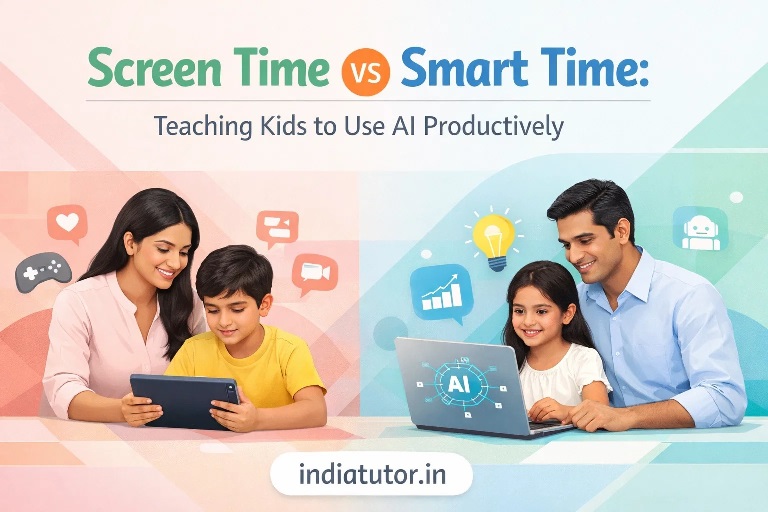
Screen Time vs Smart Time: Teaching Kids to Use AI Productively

My Thoughts

AI is neither purely a threat nor purely an opportunity. It is a powerful tool whose impact depends on how students, parents, teachers, and tutors choose to use it.

When used responsibly, AI can improve accessibility, enhance learning experiences, and support academic growth. However, replacing human effort with technology can create long-term challenges. The most successful students will be those who combine the efficiency of AI with strong critical thinking, curiosity, and guidance from experienced educators.

Register as a tutor on indiatutor.in to connect directly with students and parents searching for qualified educators across India.

Get discovered, receive direct inquiries, and build your independent teaching career with zero commission support.

Register your Tutor Profile on IndiaTutor.in

About the Author

Nidhi Mehta is the founder of IndiaTutor.in and a professional online educator with over 11 years of teaching experience. She specializes in tutoring Classes 1 to 6 across core academic subjects, with a strong focus on concept clarity and foundational skill-building. Her teaching approach is based on personalized, one-to-one learning that helps students develop long-term academic confidence and understanding.
Visit her profile    Visit About Us Page

Screen Time vs Smart Time: Teaching Kids to Use AI Productively

Screen Time vs Smart Time - Teaching Kids to Use AI Productively

Digital devices have become a part of everyday life for children. Whether it is online classes, educational videos, games, or social media, screens are everywhere. For many parents, the challenge is no longer how to eliminate screen time but how to make it meaningful.

The rise of Artificial Intelligence (AI) has added a new dimension to this conversation. Children can now use AI tools to ask questions, learn concepts, improve writing, practice languages, and explore subjects in ways that were not possible a few years ago.

The real question is not how much time children spend on screens. It is how they spend that time. The difference between screen time and smart time can significantly influence learning outcomes, creativity, and future skills.

How Excessive Screen Time Affects Your Child’s Mind and Body

Understanding the Difference Between Screen Time and Smart Time

Screen time refers to the hours spent using digital devices. This includes watching videos, scrolling through social media, playing games, and browsing content.

Smart time focuses on purposeful digital engagement. It involves activities that encourage learning, problem-solving, critical thinking, creativity, and skill development.

Examples of Passive Screen Time

    • Endless video consumption
    • Social media scrolling
    • Repetitive gaming with little educational value
    • Watching content without interaction

Examples of Smart Time

    • Using AI to solve academic doubts
    • Learning coding or programming
    • Practicing mathematics through interactive tools
    • Researching school projects
    • Improving communication and writing skills
    • Creating presentations, stories, or artwork

The goal for parents is not to ban technology but to guide children toward productive digital habits.

How to Help Your Child Balance School, Homework, and Hobbies

Why This Matters More Than Ever

Children are spending more time online than previous generations. Studies show that screen exposure among young children has increased steadily over the last decade. UNICEF data highlights the growing presence of digital devices in children’s daily lives, making digital literacy an essential life skill.

At the same time, Artificial Intelligence is rapidly becoming part of education, workplaces, and everyday decision-making. UNESCO’s State of Education Report for India emphasizes that AI is transforming learning and creating new opportunities for students to access knowledge and personalized support.

Children who learn to use technology wisely today may be better prepared for future academic and professional environments.

How AI Can Help Children Learn Better

AI should not replace teachers, parents, or independent thinking. Instead, it can serve as a powerful learning assistant.

Personalized Learning Support

Every child learns at a different pace. AI tools can explain concepts multiple times, provide examples, and adapt explanations based on a student’s understanding.

For example, if a child struggles with fractions, an AI assistant can provide simpler explanations, additional exercises, and practical examples.

Instant Answers to Questions

Many students hesitate to ask questions in class. AI provides a safe space where learners can seek clarification without fear of judgment.

This can increase confidence and encourage curiosity.

Better Writing and Communication Skills

AI can help students:

    • Improve grammar
    • Expand vocabulary
    • Organize ideas
    • Practice essay writing
    • Learn effective communication

When used responsibly, it becomes a valuable learning companion.

Research and Project Assistance

Students often spend hours searching for information online. AI can help summarize topics, generate ideas, and explain complex subjects in simpler language.

This allows learners to spend more time understanding concepts rather than searching for resources.

How to Use AI for Notes, Summaries & Revision Faster Than Ever

Teaching Children to Use AI Responsibly

While AI offers many benefits, guidance remains essential.

Teach Verification of Information

AI tools can occasionally provide inaccurate information. Children should learn to cross-check facts using textbooks, trusted educational resources, and teachers.

Encourage Thinking Before Asking

Students should first attempt to solve problems independently.

AI works best when it supports learning rather than replacing effort.

Focus on Learning, Not Shortcuts

Some learners may be tempted to use AI to complete assignments without understanding the material.

Parents and educators should encourage children to use AI for explanations, practice, and skill development rather than simply generating answers.

Discuss Online Safety

Children should understand:

    • Not sharing personal information
    • Protecting passwords
    • Using trusted platforms
    • Recognizing misleading content

Digital responsibility is just as important as digital literacy.

How to Help Kids Reduce Screen Time Without Arguments

Practical Ways Parents Can Turn Screen Time into Smart Time

Create Learning Goals

Instead of measuring only hours spent online, evaluate outcomes.

Ask questions such as:

    • What did you learn today?
    • What new skill did you practice?
    • What problem did you solve?

Follow the 80-20 Rule

A useful approach is allocating most digital usage to productive activities while allowing some time for entertainment.

For example:

Productive Activities (80%)

    • Homework support
    • Reading
    • Skill development
    • Educational videos
    • AI-assisted learning

Recreation (20%)

    • Games
    • Movies
    • Social media

This creates balance without making children feel restricted.

Learn Together

Parents do not need to be technology experts.

Exploring AI tools together can create valuable learning opportunities and open conversations about responsible technology use.

Combine Digital and Offline Learning

If a child learns about planets using AI, encourage them to create a model of the solar system.

If they explore a science concept online, ask them to perform a simple experiment at home.

Connecting digital learning with real-world activities strengthens understanding.

Why Your Child Needs More Outdoor Playtime and Less Screen Time

The Role of Tutors in the AI Era

Many parents worry that AI will replace tutors. In reality, the opposite is often true.

AI can explain information, but experienced tutors provide:

    • Personal mentorship
    • Motivation
    • Emotional support
    • Accountability
    • Customized learning strategies

A skilled tutor helps students understand concepts deeply, develop confidence, and apply knowledge effectively.

The most successful learners are likely to combine the strengths of technology with expert human guidance.

How Tutors Can Use AI Effectively

Forward-thinking educators are already using AI to:

    • Create personalized lesson plans
    • Generate practice questions
    • Identify learning gaps
    • Provide additional learning resources
    • Improve student engagement

This allows tutors to focus more on teaching and less on repetitive administrative tasks.

How Tutors Can Use AI to Create Lesson Plans in Minutes

Preparing Children for an AI-Driven Future

Artificial Intelligence is not a passing trend. It is becoming part of education, business, healthcare, and countless other industries.

UNICEF notes that AI is increasingly influencing how children learn, access information, and interact with digital environments. More than one-third of children aged 9 to 11 in some studies already use AI tools such as ChatGPT to find information.

The students who thrive in the future will not necessarily be those who avoid technology. They will be the ones who learn how to use it thoughtfully, creatively, and responsibly.

10 Smart Ways Students Can Use AI to Score Higher in Exams

My Thoughts

The debate should no longer focus only on reducing screen time. The more important objective is transforming screen time into smart time.

When guided properly, AI can help children become better learners, stronger problem-solvers, and more confident thinkers. Parents, teachers, and tutors all have an important role in helping young learners develop healthy digital habits.

Technology works best when it supports human learning rather than replacing it. By teaching children to use AI productively, families can turn digital devices from distractions into powerful educational tools.

Looking for experienced tutors who can help students combine traditional learning with modern educational tools? Explore qualified tutors across subjects and classes at IndiaTutor.in.

Tutors can also register on IndiaTutor.in to showcase their expertise, connect directly with students and parents, and grow their teaching practice without paying commissions.

Will AI Replace Teachers or Make Smart Tutors Grow Stronger? 

About the Author

Nidhi Mehta is the founder of IndiaTutor.in and a professional online educator with over 11 years of teaching experience. She specializes in tutoring Classes 1 to 6 across core academic subjects, with a strong focus on concept clarity and foundational skill-building. Her teaching approach is based on personalized, one-to-one learning that helps students develop long-term academic confidence and understanding.
Visit her profile    Visit About Us Page

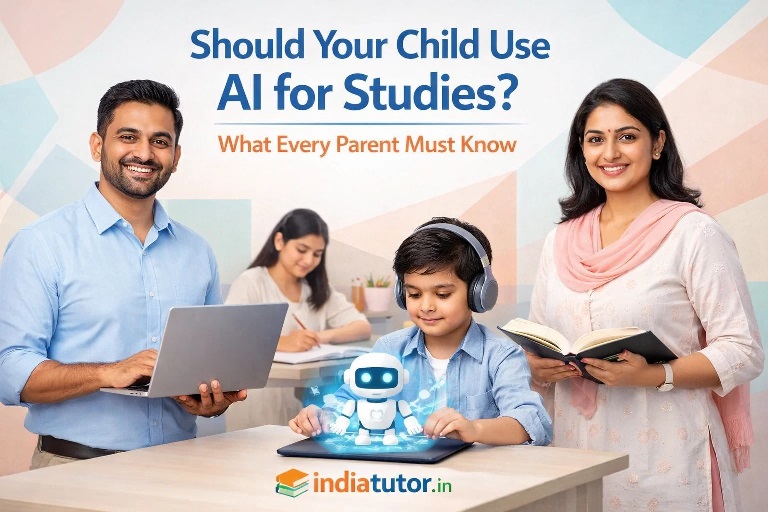
Should Your Child Use AI for Studies? What Every Parent Must Know

Should Your Child Use AI for Studies - What Every Parent Must Know

Artificial Intelligence (AI) is rapidly becoming part of everyday learning. Students use tools like ChatGPT and other AI-powered platforms to find information, understand concepts, solve problems, generate ideas, and complete assignments.

For many parents, this raises an important question: Should children use AI for studies, or will it negatively affect learning?

The answer is not a simple yes or no. AI can be a valuable educational tool when used correctly. However, over dependence on it can create learning gaps and weaken essential academic skills.

This guide explains the benefits, risks, and best practices every parent should understand.

What Is AI in Education?

AI refers to computer systems that can generate responses, explain concepts, answer questions, summarize content, and assist with learning tasks.

Students commonly use AI for:

    • Homework assistance
    • Understanding difficult topics
    • Language improvement
    • Project research
    • Exam preparation
    • Practice questions
    • Writing support

Instead of searching through multiple websites, many students now ask AI tools directly for explanations and solutions.

AI Is Already Being Used by Students Worldwide

AI adoption among students has grown dramatically in a short period.

A 2025 survey of over 1,000 students found that 92% had used AI in some form, while 88% had used generative AI tools for academic work. The most common uses included concept explanation, article summarization, and research support.

Another international survey reported that 58% of students globally use AI for studies, while the figure reached 63% among students in India.

These numbers show that AI is no longer a future trend. It is already part of modern education.

Benefits of AI for Students

When used appropriately, AI can support learning in several ways.

Faster Understanding of Difficult Topics

Children often hesitate to ask questions repeatedly in a classroom. AI tools can explain the same concept multiple times using different examples.

This can be particularly useful in subjects such as Mathematics, Science, and English.

Personalized Learning Support

Every student learns at a different pace.

AI can provide explanations based on a child’s current understanding, helping learners revisit concepts whenever needed.

Better Exam Preparation

Students can generate quizzes, practice questions, revision notes, and summaries.

This makes revision more organized and helps learners identify weak areas.

Improved Confidence

Some children feel uncomfortable asking questions in front of classmates.

AI provides a private environment where students can explore doubts without fear of judgment.

How to Use AI Tools for Homework Without Cheating

The Risks Parents Should Not Ignore

Although AI offers advantages, it also comes with significant challenges.

AI Can Give Incorrect Answers

AI systems do not always provide accurate information.

Studies show that many students worry about receiving inaccurate or misleading responses from AI tools.

A child who blindly accepts every answer may end up learning incorrect concepts.

Reduced Critical Thinking

Learning happens when students analyze, calculate, reason, and solve problems independently.

If AI performs all the thinking, students may miss opportunities to develop problem-solving abilities and analytical skills. Researchers have identified concerns that excessive dependence can reduce active mental engagement.

Homework Without Learning

One of the biggest concerns among educators is that students may use AI to complete assignments without understanding the material.

A finished homework sheet does not always mean genuine learning has taken place.

Privacy Concerns

Many AI platforms collect user inputs.

Students should avoid sharing personal details, school records, passwords, contact information, or sensitive data while using AI tools.

10 Smart Ways Students Can Use AI to Score Higher in Exams

When AI Helps Learning

AI can be extremely useful when students use it as a guide rather than a shortcut.

Good Uses of AI

    • Explaining difficult concepts
    • Creating practice tests
    • Improving grammar and writing
    • Summarizing lengthy chapters
    • Brainstorming project ideas
    • Revising lessons before exams

In these situations, AI supports learning rather than replacing it.

When AI Hurts Learning

Parents should watch for signs that AI is becoming a substitute for effort.

Warning Signs

    • Copying answers directly into assignments
    • Completing homework without reading the explanation
    • Using AI instead of textbooks
    • Avoiding independent thinking
    • Relying on AI for every academic task

These habits can affect long-term academic growth.

How to Use AI for Notes, Summaries & Revision Faster Than Ever

How Parents Can Guide Children to Use AI Responsibly

Parents do not need to ban AI. Instead, they should help children develop healthy habits.

Encourage Verification

Teach children to compare AI responses with textbooks, school notes, and trusted educational resources.

Ask for Explanations

Instead of checking only whether homework is completed, ask children to explain what they learned.

This helps confirm real understanding.

Set Clear Rules

Children should know that AI can assist with learning but should not complete their entire assignment.

Promote Independent Problem Solving

Encourage students to attempt questions on their own before seeking AI assistance.

The struggle to solve a problem is often where learning happens.

AI for Competitive Exams: Smarter Prep for JEE, NEET & Olympiads 

Why Human Teachers and Tutors Still Matter

AI can explain information, but it cannot fully replace experienced educators.

Emotional Support

Teachers understand a student’s strengths, weaknesses, motivation levels, and learning style.

Personalized Feedback

A tutor can identify specific mistakes and provide targeted guidance that AI may miss.

Accountability

Regular interaction with a teacher encourages discipline, consistency, and academic responsibility.

Real-World Learning

Human educators help students develop communication skills, confidence, creativity, and critical thinking.

These qualities remain essential regardless of technological advances.

Will AI Replace Teachers or Make Smart Tutors Grow Stronger? 

Should Parents Be Worried About AI?

The goal should not be to stop children from using AI.

Instead, parents should focus on teaching responsible use.

Technology has always changed education. Calculators, computers, and the internet were once viewed with concern. Today, they are standard learning tools.

AI is likely to follow a similar path.

Children who learn how to use AI wisely may gain valuable advantages in academics and future careers. However, students who depend on it for every task may struggle to build the knowledge and thinking skills needed for long-term success.

Screen Time vs Smart Time: Teaching Kids to Use AI Productively

My Thoughts

AI can be a powerful learning companion when used correctly. It can explain concepts, support revision, and improve study efficiency. At the same time, parents must ensure that technology enhances learning rather than replacing it.

The best approach is balance: combine the convenience of AI with the guidance of teachers, tutors, textbooks, and independent thinking. This helps students gain both technological skills and strong academic foundations.

Looking for experienced tutors who can help your child use technology effectively while building strong subject knowledge? Register on IndiaTutor.in and connect directly with qualified tutors across India for online and home tuition classes.

Tutors can also create a profile on IndiaTutor.in to reach students and parents worldwide, receive direct enquiries, and grow their teaching practice without paying commissions.

AI in Education: Threat or Opportunity for Indian Students?

About the Author

Nidhi Mehta is the founder of IndiaTutor.in and a professional online educator with over 11 years of teaching experience. She specializes in tutoring Classes 1 to 6 across core academic subjects, with a strong focus on concept clarity and foundational skill-building. Her teaching approach is based on personalized, one-to-one learning that helps students develop long-term academic confidence and understanding.
Visit her profile    Visit About Us Page

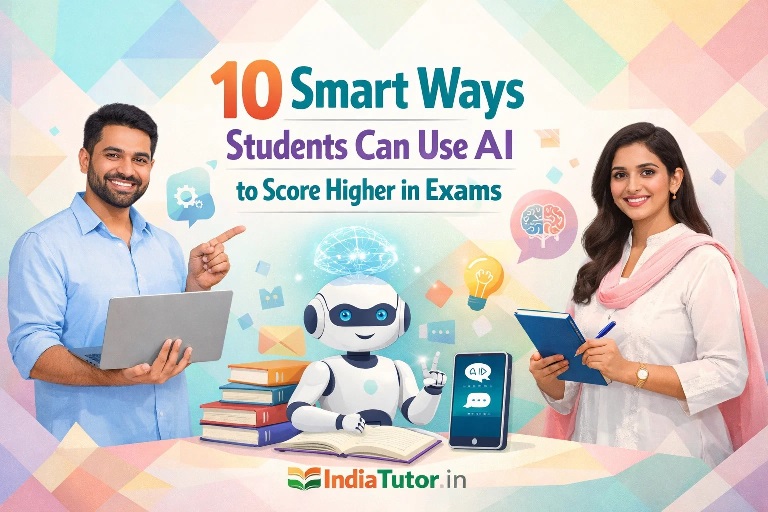
10 Smart Ways Students Can Use AI to Score Higher in Exams

10 Smart Ways Students Can Use AI to Score Higher in Exams

Artificial Intelligence is changing how students learn, revise, and prepare for exams. Studies from education research platforms such as UNESCO and McKinsey indicate that personalized digital learning can improve student performance by 20% to 30% when used consistently. Today, AI tools are not just for tech experts—they are becoming everyday study assistants for school students across subjects including Mathematics, Science, and Languages.

How to Use AI for Notes, Summaries & Revision Faster Than Ever

Here are practical ways students can use AI effectively to improve exam scores in a structured and responsible manner.

Personalized Learning Based on Weak Areas

Every student has different strengths and weaknesses. AI-based learning systems can analyze answers, quiz results, and practice patterns to identify weak topics. Instead of studying everything equally, students can focus more on areas where mistakes are frequent.

Research in adaptive learning shows that targeted practice can reduce learning time by nearly 40% while improving retention.

Instant Doubt Solving for Faster Understanding

One major advantage of AI tools is instant explanation of concepts. Students no longer need to wait for tuition or next class to clear doubts. AI can break down complex topics into simpler explanations step by step.

This reduces learning gaps and helps students revise faster before exams.

Smart Practice Tests and Mock Exams

AI systems can generate unlimited practice papers based on exam patterns. These tests simulate real exam environments, helping students manage time and pressure better.

According to assessment studies, students who regularly take mock tests perform 15% to 25% better in final exams compared to those who only revise theory.

Better Revision with Spaced Learning Techniques

AI tools often use spaced repetition methods, where important concepts are revised at increasing intervals. This method is scientifically proven to improve long-term memory retention.

Students can use AI reminders to revise formulas, definitions, and key concepts before they are forgotten.

Step-by-Step Problem Solving Support

In subjects like Mathematics, AI can show step-by-step solutions instead of just final answers. This helps students understand logic and method rather than memorizing results.

It is especially useful for topics such as algebra, geometry, and arithmetic problem solving.

Writing Improvement for Theory Subjects

For subjects like English and Social Science, AI can help improve grammar, structure, and clarity of answers. It can suggest better sentence formation and highlight missing points in written responses.

Clear and structured answers can significantly increase marks in board exams.

Time Management and Study Planning

AI-based planners can create daily and weekly study schedules based on syllabus load and exam dates. This helps students avoid last-minute stress and distribute study time evenly.

Students following structured study plans are statistically more consistent in performance.

Concept Visualization for Better Understanding

AI tools can convert abstract concepts into visual diagrams, charts, and interactive explanations. This is particularly helpful in Science and Mathematics where visualization improves comprehension.

Visual learning improves memory recall by up to 65% compared to text-only study methods.

Language Support for Better Learning Access

Many students struggle not because of concepts but due to language barriers. AI translation and explanation tools help students understand subjects in their preferred language before switching back to exam language.

This improves clarity and reduces confusion during preparation.

Continuous Performance Tracking

AI platforms track progress over time and highlight improvement trends. Students can clearly see which topics are improving and which need more effort.

This data-driven feedback helps in smarter preparation instead of random studying.

AI for Competitive Exams: Smarter Prep for JEE, NEET & Olympiads 

My Thoughts

AI is not a replacement for teachers or structured learning but a strong support system for consistent exam preparation. When used correctly, it can improve understanding, speed, and accuracy across subjects while reducing study stress.

Indiatutor.in connects students with experienced tutors who provide guided learning, personal attention, and structured support aligned with school curriculum. Tutors on indiatutor.in help students apply these smart learning methods effectively for better academic results.

Search Tutors by Subject     Search Tutors by Class Level 

About the Author

Nidhi Mehta is the founder of IndiaTutor.in and a professional online educator with over 11 years of teaching experience. She specializes in tutoring Classes 1 to 6 across core academic subjects, with a strong focus on concept clarity and foundational skill-building. Her teaching approach is based on personalized, one-to-one learning that helps students develop long-term academic confidence and understanding.
Visit her profile    Visit About Us Page

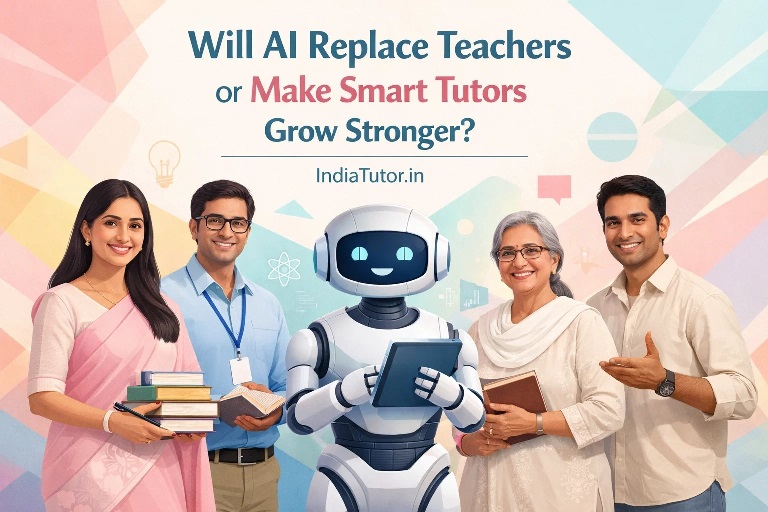
Will AI Replace Teachers or Make Smart Tutors Grow Stronger?

Will AI Replace Teachers or Make Smart Tutors Grow Stronger

Artificial Intelligence (AI) is transforming almost every industry, and education is no exception. From instant homework help and personalized learning apps to AI-powered chatbots that answer questions in seconds, technology is becoming a regular part of students’ lives.

This has created an important question among parents, teachers, and aspiring tutors: Will AI replace teachers, or will it make good tutors even more valuable?

The short answer is simple. AI is unlikely to replace skilled teachers. Instead, it is creating new opportunities for tutors who can combine technology with human guidance.

Understanding how AI affects education can help parents make better decisions and help tutors prepare for the future.

Why AI Is Growing Rapidly in Education

The global AI in education market has expanded significantly over the last few years. Industry reports estimate that the sector is expected to reach tens of billions of dollars by the end of this decade.

Students now use AI tools for:

    • Solving mathematical problems
    • Understanding concepts
    • Creating study notes
    • Practicing languages
    • Research assistance
    • Exam preparation

Many learners can get answers within seconds, making AI a powerful educational resource.

However, getting answers and achieving academic success are two different things.

What AI Can Do Well

Artificial Intelligence offers several benefits that make learning more accessible.

Instant Responses

Students no longer need to wait for a teacher to answer basic questions. AI systems can provide explanations immediately.

Personalized Practice

Many platforms adjust questions based on student performance. This helps learners focus on weak areas.

24/7 Availability

Unlike traditional classrooms, AI tools are available anytime. Students can study late at night, during weekends, or while traveling.

Large Knowledge Base

AI can access and organize information across multiple subjects, helping students find explanations quickly.

For motivated learners, these advantages can improve efficiency and save time.

What AI Cannot Replace

Despite impressive capabilities, AI still lacks several qualities that make great teachers successful.

Human Connection

Learning is not only about information. Students need encouragement, motivation, and confidence-building.

A tutor understands emotions, recognizes frustration, and adapts teaching methods accordingly. AI cannot genuinely connect with a student’s feelings or experiences.

Understanding Individual Personalities

Every learner is different.

Some students need visual explanations. Others learn through discussion, examples, or repeated practice.

Experienced tutors identify learning styles and modify lessons accordingly. This level of understanding remains difficult for technology alone.

Mentorship and Guidance

A teacher often becomes a mentor.

Students frequently seek advice about:

    • Career choices
    • Subject selection
    • Study habits
    • Time management
    • Examination stress

These conversations require life experience, empathy, and judgment that AI cannot fully provide.

Building Character and Values

Education is about more than marks.

Teachers help develop:

    • Discipline
    • Responsibility
    • Communication skills
    • Critical thinking
    • Ethical decision-making

These human qualities play a major role in long-term success.

Why Parents Still Prefer Human Tutors

Parents invest in tutoring because they want results, accountability, and personal attention.

While AI can answer questions, it cannot monitor a student’s attitude toward learning.

Regular Progress Tracking

Tutors observe performance over weeks and months.

They can identify:

    • Knowledge gaps
    • Weak concepts
    • Lack of confidence
    • Poor study habits

This allows timely intervention before problems become serious.

Accountability Improves Performance

Many students study more consistently when guided by a teacher.

Scheduled classes create structure and discipline, which are essential for academic success.

Better Communication with Families

Parents value feedback from tutors regarding their child’s strengths and areas needing improvement.

AI tools do not provide the same level of personalized communication and insight.

How Smart Tutors Can Benefit from AI

The future belongs not to teachers who compete against AI but to those who use it effectively.

Faster Lesson Planning

AI can help tutors:

    • Generate worksheets
    • Create quizzes
    • Prepare summaries
    • Design practice questions

This reduces administrative work and saves valuable time.

More Personalized Teaching

Tutors can use AI-generated insights to understand student weaknesses and create targeted learning plans.

Better Content Creation

Many educators now create:

    • Educational videos
    • Study guides
    • Practice tests
    • Revision notes

AI can assist in producing these resources more efficiently.

Expanding Reach Through Online Teaching

Technology allows tutors to teach students across cities, states, and countries.

This creates opportunities that were difficult to imagine a decade ago.

The Rise of Hybrid Learning

The most successful educational model is increasingly becoming a combination of technology and human instruction.

AI Handles Routine Tasks

Technology can manage repetitive activities such as:

    • Practice exercises
    • Automated assessments
    • Basic explanations
    • Progress reports

Tutors Focus on High-Value Teaching

Teachers can spend more time on:

    • Concept clarity
    • Problem-solving
    • Motivation
    • Exam strategies
    • Personalized mentoring

This combination creates a more effective learning experience.

Will Certain Teaching Roles Change?

Yes. Some aspects of education will evolve.

Tutors who rely solely on delivering information may face challenges because information is now widely available.

However, tutors who offer expertise, guidance, motivation, and personalized support will remain in demand.

Students do not simply need answers.

They need help understanding, applying, and remembering knowledge.

That is where skilled educators continue to add value.

What Aspiring Tutors Should Do Now

The growing influence of AI should not discourage individuals from entering the teaching profession.

Instead, it should encourage continuous improvement.

Develop Subject Expertise

Strong knowledge remains the foundation of successful tutoring.

Students and parents trust educators who demonstrate mastery of their subjects.

Learn Educational Technology

Become familiar with modern tools that improve teaching efficiency.

Technology skills can help tutors deliver better learning experiences.

Improve Communication Skills

Parents often choose tutors based on their ability to explain concepts clearly.

Effective communication remains one of the most valuable professional skills.

Build an Online Presence

Many families now search online for tutors.

Having a professional profile, testimonials, teaching videos, and student reviews can significantly increase visibility.

Focus on Results

Students and parents look for measurable improvement.

Tutors who consistently help learners achieve better grades and stronger understanding will continue to grow regardless of technological advances.

What the Future of Education Looks Like

The future is not a battle between AI and teachers.

Instead, it is a partnership.

Artificial Intelligence will continue making education more accessible, efficient, and personalized. At the same time, human educators will remain essential for mentorship, emotional support, motivation, and deep learning.

Research consistently shows that students achieve the best outcomes when technology is combined with effective teaching rather than replacing it entirely.

As educational tools become smarter, the most adaptable tutors may become even more valuable than before.

My Thoughts

AI is changing the way students learn, but it is not eliminating the need for great teachers. Information can be automated, but inspiration, mentorship, empathy, and human connection cannot.

Parents will continue seeking tutors who can guide, motivate, and help children achieve their full potential. Tutors who embrace technology while strengthening their teaching skills are likely to thrive in the years ahead.

Are you a tutor looking to reach students across India and worldwide? Register on IndiaTutor.in and create your professional tutor profile to connect directly with parents and learners.

IndiaTutor.in helps tutors increase visibility, generate quality enquiries, showcase expertise, and grow their teaching career without commission-based deductions.

About the Author

Nidhi Mehta is the founder of IndiaTutor.in and a professional online educator with over 11 years of teaching experience. She specializes in tutoring Classes 1 to 6 across core academic subjects, with a strong focus on concept clarity and foundational skill-building. Her teaching approach is based on personalized, one-to-one learning that helps students develop long-term academic confidence and understanding.

Visit her profile    Visit About Us Page

Related Topics

How Tutors Can Use AI to Create Lesson Plans in Minutes

How Tutors Can Use AI to Attract More Students Online

error: Content is protected !!

Found this helpful? Share it in 2 seconds!

Link copied to clipboard