

Computer Science Skills Every School Student Should Develop

Computer Science Skills Every School Student Should Develop

Computer Science is no longer a subject meant only for future software engineers. Today, technology influences education, communication, business, healthcare, banking, entertainment, and almost every industry. As a result, computer science skills have become essential for school students regardless of their career goals.

According to the World Economic Forum, digital skills, problem-solving abilities, and technology literacy are among the most important competencies required in the modern workforce. Students who develop these skills early often find it easier to adapt to new technologies, perform better academically, and prepare for future career opportunities.

This article explores the most important computer science skills every school student should develop and practical ways to improve them.

Why Computer Science Skills Matter for Students

Technology has become a part of everyday life. Students use computers for assignments, online learning, research, presentations, and communication. However, using technology is different from understanding how it works.

Learning computer science helps students:

    • Improve logical thinking
    • Develop problem-solving abilities
    • Enhance creativity
    • Build confidence with technology
    • Prepare for future careers
    • Understand digital safety and responsibility

Research from various educational studies has shown that students exposed to coding and computational thinking often demonstrate stronger analytical and reasoning skills compared to those with limited technology education.

Why Logical Thinking Matters More Than Memorization in Computer Science

Problem-Solving Skills

Problem-solving is one of the most valuable abilities taught through computer science.

Understanding Problems Systematically

Students learn to break large challenges into smaller parts. This approach helps not only in programming but also in mathematics, science, and daily life.

For example, if a student needs to design a school project website, they must first identify the requirements, plan the structure, create the pages, and then test the final product.

This step-by-step approach develops organized thinking.

Learning Through Mistakes

Programming teaches students that errors are part of learning. When code does not work correctly, students investigate the cause and find solutions.

This habit encourages persistence and resilience.

Computational Thinking

Computational thinking is a method of solving problems using concepts commonly applied in computer science.

Breaking Down Complex Tasks

Students learn to divide difficult tasks into manageable components.

For example, creating a simple game may involve:

    • Designing characters
    • Creating movement controls
    • Adding scoring systems
    • Testing gameplay

Handling each part separately makes the project easier to complete.

Recognizing Patterns

Many computer science activities involve identifying similarities between problems.

Students who recognize patterns often solve new challenges more efficiently because they can apply previous knowledge.

Why Some Students Excel in Computer Science While Others Struggle

Basic Programming Knowledge

Programming is one of the foundational skills in computer science.

Why Coding Is Important

Coding teaches students how software, applications, and websites are built.

Even basic programming knowledge helps students understand technology more deeply.

Popular beginner-friendly languages include:

    • Python
    • Scratch
    • JavaScript
    • HTML
    • CSS

Python is especially popular because its simple syntax makes it easier for beginners to learn.

Building Logical Thinking

Writing code requires students to think carefully about instructions and sequences.

For example, if a student wants a program to calculate average marks, they must identify the required inputs, perform calculations, and display the results correctly.

This develops structured reasoning.

Digital Literacy

Digital literacy goes beyond operating a computer.

Finding Reliable Information

Students often use the internet for research. Learning how to evaluate sources is extremely important.

They should learn to:

    • Verify information from multiple sources
    • Check publication dates
    • Identify trustworthy websites
    • Avoid misinformation

These skills are valuable throughout academic and professional life.

Effective Online Communication

Students should understand how to communicate professionally through email, online discussions, and collaborative platforms.

Clear communication supports teamwork and academic success.

How Students Can Build a Strong Foundation in Computer Science

Cyber Safety Awareness

As internet usage increases, digital safety becomes increasingly important.

Protecting Personal Information

Students should understand how to:

    • Create strong passwords
    • Enable two-factor authentication
    • Avoid sharing sensitive information online
    • Recognize suspicious messages

Cybercrime affects millions of internet users worldwide every year, making online safety education essential.

Understanding Digital Responsibility

Responsible technology use includes:

    • Respecting privacy
    • Avoiding cyberbullying
    • Following ethical online behavior
    • Respecting intellectual property rights

Developing these habits early creates responsible digital citizens.

Data Handling and Analysis

Data is everywhere in today’s world.

Understanding Data

Students encounter data in subjects such as mathematics, science, economics, and geography.

Computer science teaches them how to:

    • Collect information
    • Organize records
    • Interpret results
    • Draw conclusions

Using Spreadsheets Effectively

Learning tools such as spreadsheets helps students analyze information efficiently.

For example, students can track study hours, calculate averages, create charts, and identify trends.

These practical skills are widely used in higher education and workplaces.

Creativity Through Technology

Computer science is not only about coding.

Designing Digital Projects

Students can express creativity through:

    • Website design
    • Graphic creation
    • App development
    • Game design
    • Animation projects

These activities combine technical skills with imagination.

Creating Solutions

Many successful technological innovations began as simple ideas designed to solve everyday problems.

Computer science encourages students to think creatively and develop practical solutions.

How to Make Computer Science Fun and Exciting for Children

Collaboration and Teamwork

Modern technology projects are rarely completed by individuals working alone.

Working Together on Projects

Students often participate in group activities where they:

    • Share ideas
    • Divide responsibilities
    • Review each other’s work
    • Solve challenges collectively

These experiences improve teamwork and communication.

Learning Project Management

Students gain experience planning tasks, managing deadlines, and coordinating efforts with others.

These abilities are valuable in both academic and professional environments.

Understanding Artificial Intelligence and Emerging Technologies

Artificial Intelligence is becoming increasingly important in modern society.

Learning the Basics

School students should develop a basic understanding of:

    • Artificial Intelligence
    • Machine Learning
    • Automation
    • Robotics
    • Cloud Computing

They do not need advanced technical expertise, but understanding the concepts helps them stay informed about technological developments.

Preparing for Future Careers

According to reports from international workforce organizations, many future jobs will require digital and technology-related skills.

Early exposure helps students adapt more easily to future opportunities.

Questions Parents Should Ask Before Hiring a Computer Science Tutor

Time Management and Productivity Tools

Technology can help students become more organized.

Using Digital Tools Effectively

Students can use technology to:

    • Create study schedules
    • Set reminders
    • Manage assignments
    • Track deadlines
    • Organize notes

These habits improve productivity and reduce academic stress.

Avoiding Digital Distractions

Students should also learn how to balance technology use.

Developing self-discipline helps them focus on learning rather than spending excessive time on entertainment platforms.

Communication and Presentation Skills

Computer science supports effective communication.

Creating Professional Presentations

Students should learn to create presentations that are:

    • Clear
    • Visually appealing
    • Well-organized
    • Informative

Presentation skills are valuable in school projects, competitions, and future careers.

Explaining Technical Concepts

Learning how to explain technology in simple language helps students communicate effectively with different audiences.

This skill is highly valued in education and the workplace.

Practical Ways Students Can Improve Computer Science Skills

Students can strengthen their abilities through regular practice.

Start Small

Begin with basic programming exercises and gradually increase complexity.

Build Simple Projects

Examples include:

    • Personal websites
    • Quiz applications
    • Calculators
    • Digital portfolios
    • Educational games

Projects provide hands-on experience and reinforce learning.

Participate in Competitions

Coding competitions, technology clubs, and school projects help students apply their knowledge in real-world situations.

Stay Curious

Technology evolves rapidly. Reading articles, exploring educational resources, and experimenting with new tools helps students continue learning.

My Thoughts

Computer science skills are becoming essential for success in education and future careers. Problem-solving, coding, digital literacy, cybersecurity awareness, data analysis, creativity, teamwork, and technology understanding all contribute to a student’s overall development.

Students who start building these skills during their school years often gain confidence, improve academic performance, and become better prepared for future opportunities. While self-learning can be effective, a private computer science tutor can provide structured guidance, personalized feedback, and targeted support. Tutors help students overcome difficulties faster, strengthen weak areas, and build confidence through one-to-one attention. This personalized approach often leads to deeper understanding, better grades, and stronger long-term technology skills.

Looking for expert Computer Science tutors?

Find Computer Science Tutors on IndiaTutor.in

About the Author

Nidhi Mehta is the founder of IndiaTutor.in and a professional online educator with over 11 years of teaching experience. She specializes in tutoring Classes 1 to 6 across core academic subjects, with a strong focus on concept clarity and foundational skill-building. Her teaching approach is based on personalized, one-to-one learning that helps students develop long-term academic confidence and understanding.
Visit her profile    Visit About Us Page

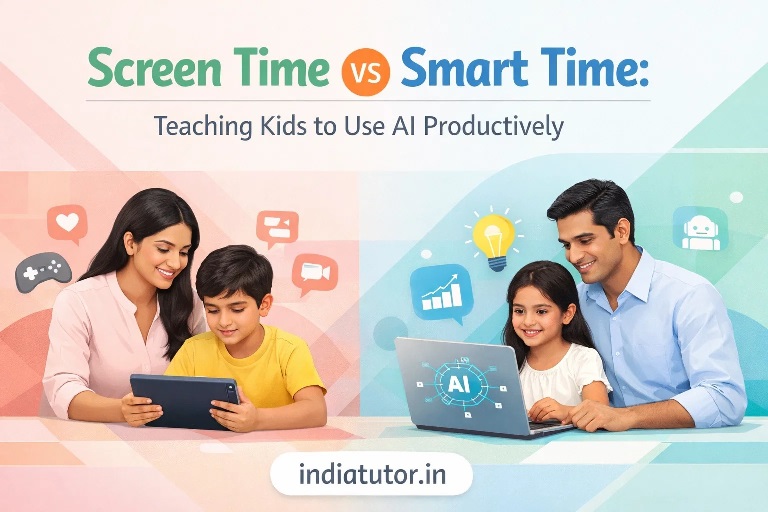
Screen Time vs Smart Time: Teaching Kids to Use AI Productively

Screen Time vs Smart Time - Teaching Kids to Use AI Productively

Digital devices have become a part of everyday life for children. Whether it is online classes, educational videos, games, or social media, screens are everywhere. For many parents, the challenge is no longer how to eliminate screen time but how to make it meaningful.

The rise of Artificial Intelligence (AI) has added a new dimension to this conversation. Children can now use AI tools to ask questions, learn concepts, improve writing, practice languages, and explore subjects in ways that were not possible a few years ago.

The real question is not how much time children spend on screens. It is how they spend that time. The difference between screen time and smart time can significantly influence learning outcomes, creativity, and future skills.

How Excessive Screen Time Affects Your Child’s Mind and Body

Understanding the Difference Between Screen Time and Smart Time

Screen time refers to the hours spent using digital devices. This includes watching videos, scrolling through social media, playing games, and browsing content.

Smart time focuses on purposeful digital engagement. It involves activities that encourage learning, problem-solving, critical thinking, creativity, and skill development.

Examples of Passive Screen Time

    • Endless video consumption
    • Social media scrolling
    • Repetitive gaming with little educational value
    • Watching content without interaction

Examples of Smart Time

    • Using AI to solve academic doubts
    • Learning coding or programming
    • Practicing mathematics through interactive tools
    • Researching school projects
    • Improving communication and writing skills
    • Creating presentations, stories, or artwork

The goal for parents is not to ban technology but to guide children toward productive digital habits.

How to Help Your Child Balance School, Homework, and Hobbies

Why This Matters More Than Ever

Children are spending more time online than previous generations. Studies show that screen exposure among young children has increased steadily over the last decade. UNICEF data highlights the growing presence of digital devices in children’s daily lives, making digital literacy an essential life skill.

At the same time, Artificial Intelligence is rapidly becoming part of education, workplaces, and everyday decision-making. UNESCO’s State of Education Report for India emphasizes that AI is transforming learning and creating new opportunities for students to access knowledge and personalized support.

Children who learn to use technology wisely today may be better prepared for future academic and professional environments.

How AI Can Help Children Learn Better

AI should not replace teachers, parents, or independent thinking. Instead, it can serve as a powerful learning assistant.

Personalized Learning Support

Every child learns at a different pace. AI tools can explain concepts multiple times, provide examples, and adapt explanations based on a student’s understanding.

For example, if a child struggles with fractions, an AI assistant can provide simpler explanations, additional exercises, and practical examples.

Instant Answers to Questions

Many students hesitate to ask questions in class. AI provides a safe space where learners can seek clarification without fear of judgment.

This can increase confidence and encourage curiosity.

Better Writing and Communication Skills

AI can help students:

    • Improve grammar
    • Expand vocabulary
    • Organize ideas
    • Practice essay writing
    • Learn effective communication

When used responsibly, it becomes a valuable learning companion.

Research and Project Assistance

Students often spend hours searching for information online. AI can help summarize topics, generate ideas, and explain complex subjects in simpler language.

This allows learners to spend more time understanding concepts rather than searching for resources.

How to Use AI for Notes, Summaries & Revision Faster Than Ever

Teaching Children to Use AI Responsibly

While AI offers many benefits, guidance remains essential.

Teach Verification of Information

AI tools can occasionally provide inaccurate information. Children should learn to cross-check facts using textbooks, trusted educational resources, and teachers.

Encourage Thinking Before Asking

Students should first attempt to solve problems independently.

AI works best when it supports learning rather than replacing effort.

Focus on Learning, Not Shortcuts

Some learners may be tempted to use AI to complete assignments without understanding the material.

Parents and educators should encourage children to use AI for explanations, practice, and skill development rather than simply generating answers.

Discuss Online Safety

Children should understand:

    • Not sharing personal information
    • Protecting passwords
    • Using trusted platforms
    • Recognizing misleading content

Digital responsibility is just as important as digital literacy.

How to Help Kids Reduce Screen Time Without Arguments

Practical Ways Parents Can Turn Screen Time into Smart Time

Create Learning Goals

Instead of measuring only hours spent online, evaluate outcomes.

Ask questions such as:

    • What did you learn today?
    • What new skill did you practice?
    • What problem did you solve?

Follow the 80-20 Rule

A useful approach is allocating most digital usage to productive activities while allowing some time for entertainment.

For example:

Productive Activities (80%)

    • Homework support
    • Reading
    • Skill development
    • Educational videos
    • AI-assisted learning

Recreation (20%)

    • Games
    • Movies
    • Social media

This creates balance without making children feel restricted.

Learn Together

Parents do not need to be technology experts.

Exploring AI tools together can create valuable learning opportunities and open conversations about responsible technology use.

Combine Digital and Offline Learning

If a child learns about planets using AI, encourage them to create a model of the solar system.

If they explore a science concept online, ask them to perform a simple experiment at home.

Connecting digital learning with real-world activities strengthens understanding.

Why Your Child Needs More Outdoor Playtime and Less Screen Time

The Role of Tutors in the AI Era

Many parents worry that AI will replace tutors. In reality, the opposite is often true.

AI can explain information, but experienced tutors provide:

    • Personal mentorship
    • Motivation
    • Emotional support
    • Accountability
    • Customized learning strategies

A skilled tutor helps students understand concepts deeply, develop confidence, and apply knowledge effectively.

The most successful learners are likely to combine the strengths of technology with expert human guidance.

How Tutors Can Use AI Effectively

Forward-thinking educators are already using AI to:

    • Create personalized lesson plans
    • Generate practice questions
    • Identify learning gaps
    • Provide additional learning resources
    • Improve student engagement

This allows tutors to focus more on teaching and less on repetitive administrative tasks.

How Tutors Can Use AI to Create Lesson Plans in Minutes

Preparing Children for an AI-Driven Future

Artificial Intelligence is not a passing trend. It is becoming part of education, business, healthcare, and countless other industries.

UNICEF notes that AI is increasingly influencing how children learn, access information, and interact with digital environments. More than one-third of children aged 9 to 11 in some studies already use AI tools such as ChatGPT to find information.

The students who thrive in the future will not necessarily be those who avoid technology. They will be the ones who learn how to use it thoughtfully, creatively, and responsibly.

10 Smart Ways Students Can Use AI to Score Higher in Exams

My Thoughts

The debate should no longer focus only on reducing screen time. The more important objective is transforming screen time into smart time.

When guided properly, AI can help children become better learners, stronger problem-solvers, and more confident thinkers. Parents, teachers, and tutors all have an important role in helping young learners develop healthy digital habits.

Technology works best when it supports human learning rather than replacing it. By teaching children to use AI productively, families can turn digital devices from distractions into powerful educational tools.

Looking for experienced tutors who can help students combine traditional learning with modern educational tools? Explore qualified tutors across subjects and classes at IndiaTutor.in.

Tutors can also register on IndiaTutor.in to showcase their expertise, connect directly with students and parents, and grow their teaching practice without paying commissions.

Will AI Replace Teachers or Make Smart Tutors Grow Stronger? 

About the Author

Nidhi Mehta is the founder of IndiaTutor.in and a professional online educator with over 11 years of teaching experience. She specializes in tutoring Classes 1 to 6 across core academic subjects, with a strong focus on concept clarity and foundational skill-building. Her teaching approach is based on personalized, one-to-one learning that helps students develop long-term academic confidence and understanding.
Visit her profile    Visit About Us Page

10 Smart Ways Students Can Use AI to Score Higher in Exams

10 Smart Ways Students Can Use AI to Score Higher in Exams

Artificial Intelligence is changing how students learn, revise, and prepare for exams. Studies from education research platforms such as UNESCO and McKinsey indicate that personalized digital learning can improve student performance by 20% to 30% when used consistently. Today, AI tools are not just for tech experts—they are becoming everyday study assistants for school students across subjects including Mathematics, Science, and Languages.

How to Use AI for Notes, Summaries & Revision Faster Than Ever

Here are practical ways students can use AI effectively to improve exam scores in a structured and responsible manner.

Personalized Learning Based on Weak Areas

Every student has different strengths and weaknesses. AI-based learning systems can analyze answers, quiz results, and practice patterns to identify weak topics. Instead of studying everything equally, students can focus more on areas where mistakes are frequent.

Research in adaptive learning shows that targeted practice can reduce learning time by nearly 40% while improving retention.

Instant Doubt Solving for Faster Understanding

One major advantage of AI tools is instant explanation of concepts. Students no longer need to wait for tuition or next class to clear doubts. AI can break down complex topics into simpler explanations step by step.

This reduces learning gaps and helps students revise faster before exams.

Smart Practice Tests and Mock Exams

AI systems can generate unlimited practice papers based on exam patterns. These tests simulate real exam environments, helping students manage time and pressure better.

According to assessment studies, students who regularly take mock tests perform 15% to 25% better in final exams compared to those who only revise theory.

Better Revision with Spaced Learning Techniques

AI tools often use spaced repetition methods, where important concepts are revised at increasing intervals. This method is scientifically proven to improve long-term memory retention.

Students can use AI reminders to revise formulas, definitions, and key concepts before they are forgotten.

Step-by-Step Problem Solving Support

In subjects like Mathematics, AI can show step-by-step solutions instead of just final answers. This helps students understand logic and method rather than memorizing results.

It is especially useful for topics such as algebra, geometry, and arithmetic problem solving.

Writing Improvement for Theory Subjects

For subjects like English and Social Science, AI can help improve grammar, structure, and clarity of answers. It can suggest better sentence formation and highlight missing points in written responses.

Clear and structured answers can significantly increase marks in board exams.

Time Management and Study Planning

AI-based planners can create daily and weekly study schedules based on syllabus load and exam dates. This helps students avoid last-minute stress and distribute study time evenly.

Students following structured study plans are statistically more consistent in performance.

Concept Visualization for Better Understanding

AI tools can convert abstract concepts into visual diagrams, charts, and interactive explanations. This is particularly helpful in Science and Mathematics where visualization improves comprehension.

Visual learning improves memory recall by up to 65% compared to text-only study methods.

Language Support for Better Learning Access

Many students struggle not because of concepts but due to language barriers. AI translation and explanation tools help students understand subjects in their preferred language before switching back to exam language.

This improves clarity and reduces confusion during preparation.

Continuous Performance Tracking

AI platforms track progress over time and highlight improvement trends. Students can clearly see which topics are improving and which need more effort.

This data-driven feedback helps in smarter preparation instead of random studying.

AI for Competitive Exams: Smarter Prep for JEE, NEET & Olympiads 

My Thoughts

AI is not a replacement for teachers or structured learning but a strong support system for consistent exam preparation. When used correctly, it can improve understanding, speed, and accuracy across subjects while reducing study stress.

Indiatutor.in connects students with experienced tutors who provide guided learning, personal attention, and structured support aligned with school curriculum. Tutors on indiatutor.in help students apply these smart learning methods effectively for better academic results.

Search Tutors by Subject     Search Tutors by Class Level 

About the Author

Nidhi Mehta is the founder of IndiaTutor.in and a professional online educator with over 11 years of teaching experience. She specializes in tutoring Classes 1 to 6 across core academic subjects, with a strong focus on concept clarity and foundational skill-building. Her teaching approach is based on personalized, one-to-one learning that helps students develop long-term academic confidence and understanding.

Visit her profile    Visit About Us Page

How to Use AI Tools for Homework Without Cheating

How to Use AI Tools for Homework Without Cheating

Artificial Intelligence is no longer a futuristic concept. From chatbots to writing assistants and math solvers, AI tools are now easily available to students across India. Whether it is generating essays, solving equations, summarizing chapters, or explaining difficult concepts, AI can make homework faster and easier. But this convenience also brings a big question: how can students use AI tools for homework without cheating?

For Indian parents and tutors, especially those connected with online learning platforms like IndiaTutor.in, this is an important concern. AI can either become a powerful learning partner or a shortcut that harms real understanding. The key lies in how it is used.

Understanding the Difference Between Help and Cheating

Cheating happens when a student submits work generated entirely by AI as their own, without understanding it. This includes copying AI-written essays, solutions, or answers and presenting them without effort or learning.

Using AI ethically, however, means using it as a guide, not a replacement. Just like a tutor explains concepts and encourages independent thinking, AI should support learning, not replace it.

For example, asking AI to explain a maths concept step-by-step is acceptable. Copying the final answer without solving it yourself is not. Asking AI to suggest essay ideas is fine. Submitting a full AI-written essay without edits or understanding is cheating.

Students must remember that homework is not just about marks. It is about practice, clarity, and building skills.

10 Smart Ways Students Can Use AI to Score Higher in Exams

Smart Ways Students Can Use AI for Homework

AI tools can be very useful when used responsibly. Here are practical and ethical ways students can use them:

Use AI to understand difficult concepts. If a chapter in science or mathematics feels confusing, students can ask AI to explain it in simple language. They can even request examples related to daily life. This helps in building conceptual clarity.

Use AI for brainstorming ideas. For essay writing or projects, AI can help generate topic ideas, outlines, or key points. Students can then develop these ideas in their own words.

Use AI to check grammar and improve writing. Tools that correct spelling, grammar, and sentence structure are excellent for improving English skills. Instead of copying text, students can learn from the corrections.

Use AI for practice questions. Students can ask AI to generate additional practice problems for subjects like maths or physics. Solving extra questions improves confidence and exam readiness.

Use AI for summaries after reading. Instead of asking AI to summarize the entire chapter first, students should read it themselves and then use AI to check if they understood it correctly.

How to Use AI for Notes, Summaries & Revision Faster Than Ever

The Role of Online Tutors in the AI Era

Online tutors in India are playing a crucial role in guiding students on ethical AI usage. Instead of banning AI tools completely, tutors can teach students how to use them wisely.

Tutors can assign homework that requires personal reflection, critical thinking, or real-life examples. This makes it difficult to copy directly from AI. They can also ask students to explain their answers orally during online classes. If a student truly understands the topic, they will be able to explain it confidently.

Platforms like IndiaTutor.in connect students with experienced Indian tutors who focus on conceptual learning. When a tutor is involved in the learning process, students are less likely to misuse AI because they know they will be questioned and guided.

Tutors can also encourage students to show their rough work, thought process, and drafts. This ensures authenticity and promotes genuine learning.

AI for Competitive Exams: Smarter Prep for JEE, NEET & Olympiads 

Teaching Students Digital Responsibility

Using AI responsibly is part of digital literacy. Just as students are taught not to copy from textbooks or friends, they should also be taught not to misuse AI tools.

Parents and teachers should openly discuss the ethics of AI. Instead of scaring students, they should explain the long-term impact of cheating. If students depend completely on AI, they may score well in homework but struggle in exams, interviews, and real-life situations.

Students must understand that AI cannot replace their own thinking ability. Overdependence weakens creativity, problem-solving skills, and confidence.

Encouraging self-discipline is important. For example, students can first attempt homework on their own and then use AI only to cross-check answers or clarify doubts.

Practical Guidelines for Ethical AI Use

Here are some simple rules students can follow:

First attempt the question yourself before asking AI for help.
Use AI for explanation, not for final answers.
Rewrite everything in your own words after understanding it.
Do not copy and paste directly from AI tools.
Discuss AI-generated answers with your tutor to ensure clarity.
Use AI to learn, not to escape hard work.

Schools and online tutoring platforms can also create clear policies about AI usage. When expectations are clearly defined, students are less likely to misuse technology.

Why Ethical AI Use Matters for the Future

The education system in India is becoming more competitive. From board exams like CBSE and ICSE to competitive exams like JEE and NEET, real understanding is essential. AI cannot sit in the exam hall for students. If they rely only on shortcuts, they will face difficulties later.

Moreover, future careers demand creativity, analytical thinking, and communication skills. Ethical use of AI can enhance these skills, while misuse can weaken them.

When students learn to use AI as a supportive tool, they gain an advantage. They become smarter learners who know how to combine technology with human intelligence.

AI in Education: Threat or Opportunity for Indian Students?

AI is a Learning Partner, Not a Replacement

AI tools are neither good nor bad by themselves. Their impact depends entirely on how they are used. For students in India, especially those learning through online platforms, AI can be a powerful assistant when used responsibly.

Parents, tutors, and students must work together to ensure that AI supports real learning. By focusing on understanding, practice, and originality, students can use AI tools for homework without cheating.

At IndiaTutor.in, the focus remains on genuine learning guided by experienced Indian tutors. AI can assist, but true success comes from effort, discipline, and strong conceptual clarity.

In the end, the goal of education is not just completing homework, but building knowledge, confidence, and character. When AI is used ethically, it becomes a bridge to better learning rather than a shortcut to temporary results.

Search on indiatutor.in to connect with qualified tutors who can guide students with personalized learning plans, concept clarity, and structured preparation strategies. IndiaTutor.in helps students find trusted tutors for competitive exam success with direct communication and flexible learning support.

Search Tutors by Subject     Search Tutors by Class Level 

About the Author

Nidhi Mehta is the founder of IndiaTutor.in and a professional online educator with over 11 years of teaching experience. She specializes in tutoring Classes 1 to 6 across core academic subjects, with a strong focus on concept clarity and foundational skill-building. Her teaching approach is based on personalized, one-to-one learning that helps students develop long-term academic confidence and understanding.

Visit her profile    Visit About Us Page

error: Content is protected !!

Found this helpful? Share it in 2 seconds!

Link copied to clipboard