
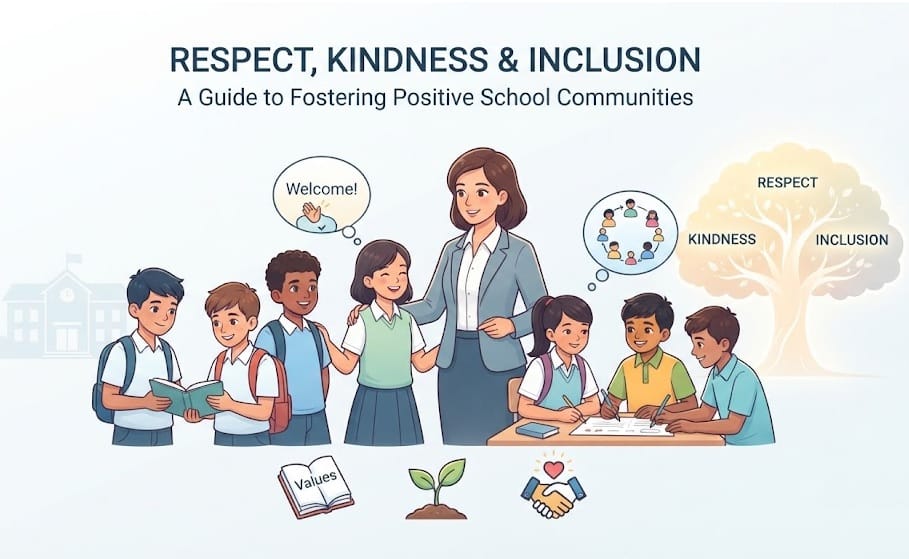
Respect, Kindness & Inclusion

Respect, Kindness & Inclusion

Every student wants to feel accepted, respected, and valued. A positive school environment is not created only by good teachers or modern classrooms. It grows when students treat one another with respect, show kindness in everyday actions, and include everyone regardless of differences.

These simple values improve learning, reduce bullying, strengthen friendships, and help children develop into caring and responsible adults. Whether a student is in Class 1 or Class 12, learning to respect others is just as important as learning Mathematics, Science, or English.

This article explains why respect, kindness, and inclusion matter, how they benefit students, and what schools, parents, and children can do to create a happier and safer learning environment.

What Is Respect?

Respect means treating others with dignity, fairness, and consideration. It involves listening carefully, speaking politely, valuing different opinions, and recognizing that everyone deserves kindness.

Respect is shown through everyday actions such as:

    • Listening without interrupting
    • Using polite language
    • Following classroom rules
    • Respecting personal space
    • Taking care of school property
    • Appreciating teachers, classmates, and support staff

Respect does not mean always agreeing with someone. It means disagreeing politely and treating people with courtesy even when opinions differ.

Understanding Kindness

Kindness is choosing to help, encourage, and support others without expecting anything in return.

Kind acts may seem small, but they often make a lasting difference.

Examples include:

    • Helping a classmate understand a lesson
    • Inviting someone sitting alone to join a group
    • Sharing study notes
    • Thanking teachers and school staff
    • Encouraging friends before exams
    • Saying kind words during difficult times

Research consistently shows that kindness benefits both the giver and the receiver. According to studies published by researchers at the University of Oxford and other institutions, acts of kindness are linked to improved happiness, stronger social relationships, and reduced stress.

What Does Inclusion Mean?

Inclusion means making sure everyone feels welcomed, accepted, and involved.

Every student is unique. Children differ in their abilities, language, culture, religion, interests, personality, learning speed, and family background.

An inclusive classroom ensures that every child feels they belong.

Inclusion means:

    • No student is left out.
    • Everyone gets opportunities to participate.
    • Differences are respected instead of criticized.
    • Every voice is heard.

Students who feel included are generally more confident and participate more actively in classroom activities.

Why These Values Matter in Schools

Schools are where children spend a significant part of their lives. Positive interactions during these years shape their personality, emotional well-being, and future relationships.

A respectful and inclusive school environment helps students:

Feel Safe

Students who feel emotionally safe are more willing to ask questions, participate in discussions, and express their ideas.

Improve Academic Performance

Research from educational organizations has shown that positive school climate is associated with better attendance, higher academic achievement, and greater student engagement.

Build Confidence

Children who receive encouragement and acceptance develop stronger self-esteem.

Develop Leadership Skills

Students who practice empathy and cooperation often become effective leaders because they know how to work well with others.

The Impact of Bullying

Bullying has serious consequences for both victims and those who engage in it.

According to UNESCO’s global school violence reports, nearly one in three students worldwide has experienced bullying at school.

Bullying may be:

Physical Bullying

Pushing, hitting, or damaging belongings.

Verbal Bullying

Name-calling, teasing, insults, or threats.

Social Bullying

Excluding someone, spreading rumors, or encouraging others to avoid a classmate.

Cyberbullying

Using social media, messaging apps, or online games to harass or embarrass someone.

Even small acts of exclusion can affect a child’s confidence and mental well-being.

Simple Ways Students Can Show Respect

Students can create a positive classroom every day through small actions.

Listen Carefully

Allow others to finish speaking before responding.

Speak Politely

Use respectful language even during disagreements.

Follow School Rules

Rules exist to create fairness and safety for everyone.

Respect Different Opinions

Not everyone thinks the same way, and that is perfectly normal.

Appreciate Others

Celebrate classmates’ achievements instead of feeling jealous.

Easy Ways to Practice Kindness Every Day

Kindness does not require money or special skills.

Students can:

    • Smile and greet classmates.
    • Offer help during difficult lessons.
    • Encourage friends before tests.
    • Thank teachers regularly.
    • Include new students in games.
    • Help someone who drops their books.
    • Share useful learning resources.

These simple actions create lasting positive memories.

Making Every Student Feel Included

Inclusion begins with everyday choices.

Welcome New Students

A friendly introduction can help someone settle into a new school much faster.

Include Everyone in Activities

Avoid forming groups that leave certain classmates out.

Respect Different Cultures

Schools bring together students from diverse backgrounds. Learning about different traditions builds understanding and friendship.

Support Students with Different Learning Needs

Everyone learns differently. Patience and encouragement help create an inclusive classroom.

The Role of Teachers

Teachers play an important role in building respectful classrooms.

They can:

Set Clear Expectations

Students should understand what respectful behavior looks like.

Encourage Teamwork

Group activities help children learn cooperation.

Address Problems Early

Small conflicts should be resolved before they become bigger issues.

Celebrate Diversity

Recognizing different talents, cultures, and achievements helps every student feel valued.

How Parents Can Help

Learning respect starts at home.

Parents can:

    • Demonstrate polite behavior.
    • Encourage children to apologise sincerely.
    • Teach empathy.
    • Praise kind actions.
    • Discuss online behaviour.
    • Encourage children to stand up against bullying safely.

Children often copy the behaviour they observe at home.

Digital Respect Is Just as Important

Today’s students spend considerable time online.

Digital kindness means:

    • Thinking before posting.
    • Avoiding hurtful comments.
    • Respecting privacy.
    • Never forwarding embarrassing photos or messages.
    • Reporting cyberbullying to trusted adults.

A kind online community is just as important as a kind classroom.

Real-Life Example

Imagine two students joining a new school.

One is ignored during lunch, left out of games, and rarely spoken to.

The other is welcomed by classmates, invited to group activities, and helped with schoolwork.

Which student is more likely to feel confident, enjoy learning, and perform better academically?

The answer is obvious. Small acts of inclusion can completely change someone’s school experience.

Benefits That Last a Lifetime

Respect, kindness, and inclusion prepare students for success beyond school.

These values help children become:

Better Communicators

Respectful conversations improve relationships.

Strong Team Players

Most careers require collaboration.

Responsible Citizens

Inclusive thinking strengthens communities.

Confident Individuals

Students who feel accepted develop greater self-belief.

Practical Classroom Activities

Schools can encourage these values through simple activities.

Kindness Challenge

Students perform one kind act every day for a week.

Appreciation Wall

Classmates write positive notes about one another.

Buddy System

Older or experienced students help new classmates adjust.

Group Projects

Mixed teams encourage cooperation and understanding.

Gratitude Journal

Students write three positive experiences every week.

These activities build habits that continue beyond the classroom.

My Thoughts

Respect, kindness, and inclusion are not complicated ideas. They are everyday choices that make schools happier, safer, and more welcoming for everyone.

Every polite conversation, every helping hand, every encouraging word, and every effort to include someone creates a stronger school community.

Students who practice these values not only become better classmates but also grow into compassionate, confident, and responsible adults. When schools, families, and communities work together to promote respect, kindness, and inclusion, everyone benefits.

A better school begins with one simple decision: treat every person with dignity, kindness, and respect.

Related Topics

Bullying & Cyberbullying

Smoking, Vaping, Alcohol & Drugs

Mental Health, Anxiety & Depression

Internet Safety & Social Media Safety

Self-Esteem, Confidence & Body Image

Exam Stress & Time Management

Peer Pressure

Online Gaming & Smartphone Addiction 

Managing Anger & Emotions

About the Author

Nidhi Mehta is the founder of IndiaTutor.in and a professional online educator with over 11 years of teaching experience. She specializes in tutoring Classes 1 to 6 across core academic subjects, with a strong focus on concept clarity and foundational skill-building. Her teaching approach is based on personalized, one-to-one learning that helps students develop long-term academic confidence and understanding.

Visit her profile    Visit About Us Page

Should Kids Watch Web Series? Expert Advice for Parents

Should Kids Watch Web Series Expert Advice for Parents

Web series have become a regular part of family entertainment. From educational shows and animated adventures to teen dramas and fantasy stories, children today have access to more content than any previous generation.

Many parents often ask: Should kids watch web series? Is it good for learning, or does it create problems?

The answer is not a simple yes or no. The impact depends on the child’s age, the type of content being watched, viewing habits, and parental involvement.

This guide explains the benefits, risks, and practical strategies parents can use to help children develop healthy viewing habits.

Why Web Series Are So Popular Among Children

Streaming platforms have changed how children consume content. Unlike traditional television, web series can be watched anytime and anywhere.

Recent media studies show that online video and streaming content dominate children’s screen entertainment worldwide. Research also indicates that a large majority of children watch some form of audio-visual content every week, with streaming services becoming a major source of entertainment.

The popularity of web series comes from:

    • Easy access on multiple devices
    • Engaging storylines
    • Personalized recommendations
    • Attractive visuals and sound effects
    • Availability of content for every age group

While these features make web series entertaining, they also require thoughtful supervision.

How Web Series and OTT Platforms Are Impacting Your Child’s Mind

Benefits of Watching Web Series

Not all screen time is harmful. High-quality content can provide several benefits when consumed in moderation.

Educational Learning Opportunities

Many web series introduce children to:

    • Science concepts
    • History and culture
    • Language development
    • Problem-solving skills
    • Creativity and imagination

Educational programs often present complex topics in a simple and engaging format that children can easily understand.

How Much Screen Time Is Too Much for Kids? Expert Guidelines for Parents

Improved Vocabulary and Communication

Children who watch age-appropriate programs can learn:

    • New words
    • Sentence structures
    • Pronunciation
    • Storytelling techniques

This is especially helpful when parents discuss the content afterward.

Family Bonding

Watching selected shows together creates opportunities for:

    • Meaningful conversations
    • Shared experiences
    • Teaching values
    • Discussing real-life situations

Co-viewing helps parents understand what their children are watching and thinking.

How Excessive Screen Time Affects Your Child’s Mind and Body

Potential Risks Parents Should Know

While web series offer benefits, excessive or unsupervised viewing can create challenges.

Exposure to Inappropriate Content

Many platforms use recommendation algorithms. A child may begin with harmless content but eventually encounter material that is unsuitable for their age.

Experts have raised concerns that children can sometimes be exposed to harmful themes, violence, misinformation, or unhealthy social influences through online content.

Reduced Physical Activity

When screen time replaces outdoor play, children may become less active.

Physical movement is essential for:

    • Healthy growth
    • Motor skills development
    • Better sleep
    • Stronger immunity

A balanced routine remains important.

Impact on Sleep

Watching web series late at night can affect sleep quality.

Fast-paced entertainment and prolonged device use may make it harder for children to relax before bedtime.

Shortened Attention Span

Constant exposure to rapidly changing visuals can make traditional learning activities seem less engaging.

Some parents report difficulty getting children to focus on reading, homework, or offline hobbies after extended screen use.

How to Help Kids Reduce Screen Time Without Arguments

What Research Says About Excessive Screen Time

Studies continue to examine how digital media affects children.

A large analysis involving more than 292,000 children found associations between higher screen use and emotional or behavioral difficulties. Researchers also noted that children experiencing such challenges may turn to screens more often, creating a cycle that becomes difficult to manage.

Another survey found that nearly one in two urban Indian parents reported their children spending three or more hours daily on screens, including video streaming platforms and online entertainment.

These findings do not mean web series are harmful by themselves. They highlight the importance of balance and supervision.

The Rise of Couch Potato Kids – How to Get Them Active Again

How Much Web Series Viewing Is Reasonable?

There is no single rule that fits every family.

Instead of focusing only on the number of hours, parents should consider:

    • Child’s age
    • Content quality
    • School performance
    • Sleep patterns
    • Physical activity levels
    • Social interactions

A child who maintains healthy routines and watches quality content in moderation is less likely to experience negative effects.

Signs That Viewing Habits May Need Attention

Parents should observe whether a child:

    • Becomes irritated when screen time ends
    • Avoids outdoor activities
    • Shows declining academic performance
    • Experiences sleep difficulties
    • Loses interest in hobbies
    • Spends less time interacting with family

These signs may indicate the need for healthier boundaries.

Expert Tips for Parents

Watch Together When Possible

Co-viewing allows parents to:

    • Explain confusing topics
    • Discuss values and behavior
    • Answer questions
    • Encourage critical thinking

Children often learn more when adults participate.

Select Age-Appropriate Content

Review ratings and previews before allowing access.

Choose programs that match:

    • Emotional maturity
    • Learning needs
    • Family values

Create Viewing Rules

Clear expectations help children develop self-control.

Examples include:

    • No screens during meals
    • No devices before bedtime
    • Homework completed first
    • Limited viewing on school days

Consistency is important.

Encourage Offline Activities

Children need experiences beyond screens.

Healthy alternatives include:

    • Reading books
    • Sports and games
    • Art and crafts
    • Music
    • Family outings
    • Creative projects

A balanced lifestyle naturally reduces dependence on digital entertainment.

Rising Stress in School Children – Causes, Symptoms, and How Parents Can Help

Can Web Series Be Educational?

Yes, when selected carefully.

Many high-quality programs teach:

    • Mathematics
    • Science
    • Geography
    • Language skills
    • Social development
    • Emotional intelligence

Parents can turn entertainment into learning by asking questions about what was watched and encouraging discussion.

The Role of Tutors in Building Better Screen Habits

Academic support can play a valuable role in reducing excessive entertainment consumption.

When children are engaged in structured learning activities, they often develop:

    • Better study routines
    • Improved focus
    • Stronger academic confidence
    • More productive use of time

Experienced tutors can also recommend educational content that supports classroom learning rather than distracting from it.

My Thoughts

Kids can watch web series, but moderation and supervision matter. The goal is not to eliminate screens entirely. Instead, parents should focus on content quality, healthy routines, and meaningful engagement.

When used wisely, web series can educate, entertain, and inspire. When left unchecked, excessive viewing may affect learning, sleep, physical activity, and emotional well-being.

The most effective approach is balance—combining digital entertainment with learning, social interaction, outdoor activities, and family time.

Looking for experienced tutors who can help your child stay engaged in learning and build strong academic habits? Register on IndiaTutor.in to connect directly with qualified tutors across subjects and classes.

IndiaTutor.in allows parents to compare tutor profiles, communicate directly, and find the right academic support without paying commissions.

Register your Tutor Profile on IndiaTutor.in

About the Author

Nidhi Mehta is the founder of IndiaTutor.in and a professional online educator with over 11 years of teaching experience. She specializes in tutoring Classes 1 to 6 across core academic subjects, with a strong focus on concept clarity and foundational skill-building. Her teaching approach is based on personalized, one-to-one learning that helps students develop long-term academic confidence and understanding.

Visit her profile    Visit About Us Page

error: Content is protected !!

Found this helpful? Share it in 2 seconds!

Link copied to clipboard