
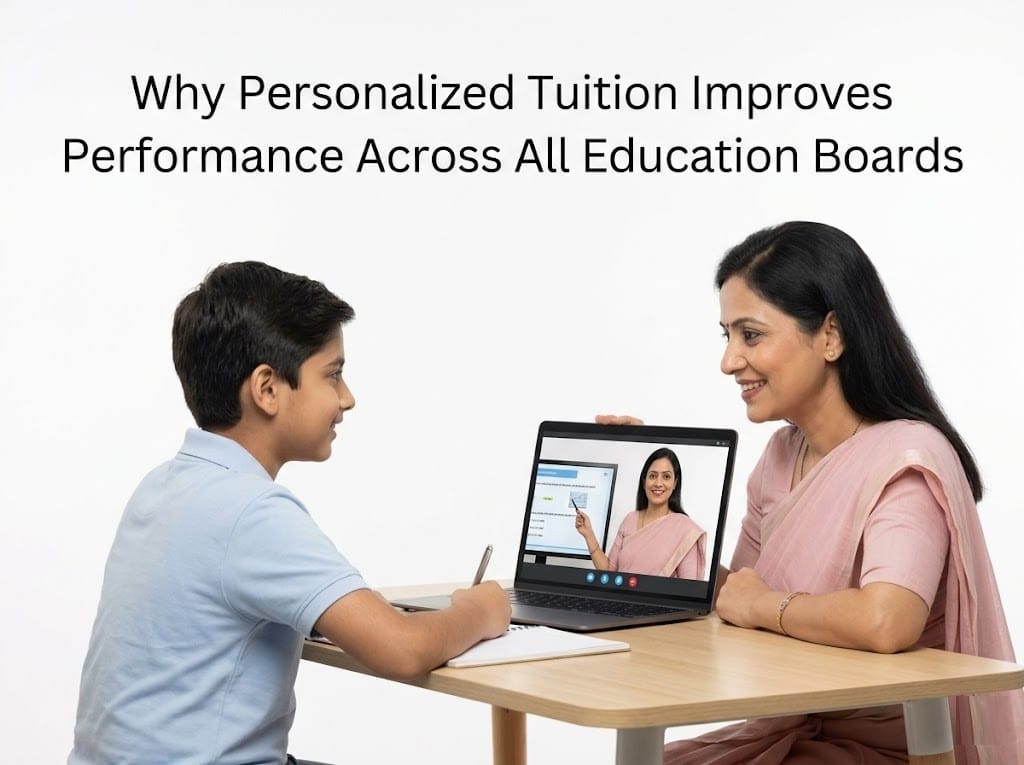
Education today is no longer limited to a single syllabus or uniform classroom approach. Students study under different systems such as CBSE, ICSE, State Boards, IB, and Cambridge programs. Each curriculum has its own teaching style, assessment method, and learning expectations. In this situation, many parents are noticing one common trend: students often perform better when they receive personalized tuition support alongside school learning.
This article explains why one-to-one or small group tutoring is becoming a key factor in improving academic performance across all education boards, supported by research, learning data, and real-world examples.
Understanding the Challenge Across Different Education Boards
Every education board in India and abroad follows a distinct academic structure. This creates variation in difficulty level, content depth, and exam preparation style.
CBSE and Competitive Exam Pressure
CBSE is widely followed in India and focuses on a structured syllabus aligned with entrance exams like JEE and NEET. However, students often struggle with application-based questions even after understanding concepts in class.
ICSE and Detailed Curriculum Load
ICSE places strong emphasis on language, detailed explanations, and subject depth. Many students find it challenging to manage the volume of content and written expression requirements.
State Boards and Concept Gaps
State boards often vary from region to region. Some focus heavily on theory-based learning, which can lead to gaps when students transition to competitive or national-level exams.
IB and Cambridge Systems
International boards such as IB and Cambridge focus on analytical thinking, research skills, and continuous assessment. A study published by the International Baccalaureate Organization shows that IB students spend significantly more time on independent learning compared to traditional board students, which can become overwhelming without guidance.
The variation in learning systems means a uniform teaching method in school does not suit every learner.
Understanding CBSE, ICSE, ISC, State Boards, IB and Cambridge Curriculums
What Personalized Tuition Actually Means
Personalized tuition refers to customized learning support designed around a student’s strengths, weaknesses, pace, and academic goals.
One-to-One Attention
Unlike classroom teaching where one teacher handles 30–60 students, private tuition focuses on a single student or a very small group.
Adaptive Teaching Methods
The tutor modifies explanations based on how quickly the student understands a topic.
Targeted Learning Plan
Instead of following a fixed syllabus pace, tuition sessions focus more on weak areas and exam priorities.
Research from the Education Endowment Foundation (EEF), UK, indicates that individualized tutoring can lead to an average improvement of +4 to +5 months of additional learning progress in one academic year.
How Education Boards Affect Career Choices
Why Students Struggle in Traditional Classrooms
Limited Individual Attention
In a classroom, teachers cannot always identify each student’s learning gap. A student may hesitate to ask questions, leading to confusion that grows over time.
Fixed Teaching Speed
Every student learns at a different pace. Fast learners may feel bored, while slow learners may fall behind.
Exam-Oriented Pressure
Teachers often focus on completing the syllabus rather than revisiting weak concepts.
Curriculum Differences
Students shifting between boards such as CBSE to IB or State Board to ICSE often find sudden changes in difficulty level and assessment style.
A UNESCO report on global education systems highlights that personalized learning environments significantly reduce dropout rates and improve academic engagement.
How to Choose the Right School Board for Your Child
How Personalized Tuition Improves Academic Performance
Stronger Concept Clarity
When students learn in a focused environment, they are more likely to ask questions and clear doubts immediately. This reduces confusion in subjects like Mathematics and Science.
Better Exam Preparation Strategy
Tutors help students understand question patterns, marking schemes, and time management techniques. This is especially useful for board exams and competitive entrance preparation.
Faster Progress in Weak Subjects
Instead of revising all subjects equally, personalized tuition focuses more time on difficult topics, improving overall scores efficiently.
Improved Confidence and Motivation
Students often feel more comfortable learning in a non-judgmental environment. This builds confidence, which directly impacts performance.
A study by the National Bureau of Economic Research (NBER) found that students receiving structured tutoring support showed measurable improvements in test scores compared to those without additional academic help.
Impact Across Different Education Boards
CBSE Students
Personalized tuition helps in solving application-based questions, numerical problems, and sample paper practice aligned with board exams.
ICSE Students
Tutors support structured writing, literature analysis, and detailed subject explanations required in ICSE examinations.
State Board Students
Tutoring helps bridge foundational gaps and prepares students for higher-level competitive exams or board transitions.
IB Students
Personalized guidance supports Internal Assessments (IA), Extended Essays, and concept-based learning, which are essential in IB curriculum success.
Cambridge Students
Tutors help manage syllabus depth, exam techniques, and analytical question patterns across IGCSE and A-Level subjects.
Common Academic Challenges Students Face in Different Boards
Role of Personalized Tuition in Online Learning Era
With the growth of digital education, online tutoring has become a strong alternative to traditional home tuition.
Flexibility in Learning
Students can schedule classes based on their availability, reducing academic stress.
Access to Expert Tutors
Geography is no longer a barrier. A student in one city can learn from a subject expert anywhere in the country or abroad.
Use of Digital Tools
Interactive whiteboards, quizzes, and recorded sessions improve retention and revision quality.
According to a report by Research and Markets, the global online tutoring market is expected to grow significantly, driven by demand for customized learning experiences.
Common Misconceptions About Private Tuition
“Only weak students need tuition”
In reality, many top-performing students use tutoring to maintain and improve their grades.
“School teaching is enough”
School provides foundational learning, but personalized tuition helps refine understanding and exam readiness.
“Tutors only repeat school content”
Modern tutors focus on problem-solving, exam strategy, and conceptual clarity rather than repetition.
How Parents Benefit from Personalized Tuition Support
Parents often struggle to track academic progress due to busy schedules and complex syllabi. Personalized tuition provides:
Regular Performance Updates
Parents receive feedback on strengths and improvement areas.
Reduced Academic Stress at Home
Homework and revision guidance are handled by tutors, reducing conflicts during study time.
Better Academic Planning
Tutors guide subject selection, exam preparation, and long-term academic goals.
Understanding Different Grading Systems Across Education Boards
Why Personalized Tuition Works Across All Education Boards
The main reason personalized tuition is effective is its adaptability. Whether a student is studying CBSE in India, IB in an international school, or Cambridge curriculum abroad, learning gaps and exam pressure exist everywhere.
Personalized learning removes the one-size-fits-all limitation of traditional classrooms and replaces it with a focused academic support system designed for individual success.
Thoughts for Parents
Every child learns differently. Some need repetition, some need visual explanation, and some need structured practice. School systems cannot always adjust to these differences, especially across diverse education boards.
Private tutoring bridges this gap by offering focused attention, structured learning, and exam-oriented preparation. It helps students build clarity, improve marks, and develop long-term confidence in their academic journey.
For parents, hiring a private tutor means giving their child a learning environment tailored to their exact needs. It supports better understanding of subjects, reduces academic pressure, and improves overall performance across CBSE, ICSE, State Boards, IB, and Cambridge systems.
Looking for expert tutors?
Find Verified Tutors on IndiaTutor.in
About the Author
Nidhi Mehta is the founder of IndiaTutor.in and a professional online educator with over 11 years of teaching experience. She specializes in tutoring Classes 1 to 6 across core academic subjects, with a strong focus on concept clarity and foundational skill-building. Her teaching approach is based on personalized, one-to-one learning that helps students develop long-term academic confidence and understanding.