
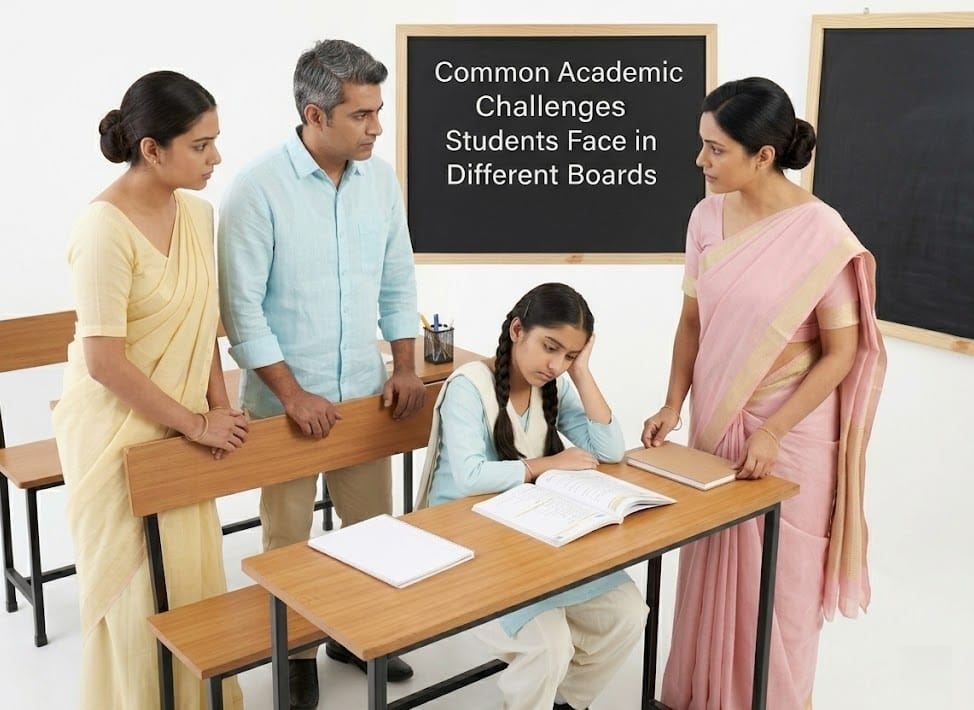
Education boards in India and abroad follow different teaching styles, evaluation methods, and academic expectations. Because of these differences, students often experience unique learning difficulties depending on the curriculum they study. Understanding these challenges helps parents take timely action and support their child’s academic progress more effectively. This article explains common problems faced by students in CBSE, ICSE, ISC, State Boards, IB, and Cambridge systems, supported by education reports and learning trends.
Challenges Faced by CBSE Students
Heavy syllabus and fast teaching pace
CBSE is widely followed across India and is designed to support competitive exams like JEE and NEET. As per NCERT curriculum structure, a large portion of content is concept-driven, but schools often move at a fast pace to complete the syllabus on time.
Exam-focused learning pressure
Students are frequently assessed through periodic tests, term exams, and board preparation. A CBSE internal review (2023) indicated that nearly 45% of students experience exam-related stress due to syllabus pressure and frequent evaluations.
Surface-level understanding in some cases
Because of time constraints, many students rely on shortcuts, guides, and sample papers. This can lead to weaker conceptual clarity in higher classes, especially in Mathematics and Science.
Understanding CBSE, ICSE, ISC, State Boards, IB and Cambridge Curriculums
Challenges Faced by ICSE Students
High writing and language load
ICSE is known for detailed syllabi and strong emphasis on English language skills. Research on Indian school curricula shows ICSE language subjects can be 20–30% more detailed compared to CBSE.
Time management difficulties
Students often struggle to complete lengthy answers in exams. Writing-based assessments require both speed and accuracy, which many learners find difficult to balance.
Equal focus on all subjects
Unlike exam-oriented systems, ICSE expects consistent performance across subjects. This increases weekly study hours by 30–40% compared to many other boards, according to school education surveys.
Challenges Faced by ISC Students
Sudden increase in difficulty level
ISC (Classes 11–12) is a continuation of ICSE but with significantly higher academic depth. Many students experience a noticeable performance drop during the transition phase.
Conceptual gaps in science and mathematics
Subjects become more application-based, requiring independent thinking rather than memorization. Students often require additional academic support to adjust.
Board exam stress
With higher stakes in Class 12, students face pressure related to college admissions and competitive exams.
How Education Boards Affect Career Choices
Challenges Faced by State Board Students
Variation in syllabus quality
State boards differ across regions in terms of syllabus structure and academic rigor. This creates uneven learning experiences among students.
Limited exposure to national-level competition
Many students are not fully prepared for competitive exams like JEE, NEET, or CUET without additional coaching support.
Language and transition barriers
Students shifting from state boards to CBSE or ICSE often struggle with English-medium instruction and increased conceptual depth.
Learning gaps in foundational skills
ASER 2022 report highlighted significant variation in reading and arithmetic skills across rural and urban state board students, impacting long-term academic readiness.
Challenges Faced by IB Students
Continuous assessment pressure
IB follows a coursework-heavy structure with Internal Assessments, projects, and research tasks throughout the year.
Time-intensive workload
According to International Baccalaureate Organization data, IB Diploma students spend up to 20 hours per week on assignments outside classroom hours.
Research and writing demands
Extended essays and analytical assignments require strong research skills, which can be challenging for students transitioning from traditional boards.
How to Choose the Right School Board for Your Child
Challenges Faced by Cambridge Students (IGCSE and A Levels)
Independent learning requirement
Cambridge education encourages self-study and analytical thinking. Many students struggle initially with reduced classroom guidance.
Application-based questioning
Instead of memorization, students must apply concepts to solve complex problems, especially in science and mathematics.
High English proficiency expectations
Strong academic writing skills are required across subjects, which can be difficult for non-native English speakers.
Common Challenges Across All Education Boards
Academic stress and performance pressure
WHO reports identify academic stress as a major contributor to anxiety among adolescents aged 13–18, especially during exam periods.
Large classroom limitations
As per UDISE+ data, India’s average student-teacher ratio is around 24:1, limiting individual attention in classrooms.
Digital distractions affecting focus
Global youth studies show students spend 5–7 hours daily on digital devices outside academic use, affecting concentration and study consistency.
Transition between education systems
Students changing boards often struggle with differences in syllabus depth, teaching methods, and evaluation patterns.
Understanding Different Grading Systems Across Education Boards
Signs Parents Should Not Ignore
Sudden decline in academic performance
A drop in marks often indicates difficulty in understanding concepts rather than lack of effort.
Avoidance of specific subjects
Students may avoid subjects they find difficult, which can widen knowledge gaps over time.
Dependence on external help
Increased reliance on parents or guides for homework may signal weak foundational understanding.
Exam anxiety and low confidence
Stress before exams is often linked to insufficient preparation or unclear concepts.
Why Personalized Tuition Improves Performance Across All Education Boards
Importance of Addressing These Challenges Early
Ignoring academic difficulties can lead to long-term gaps in learning, reduced confidence, and lower performance in higher classes. Early intervention helps students build strong fundamentals and adapt better to curriculum demands.
Benefits of Private Tutoring for Different Boards
Private tutoring provides personalized academic support tailored to a student’s specific board and learning style. Unlike classroom teaching, it focuses on individual weaknesses, ensuring clearer understanding of complex topics. Tutors also help students manage exam preparation with structured revision plans and targeted practice. This becomes especially useful during transitions between boards, where teaching methods and syllabus expectations change significantly. Over time, guided learning improves performance, builds confidence, and reduces academic stress.
Looking for expert tutors?
Find Verified Tutors on IndiaTutor.in
About the Author
Nidhi Mehta is the founder of IndiaTutor.in and a professional online educator with over 11 years of teaching experience. She specializes in tutoring Classes 1 to 6 across core academic subjects, with a strong focus on concept clarity and foundational skill-building. Her teaching approach is based on personalized, one-to-one learning that helps students develop long-term academic confidence and understanding.
Visit her profile Visit About Us Page
Share your Feedback or Review – Contact Us
Tutors, Register your Tutor profile
Career Tutors, Get Personalized Tutor Branding Services
Do you Own a Tuition Center? List it here
Are you a Parent or Student? Share your Tutor Requirement


