
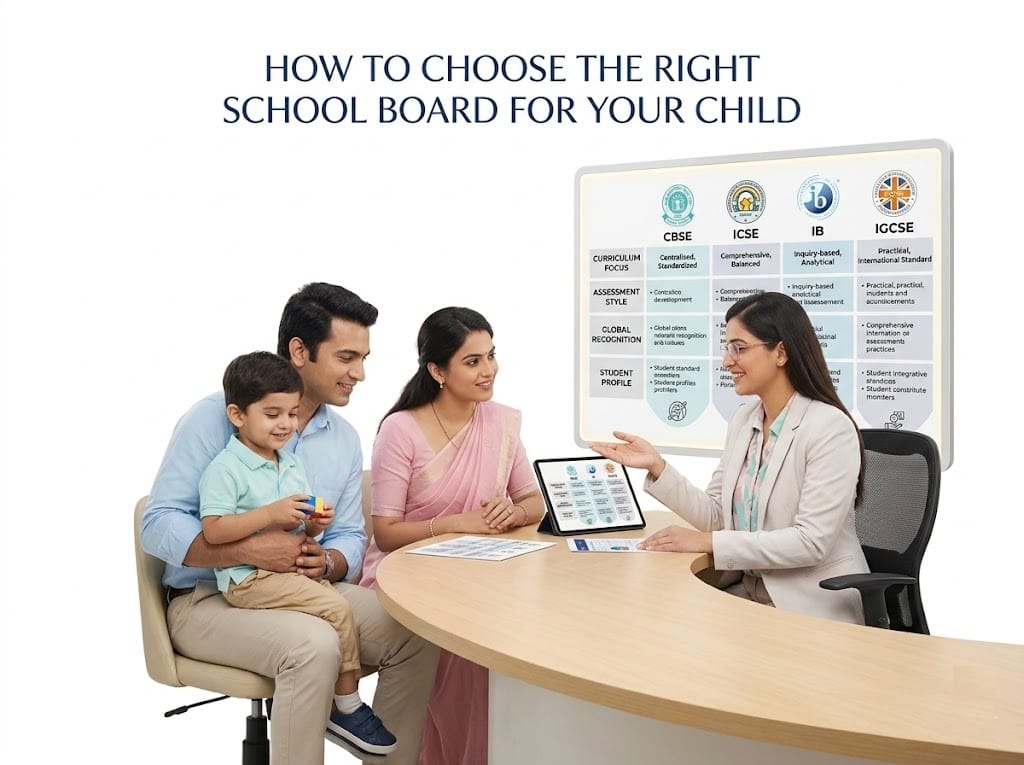
Choosing a school for your child is one of the biggest decisions you will make as a parent. Along with selecting the right school, choosing the right education board is equally important. The curriculum your child follows can influence the way they learn, prepare for exams, develop skills and plan for higher education.
There is no single board that is best for every child. A curriculum that works well for one student may not suit another. Factors such as learning style, career goals, future plans, family circumstances and academic interests all play an important role.
This guide explains the major school boards in India and international curriculums in simple language, helping you make an informed decision.
What Is a School Board?
A school board or curriculum sets the academic framework that schools follow. It determines:
-
- Subjects taught
- Course content
- Teaching methods
- Examination pattern
- Grading system
- Learning outcomes
- Assessment standards
Different boards have different approaches. Some focus more on conceptual understanding, while others place greater emphasis on examinations, projects or research-based learning.
Understanding CBSE, ICSE, ISC, State Boards, IB and Cambridge Curriculums
Why Choosing the Right Board Matters
The right curriculum helps children learn with confidence instead of feeling overwhelmed.
Choosing a suitable board can affect:
-
- Academic performance
- Interest in learning
- Confidence in classrooms
- Preparation for competitive exams
- Admission to colleges in India and abroad
- Development of practical and analytical skills
According to the National Education Policy (NEP) 2020, education should move beyond rote learning and encourage critical thinking, creativity and problem-solving. Many school boards have gradually updated their curriculum to support these goals.
Major School Boards Available in India
CBSE
The Central Board of Secondary Education (CBSE) is one of India’s largest education boards, with more than 30,000 affiliated schools in India and abroad.
CBSE focuses on:
-
- Strong fundamentals
- Mathematics and Science
- Standardised syllabus
- NCERT textbooks
- Competitive exam preparation
Students preparing for entrance examinations such as JEE and NEET often find the CBSE curriculum closely aligned with these exams because many questions are based on NCERT concepts.
CBSE is suitable for families that relocate frequently since thousands of schools across India follow the same curriculum.
ICSE and ISC
The Indian Certificate of Secondary Education (ICSE) covers Class 10, while the Indian School Certificate (ISC) covers Classes 11 and 12.
The curriculum generally includes:
-
- Detailed subject coverage
- Strong English language skills
- Project-based assessments
- Balanced focus on Science, Commerce, Humanities and Arts
Students who enjoy reading, writing, languages and detailed learning often perform well under this curriculum.
State Boards
Every Indian state has its own education board.
Examples include:
-
- Maharashtra State Board
- Tamil Nadu State Board
- Karnataka State Board
- Gujarat State Board
- Rajasthan Board
- Uttar Pradesh Board
State boards usually align their curriculum with local educational needs and regional languages. Students planning to continue higher education within their own state may find this curriculum beneficial.
International Baccalaureate (IB)
The International Baccalaureate is recognised in many countries around the world.
IB focuses on:
-
- Inquiry-based learning
- Research skills
- Independent thinking
- Global perspectives
- Creativity and communication
Instead of memorising facts, students are encouraged to ask questions, conduct research and solve real-world problems.
IB is often preferred by families planning international education.
Cambridge Curriculum
The Cambridge curriculum, offered by Cambridge Assessment International Education, is followed in schools across more than 160 countries.
It includes programmes such as:
-
- Cambridge Primary
- Cambridge Lower Secondary
- Cambridge IGCSE
- Cambridge International AS & A Level
Cambridge encourages flexible learning, subject choices, analytical thinking and practical application of knowledge.
Many universities worldwide recognise Cambridge qualifications.
How Education Boards Affect Career Choices
How Different Boards Compare
Learning Style
CBSE focuses on structured learning and concept clarity.
ICSE and ISC provide detailed subject knowledge and strong language development.
IB encourages inquiry, discussion and independent research.
Cambridge combines conceptual learning with international assessment standards.
State boards vary depending on the state curriculum.
Examination Pattern
CBSE uses a combination of theory and internal assessment.
ICSE and ISC include projects, practical work and written examinations.
IB evaluates students through assignments, presentations, internal assessments and final examinations.
Cambridge uses coursework along with external assessments depending on the programme.
Subject Flexibility
International curriculums generally offer greater flexibility in selecting subjects.
CBSE, ICSE and State Boards also provide options, especially in higher classes, although the structure is usually more defined.
Common Academic Challenges Students Face in Different Boards
Questions Every Parent Should Ask
What Are My Child’s Strengths?
Every child learns differently.
Some enjoy practical activities.
Some prefer reading.
Others learn best through discussions or visual examples.
Choosing a curriculum that matches your child’s natural learning style often leads to better academic outcomes.
Does My Family Relocate Frequently?
Families working in transferable jobs often prefer CBSE because affiliated schools are available throughout India.
International curriculums may also be useful for families moving overseas.
Where Does My Child Plan to Study Later?
Students aiming for Indian engineering or medical entrance examinations often find CBSE helpful.
Students planning overseas education may benefit from IB or Cambridge programmes, depending on their chosen university and country.
What Is My Budget?
School fees vary significantly.
International curriculum schools generally charge higher tuition fees than many CBSE, ICSE or State Board schools.
Parents should also consider expenses such as books, activities, uniforms and examination fees.
Does My Child Enjoy Practical Learning?
Children who enjoy experiments, presentations, projects and research often adapt well to IB and Cambridge.
Students who prefer structured textbooks and regular examinations may find CBSE or ICSE more comfortable.
Understanding Different Grading Systems Across Education Boards
Common Myths About School Boards
The Toughest Board Is Always the Best
Difficulty does not guarantee better learning.
A curriculum should match the child’s abilities, interests and future plans.
One Board Guarantees Success
Academic success depends more on consistent effort, quality teaching, good study habits and family support than the board itself.
Students from every major curriculum secure admission to leading colleges in India and abroad each year.
Changing Boards Is Impossible
Many students successfully change from one curriculum to another.
Some adjustment may be required, especially in subjects such as English, Mathematics or Science, but proper guidance can make the transition smoother.
Signs You May Need to Reconsider Your Choice
You may want additional support if your child:
-
- Frequently struggles to understand lessons
- Shows a sudden drop in academic performance
- Feels anxious about schoolwork
- Finds the pace too fast or too slow
- Has difficulty adapting after changing schools
- Loses confidence despite regular effort
These situations often indicate that the child needs better academic support rather than a different curriculum.
Why Personalized Tuition Improves Performance Across All Education Boards
Tips for Making the Right Decision
Visit Multiple Schools
Meet teachers and understand how the curriculum is delivered.
Teaching quality often matters more than the curriculum alone.
Speak With Other Parents
Parents whose children already study in a particular board can provide valuable practical insights.
Focus on Your Child, Not Trends
Avoid choosing a curriculum simply because friends or relatives recommend it.
Every child has different strengths, interests and learning preferences.
Think Long Term
Consider where your child may study after school, whether your family expects to relocate and what learning environment will help them stay motivated over the next several years.
Every Child Can Succeed
The best school board is the one that allows your child to enjoy learning, build confidence and develop essential life skills.
Whether your child studies under CBSE, ICSE, ISC, a State Board, IB or Cambridge, success ultimately depends on supportive teachers, consistent practice, curiosity and encouragement at home.
If your child finds certain subjects challenging, one-to-one guidance can make a significant difference. A private tutor provides personalised attention, identifies learning gaps and teaches at a pace that suits the student. Tutors also help improve confidence, strengthen concepts and prepare effectively for school assessments and board examinations. Finding an experienced tutor with expertise in your child’s curriculum can make learning more enjoyable and help your child reach their full potential.
Looking for expert tutors?
Find Verified Tutors on IndiaTutor.in
About the Author
Nidhi Mehta is the founder of IndiaTutor.in and a professional online educator with over 11 years of teaching experience. She specializes in tutoring Classes 1 to 6 across core academic subjects, with a strong focus on concept clarity and foundational skill-building. Her teaching approach is based on personalized, one-to-one learning that helps students develop long-term academic confidence and understanding.
Visit her profile Visit About Us Page
Share your Feedback or Review – Contact Us
Tutors, Register your Tutor profile
Career Tutors, Get Personalized Tutor Branding Services
Do you Own a Tuition Center? List it here
Are you a Parent or Student? Share your Tutor Requirement


