
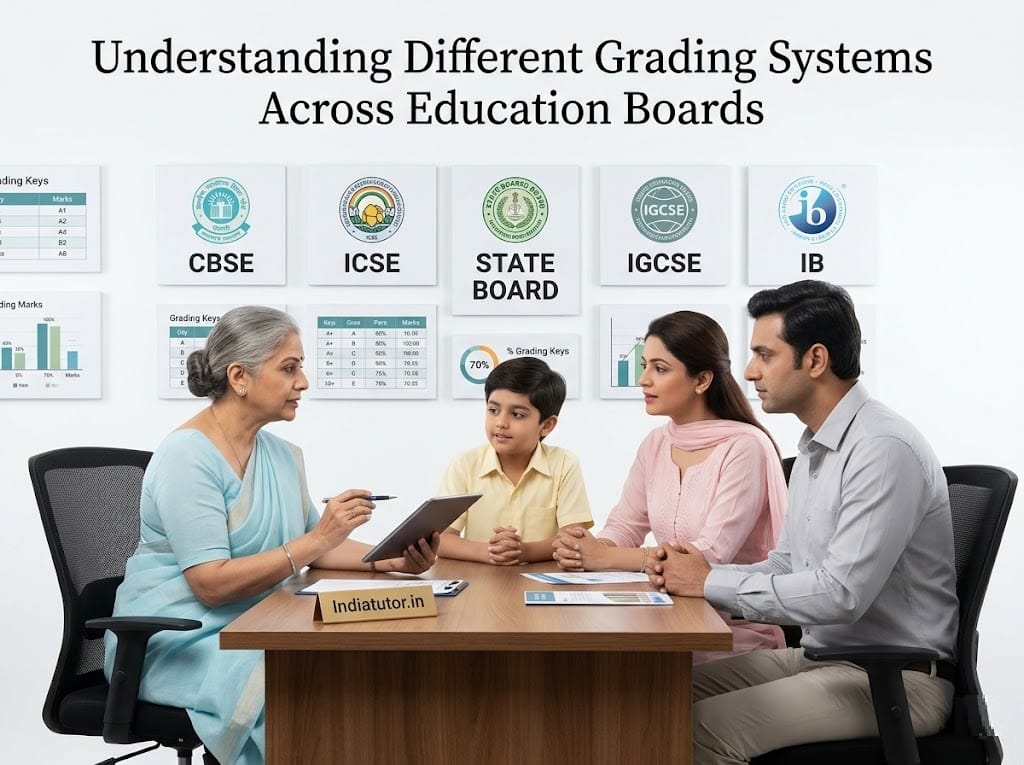
Understanding how children are assessed in school is essential for parents. Marks are not just numbers on a report card. They reflect learning style, evaluation method, exam pattern, and even stress levels. In India and abroad, different education boards follow different grading systems. This often creates confusion when families compare performance or shift schools.
This guide explains how grading works across major boards like CBSE, ICSE, State Boards, IB, and Cambridge in a simple and practical way.
Why Grading Systems Are Not the Same Everywhere
Education boards do not follow a single universal method of evaluation. Each system is designed with its own philosophy. Some focus on memory-based exams, others on conceptual understanding, projects, or skill application.
According to UNESCO’s Global Education Monitoring Report, assessment methods directly influence student learning outcomes and motivation levels. Boards that use continuous evaluation tend to reduce exam pressure, while exam-heavy systems often increase performance stress.
Understanding these differences helps parents interpret marks correctly instead of comparing students unfairly.
Understanding CBSE, ICSE, ISC, State Boards, IB and Cambridge Curriculums
CBSE Grading System Explained
How CBSE evaluates students
The Central Board of Secondary Education (CBSE) uses a combination of marks and grades in many classes, especially in middle school. In Class 10, CBSE moved to a grading system in some subjects earlier, but currently uses marks with percentage and grade conversion.
For Class 10 board exams, students are assessed out of 100 per subject. Grades are derived based on marks distribution.
CBSE grade scale
CBSE typically follows a 9-point grading scale:
-
- A1: Top 1/8th of passed students
- A2: Next 1/8th
- B1, B2, C1, C2, D, E follow similarly
For example, if a student scores 95 in Mathematics, they fall in A1 category.
Key features
CBSE is known for structured syllabus aligned with competitive exams like JEE and NEET. A NCERT-based study survey shows CBSE students often perform better in national entrance exams due to concept alignment.
ICSE and ISC Grading System
Evaluation style
The Indian Certificate of Secondary Education (ICSE) and Indian School Certificate (ISC) are known for detailed subject coverage. English language skills, literature, and analytical writing carry higher weight.
Grading pattern
ICSE uses percentage-based marking but converts results into grades in some reporting formats:
-
- 90–100: A1 (Outstanding)
- 80–89: A2
- 70–79: B1
- 60–69: B2 and so on
Practical subjects and internal assessments also contribute significantly.
Why ICSE feels different
Research in curriculum studies published in Indian Education Review journals highlights that ICSE students develop stronger language and analytical skills due to broader syllabi and detailed marking schemes.
How Education Boards Affect Career Choices
State Board Grading System
Diversity across states
India has more than 30 state education boards, and each follows its own evaluation method. However, most state boards use a percentage-based system.
For example:
-
- 75% and above: Distinction
- 60–74%: First Class
- 50–59%: Second Class
Real-world impact
State boards often focus on regional language, local context, and practical knowledge. However, difficulty levels vary widely. For instance, Maharashtra State Board exams are considered moderate in difficulty, while some boards like Tamil Nadu and West Bengal are known for theory-heavy papers.
A comparative study by India Education Research Initiative found that variation in marking schemes across states can lead to 10–15% difference in average scoring patterns even with similar academic ability.
IB Grading System (International Baccalaureate)
Global evaluation model
The International Baccalaureate (IB) uses a point-based system instead of percentage marks.
Students are assessed on a scale of 1 to 7 in each subject. Additionally, core components like Theory of Knowledge, Extended Essay, and Creativity-Activity-Service add up to 3 extra points.
Total maximum score is 45.
What scores mean
-
- 7: Excellent understanding
- 6: Very good
- 5: Good
- 4: Satisfactory
- Below 4: Needs improvement
According to IB Global Statistics, the world average diploma score is around 30 points.
Why IB is unique
IB focuses on critical thinking, research skills, and application. Students are evaluated on essays, presentations, and projects, not just final exams.
How to Choose the Right School Board for Your Child
Cambridge Grading System (IGCSE and A Levels)
Structure of grading
Cambridge Assessment International Education uses letter grades.
For IGCSE:
-
- A* (highest)
- A, B, C, D, E
- U (ungraded)
For A Levels:
-
- A*, A, B, C, D, E
Percentage alignment
While Cambridge does not officially publish strict percentage cutoffs, general academic mapping suggests:
-
- A* ≈ 90% and above
- A ≈ 80–89%
- C ≈ 60–69%
Assessment style
Cambridge focuses on application-based learning. Exams include structured problem solving, case studies, and analytical writing. It is widely accepted by universities in the UK, USA, Canada, and Australia.
Research from Cambridge International Education shows that students trained in this system often perform better in higher education due to strong analytical preparation.
Comparison of All Major Boards
Differences in scoring systems
-
- CBSE: Marks + grade conversion
- ICSE/ISC: Percentage-based with detailed evaluation
- State Boards: Mostly percentage-based, varies by state
- IB: Point system (out of 45)
- Cambridge: Letter grades (A* to U)
Difficulty perception
Difficulty depends on student ability and teaching quality. However:
-
- CBSE is structured and exam-oriented
- ICSE is content-heavy and language-focused
- State boards vary significantly
- IB is research-intensive
- Cambridge is concept-driven
Why comparison is difficult
A student scoring 85% in ICSE may have a different academic workload than a student scoring 85% in CBSE. Similarly, IB 35 points cannot be directly compared to percentage marks.
Education experts from OECD studies suggest that comparing boards without context often leads to misleading conclusions about student ability.
Common Academic Challenges Students Face in Different Boards
Common Challenges Parents Face
Misinterpretation of grades
Parents often compare percentages without understanding grading philosophy. A 75% in ICSE may reflect stronger analytical depth than a 90% in some other systems.
Board transition issues
Students shifting from State Board to CBSE or CBSE to IB often struggle due to different evaluation styles.
Exam pressure
Boards with high-stakes final exams increase stress, while continuous assessment systems require consistent effort throughout the year.
Lack of subject clarity
Many students do not fully understand what examiners expect in answers, especially in IB and Cambridge systems.
Why Understanding Grading Systems Matters
A clear understanding helps parents:
-
- Set realistic expectations
- Avoid unnecessary comparison
- Identify learning gaps early
- Support better academic planning
- Choose appropriate tutoring support
It also helps students understand how to prepare strategically instead of memorizing blindly.
Why Personalized Tuition Improves Performance Across All Education Boards
Role of Private Tutors in Different Board Systems
Every education board follows a unique assessment method, which makes one-size-fits-all teaching ineffective. A private tutor helps bridge this gap by adapting learning style to the board requirement. Students receive targeted support based on exam patterns, marking schemes, and weak areas.
A good tutor explains concepts in a simplified manner, improves answer presentation, and builds exam readiness. They also provide regular feedback, which is often missing in large classrooms. For boards like IB and Cambridge, where assignments and analytical writing matter, personalized guidance becomes even more important.
Private tuition also helps students adjust during board transitions, improve confidence, and reduce academic pressure through structured learning plans tailored to their curriculum.
Looking for expert tutors?
Find Verified Tutors on IndiaTutor.in
About the Author
Nidhi Mehta is the founder of IndiaTutor.in and a professional online educator with over 11 years of teaching experience. She specializes in tutoring Classes 1 to 6 across core academic subjects, with a strong focus on concept clarity and foundational skill-building. Her teaching approach is based on personalized, one-to-one learning that helps students develop long-term academic confidence and understanding.
Visit her profile Visit About Us Page
Share your Feedback or Review – Contact Us
Tutors, Register your Tutor profile
Career Tutors, Get Personalized Tutor Branding Services
Do you Own a Tuition Center? List it here
Are you a Parent or Student? Share your Tutor Requirement


