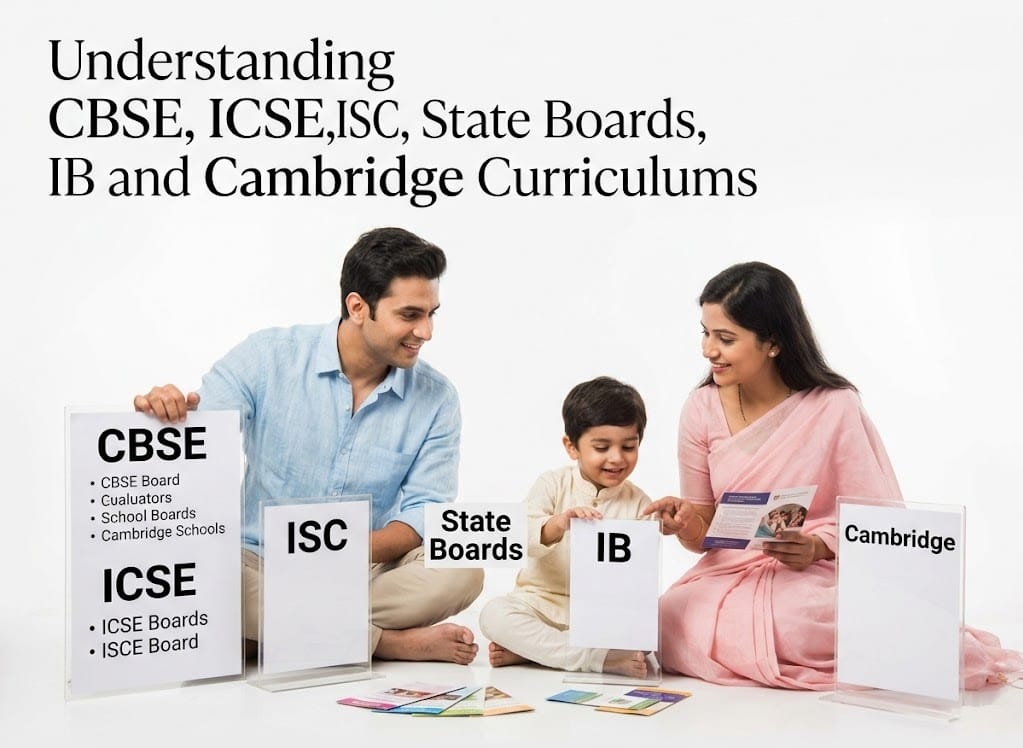
Choosing the right school curriculum is one of the most important decisions parents make for their child’s education. Every curriculum follows a different teaching approach, assessment style, and learning philosophy. While all aim to build knowledge and skills, they prepare students in different ways for higher education and future careers.
In India, the most common school curriculums include CBSE, ICSE, ISC, State Boards, the International Baccalaureate (IB), and Cambridge. Understanding how each one works can help parents select the best fit for their child’s learning style, academic goals, and future plans.
According to the Ministry of Education, India has more than 1.5 million schools serving over 250 million students, making it one of the world’s largest education systems. Students today have more curriculum choices than ever before, making informed decisions increasingly important.
How Education Boards Affect Career Choices
Why Understanding Different School Curriculums Matters
Every child learns differently. Some students enjoy structured learning, while others perform better through projects, research, discussions, and practical activities. The curriculum influences:
-
- Subjects offered
- Teaching methods
- Examination pattern
- Grading system
- Homework expectations
- Critical thinking development
- College and career opportunities
Choosing the right curriculum is not about finding the “best” one. It is about finding the one that best matches a student’s strengths, interests, and long-term goals.
What is CBSE?
The Central Board of Secondary Education (CBSE) is one of India’s largest national education boards. Thousands of schools across India and many international schools abroad follow the CBSE curriculum.
Key Features of CBSE
-
- Uniform curriculum across affiliated schools
- Strong emphasis on Mathematics and Science
- NCERT textbooks form the academic foundation
- Regular syllabus updates
- Focus on conceptual understanding
- Widely accepted across Indian colleges and universities
Who Benefits Most from CBSE?
CBSE is often preferred by families whose children may relocate frequently because the curriculum remains consistent across affiliated schools.
It is also a popular choice for students preparing for competitive examinations such as engineering and medical entrance tests because these exams are largely based on NCERT concepts.
What is ICSE?
The Indian Certificate of Secondary Education (ICSE) is conducted by the Council for the Indian School Certificate Examinations (CISCE).
ICSE is known for its balanced curriculum that gives equal importance to languages, sciences, mathematics, social sciences, arts, and practical learning.
Key Features of ICSE
-
- Strong focus on English language skills
- Detailed subject content
- Project work and internal assessments
- Application-based learning
- Broad subject choices
Students often develop strong communication, analytical thinking, and writing skills through the ICSE curriculum.
What is ISC?
The Indian School Certificate (ISC) is the senior secondary curriculum offered by CISCE for Classes 11 and 12.
Key Features of ISC
-
- Flexible subject combinations
- In-depth academic content
- Strong emphasis on analytical writing
- Extensive practical and project work
- Preparation for university education
Students can choose combinations across Science, Commerce, Humanities, and other disciplines depending on their career aspirations.
How to Choose the Right School Board for Your Child
Understanding State Boards
Every Indian state has its own education board designed according to regional educational priorities and state-level requirements.
Examples include boards in Maharashtra, Tamil Nadu, Karnataka, Uttar Pradesh, Rajasthan, Gujarat, West Bengal, Kerala, Punjab, and many other states.
Key Features of State Boards
-
- Regional language options
- Affordable education
- Curriculum aligned with state universities
- Focus on local history and culture
- State-level examination system
Many students successfully qualify for engineering, medical, civil services, and government examinations after studying in State Board schools.
The curriculum and assessment methods may vary from one state to another.
What is the International Baccalaureate (IB)?
The International Baccalaureate (IB) is an internationally recognized education framework followed by schools in more than 160 countries.
Rather than emphasizing memorization, IB encourages students to become independent thinkers, researchers, and effective communicators.
Main IB Programmes
Primary Years Programme (PYP)
Designed for younger learners with inquiry-based education.
Middle Years Programme (MYP)
Encourages interdisciplinary learning and practical application.
Diploma Programme (DP)
A rigorous programme for students aged 16 to 19 that is widely respected by universities worldwide.
Key Features of IB
-
- Inquiry-based learning
- Research projects
- International perspective
- Creativity, Activity and Service (CAS)
- Critical thinking
- Independent learning
Many universities around the world value the research and analytical skills developed through the IB Diploma Programme.
Common Academic Challenges Students Face in Different Boards
What is Cambridge Curriculum?
The Cambridge curriculum is developed by Cambridge Assessment International Education and is followed by schools in more than 160 countries.
It provides a flexible learning pathway from primary education through advanced secondary education.
Cambridge Learning Stages
Cambridge Primary
Builds strong foundations in literacy, numeracy, and science.
Cambridge Lower Secondary
Develops subject knowledge and problem-solving skills.
Cambridge IGCSE
Typically taken by students aged 14 to 16, Cambridge IGCSE is one of the world’s most recognized international qualifications.
Students can choose from a wide range of subjects according to their interests.
Cambridge International AS & A Level
These advanced qualifications prepare students for university education across the world.
Key Features of Cambridge
-
- Flexible subject selection
- Global recognition
- Conceptual learning
- Practical assessments
- Research-based assignments
- Development of independent learning skills
Cambridge qualifications are accepted by universities in many countries.
Understanding Different Grading Systems Across Education Boards
Comparing the Major School Curriculums
Learning Style
CBSE focuses on conceptual clarity.
ICSE provides detailed subject knowledge.
ISC promotes deeper academic understanding.
State Boards vary depending on the state.
IB emphasizes inquiry and research.
Cambridge encourages flexible and application-oriented learning.
Assessment
CBSE combines theory with competency-based questions.
ICSE includes written examinations along with project work.
ISC places strong emphasis on analytical writing and practical assessments.
State Boards follow their respective examination systems.
IB evaluates students using coursework, projects, presentations, and examinations.
Cambridge uses a combination of written papers, coursework, and practical assessments depending on the subject.
Best for Higher Education
All these curriculums provide pathways to higher education.
The right choice depends on where a student intends to study and the learning environment that suits them best.
Students aiming for Indian competitive examinations often find CBSE helpful because of its alignment with NCERT.
Students planning to study overseas may benefit from IB or Cambridge qualifications, as these are widely recognized internationally.
Which Curriculum is the Hardest?
There is no universally hardest curriculum.
Difficulty depends on several factors:
-
- Learning style
- Interest in subjects
- Quality of teaching
- Study habits
- Time management
- Academic support
A curriculum that challenges one student may be ideal for another.
Why Personalized Tuition Improves Performance Across All Education Boards
Common Misconceptions
Higher Fees Mean Better Education
School quality depends on teaching standards, student support, and learning environment, not only on curriculum or fees.
One Curriculum Guarantees Success
Academic success depends on consistent effort, curiosity, discipline, and guidance rather than the curriculum alone.
Students Cannot Switch Curriculums
Many students successfully transition between curriculums with proper planning and academic support.
How Parents Can Choose the Right Curriculum
Before selecting a curriculum, consider:
-
- Your child’s interests
- Learning preferences
- Future career plans
- College aspirations
- Language comfort
- School teaching quality
- Availability of academic support
Visiting schools, interacting with teachers, and understanding the curriculum structure can help parents make a confident decision.
Frequently Asked Questions
Which curriculum is best for engineering and medical entrance exams?
Many students preparing for national competitive examinations prefer CBSE because of its close alignment with NCERT textbooks.
Is ICSE better than CBSE?
Neither is universally better. Both have different strengths and suit different learners.
Is IB accepted in India?
Yes. Universities across India and around the world recognize IB qualifications, subject to their admission requirements.
Is Cambridge accepted by Indian universities?
Yes. Cambridge qualifications are accepted by many Indian universities as well as institutions across the globe, provided students meet the respective eligibility criteria.
Can students move from one curriculum to another?
Yes. Many schools admit transfer students, although some additional academic preparation may be required depending on syllabus differences.
My Thoughts
Every curriculum offers valuable learning opportunities. The best choice depends on a student’s goals, interests, strengths, and preferred learning style. Rather than searching for the “perfect” board, focus on finding a school and curriculum that encourage curiosity, confidence, and consistent academic growth.
No matter which curriculum a student follows, there may be times when extra academic support becomes valuable. A private tutor provides individual attention, explains difficult concepts at the student’s pace, strengthens confidence, and fills learning gaps that may not be addressed in a busy classroom. Personalised tuition also helps students prepare effectively for school assessments, board examinations, and competitive tests while developing better study habits and independent learning skills.
Find Verified Tutors on IndiaTutor.in
About the Author
Nidhi Mehta is the founder of IndiaTutor.in and a professional online educator with over 11 years of teaching experience. She specializes in tutoring Classes 1 to 6 across core academic subjects, with a strong focus on concept clarity and foundational skill-building. Her teaching approach is based on personalized, one-to-one learning that helps students develop long-term academic confidence and understanding.
Visit her profile Visit About Us Page
Share your Feedback or Review – Contact Us
Tutors, Register your Tutor profile
Career Tutors, Get Personalized Tutor Branding Services
Do you Own a Tuition Center? List it here
Are you a Parent or Student? Share your Tutor Requirement


