

How to Build a High-Converting Online Tutor Profile That Gets Enquiries

How to Build a High-Converting Online Tutor Profile That Gets Enquiries

Finding students online is no longer just about being a qualified teacher. Parents and students have thousands of tutors to choose from, and your online profile is often the first impression they have of you. A well-written, complete, and trustworthy tutor profile can significantly improve your chances of receiving genuine enquiries.

Whether you teach school subjects, competitive exams, languages, music, coding, or any other skill, your profile should answer one important question: Why should a parent choose you over hundreds of other tutors?

This guide explains how to create an online tutor profile that attracts attention, builds trust, and encourages parents to contact you.

Why Your Tutor Profile Matters

According to research by the [“organization”,”Nielsen Norman Group”,”User experience research organization”], visitors typically spend only a few seconds scanning a webpage before deciding whether to continue reading. This means your tutor profile needs to communicate value quickly and clearly.

A complete profile helps parents understand:

    • What subjects you teach
    • Which classes and boards you cover
    • Your qualifications and teaching experience
    • Your teaching style
    • Whether you are the right tutor for their child

Parents usually compare several tutors before making contact. A professional profile can make that decision much easier.

How to Build Credibility as a New Online Teacher

What Makes a Tutor Profile High-Converting?

A high-converting profile is one that encourages visitors to take the next step, whether that is sending an enquiry, making a phone call, or requesting a trial class.

Several factors influence this decision.

A Clear and Informative Title

Your title should immediately explain what you teach.

Instead of writing:

“Experienced Teacher”

Write something more specific such as:

“Online Mathematics Tutor for CBSE Class 6–12”

or

“English Language Tutor for School Students and Adults”

A descriptive title also helps search engines understand your page, improving your chances of appearing in relevant search results.

Write an Honest Introduction

The first paragraph should briefly introduce yourself.

Include information such as:

    • Your teaching experience
    • Subjects taught
    • Classes or age groups
    • Teaching mode
    • What students can expect

Keep it natural and easy to understand.

For example:

“I have been teaching Mathematics for more than 10 years and conduct personalised online classes for students from Class 6 to 12 across CBSE, ICSE, State Boards, and international curricula. My lessons focus on concept clarity, regular practice, and confidence building.”

Parents appreciate clarity more than exaggerated claims.

Highlight Your Qualifications

Qualifications establish credibility.

Mention relevant degrees, certifications, teacher training, or professional experience.

Examples include:

    • B.Ed.
    • M.Sc. Mathematics
    • M.A. English
    • IIT Graduate
    • Certified Language Trainer
    • Former School Teacher

If you have specialised training in online teaching or educational technology, include that as well.

Explain Your Teaching Experience

Experience is more than the number of years you have taught.

Describe:

    • Subjects handled
    • Boards covered
    • Student age groups
    • Online teaching experience
    • Exam preparation experience

For example, instead of writing:

“10 years experience.”

Write:

“I have taught over 500 students from CBSE, ICSE, IGCSE, IB, and State Boards, helping learners improve conceptual understanding and examination performance.”

Specific information builds confidence.

Simple Online Teaching Setup for Tutors at Home

Describe Your Teaching Method

Parents want to know how you teach.

Explain your approach in simple language.

You may mention:

Personalised Learning

Every student learns differently. Explain how you adapt lessons according to the student’s pace and strengths.

Concept-Based Teaching

Many parents prefer tutors who focus on understanding rather than memorisation.

Mention how you simplify difficult topics using examples, diagrams, activities, or real-life situations.

Regular Assessments

Weekly tests, assignments, revision sessions, and progress reports reassure parents that learning is being monitored.

Doubt Support

Mention whether students can ask questions outside class hours or receive additional revision support before examinations.

Mention Boards, Curriculum, and Subjects Clearly

Avoid making parents search for basic information.

Create a clear list of:

    • Subjects
    • Classes
    • Boards
    • Competitive exams
    • Languages

For example:

    • Mathematics
    • Science
    • English
    • CBSE
    • ICSE
    • State Boards
    • IGCSE
    • IB
    • Olympiads
    • JEE Foundation

This also improves keyword relevance for search engines.

Best Strategies for Student Enquiries for Online Tutors

Add a Professional Profile Photograph

A profile photo creates trust.

Research published by the [“organization”,”Baymard Institute”,”E-commerce usability research organization”] has consistently shown that trust signals strongly influence user decisions online. While tutors are different from online stores, the same principle applies: genuine identity builds confidence.

Choose a recent photograph that is:

    • Clear
    • Well-lit
    • Professionally dressed
    • Friendly
    • Looking towards the camera

Avoid group photographs, selfies, heavy filters, or distracting backgrounds.

Showcase Your Achievements

Achievements provide social proof.

You may include:

    • Student success stories
    • Board examination results
    • Olympiad winners
    • Scholarship selections
    • Years of teaching
    • Awards
    • School or institutional recognition

Use factual information.

Instead of saying:

“My students always score excellent marks.”

Write:

“Several of my students have scored above 90% in CBSE board examinations.”

Specific statements are more believable.

Include Keywords Naturally

Many parents search online using phrases like:

    • Online Maths Tutor
    • CBSE Science Teacher
    • English Tutor Near Me
    • Online Tuition for Class 10
    • Physics Tutor for NEET Foundation

Use these naturally throughout your profile.

Avoid repeating the same keyword multiple times. Search engines today reward useful and natural writing rather than keyword stuffing.

According to [“company”,”Google”,”Search engine company”], content created primarily for people generally performs better than content written only for search engines.

Keep Your Information Updated

An outdated profile may discourage enquiries.

Review your profile regularly.

Update:

    • Experience
    • Qualifications
    • New subjects
    • New boards
    • Student achievements
    • Availability
    • Teaching methods

Fresh content also helps search engines recognise that your page remains active.

What Makes a Tutor Profile Stand Out in Online Searches

Build Trust Through Transparency

Parents appreciate honesty.

Clearly mention:

    • Teaching mode
    • Available timings
    • Languages spoken
    • Areas of expertise
    • Trial class availability
    • Years of experience

If you specialise in helping weak students, gifted learners, or examination preparation, explain that clearly.

Trust often leads to enquiries.

Write in Simple Language

Avoid educational jargon.

Parents from different educational backgrounds should easily understand your profile.

Instead of using complicated terminology, write naturally.

Simple writing increases readability and keeps visitors engaged for longer.

Common Mistakes That Reduce Enquiries

Many tutors unknowingly make small mistakes that discourage parents.

Incomplete Information

Missing qualifications, subjects, or experience create uncertainty.

Very Short Profiles

One or two sentences rarely provide enough information for parents to make a decision.

Grammar and Spelling Errors

Poor writing may affect credibility.

Review your profile carefully before publishing.

Overusing Promotional Claims

Avoid phrases such as:

    • Best tutor in India
    • Guaranteed 100% marks
    • Number one teacher

Parents generally trust factual information more than exaggerated promises.

Poor Profile Images

Blurry or casual photographs reduce professionalism.

Think Like a Parent

Before publishing your profile, ask yourself these questions.

Does the profile clearly explain what I teach?

Does it show why I am qualified?

Does it explain how I teach?

Does it answer common parent questions?

Does it build confidence?

If the answer is yes, your profile is already stronger than many tutor profiles available online.

Small Improvements Can Make a Big Difference

You do not need to rewrite your entire profile every month.

Even small updates can improve performance.

Examples include:

    • Adding a recent achievement
    • Updating experience
    • Improving your introduction
    • Uploading a better photograph
    • Including additional subjects
    • Mentioning new teaching tools

These improvements make your profile more informative and useful.

My Thoughts

A high-converting tutor profile is built on trust, clarity, and relevance. Parents are not simply looking for qualifications; they are looking for a teacher who understands their child’s learning needs and communicates professionalism from the very first interaction. By presenting accurate information, explaining your teaching approach, highlighting your experience, and keeping your profile updated, you make it easier for families to choose you with confidence.

If you are looking to expand your reach and connect directly with students across India and abroad, listing your profile on IndiaTutor.in can help increase your online visibility. Your profile becomes easier for parents to discover through search, allowing them to contact you directly without intermediary commissions. With affordable listing plans, nationwide exposure, and a platform dedicated exclusively to tutors, IndiaTutor.in offers a practical way to grow your teaching career and reach more genuine student enquiries.

Want to Teach Students in India and Abroad?

Register your Tutor Profile on IndiaTutor.in

About the Author

Nidhi Mehta is the founder of IndiaTutor.in and a professional online educator with over 11 years of teaching experience. She specializes in tutoring Classes 1 to 6 across core academic subjects, with a strong focus on concept clarity and foundational skill-building. Her teaching approach is based on personalized, one-to-one learning that helps students develop long-term academic confidence and understanding.

Visit her profile    Visit About Us Page

How to Choose the Right School Board for Your Child

How to Choose the Right School Board for Your Child

Choosing a school for your child is one of the biggest decisions you will make as a parent. Along with selecting the right school, choosing the right education board is equally important. The curriculum your child follows can influence the way they learn, prepare for exams, develop skills and plan for higher education.

There is no single board that is best for every child. A curriculum that works well for one student may not suit another. Factors such as learning style, career goals, future plans, family circumstances and academic interests all play an important role.

This guide explains the major school boards in India and international curriculums in simple language, helping you make an informed decision.

What Is a School Board?

A school board or curriculum sets the academic framework that schools follow. It determines:

    • Subjects taught
    • Course content
    • Teaching methods
    • Examination pattern
    • Grading system
    • Learning outcomes
    • Assessment standards

Different boards have different approaches. Some focus more on conceptual understanding, while others place greater emphasis on examinations, projects or research-based learning.

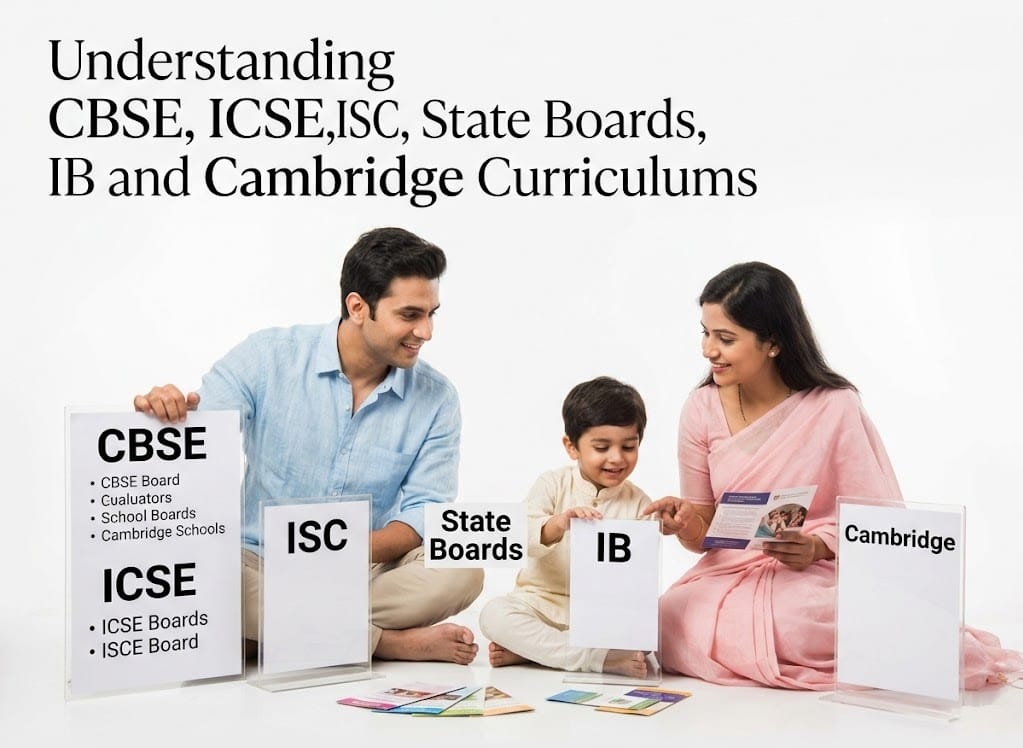
Understanding CBSE, ICSE, ISC, State Boards, IB and Cambridge Curriculums  

Why Choosing the Right Board Matters

The right curriculum helps children learn with confidence instead of feeling overwhelmed.

Choosing a suitable board can affect:

    • Academic performance
    • Interest in learning
    • Confidence in classrooms
    • Preparation for competitive exams
    • Admission to colleges in India and abroad
    • Development of practical and analytical skills

According to the National Education Policy (NEP) 2020, education should move beyond rote learning and encourage critical thinking, creativity and problem-solving. Many school boards have gradually updated their curriculum to support these goals.

Major School Boards Available in India

CBSE

The Central Board of Secondary Education (CBSE) is one of India’s largest education boards, with more than 30,000 affiliated schools in India and abroad.

CBSE focuses on:

    • Strong fundamentals
    • Mathematics and Science
    • Standardised syllabus
    • NCERT textbooks
    • Competitive exam preparation

Students preparing for entrance examinations such as JEE and NEET often find the CBSE curriculum closely aligned with these exams because many questions are based on NCERT concepts.

CBSE is suitable for families that relocate frequently since thousands of schools across India follow the same curriculum.

ICSE and ISC

The Indian Certificate of Secondary Education (ICSE) covers Class 10, while the Indian School Certificate (ISC) covers Classes 11 and 12.

The curriculum generally includes:

    • Detailed subject coverage
    • Strong English language skills
    • Project-based assessments
    • Balanced focus on Science, Commerce, Humanities and Arts

Students who enjoy reading, writing, languages and detailed learning often perform well under this curriculum.

State Boards

Every Indian state has its own education board.

Examples include:

    • Maharashtra State Board
    • Tamil Nadu State Board
    • Karnataka State Board
    • Gujarat State Board
    • Rajasthan Board
    • Uttar Pradesh Board

State boards usually align their curriculum with local educational needs and regional languages. Students planning to continue higher education within their own state may find this curriculum beneficial.

International Baccalaureate (IB)

The International Baccalaureate is recognised in many countries around the world.

IB focuses on:

    • Inquiry-based learning
    • Research skills
    • Independent thinking
    • Global perspectives
    • Creativity and communication

Instead of memorising facts, students are encouraged to ask questions, conduct research and solve real-world problems.

IB is often preferred by families planning international education.

Cambridge Curriculum

The Cambridge curriculum, offered by Cambridge Assessment International Education, is followed in schools across more than 160 countries.

It includes programmes such as:

    • Cambridge Primary
    • Cambridge Lower Secondary
    • Cambridge IGCSE
    • Cambridge International AS & A Level

Cambridge encourages flexible learning, subject choices, analytical thinking and practical application of knowledge.

Many universities worldwide recognise Cambridge qualifications.

How Education Boards Affect Career Choices

How Different Boards Compare

Learning Style

CBSE focuses on structured learning and concept clarity.

ICSE and ISC provide detailed subject knowledge and strong language development.

IB encourages inquiry, discussion and independent research.

Cambridge combines conceptual learning with international assessment standards.

State boards vary depending on the state curriculum.

Examination Pattern

CBSE uses a combination of theory and internal assessment.

ICSE and ISC include projects, practical work and written examinations.

IB evaluates students through assignments, presentations, internal assessments and final examinations.

Cambridge uses coursework along with external assessments depending on the programme.

Subject Flexibility

International curriculums generally offer greater flexibility in selecting subjects.

CBSE, ICSE and State Boards also provide options, especially in higher classes, although the structure is usually more defined.

Common Academic Challenges Students Face in Different Boards

Questions Every Parent Should Ask

What Are My Child’s Strengths?

Every child learns differently.

Some enjoy practical activities.

Some prefer reading.

Others learn best through discussions or visual examples.

Choosing a curriculum that matches your child’s natural learning style often leads to better academic outcomes.

Does My Family Relocate Frequently?

Families working in transferable jobs often prefer CBSE because affiliated schools are available throughout India.

International curriculums may also be useful for families moving overseas.

Where Does My Child Plan to Study Later?

Students aiming for Indian engineering or medical entrance examinations often find CBSE helpful.

Students planning overseas education may benefit from IB or Cambridge programmes, depending on their chosen university and country.

What Is My Budget?

School fees vary significantly.

International curriculum schools generally charge higher tuition fees than many CBSE, ICSE or State Board schools.

Parents should also consider expenses such as books, activities, uniforms and examination fees.

Does My Child Enjoy Practical Learning?

Children who enjoy experiments, presentations, projects and research often adapt well to IB and Cambridge.

Students who prefer structured textbooks and regular examinations may find CBSE or ICSE more comfortable.

Understanding Different Grading Systems Across Education Boards

Common Myths About School Boards

The Toughest Board Is Always the Best

Difficulty does not guarantee better learning.

A curriculum should match the child’s abilities, interests and future plans.

One Board Guarantees Success

Academic success depends more on consistent effort, quality teaching, good study habits and family support than the board itself.

Students from every major curriculum secure admission to leading colleges in India and abroad each year.

Changing Boards Is Impossible

Many students successfully change from one curriculum to another.

Some adjustment may be required, especially in subjects such as English, Mathematics or Science, but proper guidance can make the transition smoother.

Signs You May Need to Reconsider Your Choice

You may want additional support if your child:

    • Frequently struggles to understand lessons
    • Shows a sudden drop in academic performance
    • Feels anxious about schoolwork
    • Finds the pace too fast or too slow
    • Has difficulty adapting after changing schools
    • Loses confidence despite regular effort

These situations often indicate that the child needs better academic support rather than a different curriculum.

Why Personalized Tuition Improves Performance Across All Education Boards

Tips for Making the Right Decision

Visit Multiple Schools

Meet teachers and understand how the curriculum is delivered.

Teaching quality often matters more than the curriculum alone.

Speak With Other Parents

Parents whose children already study in a particular board can provide valuable practical insights.

Focus on Your Child, Not Trends

Avoid choosing a curriculum simply because friends or relatives recommend it.

Every child has different strengths, interests and learning preferences.

Think Long Term

Consider where your child may study after school, whether your family expects to relocate and what learning environment will help them stay motivated over the next several years.

Every Child Can Succeed

The best school board is the one that allows your child to enjoy learning, build confidence and develop essential life skills.

Whether your child studies under CBSE, ICSE, ISC, a State Board, IB or Cambridge, success ultimately depends on supportive teachers, consistent practice, curiosity and encouragement at home.

If your child finds certain subjects challenging, one-to-one guidance can make a significant difference. A private tutor provides personalised attention, identifies learning gaps and teaches at a pace that suits the student. Tutors also help improve confidence, strengthen concepts and prepare effectively for school assessments and board examinations. Finding an experienced tutor with expertise in your child’s curriculum can make learning more enjoyable and help your child reach their full potential.

Looking for expert tutors?

Find Verified Tutors on IndiaTutor.in

About the Author

Nidhi Mehta is the founder of IndiaTutor.in and a professional online educator with over 11 years of teaching experience. She specializes in tutoring Classes 1 to 6 across core academic subjects, with a strong focus on concept clarity and foundational skill-building. Her teaching approach is based on personalized, one-to-one learning that helps students develop long-term academic confidence and understanding.

Visit her profile    Visit About Us Page

Understanding CBSE, ICSE, ISC, State Boards, IB and Cambridge Curriculums

Understanding CBSE, ICSE, ISC, State Boards, IB and Cambridge Curriculums

Choosing the right school curriculum is one of the most important decisions parents make for their child’s education. Every curriculum follows a different teaching approach, assessment style, and learning philosophy. While all aim to build knowledge and skills, they prepare students in different ways for higher education and future careers.

In India, the most common school curriculums include CBSE, ICSE, ISC, State Boards, the International Baccalaureate (IB), and Cambridge. Understanding how each one works can help parents select the best fit for their child’s learning style, academic goals, and future plans.

According to the Ministry of Education, India has more than 1.5 million schools serving over 250 million students, making it one of the world’s largest education systems. Students today have more curriculum choices than ever before, making informed decisions increasingly important.

How Education Boards Affect Career Choices

Why Understanding Different School Curriculums Matters

Every child learns differently. Some students enjoy structured learning, while others perform better through projects, research, discussions, and practical activities. The curriculum influences:

    • Subjects offered
    • Teaching methods
    • Examination pattern
    • Grading system
    • Homework expectations
    • Critical thinking development
    • College and career opportunities

Choosing the right curriculum is not about finding the “best” one. It is about finding the one that best matches a student’s strengths, interests, and long-term goals.

What is CBSE?

The Central Board of Secondary Education (CBSE) is one of India’s largest national education boards. Thousands of schools across India and many international schools abroad follow the CBSE curriculum.

Key Features of CBSE

    • Uniform curriculum across affiliated schools
    • Strong emphasis on Mathematics and Science
    • NCERT textbooks form the academic foundation
    • Regular syllabus updates
    • Focus on conceptual understanding
    • Widely accepted across Indian colleges and universities

Who Benefits Most from CBSE?

CBSE is often preferred by families whose children may relocate frequently because the curriculum remains consistent across affiliated schools.

It is also a popular choice for students preparing for competitive examinations such as engineering and medical entrance tests because these exams are largely based on NCERT concepts.

What is ICSE?

The Indian Certificate of Secondary Education (ICSE) is conducted by the Council for the Indian School Certificate Examinations (CISCE).

ICSE is known for its balanced curriculum that gives equal importance to languages, sciences, mathematics, social sciences, arts, and practical learning.

Key Features of ICSE

    • Strong focus on English language skills
    • Detailed subject content
    • Project work and internal assessments
    • Application-based learning
    • Broad subject choices

Students often develop strong communication, analytical thinking, and writing skills through the ICSE curriculum.

What is ISC?

The Indian School Certificate (ISC) is the senior secondary curriculum offered by CISCE for Classes 11 and 12.

Key Features of ISC

    • Flexible subject combinations
    • In-depth academic content
    • Strong emphasis on analytical writing
    • Extensive practical and project work
    • Preparation for university education

Students can choose combinations across Science, Commerce, Humanities, and other disciplines depending on their career aspirations.

How to Choose the Right School Board for Your Child

Understanding State Boards

Every Indian state has its own education board designed according to regional educational priorities and state-level requirements.

Examples include boards in Maharashtra, Tamil Nadu, Karnataka, Uttar Pradesh, Rajasthan, Gujarat, West Bengal, Kerala, Punjab, and many other states.

Key Features of State Boards

    • Regional language options
    • Affordable education
    • Curriculum aligned with state universities
    • Focus on local history and culture
    • State-level examination system

Many students successfully qualify for engineering, medical, civil services, and government examinations after studying in State Board schools.

The curriculum and assessment methods may vary from one state to another.

What is the International Baccalaureate (IB)?

The International Baccalaureate (IB) is an internationally recognized education framework followed by schools in more than 160 countries.

Rather than emphasizing memorization, IB encourages students to become independent thinkers, researchers, and effective communicators.

Main IB Programmes

Primary Years Programme (PYP)

Designed for younger learners with inquiry-based education.

Middle Years Programme (MYP)

Encourages interdisciplinary learning and practical application.

Diploma Programme (DP)

A rigorous programme for students aged 16 to 19 that is widely respected by universities worldwide.

Key Features of IB

    • Inquiry-based learning
    • Research projects
    • International perspective
    • Creativity, Activity and Service (CAS)
    • Critical thinking
    • Independent learning

Many universities around the world value the research and analytical skills developed through the IB Diploma Programme.

Common Academic Challenges Students Face in Different Boards

What is Cambridge Curriculum?

The Cambridge curriculum is developed by Cambridge Assessment International Education and is followed by schools in more than 160 countries.

It provides a flexible learning pathway from primary education through advanced secondary education.

Cambridge Learning Stages

Cambridge Primary

Builds strong foundations in literacy, numeracy, and science.

Cambridge Lower Secondary

Develops subject knowledge and problem-solving skills.

Cambridge IGCSE

Typically taken by students aged 14 to 16, Cambridge IGCSE is one of the world’s most recognized international qualifications.

Students can choose from a wide range of subjects according to their interests.

Cambridge International AS & A Level

These advanced qualifications prepare students for university education across the world.

Key Features of Cambridge

    • Flexible subject selection
    • Global recognition
    • Conceptual learning
    • Practical assessments
    • Research-based assignments
    • Development of independent learning skills

Cambridge qualifications are accepted by universities in many countries.

Understanding Different Grading Systems Across Education Boards

Comparing the Major School Curriculums

Learning Style

CBSE focuses on conceptual clarity.

ICSE provides detailed subject knowledge.

ISC promotes deeper academic understanding.

State Boards vary depending on the state.

IB emphasizes inquiry and research.

Cambridge encourages flexible and application-oriented learning.

Assessment

CBSE combines theory with competency-based questions.

ICSE includes written examinations along with project work.

ISC places strong emphasis on analytical writing and practical assessments.

State Boards follow their respective examination systems.

IB evaluates students using coursework, projects, presentations, and examinations.

Cambridge uses a combination of written papers, coursework, and practical assessments depending on the subject.

Best for Higher Education

All these curriculums provide pathways to higher education.

The right choice depends on where a student intends to study and the learning environment that suits them best.

Students aiming for Indian competitive examinations often find CBSE helpful because of its alignment with NCERT.

Students planning to study overseas may benefit from IB or Cambridge qualifications, as these are widely recognized internationally.

Which Curriculum is the Hardest?

There is no universally hardest curriculum.

Difficulty depends on several factors:

    • Learning style
    • Interest in subjects
    • Quality of teaching
    • Study habits
    • Time management
    • Academic support

A curriculum that challenges one student may be ideal for another.

Why Personalized Tuition Improves Performance Across All Education Boards

Common Misconceptions

Higher Fees Mean Better Education

School quality depends on teaching standards, student support, and learning environment, not only on curriculum or fees.

One Curriculum Guarantees Success

Academic success depends on consistent effort, curiosity, discipline, and guidance rather than the curriculum alone.

Students Cannot Switch Curriculums

Many students successfully transition between curriculums with proper planning and academic support.

How Parents Can Choose the Right Curriculum

Before selecting a curriculum, consider:

    • Your child’s interests
    • Learning preferences
    • Future career plans
    • College aspirations
    • Language comfort
    • School teaching quality
    • Availability of academic support

Visiting schools, interacting with teachers, and understanding the curriculum structure can help parents make a confident decision.

Frequently Asked Questions

Which curriculum is best for engineering and medical entrance exams?

Many students preparing for national competitive examinations prefer CBSE because of its close alignment with NCERT textbooks.

Is ICSE better than CBSE?

Neither is universally better. Both have different strengths and suit different learners.

Is IB accepted in India?

Yes. Universities across India and around the world recognize IB qualifications, subject to their admission requirements.

Is Cambridge accepted by Indian universities?

Yes. Cambridge qualifications are accepted by many Indian universities as well as institutions across the globe, provided students meet the respective eligibility criteria.

Can students move from one curriculum to another?

Yes. Many schools admit transfer students, although some additional academic preparation may be required depending on syllabus differences.

My Thoughts

Every curriculum offers valuable learning opportunities. The best choice depends on a student’s goals, interests, strengths, and preferred learning style. Rather than searching for the “perfect” board, focus on finding a school and curriculum that encourage curiosity, confidence, and consistent academic growth.

No matter which curriculum a student follows, there may be times when extra academic support becomes valuable. A private tutor provides individual attention, explains difficult concepts at the student’s pace, strengthens confidence, and fills learning gaps that may not be addressed in a busy classroom. Personalised tuition also helps students prepare effectively for school assessments, board examinations, and competitive tests while developing better study habits and independent learning skills.

Find Verified Tutors on IndiaTutor.in

About the Author

Nidhi Mehta is the founder of IndiaTutor.in and a professional online educator with over 11 years of teaching experience. She specializes in tutoring Classes 1 to 6 across core academic subjects, with a strong focus on concept clarity and foundational skill-building. Her teaching approach is based on personalized, one-to-one learning that helps students develop long-term academic confidence and understanding.

Visit her profile    Visit About Us Page

Why Logical Thinking Matters More Than Memorization in Computer Science

Why Logical Thinking Matters More Than Memorization in Computer Science

Computer Science is one of the most exciting subjects students can learn today. From mobile apps and websites to artificial intelligence and robotics, technology is shaping almost every aspect of modern life. However, many students make the mistake of treating Computer Science like a subject that requires memorizing definitions, formulas, and programming syntax.

While remembering certain concepts is helpful, logical thinking plays a far more important role in success. Students who develop strong reasoning skills can solve problems, write better programs, and adapt to new technologies much more effectively than those who rely only on memorization.

Understanding why logical thinking matters can help students improve their performance in school, competitive exams, higher education, and future careers.

What Is Logical Thinking in Computer Science?

Logical thinking is the ability to analyze information, identify patterns, break down problems into smaller parts, and develop step-by-step solutions.

In Computer Science, logical thinking helps students:

    • Understand how programs work
    • Identify errors in code
    • Design algorithms
    • Solve computational problems
    • Make decisions based on data
    • Create efficient solutions

Rather than simply remembering answers, students learn how to think through challenges and find solutions independently.

For example, if a student memorizes a program to calculate the average of numbers, they may struggle when asked to calculate a weighted average. A student with strong reasoning skills can adapt their understanding and solve the new problem.

Why Some Students Excel in Computer Science While Others Struggle

Why Memorization Has Limitations

Memorization can help students recall information quickly, but it has several limitations.

Technology Changes Rapidly

Programming languages, software tools, and development frameworks evolve constantly.

According to the World Economic Forum, technological change is one of the major forces transforming future jobs. Skills such as analytical thinking and problem-solving are among the most valued workplace abilities.

A student who memorizes commands may become outdated when technology changes. Someone who understands the underlying logic can learn new tools more easily.

Real Problems Rarely Match Textbook Examples

In classrooms, students often practice predictable questions. In real-world situations, problems can be unique and complex.

Software developers, cybersecurity experts, and data scientists regularly encounter challenges they have never seen before. Logical thinking enables them to analyze unfamiliar situations and create effective solutions.

Memorized Knowledge Is Easily Forgotten

Research in educational psychology suggests that information learned through rote memorization is more likely to be forgotten compared to knowledge gained through understanding and application.

Students who actively solve problems tend to retain concepts longer because they connect ideas with practical experience.

How Logical Thinking Improves Programming Skills

Programming is often described as the language of problem-solving.

Breaking Down Complex Problems

A large problem can feel overwhelming. Logical thinkers divide it into smaller tasks.

For example, creating a student attendance application may involve:

    1. Collecting student information
    2. Recording attendance
    3. Storing data
    4. Generating reports

By solving each step individually, the overall task becomes manageable.

Finding and Fixing Errors

Every programmer encounters bugs.

A study by various software engineering researchers has shown that debugging can consume a significant portion of software development time, sometimes exceeding 50% of the development process.

Students who think logically can identify where a mistake occurs and understand why it happened instead of randomly changing code.

Writing Efficient Programs

Two programs may produce the same output, but one may run much faster.

Logical reasoning helps students evaluate different approaches and select the most efficient solution.

How Students Can Build a Strong Foundation in Computer Science

The Role of Algorithms in Logical Thinking

An algorithm is a step-by-step method for solving a problem.

Every computer program relies on algorithms.

Everyday Examples of Algorithms

Students already use algorithms without realizing it.

Examples include:

    • Following a recipe
    • Finding the shortest route to school
    • Organizing books alphabetically
    • Following instructions to assemble furniture

Computer Science teaches students to develop similar structured approaches for technical problems.

Why Algorithmic Thinking Matters

Algorithmic thinking encourages students to:

    • Analyze situations carefully
    • Consider multiple solutions
    • Predict outcomes
    • Improve efficiency

These abilities are valuable not only in academics but also in daily life.

Logical Thinking and Artificial Intelligence

Artificial Intelligence is one of the fastest-growing areas of technology.

Many students believe AI development requires memorizing complex programming concepts. In reality, logical reasoning forms the foundation of AI systems.

Machine learning models use logical structures to recognize patterns, classify information, and make predictions.

Whether students want to work in AI, robotics, game development, or software engineering, reasoning skills remain essential.

Pattern Recognition

Pattern recognition is a major component of logical thinking.

Students who can identify relationships between data points often perform better in:

    • Coding
    • Mathematics
    • Data Science
    • Artificial Intelligence

For example, recognizing patterns in a sequence can help students develop efficient algorithms.

Computer Science Skills Every School Student Should Develop

How Schools and Exams Are Changing

Educational systems around the world are gradually placing greater emphasis on critical thinking and application-based learning.

Many modern Computer Science examinations now include:

    • Problem-solving questions
    • Case studies
    • Practical coding exercises
    • Real-world scenarios

Students who focus only on memorization may struggle when questions require analysis and reasoning.

The Growing Importance of Computational Thinking

Computational thinking is a problem-solving approach widely promoted in modern education.

According to educational research, computational thinking includes:

    • Decomposition
    • Pattern recognition
    • Abstraction
    • Algorithm design

These skills help students solve problems systematically and efficiently.

Ways Students Can Improve Logical Thinking

The good news is that logical thinking can be developed with regular practice.

Solve Coding Challenges

Coding platforms and programming exercises encourage students to think critically.

Rather than copying solutions, students should attempt problems independently before reviewing answers.

Learn Through Projects

Creating small projects helps students apply concepts in meaningful ways.

Examples include:

    • Calculator applications
    • Quiz programs
    • Personal websites
    • Budget trackers

Projects expose students to practical challenges that strengthen reasoning abilities.

Play Logic-Based Games

Games such as Sudoku, chess, puzzles, and strategy games can improve analytical skills.

Several studies have suggested that such activities may enhance problem-solving and planning abilities.

Ask “Why” Instead of “What”

When learning a concept, students should focus on understanding why it works.

For example, instead of memorizing a loop structure, ask:

    • Why is the loop needed?
    • When should it be used?
    • What problem does it solve?

This approach leads to deeper understanding.

How to Make Computer Science Fun and Exciting for Children

Common Mistakes Students Make

Memorizing Entire Programs

Many students attempt to remember complete code examples without understanding the logic behind them.

This often creates confusion when questions change slightly.

Ignoring Problem Analysis

Students sometimes rush into writing code before understanding the problem.

Successful programmers spend time analyzing requirements before developing solutions.

Fear of Making Mistakes

Errors are a natural part of learning Computer Science.

Every bug provides an opportunity to improve reasoning and debugging skills.

Students should view mistakes as learning experiences rather than failures.

How Logical Thinking Helps Beyond Computer Science

The benefits of logical thinking extend far beyond programming.

Students develop skills that are useful in:

    • Mathematics
    • Science
    • Engineering
    • Business
    • Finance
    • Everyday decision-making

Employers increasingly value candidates who can analyze situations, solve problems, and adapt to changing environments.

The World Economic Forum consistently ranks analytical thinking and problem-solving among the most important workplace skills for the future.

Questions Parents Should Ask Before Hiring a Computer Science Tutor

My Thoughts

Computer Science is not about memorizing hundreds of commands or copying code from textbooks. At its core, it is about understanding problems and developing logical solutions. Students who focus on reasoning, analysis, and problem-solving gain a deeper understanding of technology and become more confident learners.

As technology continues to evolve, logical thinking will remain valuable while specific tools and programming languages may change. Building strong reasoning skills today can prepare students for academic success, future careers, and lifelong learning.

For students who find Computer Science challenging, a private tutor can provide personalized guidance based on their learning style and current skill level. One-to-one support helps students understand concepts more clearly, strengthen logical reasoning, and overcome specific difficulties. A qualified tutor can also provide structured practice, regular feedback, and targeted problem-solving strategies that improve confidence and academic performance.

Looking for expert Computer Science tutors?

Find Computer Science Tutors on IndiaTutor.in

About the Author

Nidhi Mehta is the founder of IndiaTutor.in and a professional online educator with over 11 years of teaching experience. She specializes in tutoring Classes 1 to 6 across core academic subjects, with a strong focus on concept clarity and foundational skill-building. Her teaching approach is based on personalized, one-to-one learning that helps students develop long-term academic confidence and understanding.

Visit her profile    Visit About Us Page

How to Handle Parent Expectations as a Private Tutor

How to Handle Parent Expectations as a Private Tutor

Private tutoring is no longer limited to helping students complete homework or prepare for exams. Today, parents invest significant time and money in tutoring because they expect measurable academic improvement, better study habits, increased confidence, and long-term success for their children.

A private tutor’s ability to manage parent expectations can be just as important as subject knowledge. Even highly qualified tutors can face challenges when expectations are unclear or unrealistic. Learning how to communicate effectively with parents helps build trust, improve student outcomes, and create long-lasting tutoring relationships.

How to Handle a Tuition Query

Why Parent Expectations Matter

Parents play a major role in a student’s educational journey. According to various education studies, parental involvement can improve academic performance by as much as 20% to 30% when combined with effective teaching and consistent support.

When parents hire a tutor, they often have specific goals in mind. These may include:

    • Improving school grades
    • Preparing for competitive exams
    • Strengthening weak subjects
    • Building confidence
    • Developing better study habits
    • Achieving top ranks in class

While these goals are understandable, problems can arise when expectations do not match reality. A tutor must establish a clear understanding from the beginning.

How to Communicate with Parents Professionally

Understanding Different Types of Parent Expectations

Academic Performance Expectations

Many parents expect immediate improvement in marks after hiring a tutor. However, learning is a gradual process.

Students often require several weeks or months to strengthen concepts, improve retention, and develop problem-solving abilities.

A tutor should explain that sustainable academic progress takes time and depends on multiple factors including attendance, effort, school curriculum, and practice.

Expectations About Homework and School Support

Some parents believe tutors should handle all homework, assignments, and projects.

While assisting students is important, the primary role of a tutor is to teach concepts and encourage independent learning rather than simply completing school work.

Communication Expectations

Parents often expect regular updates regarding their child’s progress.

Frequent communication helps maintain transparency and prevents misunderstandings.

Exam Result Expectations

Examination scores are influenced by many variables including preparation, stress levels, school teaching quality, and student consistency.

Tutors should avoid guaranteeing specific marks or ranks.

Set Clear Expectations During the First Meeting

The first interaction with parents is crucial.

Discuss the Student’s Current Level

Conduct an assessment to understand:

    • Academic strengths
    • Weak areas
    • Learning style
    • Study habits
    • Previous performance

This creates a realistic starting point for future discussions.

Define Achievable Goals

Instead of promising dramatic improvements, establish measurable objectives such as:

    • Improving mathematics fundamentals
    • Increasing test scores gradually
    • Enhancing reading comprehension
    • Developing regular study routines

Specific goals are easier to track and evaluate.

Explain the Tutoring Process

Parents appreciate knowing how sessions will be conducted.

Discuss:

    • Teaching methodology
    • Session frequency
    • Progress monitoring
    • Practice assignments
    • Assessment methods

This reduces uncertainty and builds confidence.

How to Set Clear Expectations Before Starting Tuition

Build Trust Through Transparent Communication

Trust is the foundation of successful tutoring relationships.

Share Regular Progress Updates

Parents should receive periodic updates regarding:

    • Topics covered
    • Areas of improvement
    • Challenges faced
    • Upcoming learning goals

These updates can be provided weekly or monthly.

Be Honest About Difficulties

If a student struggles with a particular concept, communicate it openly.

Parents generally appreciate honesty more than unrealistic optimism.

Focus on Evidence

Whenever possible, support observations with examples such as:

    • Improved test scores
    • Better class participation
    • Increased assignment completion
    • Enhanced problem-solving ability

Objective evidence helps parents understand actual progress.

Handling Unrealistic Expectations Professionally

Sometimes parents may expect results that are difficult to achieve within a short period.

Stay Calm and Respectful

Avoid becoming defensive during challenging conversations.

Listen carefully to concerns before responding.

A professional approach often diffuses tension and encourages constructive discussion.

Use Data and Examples

Suppose a student scored 45% before tutoring and now scores 60%.

Highlight the improvement while explaining that further progress requires continued effort.

Showing actual growth helps parents appreciate the learning journey.

Educate Parents About Learning Curves

Research consistently shows that mastery develops through repetition, practice, and reinforcement.

Students rarely move from poor performance to top rankings overnight.

Helping parents understand this reality creates more reasonable expectations.

Involve Parents as Partners

Tutoring works best when tutors, parents, and students work together.

Encourage a Supportive Home Environment

Parents can contribute by:

    • Creating a distraction-free study space
    • Maintaining study schedules
    • Encouraging reading habits
    • Monitoring assignment completion

Small changes at home can significantly improve learning outcomes.

Share Practical Suggestions

Instead of only discussing problems, provide actionable recommendations.

Examples include:

    • Daily revision plans
    • Reading exercises
    • Practice worksheets
    • Time-management techniques

Parents appreciate guidance that helps them support their children.

Managing Expectations for Online Tutoring

Online tutoring has become increasingly popular worldwide.

However, some parents may have concerns regarding effectiveness.

Explain the Benefits

Online tutoring offers:

    • Flexible scheduling
    • Access to expert tutors
    • Recorded lessons in some cases
    • Interactive learning tools
    • Reduced travel time

Studies indicate that well-structured online learning can produce outcomes comparable to traditional classroom instruction.

Discuss Student Responsibility

Online learning requires active participation.

Parents should understand that student engagement remains essential for success.

Dealing with Performance Pressure

Many students experience pressure from academic expectations.

Protect Student Confidence

Constant emphasis on marks can sometimes reduce motivation.

A tutor should celebrate improvements in effort, understanding, and consistency alongside academic results.

Encourage Growth Mindset

Students who believe abilities can improve through practice often perform better over time.

Helping parents focus on learning progress rather than only scores can reduce stress and improve outcomes.

Why Every Tutor Must Have Terms and Conditions

Common Mistakes Tutors Should Avoid

Making Unrealistic Promises

Avoid guaranteeing:

    • Specific percentages
    • Rank improvements
    • Admission outcomes

No tutor can control every factor affecting academic performance.

Poor Communication

Lack of updates often leads parents to assume no progress is being made.

Regular communication prevents confusion and strengthens trust.

Ignoring Parent Concerns

Even if concerns appear unreasonable, they should be acknowledged respectfully.

Listening carefully often resolves issues before they become larger problems.

Focusing Only on Marks

Academic success includes conceptual understanding, confidence, discipline, and critical thinking.

Parents should be reminded of these broader educational benefits.

Creating Long-Term Tutor-Parent Relationships

The most successful tutors are not only teachers but also trusted educational partners.

Long-term relationships are built through:

    • Consistent communication
    • Professional conduct
    • Honest feedback
    • Reliable scheduling
    • Student-centered teaching

Parents who trust a tutor are more likely to continue sessions, provide referrals, and recommend services to others.

My Thoughts

Managing parent expectations is one of the most important skills for private tutors. Clear communication, realistic goal setting, regular progress updates, and professional behavior help create positive relationships with families. When tutors and parents work together with shared objectives, students receive the support they need to achieve meaningful academic growth.

Looking to grow your tutoring career? Register on IndiaTutor.in to connect directly with parents and students searching for qualified tutors across India and worldwide. Create your profile, showcase your expertise, receive genuine enquiries, and expand your teaching opportunities without paying commissions.

Register your Tutor Profile on IndiaTutor.in

About the Author

Nidhi Mehta is the founder of IndiaTutor.in and a professional online educator with over 11 years of teaching experience. She specializes in tutoring Classes 1 to 6 across core academic subjects, with a strong focus on concept clarity and foundational skill-building. Her teaching approach is based on personalized, one-to-one learning that helps students develop long-term academic confidence and understanding.

Visit her profile    Visit About Us Page

Top 10 Benefits of Hiring a Private Tutor for Your Child

Top 10 benefits of hiring a private tutor for your child

Every child learns differently. While schools provide a structured learning environment, many students need additional support to fully understand concepts, improve academic performance, and develop confidence in their abilities. This is where private tutoring can make a significant difference.

The demand for private tuition has grown steadily across India and worldwide. According to various education industry reports, a large percentage of parents seek supplemental academic support to help their children improve grades, prepare for examinations, and strengthen subject knowledge.

If you are considering extra academic assistance for your child, here are the top benefits of hiring a private tutor.

Why Private Tutoring Is Becoming More Popular

The modern classroom often contains 30 to 50 students or more. Teachers work hard to support every learner, but limited classroom time can make individual attention difficult. A private tutor focuses exclusively on one student or a small group, allowing lessons to be tailored according to specific learning needs.

1. Personalized Learning Experience

One of the biggest advantages of private tutoring is individualized instruction.

Learning at the Student’s Pace

Every child has unique strengths and challenges. A tutor can:

    • Adjust teaching methods based on learning style
    • Spend more time on difficult topics
    • Move faster through concepts already understood
    • Create customized study plans

This personalized approach often leads to better understanding and retention of information.

2. Improved Academic Performance

Many parents hire tutors to help their children achieve better results in school.

Better Grades Through Targeted Support

Private tutors identify knowledge gaps and work systematically to address them. Students often experience improvements in:

    • Test scores
    • Assignment quality
    • Class participation
    • Overall subject performance

Research published by educational institutions worldwide consistently shows that one-to-one instruction can significantly improve academic outcomes compared to classroom learning alone.

3. Increased Confidence and Self-Esteem

Academic struggles can affect a child’s confidence.

Building a Positive Learning Mindset

When students begin understanding concepts and solving problems independently, they develop greater confidence in their abilities.

A tutor provides:

    • Encouragement
    • Constructive feedback
    • Regular practice opportunities
    • Recognition of progress

This support helps students become more comfortable participating in class and tackling challenging assignments.

4. Stronger Subject Knowledge

Many students memorize information for exams but struggle to understand underlying concepts.

Focus on Conceptual Understanding

Private tutors help students build a strong foundation by explaining:

Core Principles

Students learn the “why” behind formulas, theories, and problem-solving methods rather than relying solely on memorization.

Practical Applications

Real-world examples make learning more engaging and meaningful.

A solid foundation benefits students throughout their academic journey.

5. Better Study Habits and Time Management

Success in education requires more than subject knowledge.

Essential Academic Skills

A good tutor teaches students how to:

    • Organize study schedules
    • Prioritize tasks
    • Take effective notes
    • Manage deadlines
    • Prepare efficiently for examinations

These habits can benefit learners throughout school, college, and professional life.

6. Individual Attention That Schools Cannot Always Provide

Dedicated Academic Support

In a classroom setting, teachers must divide attention among many students. A private tutor focuses entirely on the student’s needs during each session.

This allows for:

    • Immediate doubt resolution
    • Continuous feedback
    • Personalized explanations
    • Targeted practice exercises

As a result, students often learn more efficiently.

7. Reduced Academic Stress

Many children experience pressure from assignments, examinations, and competitive academic environments.

Creating a Supportive Learning Environment

A tutor can help reduce stress by:

    • Breaking complex topics into manageable sections
    • Creating realistic learning goals
    • Providing consistent guidance
    • Offering structured revision plans

Students who feel supported are often more motivated to learn.

8. Better Exam Preparation

Examinations play a major role in academic success.

Strategic Preparation Methods

Private tutors help students prepare through:

Practice Papers

Regular mock tests improve familiarity with exam formats.

Revision Planning

Organized revision schedules ensure complete syllabus coverage.

Error Analysis

Reviewing mistakes helps students avoid repeating them during actual examinations.

According to educational studies, regular practice and guided revision can significantly improve examination performance.

9. Encourages Independent Learning

Many parents worry that tutoring may create dependency. In reality, quality tutoring often produces the opposite effect.

Developing Self-Learning Skills

Experienced tutors encourage students to:

  • Research independently
  • Think critically
  • Solve problems systematically
  • Ask meaningful questions

Over time, students become more confident learners who can study effectively on their own.

10. Flexible Learning Options

Today’s families have more choices than ever before.

Online and Home Tuition Opportunities

Students can learn through:

    • Online tutoring
    • Home tuition
    • Small group classes
    • Hybrid learning models

This flexibility allows parents to choose a learning format that fits their child’s schedule, goals, and preferences.

How to Choose the Right Private Tutor

Selecting the right tutor is just as important as deciding to hire one.

Look for Subject Expertise

Choose someone with strong knowledge of the required subject and curriculum.

Evaluate Teaching Experience

Experienced educators often understand how to adapt lessons for different learning styles.

Review Communication Skills

The ability to explain concepts clearly is essential.

Check Student Feedback

Reviews and testimonials can provide valuable insights into teaching effectiveness.

Benefits for Tutors

Private tutoring is not only valuable for students but also offers opportunities for educators.

Growing Demand for Qualified Tutors

The online education market continues to expand, creating opportunities for teachers, subject experts, and academic professionals to connect with students across India and internationally.

Tutors can:

    • Build their professional reputation
    • Expand their student base
    • Teach flexible schedules
    • Offer both online and offline classes

How to Choose the Right Tutor for your Child – A Parent’s Checklist

My Thoughts

Private tutoring can provide personalized instruction, stronger academic foundations, improved confidence, better study habits, and effective examination preparation. For many students, the right tutor becomes a valuable mentor who supports both academic and personal growth.

Why Smart Parents Choose Verified Tutors Instead of Random Ads

Whether your child needs help catching up, staying ahead, or preparing for important examinations, individualized guidance can make a meaningful difference in learning outcomes.

Looking for a qualified tutor? Visit IndiaTutor.in to connect directly with experienced tutors across subjects, classes, and boards. Tutors can also register on IndiaTutor.in to showcase their expertise, reach more students, and receive direct enquiries without paying commissions.

Search Tutors by Subject   

Search Tutors by Class Level 

Tutors can also create their profile on IndiaTutor.in to reach students across India and worldwide while building their teaching career.

Register your Tutor Profile on IndiaTutor.in

About the Author

Nidhi Mehta is the founder of IndiaTutor.in and a professional online educator with over 11 years of teaching experience. She specializes in tutoring Classes 1 to 6 across core academic subjects, with a strong focus on concept clarity and foundational skill-building. Her teaching approach is based on personalized, one-to-one learning that helps students develop long-term academic confidence and understanding.

Visit her profile    Visit About Us Page

error: Content is protected !!

Found this helpful? Share it in 2 seconds!

Link copied to clipboard