

How to Scale Your Tutoring Career Using Online Platforms

How to Scale Your Tutoring Career Using Online Platforms

Online tutoring has changed how teachers build careers. A tutor is no longer limited to students in a local area or nearby coaching centres. With online platforms, one teacher can connect with learners across India and many other countries at the same time. This shift has created new income opportunities, flexible schedules, and long-term career growth.

Research by Statista shows that the global online education market is expected to cross USD 350 billion in the coming years, driven by demand for personalised learning and digital classrooms. This growth directly benefits independent tutors who are willing to build their presence online and scale beyond traditional teaching limits.

This article explains practical steps, real examples, and proven methods to help tutors expand their reach and grow their teaching career using online platforms.

Understanding the Shift to Online Tutoring

Growth of digital learning demand

Over the last decade, online education adoption has increased rapidly. According to HolonIQ, global EdTech investments have consistently grown, especially after 2020 when remote learning became mainstream. Students and parents now prefer flexible learning options that can be accessed from home.

In India alone, internet users crossed 800 million, and a large share of school students now supplement learning through online tuition. This creates a strong demand for qualified tutors across CBSE, ICSE, IB, and state boards.

Why traditional tutoring limits growth

Offline tutoring depends heavily on location, timing, and physical capacity. A tutor can only teach a limited number of students per day. Growth becomes slow because expansion requires new classrooms, more travel, or hiring additional staff.

Online platforms remove these barriers. A single tutor can teach multiple batches, students from different time zones, and even conduct recorded sessions for passive learning.

How to Turn Online Tutoring into a Full-Time Income Career

Building a Strong Online Teaching Foundation

Choosing the right teaching niche

Scaling begins with clarity. Tutors who focus on a specific subject group or grade level grow faster online. For example:

    • Class 6 to 10 Science specialist
    • CBSE Mathematics tutor for competitive clarity
    • English speaking and grammar trainer for global students

Specialization helps platforms match tutors with relevant student searches, improving visibility.

Setting up a professional teaching profile

Online platforms work like search engines for education. A strong profile increases the chances of being discovered by parents.

Key elements include:

    • Clear subject expertise
    • Teaching experience with board details
    • Simple introduction focusing on results
    • Availability and batch structure
    • Learning approach explained in easy language

A study by BrightLocal shows that 87% of users trust online profiles with complete and consistent information more than incomplete listings. The same principle applies to tutoring platforms.

Future of Online Tutoring in India and Global Opportunities

Using Online Platforms for Maximum Reach

How tutoring platforms increase visibility

Online tutor marketplaces act as discovery engines. Instead of teachers searching for students, students search for tutors. These platforms rank profiles based on relevance, activity, and completeness.

This reduces dependency on personal marketing and increases organic student inquiries.

Example of scaling through platforms

A tutor teaching in Delhi with 4 local students can expand significantly online:

    • Month 1: 4 students offline
    • Month 3: 8 students including online batches
    • Month 6: 12+ students across India and abroad

This growth happens because platforms expose the tutor profile to a much larger audience beyond physical boundaries.

Strategies to Increase Student Enquiries

Optimising profile keywords

Search visibility depends on how well a tutor profile matches student queries. Adding relevant keywords helps.

Examples include:

    • “Online CBSE Maths tutor for Class 8”
    • “English speaking classes for beginners”
    • “Science tuition for Class 10 ICSE board”

These phrases match how parents search online, improving ranking inside platforms and search engines.

Maintaining response speed

Fast communication increases conversion rates. Studies in online marketplaces show that responding within 1 hour increases lead conversion by up to 60% compared to delayed replies.

Tutors who stay active on platforms usually receive more confirmed students because parents prefer quick responses.

Collecting early feedback

Even a few positive student reviews significantly improve trust. According to Spiegel Research Center, products and services with reviews are 270% more likely to be chosen than those without feedback.

For tutors, early reviews create credibility and help scale faster.

How to Improve Your Online Teaching Visibility in India and Abroad

Expanding Income Through Batch Models

Moving from one-to-one to group teaching

One of the fastest ways to scale tutoring income is batch teaching. Instead of teaching one student per hour, tutors can teach 5 to 20 students together.

Benefits include:

    • Higher earnings per hour
    • Better time management
    • Wider student reach

For example, a tutor charging ₹500 per hour for one student can earn ₹5,000–₹10,000 per hour with a batch of 10–20 learners.

Recorded classes and reusable content

Recorded sessions allow tutors to reuse teaching material. This creates passive learning opportunities and reduces repetitive effort.

Many global platforms like Coursera and Udemy rely heavily on this model, showing how scalable recorded teaching can become.

Reaching Students Beyond India

Global demand for Indian tutors

Indian tutors are increasingly in demand in countries like USA, UK, Canada, Australia, UAE, and Europe due to strong subject expertise and affordable pricing. English proficiency and exam-focused teaching make Indian educators competitive globally.

Time zone advantage

Online tutoring allows flexible scheduling. Tutors in India can teach students in the evening while covering international learners in different time zones during early mornings or weekends.

This flexibility increases earning potential without increasing working hours.

Building Long-Term Tutor Branding

Creating subject authority

Scaling is not only about more students but also about becoming a recognized educator in a subject area. Tutors who consistently teach and publish structured content develop authority over time.

Content sharing and visibility

Sharing small educational tips, solving sample problems, or posting short explanations on platforms like YouTube or blog listings helps improve visibility outside tutor marketplaces.

This builds a multi-channel presence that supports long-term growth.

How to Choose the Right Tutoring Platform for Better Visibility

Common Mistakes That Stop Scaling

Lack of consistency

Many tutors stop updating their profiles or remain inactive on platforms. This reduces ranking and visibility over time.

Generic descriptions

Profiles without clear subject focus or teaching method often fail to attract attention. Specificity improves search relevance.

Ignoring student communication

Delayed replies or unclear scheduling reduces conversion rates, even if profile visibility is high.

Future of Tutoring Careers

Online education is expected to grow steadily as hybrid learning becomes standard in schools and coaching systems. UNESCO reports that digital learning adoption will remain a key part of global education systems even after pandemic recovery phases.

Tutors who adapt early to online platforms are more likely to build stable and scalable careers. The demand for personalised learning will continue increasing, especially for school-level subjects and exam preparation.

My Thoughts

Scaling a tutoring career is no longer limited to physical classrooms or local students. Online platforms allow educators to reach thousands of learners, build strong subject authority, and create flexible income streams. With the right profile, consistent engagement, and smart teaching strategies, tutors can grow from local educators to global teaching professionals.

IndiaTutor.in provides a structured space for tutors to build visibility, connect with students, and grow their teaching presence without technical complexity. It helps educators get discovered by learners actively searching for subjects, grades, and exam support. Registration gives tutors an opportunity to showcase their expertise, reach a wider audience, and build a consistent flow of student enquiries. It is a practical step toward long-term tutoring growth in the digital education space.

Want to Teach Students in India and Abroad?

Register your Tutor Profile on IndiaTutor.in

About the Author

Nidhi Mehta is the founder of IndiaTutor.in and a professional online educator with over 11 years of teaching experience. She specializes in tutoring Classes 1 to 6 across core academic subjects, with a strong focus on concept clarity and foundational skill-building. Her teaching approach is based on personalized, one-to-one learning that helps students develop long-term academic confidence and understanding.

Visit her profile    Visit About Us Page

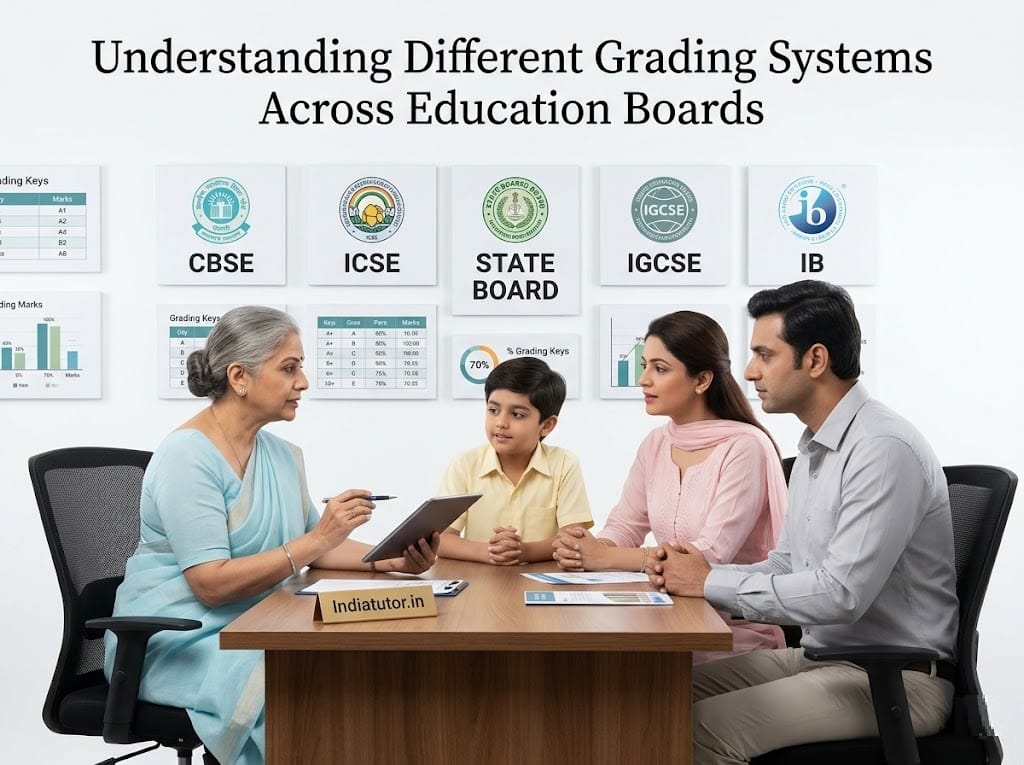
Understanding Different Grading Systems Across Education Boards

Understanding Different Grading Systems Across Education Boards

Understanding how children are assessed in school is essential for parents. Marks are not just numbers on a report card. They reflect learning style, evaluation method, exam pattern, and even stress levels. In India and abroad, different education boards follow different grading systems. This often creates confusion when families compare performance or shift schools.

This guide explains how grading works across major boards like CBSE, ICSE, State Boards, IB, and Cambridge in a simple and practical way.

Why Grading Systems Are Not the Same Everywhere

Education boards do not follow a single universal method of evaluation. Each system is designed with its own philosophy. Some focus on memory-based exams, others on conceptual understanding, projects, or skill application.

According to UNESCO’s Global Education Monitoring Report, assessment methods directly influence student learning outcomes and motivation levels. Boards that use continuous evaluation tend to reduce exam pressure, while exam-heavy systems often increase performance stress.

Understanding these differences helps parents interpret marks correctly instead of comparing students unfairly.

Understanding CBSE, ICSE, ISC, State Boards, IB and Cambridge Curriculums  

CBSE Grading System Explained

How CBSE evaluates students

The Central Board of Secondary Education (CBSE) uses a combination of marks and grades in many classes, especially in middle school. In Class 10, CBSE moved to a grading system in some subjects earlier, but currently uses marks with percentage and grade conversion.

For Class 10 board exams, students are assessed out of 100 per subject. Grades are derived based on marks distribution.

CBSE grade scale

CBSE typically follows a 9-point grading scale:

    • A1: Top 1/8th of passed students
    • A2: Next 1/8th
    • B1, B2, C1, C2, D, E follow similarly

For example, if a student scores 95 in Mathematics, they fall in A1 category.

Key features

CBSE is known for structured syllabus aligned with competitive exams like JEE and NEET. A NCERT-based study survey shows CBSE students often perform better in national entrance exams due to concept alignment.

ICSE and ISC Grading System

Evaluation style

The Indian Certificate of Secondary Education (ICSE) and Indian School Certificate (ISC) are known for detailed subject coverage. English language skills, literature, and analytical writing carry higher weight.

Grading pattern

ICSE uses percentage-based marking but converts results into grades in some reporting formats:

    • 90–100: A1 (Outstanding)
    • 80–89: A2
    • 70–79: B1
    • 60–69: B2 and so on

Practical subjects and internal assessments also contribute significantly.

Why ICSE feels different

Research in curriculum studies published in Indian Education Review journals highlights that ICSE students develop stronger language and analytical skills due to broader syllabi and detailed marking schemes.

How Education Boards Affect Career Choices

State Board Grading System

Diversity across states

India has more than 30 state education boards, and each follows its own evaluation method. However, most state boards use a percentage-based system.

For example:

    • 75% and above: Distinction
    • 60–74%: First Class
    • 50–59%: Second Class

Real-world impact

State boards often focus on regional language, local context, and practical knowledge. However, difficulty levels vary widely. For instance, Maharashtra State Board exams are considered moderate in difficulty, while some boards like Tamil Nadu and West Bengal are known for theory-heavy papers.

A comparative study by India Education Research Initiative found that variation in marking schemes across states can lead to 10–15% difference in average scoring patterns even with similar academic ability.

IB Grading System (International Baccalaureate)

Global evaluation model

The International Baccalaureate (IB) uses a point-based system instead of percentage marks.

Students are assessed on a scale of 1 to 7 in each subject. Additionally, core components like Theory of Knowledge, Extended Essay, and Creativity-Activity-Service add up to 3 extra points.

Total maximum score is 45.

What scores mean

    • 7: Excellent understanding
    • 6: Very good
    • 5: Good
    • 4: Satisfactory
    • Below 4: Needs improvement

According to IB Global Statistics, the world average diploma score is around 30 points.

Why IB is unique

IB focuses on critical thinking, research skills, and application. Students are evaluated on essays, presentations, and projects, not just final exams.

How to Choose the Right School Board for Your Child

Cambridge Grading System (IGCSE and A Levels)

Structure of grading

Cambridge Assessment International Education uses letter grades.

For IGCSE:

    • A* (highest)
    • A, B, C, D, E
    • U (ungraded)

For A Levels:

    • A*, A, B, C, D, E

Percentage alignment

While Cambridge does not officially publish strict percentage cutoffs, general academic mapping suggests:

    • A* ≈ 90% and above
    • A ≈ 80–89%
    • C ≈ 60–69%

Assessment style

Cambridge focuses on application-based learning. Exams include structured problem solving, case studies, and analytical writing. It is widely accepted by universities in the UK, USA, Canada, and Australia.

Research from Cambridge International Education shows that students trained in this system often perform better in higher education due to strong analytical preparation.

Comparison of All Major Boards

Differences in scoring systems

    • CBSE: Marks + grade conversion
    • ICSE/ISC: Percentage-based with detailed evaluation
    • State Boards: Mostly percentage-based, varies by state
    • IB: Point system (out of 45)
    • Cambridge: Letter grades (A* to U)

Difficulty perception

Difficulty depends on student ability and teaching quality. However:

    • CBSE is structured and exam-oriented
    • ICSE is content-heavy and language-focused
    • State boards vary significantly
    • IB is research-intensive
    • Cambridge is concept-driven

Why comparison is difficult

A student scoring 85% in ICSE may have a different academic workload than a student scoring 85% in CBSE. Similarly, IB 35 points cannot be directly compared to percentage marks.

Education experts from OECD studies suggest that comparing boards without context often leads to misleading conclusions about student ability.

Common Academic Challenges Students Face in Different Boards

Common Challenges Parents Face

Misinterpretation of grades

Parents often compare percentages without understanding grading philosophy. A 75% in ICSE may reflect stronger analytical depth than a 90% in some other systems.

Board transition issues

Students shifting from State Board to CBSE or CBSE to IB often struggle due to different evaluation styles.

Exam pressure

Boards with high-stakes final exams increase stress, while continuous assessment systems require consistent effort throughout the year.

Lack of subject clarity

Many students do not fully understand what examiners expect in answers, especially in IB and Cambridge systems.

Why Understanding Grading Systems Matters

A clear understanding helps parents:

    • Set realistic expectations
    • Avoid unnecessary comparison
    • Identify learning gaps early
    • Support better academic planning
    • Choose appropriate tutoring support

It also helps students understand how to prepare strategically instead of memorizing blindly.

Why Personalized Tuition Improves Performance Across All Education Boards

Role of Private Tutors in Different Board Systems

Every education board follows a unique assessment method, which makes one-size-fits-all teaching ineffective. A private tutor helps bridge this gap by adapting learning style to the board requirement. Students receive targeted support based on exam patterns, marking schemes, and weak areas.

A good tutor explains concepts in a simplified manner, improves answer presentation, and builds exam readiness. They also provide regular feedback, which is often missing in large classrooms. For boards like IB and Cambridge, where assignments and analytical writing matter, personalized guidance becomes even more important.

Private tuition also helps students adjust during board transitions, improve confidence, and reduce academic pressure through structured learning plans tailored to their curriculum.

Looking for expert tutors?

Find Verified Tutors on IndiaTutor.in

About the Author

Nidhi Mehta is the founder of IndiaTutor.in and a professional online educator with over 11 years of teaching experience. She specializes in tutoring Classes 1 to 6 across core academic subjects, with a strong focus on concept clarity and foundational skill-building. Her teaching approach is based on personalized, one-to-one learning that helps students develop long-term academic confidence and understanding.

Visit her profile    Visit About Us Page

How Education Boards Affect Career Choices

How Education Boards Affect Career Choices

Choosing a school education board is one of the most important decisions parents make for their children. While many families focus on school reputation, fees, and location, the curriculum followed by the school can also influence academic development, learning style, higher education opportunities, and future career paths.

In India and around the world, students study under different education systems such as CBSE, ICSE, ISC, State Boards, International Baccalaureate (IB), and Cambridge. Each curriculum has its own teaching methods, assessment patterns, subject choices, and learning outcomes.

A common question among parents is whether the education board can affect a student’s future career. The answer is yes, but perhaps not in the way many people think. The board itself does not determine success, but it can shape academic strengths, skill development, and preparation for specific goals.

Why Education Boards Matter

Education boards create the framework through which students learn. They determine:

    • Subjects offered
    • Examination methods
    • Assessment standards
    • Teaching approaches
    • Skill development opportunities
    • Academic flexibility

The knowledge and skills gained during school years often influence future academic and professional choices.

According to the World Economic Forum, critical thinking, problem-solving, communication, and adaptability are among the most valuable skills for future careers. Different education boards emphasize these skills in different ways.

Understanding CBSE, ICSE, ISC, State Boards, IB and Cambridge Curriculums  

Understanding Major Education Boards

CBSE (Central Board of Secondary Education)

CBSE is one of the most widely followed education boards in India. More than 30,000 schools in India and abroad are affiliated with CBSE.

The curriculum focuses on:

    • Mathematics and Science
    • Conceptual understanding
    • Structured learning
    • National-level competitive examinations

Students preparing for entrance exams such as JEE, NEET, CUET, and NDA often find the CBSE curriculum aligned with exam syllabi.

Career Areas Commonly Pursued by CBSE Students

    • Engineering
    • Medicine
    • Defence Services
    • Government Examinations
    • Technology
    • Data Science

ICSE and ISC

ICSE is conducted for Class 10, while ISC covers Classes 11 and 12.

The curriculum places strong emphasis on:

    • English language proficiency
    • Analytical thinking
    • Project-based learning
    • Balanced subject exposure

Students often develop strong writing, research, and communication skills.

Career Areas Commonly Pursued by ICSE and ISC Students

    • Law
    • Journalism
    • Literature
    • Management
    • Social Sciences
    • Liberal Arts

How to Choose the Right School Board for Your Child

How State Boards Influence Career Choices

State Boards serve millions of students across India and are designed according to regional educational requirements.

Many state boards provide:

    • Affordable education
    • Regional language learning
    • Localized curriculum
    • Strong preparation for state-level examinations

Several successful doctors, engineers, civil servants, entrepreneurs, and scientists have graduated from State Board schools.

Advantages for Certain Career Paths

Students aiming for:

    • State Public Service Commissions
    • State Government Jobs
    • Regional Professional Colleges
    • Local University Admissions

may benefit from familiarity with state-specific educational systems.

The Growing Popularity of International Curriculums

International Baccalaureate (IB)

IB is known for encouraging inquiry-based learning and global perspectives.

Students are encouraged to:

    • Think independently
    • Conduct research
    • Participate in community projects
    • Develop international awareness

The IB Diploma Programme is recognized by universities in more than 150 countries.

Careers Often Linked with IB Graduates

    • International Business
    • Global Studies
    • Research
    • Economics
    • International Relations
    • Entrepreneurship

Common Academic Challenges Students Face in Different Boards

Cambridge Curriculum

The Cambridge pathway includes Primary, Lower Secondary, IGCSE, and International AS & A Levels.

The curriculum emphasizes:

    • Critical thinking
    • Independent learning
    • Subject specialization
    • International academic standards

Cambridge qualifications are accepted by universities worldwide.

Career Areas Commonly Pursued by Cambridge Students

    • Finance
    • Computer Science
    • Design
    • Business Management
    • International Education
    • Scientific Research

Does One Board Guarantee Career Success?

A common misconception is that one board automatically leads to better career outcomes.

Research consistently shows that long-term success depends more on:

    • Student interest
    • Academic effort
    • Quality teaching
    • Learning habits
    • Family support
    • Skill development

A study published by the Organisation for Economic Co-operation and Development (OECD) found that problem-solving ability, adaptability, and lifelong learning skills are stronger indicators of future success than examination scores alone.

The education board provides a foundation, but personal commitment plays a much larger role.

How Subject Choices Matter More Than the Board

In many cases, subject selection has a greater impact on career opportunities than the curriculum itself.

For example:

Engineering Aspirants

Students usually require strong foundations in:

    • Physics
    • Chemistry
    • Mathematics

Medical Aspirants

Students need:

    • Biology
    • Chemistry
    • Physics

Future Lawyers

Students benefit from:

    • English
    • Political Science
    • History
    • Sociology

Business and Finance Careers

Useful subjects include:

    • Economics
    • Accountancy
    • Mathematics
    • Business Studies

Regardless of the board, choosing subjects aligned with career goals is essential.

Understanding Different Grading Systems Across Education Boards

Skills Employers Value Today

The modern job market is changing rapidly.

According to LinkedIn’s workplace studies and employer surveys, organizations increasingly look for candidates with:

Communication Skills

The ability to express ideas clearly remains valuable across industries.

Critical Thinking

Employers seek individuals who can analyze information and make informed decisions.

Digital Literacy

Technology is now part of almost every profession.

Collaboration

Teamwork is essential in workplaces around the world.

Adaptability

Many professionals will change careers multiple times during their working lives.

Students should focus on developing these abilities alongside academic achievement.

Factors Parents Should Consider When Choosing a Board

Child’s Learning Style

Some students thrive in structured environments, while others perform better with inquiry-based learning.

Career Aspirations

Long-term goals can help guide curriculum choices.

Higher Education Plans

Students planning to study abroad may prefer international curriculums, while those targeting Indian competitive examinations often benefit from nationally aligned syllabi.

Availability of Academic Support

Access to experienced teachers, learning resources, and subject experts can significantly influence outcomes.

Why Personalized Tuition Improves Performance Across All Education Boards

Real-World Examples

An aspiring engineer preparing for JEE may find the CBSE curriculum closely aligned with entrance examination requirements.

A student interested in international university admissions may appreciate the research and analytical focus of IB or Cambridge.

A student preparing for regional government examinations may benefit from a State Board curriculum.

At the same time, successful professionals emerge from every education system. India has produced entrepreneurs, scientists, doctors, judges, civil servants, and business leaders from CBSE, ICSE, ISC, State Boards, IB, and Cambridge backgrounds.

My Thoughts

Education boards influence how students learn, think, and prepare for future opportunities. They can shape academic strengths and learning experiences, but they do not determine career success on their own.

The most important factors remain curiosity, discipline, skill development, quality guidance, and consistent effort. Parents should focus on finding the right educational environment that matches their child’s abilities, interests, and future aspirations.

For students who need additional academic support, a private tutor can provide personalized attention that is difficult to achieve in a classroom setting. One-to-one guidance helps identify learning gaps, improve confidence, strengthen subject knowledge, and develop effective study habits. Experienced tutors can also adapt lessons to the requirements of CBSE, ICSE, ISC, State Boards, IB, and Cambridge curriculums, helping students achieve their academic and career goals more effectively.

Looking for expert tutors?

Find Verified Tutors on IndiaTutor.in

About the Author

Nidhi Mehta is the founder of IndiaTutor.in and a professional online educator with over 11 years of teaching experience. She specializes in tutoring Classes 1 to 6 across core academic subjects, with a strong focus on concept clarity and foundational skill-building. Her teaching approach is based on personalized, one-to-one learning that helps students develop long-term academic confidence and understanding.

Visit her profile    Visit About Us Page

Why Students Fear Chemistry and How Parents Can Help

Why Students Fear Chemistry and How Parents Can Help

Chemistry is one of the most important subjects in school education. It forms the foundation for careers in medicine, pharmacy, biotechnology, engineering, environmental science, and many other fields. Despite its importance, chemistry is also one of the subjects that students often struggle with the most.

Many parents notice a sudden drop in confidence when their child begins studying chemistry in higher classes. A student who performs well in other subjects may suddenly find science difficult, confusing, and overwhelming. This fear can affect academic performance, exam results, and overall interest in learning.

Understanding why students fear chemistry is the first step toward helping them overcome these challenges. With the right support, every student can build confidence and develop a better understanding of the subject.

Best Study Techniques for Learning Chemical Reactions Faster

Why Do Students Fear Chemistry?

Chemistry combines concepts from physics, mathematics, and biology. Unlike many subjects that focus mainly on theory, chemistry requires students to understand concepts, remember formulas, solve numerical problems, and visualize processes that cannot be seen with the naked eye.

This combination often creates anxiety among learners.

The Subject Introduces Many New Concepts

Students encounter unfamiliar terms such as atoms, molecules, ions, valency, molarity, equilibrium, and oxidation. These concepts can seem abstract because they cannot be observed directly.

For example, a student can easily understand a plant or an animal because they can see them. Understanding atomic structure requires imagination and conceptual thinking, which may be difficult for some learners.

Chemistry Requires Strong Foundations

Chemistry is a cumulative subject. New chapters build upon previously learned concepts.

A student who does not fully understand chemical bonding may struggle with organic chemistry later. Similarly, weak knowledge of mole concepts can create difficulties in stoichiometry and numerical calculations.

Research in educational psychology consistently shows that gaps in foundational knowledge can significantly affect future learning outcomes.

Fear of Chemical Equations and Formulae

Many students believe chemistry is only about memorizing reactions and formulas. When they encounter long equations and complicated symbols, they often feel intimidated.

For instance:

2H₂ + O₂ → 2H₂O

While this equation appears simple to an experienced learner, beginners may feel overwhelmed by symbols, numbers, and unfamiliar notation.

Numerical Problems Create Anxiety

Physical chemistry includes calculations involving mole concepts, concentration, gas laws, and thermodynamics.

Students who already struggle with mathematics may find these topics especially challenging.

According to several educational surveys conducted in India, mathematics-related anxiety often affects performance in chemistry because both subjects require logical problem-solving skills.

How Chemistry Builds Careers Beyond Medicine and Engineering

Common Reasons Students Lose Confidence in Chemistry

Lack of Conceptual Understanding

Memorization without understanding creates short-term success but often leads to long-term difficulties.

Students may remember definitions before exams but forget them shortly afterward because they never fully understood the underlying concepts.

Fast Classroom Pace

School teachers must complete large syllabi within limited timeframes.

As a result, some students may hesitate to ask questions or may not receive enough individual attention. A single missed concept can create confusion in future lessons.

Negative Past Experiences

Poor marks in a test, difficulty answering questions in class, or repeated mistakes can reduce confidence.

Over time, students may begin believing they are “bad at chemistry,” even when they simply need additional guidance.

Exam Pressure

Board examinations, entrance tests, and competitive exams place significant pressure on students.

The fear of losing marks often makes chemistry seem even more difficult than it actually is.

Signs Your Child May Be Struggling with Chemistry

Parents should watch for early warning signs.

Avoiding Chemistry Homework

Students may postpone assignments, delay revision, or spend very little time studying chemistry compared to other subjects.

Complaints About Difficult Chapters

Frequent statements such as “I don’t understand anything” or “Chemistry is impossible” may indicate deeper learning challenges.

Falling Test Scores

Consistently low marks despite effort often suggest conceptual gaps rather than lack of intelligence.

Reduced Interest in Science

Students who once enjoyed science may begin avoiding laboratory work, practical activities, or science-related discussions.

How to Learn Chemical Equations Without Memorizing Everything

How Parents Can Help Students Overcome Fear of Chemistry

Parents do not need advanced chemistry knowledge to support their children effectively.

Focus on Understanding Instead of Marks

Many students become anxious when every conversation revolves around scores.

Instead of asking only about marks, ask questions such as:

    • Which topic did you learn today?
    • What was interesting in class?
    • Which concept feels difficult?

These conversations encourage learning rather than performance pressure.

Encourage Questions

Curiosity plays an important role in science education.

Children should feel comfortable asking questions without fear of criticism.

Some examples include:

    • Why does ice float on water?
    • Why does iron rust?
    • How do medicines work?

Connecting chemistry to everyday life makes learning more meaningful.

Break Large Topics into Smaller Parts

Complex chapters become easier when divided into manageable sections.

For example, instead of studying an entire chapter in one session, students can focus on:

    • Definitions
    • Important concepts
    • Examples
    • Practice questions

Small achievements build confidence over time.

Create a Consistent Study Routine

Educational research shows that regular revision improves retention significantly more than last-minute cramming.

Even 30 to 45 minutes of focused chemistry study several times per week can produce noticeable improvements.

Use Visual Learning Resources

Many chemistry concepts become easier when students use:

    • Diagrams
    • Animations
    • Videos
    • Molecular models
    • Practical demonstrations

Visual learning helps students understand abstract ideas more effectively.

Step-by-Step Guide to Scoring Full Marks in Chemistry Numericals

Making Chemistry Relevant to Everyday Life

One reason students fear chemistry is that they do not see its practical importance.

Parents can highlight chemistry in daily activities.

Cooking

Baking, boiling, fermentation, and food preservation all involve chemical changes.

Cleaning Products

Detergents, soaps, and disinfectants work because of chemical reactions.

Medicines

Every medicine contains chemical compounds designed to produce specific effects in the body.

Environment

Air pollution, water treatment, and climate science rely heavily on chemistry.

When students recognize chemistry around them, the subject feels less intimidating and more interesting.

Helping Students Prepare for Chemistry Exams

Begin Revision Early

Starting preparation weeks before examinations reduces stress and allows time for concept clarification.

Practice Previous Year Questions

Past papers help students understand question patterns and improve time management.

Create Formula Sheets

Condensed notes containing important reactions, equations, and concepts simplify revision.

Analyze Mistakes

Instead of focusing only on marks, students should identify why errors occurred and learn how to avoid them in future tests.

How to Choose the Right Chemistry Tutor for CBSE Students

Building Long-Term Confidence in Chemistry

Confidence develops gradually through consistent effort and positive experiences.

Parents can help by:

    • Celebrating small improvements
    • Encouraging persistence
    • Avoiding comparisons with other students
    • Recognizing effort as well as results
    • Maintaining realistic expectations

Studies on student motivation show that positive reinforcement often leads to better academic outcomes than criticism or pressure.

When Additional Support May Be Needed

Sometimes students require more personalized instruction than a classroom environment can provide.

A qualified private chemistry tutor can identify learning gaps, explain difficult concepts at the student’s pace, and provide targeted practice. Individual attention often helps students ask questions more freely and build confidence. Personalized lessons can improve understanding, strengthen problem-solving skills, and make chemistry less stressful. For many students, the right tutor transforms chemistry from a feared subject into one they can approach with confidence and success.

Looking for expert Chemistry tutors?

Find Chemistry Tutors on IndiaTutor.in

About the Author

Nidhi Mehta is the founder of IndiaTutor.in and a professional online educator with over 11 years of teaching experience. She specializes in tutoring Classes 1 to 6 across core academic subjects, with a strong focus on concept clarity and foundational skill-building. Her teaching approach is based on personalized, one-to-one learning that helps students develop long-term academic confidence and understanding.

Visit her profile    Visit About Us Page

Why Science Marks Drop in Middle School and High School

Why Science Marks Drop in Middle School and High School

Science is one of the most important subjects in school, yet many parents notice a worrying pattern. Their child performs well in primary classes but begins to struggle in middle school or high school. Report cards that once showed strong scores suddenly reflect declining performance, incomplete understanding, and a lack of confidence.

If your child’s Science marks have dropped, you are not alone. This is a common concern among parents across CBSE, ICSE, State Boards, and international curricula. The good news is that poor performance in Science is often caused by identifiable factors that can be addressed with the right support and study strategies.

Understanding why this happens is the first step toward helping your child regain confidence and improve results.

Why Science Becomes More Difficult in Middle School and High School

The transition from primary classes to higher grades brings significant changes in how Science is taught and assessed.

In the early years, students mainly learn basic facts, definitions, and simple observations. As they move into Classes 6 to 10 and beyond, Science becomes more analytical. Students are expected to understand concepts, explain processes, interpret data, apply knowledge to unfamiliar situations, and solve real-world problems.

According to the latest OECD PISA 2025 Science Framework, modern Science education increasingly focuses on critical thinking, evidence evaluation, scientific reasoning, and application-based learning rather than memorization alone. Students must learn how to analyze information and use scientific knowledge to make decisions.

Many students are not prepared for this shift, resulting in lower marks despite putting in considerable effort.

How to Develop Interest in Science from an Early Age

Weak Foundation From Earlier Classes

One of the biggest reasons for declining Science performance is a weak conceptual foundation.

Science topics are interconnected. Understanding cells helps with biology. Understanding matter supports chemistry. Understanding force and motion forms the basis for physics.

When foundational concepts are unclear, new chapters become increasingly difficult. Students may memorize answers temporarily but struggle when faced with application-based questions.

Common Foundation Gaps

Difficulty Understanding Scientific Terms

Many students learn definitions without understanding their actual meaning.

Incomplete Conceptual Clarity

Students may know formulas or textbook answers but cannot explain why something happens.

Weak Link Between Topics

New chapters often build upon earlier learning. Missing pieces create confusion later.

Why Practical Understanding Is Important in Science

Increased Academic Pressure

Middle school and high school students face growing academic demands.

Apart from Science, they must manage Mathematics, languages, social studies, assignments, projects, assessments, extracurricular activities, and competitive exam preparation.

As workloads increase, students may spend less time reviewing Science concepts regularly. Last-minute preparation often leads to superficial learning rather than deep understanding.

Science requires consistent practice and revision throughout the academic year.

Memorization Instead of Understanding

Many students approach Science as a memory-based subject.

They read textbooks repeatedly, highlight notes, and memorize answers before exams. Unfortunately, this method often fails when examinations include case studies, reasoning questions, diagrams, experiments, and competency-based assessments.

Research on middle school Science learning has shown that retrieval practice, where students actively recall information rather than simply reread it, improves retention and understanding significantly.

Better Alternatives to Memorization

Active Recall

Students should regularly test themselves without looking at notes.

Spaced Revision

Short review sessions spread across several weeks improve long-term retention.

Teaching Others

Explaining concepts to someone else helps identify knowledge gaps.

How to Score Better Marks in Science Without Studying Longer Hours  

Difficulty With Application-Based Questions

Modern examinations increasingly focus on application rather than direct recall.

Students often understand textbook examples but struggle when concepts are presented in unfamiliar situations.

For example, a student may memorize the definition of photosynthesis but find it difficult to explain how environmental changes affect the process.

This gap between knowledge and application is one of the leading causes of lower Science scores.

Science Requires Strong Reading Skills

Parents often underestimate the role of reading comprehension in Science performance.

Science textbooks contain technical language, complex explanations, charts, graphs, and experimental observations.

Students with weak reading habits may find it difficult to understand questions correctly, leading to mistakes even when they know the content.

Developing strong reading skills can improve performance across Physics, Chemistry, and Biology.

Fear of Certain Topics

Many students develop anxiety around specific Science areas.

Physics

Physics often introduces calculations, formulas, and abstract concepts that require logical thinking.

Chemistry

Chemical reactions, equations, and atomic structures can seem confusing without proper explanation.

Biology

The large volume of terminology can feel overwhelming.

When students repeatedly struggle in one area, they may begin avoiding the subject altogether, leading to further declines in performance.

Lack of Practical Understanding

Science is meant to explain the world around us. However, many students learn concepts only through textbooks.

Without connecting lessons to real-life experiences, Science can feel abstract and difficult.

The most successful learners relate classroom concepts to everyday situations, observations, experiments, and practical examples.

Ways Parents Can Encourage Practical Learning

Discuss Everyday Science

Talk about weather, plants, electricity, cooking, and technology.

Encourage Curiosity

Allow children to ask questions and explore answers.

Use Educational Videos and Simulations

Visual learning can simplify difficult concepts.

10 Best Ways to Memorize Scientific Terms and Definitions

Digital Distractions and Reduced Focus

Today’s students face more distractions than ever before.

Social media, gaming platforms, streaming content, and constant notifications can reduce concentration and study effectiveness.

Many students spend hours studying while remaining only partially focused.

Quality of study time matters more than quantity.

Creating a structured study environment with limited distractions can improve both learning and retention.

Ineffective Study Methods

A surprising number of students work hard but use inefficient techniques.

Recent learning science research consistently highlights methods that outperform passive reading and highlighting. These include active recall, spaced repetition, concept mapping, self-testing, and mixed-topic practice.

Modern Science Learning Techniques

Retrieval Practice

Students regularly answer questions from memory.

Spaced Repetition

Review sessions are scheduled over increasing intervals.

Interleaved Learning

Different topics are mixed together during revision.

Visual Concept Mapping

Diagrams help students connect related concepts.

These approaches improve understanding and long-term retention more effectively than repeated reading.

Limited Individual Attention in Classrooms

School teachers work hard, but large class sizes can make personalized support difficult.

Some students hesitate to ask questions. Others may need additional explanations or alternative teaching approaches.

Small misunderstandings can accumulate over time and eventually affect examination performance.

Parents should pay attention to signs such as incomplete homework, avoidance of Science discussions, declining confidence, or frequent complaints about specific chapters.

Exam Anxiety and Lack of Confidence

Even well-prepared students can underperform due to examination stress.

Anxiety affects concentration, memory retrieval, and problem-solving ability.

Repeated poor results often create a cycle where students begin believing they are “weak in Science.”

Confidence plays a major role in academic success. Positive reinforcement, realistic goals, and consistent support can help break this cycle.

How to Build Strong Science Fundamentals From an Early Age

How Parents Can Help Improve Science Marks

Parents do not need to become Science experts to support their children.

Focus on creating an environment that encourages learning.

Practical Steps

Monitor Understanding, Not Just Homework Completion

Ask children to explain concepts in their own words.

Encourage Consistent Revision

Short daily review sessions are more effective than marathon study sessions.

Promote Question Asking

Curiosity is a key driver of Science learning.

Celebrate Progress

Recognize effort and improvement rather than focusing only on marks.

When Additional Support May Be Needed

If a student continues struggling despite regular effort, extra academic support may be beneficial.

A qualified tutor can identify conceptual gaps, provide personalized explanations, strengthen fundamentals, and build confidence. One-on-one attention allows students to learn at their own pace and ask questions freely.

Online Science tuition has become especially effective because students can connect with experienced tutors from anywhere, access interactive learning tools, receive individualized guidance, and benefit from flexible scheduling. With the right mentor, many students not only improve their Science marks but also develop genuine interest and confidence in the subject.

My Thoughts

A drop in Science marks during middle school or high school does not necessarily indicate a lack of ability. In most cases, it reflects changing academic demands, weak foundations, ineffective study habits, or insufficient conceptual understanding. By identifying the root causes early and providing the right guidance, parents can help their children overcome challenges, strengthen scientific thinking, and achieve long-term academic success.

Looking for expert Science tutors?

Find Science Tutors on IndiaTutor.in

About the Author

Nidhi Mehta is the founder of IndiaTutor.in and a professional online educator with over 11 years of teaching experience. She specializes in tutoring Classes 1 to 6 across core academic subjects, with a strong focus on concept clarity and foundational skill-building. Her teaching approach is based on personalized, one-to-one learning that helps students develop long-term academic confidence and understanding.

Visit her profile    Visit About Us Page

What 10 Years of Tutoring Taught Me About Real Success

IndiaTutor.in - Get Noticed

When I started my journey as an online tutor more than ten years ago, I believed that knowledge alone was enough. I thought if I knew my subject well, students would automatically come to me. I was wrong.

Over the years, through mistakes, experiments, failures, and small wins, I learnt that becoming a successful tutor requires much more than subject knowledge. It requires visibility, credibility, consistency, marketing skills, communication skills, and continuous self-improvement.

This is not theory. This is what I have personally experienced in my tutoring career.

Visibility Is Everything

In the online world, visibility is everything. You may be an excellent Maths, Science, or English tutor, but if parents and students cannot find you, your skills remain hidden. Early in my career, I relied only on word of mouth. It worked for some time, but it limited my growth. I realized that if I wanted more students, I had to make myself visible where parents were actively searching for tutors.

If you are seen, you will be considered for a tuition job. It is that simple. Parents do not magically discover tutors. They search online. They compare profiles. They read descriptions. They check reviews. If your profile does not appear in their search, you do not exist for them.

Creating a strong online tutor profile was one of the biggest turning points in my career. The moment I started focusing on how I appeared online, my inquiries increased.

How to create a perfect Tutor Profile that attracts students

If You Are Considered, You Must Show Your Potential

Visibility brings opportunity, but opportunity alone is not enough. If you are considered for a job, you must show your potential clearly and confidently.

When parents contact you, they are not just checking your qualification. They are judging your clarity, communication, patience, and confidence. In my early days, I used to speak too technically. I would explain my degrees in detail but forget to explain how I could help their child improve marks.

Over time, I learnt to focus on outcomes. Instead of saying, “I have 10 years of experience,” I started saying, “I help Class 1 to 6 students improve Maths scores by building strong fundamentals and regular practice habits.” That shift made a huge difference.

Your profile and your conversation should answer one question: How will you add value to the student?

How to Handle a Tuition Query

A Trusted Profile Creates Trust

Having your profile on a trusted platform like IndiaTutor.in gives you a positive response. Parents feel safer when they see a tutor listed on a professional and structured platform. It builds instant credibility.

When I compared direct social media promotion versus listing on a trusted tutoring website, I saw a clear difference. On a trusted platform, parents already come with an intention to hire. They are serious. They are searching actively. Your profile becomes part of a professional ecosystem.

Trust reduces hesitation. And when hesitation reduces, conversion increases.

How to Use Your Tutor Profile to Impress Parents

Verified Listings Stand Higher

One important lesson I learnt is that a verified tutor listing stands much higher than a free listing without contact details. Initially, I hesitated to invest in profile verification. I thought free exposure was enough.

But free listings often look incomplete. When parents cannot see proper details, verification badge, or structured information, they move to the next profile. In a competitive market, small differences matter.

Once I upgraded my listing and completed every detail carefully, I noticed better quality inquiries. Parents were more serious. They responded faster. They treated me as a professional, not just another tutor.

Investment in credibility always pays back.

Free Tutor Registration vs Paid Profiles

Marketing Your Profile Brings Traffic

Many tutors believe marketing is only for companies. That is not true. As a tutor, you are also a brand. If you do not market your profile, you limit your own growth.

Investing your time in marketing your profile will bring more traffic to your profile. Marketing does not mean spending huge money. It means writing a strong profile description, adding keywords related to your subject and curriculum, sharing your profile link on social media, asking for testimonials, and staying active.

I started sharing small educational tips on WhatsApp groups and LinkedIn. I optimized my tutor profile with relevant keywords like CBSE Maths tutor, ICSE Science tutor, online English classes for Class 4. Slowly, my search visibility improved.

More visibility led to more profile visits. More profile visits led to more inquiries.

How Online Marketing helps boost Visibility, Reach and get Students Leads

More Reach Means More Students

Increasing your profile reach leads to more leads and more students. It is a numbers game. If 10 parents see your profile, maybe 1 will contact you. If 100 parents see your profile, 10 may contact you.

Your job is to increase that reach consistently. Update your profile regularly. Add new achievements. Add new subjects if you are qualified. Upload a professional photo. Write clearly about your teaching method.

Every small improvement increases your chances of being chosen.

Social Media Marketing Guide for Tutors

Consistency Is the Key

In these ten years, one thing has stayed constant. Consistency is the key. Many tutors start with excitement but lose momentum after a few months. They stop updating their profile. They stop learning. They stop promoting themselves.

Success in tutoring is not built in one month. It is built over years of consistent effort. Show up regularly. Take demo classes seriously. Follow up with parents politely. Maintain discipline in scheduling and preparation.

Students stay longer with tutors who are consistent. Parents recommend tutors who are reliable.

Top Teaching Strategies to Engage Students in Online Classes

Keep Upgrading Yourself

The education industry keeps changing. New syllabi, new teaching tools, new expectations from parents. If you do not upgrade yourself, you fall behind.

Keep upgrading yourself to stay ahead of your competition. Attend online workshops. Learn about new exam patterns. Understand different curriculums like CBSE, ICSE, IB, IGCSE if possible.

Become a master in your subject. Do not just teach from the textbook. Understand concepts deeply. Solve advanced problems. Explore different teaching approaches. Mastery builds confidence. Confidence builds authority.

Essential Tools Every Online Tutor in India Should Use

Learn New Skills

Subject knowledge alone is not enough. Learn new skills that support your tutoring career. Learn how to use online teaching tools effectively. Learn basic SEO to improve your online visibility. Learn how to create simple presentations.

Upgrade your communication and presentation skills. Speak clearly. Listen patiently. Avoid complicated language. Parents appreciate tutors who explain complex topics in simple words.

I personally worked on my communication. I practiced speaking in front of a mirror. I recorded demo sessions and improved my clarity. These small efforts improved my conversion rate significantly.

Must-Have Soft Skills for Tutors to Succeed

Fine Tune Your Marketing Skills

Fine tuning your marketing skills is essential. Understand what makes your profile unique. Highlight your strengths clearly. Do you specialize in weak students? Do you prepare students for board exams? Do you focus on concept clarity?

Write it clearly. Use simple and direct language. Keep your profile structured. Add achievements, results, and testimonials wherever possible.

Marketing is not about exaggeration. It is about clarity.

How Tutors Can Use AI to Attract More Students Online

Add More Value to Yourself

The more value you add to yourself, the less you compete on price. When you improve your subject mastery, communication, technology skills, and profile quality, you naturally stand out.

Add value by offering structured study plans. Provide regular feedback reports. Guide students on time management. Share practice worksheets. Small additional efforts create a big impact.

Parents are willing to pay more for tutors who deliver results and show professionalism.

Top 10 Skills Every Tutor Must Learn to Succeed

Create Your Own Success

After ten years in tutoring, I can confidently say that success does not happen by chance. You create opportunities and your own success. No one will promote you more than you promote yourself. No one will invest in you more than you invest in yourself.

Build your visibility. Build your credibility. Stay consistent. Keep learning. Improve your marketing. Improve your communication. Master your subject.

If you do these things patiently and consistently, success as a tutor is not just possible, it is predictable.

The online tutoring industry in India is growing rapidly. Parents are actively searching for dedicated, skilled, and professional tutors. Position yourself correctly. Present yourself confidently. Keep improving every year.

Register as a tutor on indiatutor.in to connect directly with students and parents searching for qualified educators across India.

Get discovered, receive direct inquiries, and build your independent teaching career with zero commission support.

Register your Tutor Profile on IndiaTutor.in

About the Author

Nidhi Mehta is the founder of IndiaTutor.in and a professional online educator with over 11 years of teaching experience. She specializes in tutoring Classes 1 to 6 across core academic subjects, with a strong focus on concept clarity and foundational skill-building. Her teaching approach is based on personalized, one-to-one learning that helps students develop long-term academic confidence and understanding.

Visit her profile    Visit About Us Page

How to Structure a Powerful Demo Class That Converts

How to Structure a Powerful Demo Class That Converts

A demo class is often the most important step in a tutor’s journey. Parents rarely make a decision based only on qualifications, certificates, or years of experience. They want to see how a tutor interacts with their child, explains concepts, communicates, and creates confidence.

Research across education and service industries consistently shows that first impressions significantly influence buying decisions. Studies suggest that people form initial impressions within the first few minutes of interaction. For tutors, this means the demo class can determine whether a parent chooses to continue with paid lessons or move on to another educator.

A well-planned session does much more than showcase subject knowledge. It demonstrates teaching ability, professionalism, patience, and the potential to improve a student’s academic performance.

This guide explains how to structure a powerful demo class that builds trust and increases conversion rates.

Why Demo Classes Matter

Parents invest both money and time when selecting a tutor. They want reassurance that the educator can understand their child’s learning style and academic needs.

A successful trial lesson helps parents evaluate:

    • Communication skills
    • Teaching methodology
    • Subject expertise
    • Student engagement
    • Professionalism
    • Compatibility with the learner

Students also benefit because they can experience the tutor’s approach before committing to regular classes.

Preparation Before the Demo Class

Understand the Student’s Requirements

Before the session begins, gather relevant information from the parent.

Ask questions such as:

    • Which class and board is the student studying in?
    • Which subjects require support?
    • What are the current academic challenges?
    • What are the target scores or goals?
    • Has the student worked with tutors previously?

This information allows you to personalize the lesson instead of delivering a generic presentation.

Review the Syllabus

Spend time reviewing the student’s curriculum.

A tutor teaching CBSE Class 10 Mathematics should not prepare the same content as someone teaching IGCSE English or IB Physics.

When the lesson aligns with the student’s actual coursework, parents immediately see value.

Prepare Teaching Materials

Organize all resources beforehand.

These may include:

    • Worksheets
    • Practice questions
    • Presentation slides
    • Visual aids
    • Digital whiteboards
    • Sample assessments

Prepared tutors appear more professional and confident.

The Ideal Demo Class Structure

First 5 Minutes: Build Rapport

The beginning of the lesson should focus on creating a comfortable environment.

Introduce yourself briefly and learn more about the student.

Ask simple questions such as:

    • Which subjects do you enjoy?
    • What topics seem difficult?
    • What are your academic goals?

Students learn better when they feel relaxed and understood.

Avoid turning the opening minutes into a lengthy discussion about your achievements. The focus should remain on the learner.

Next 5 Minutes: Assess Current Understanding

Before teaching, determine the student’s starting point.

Ask a few questions related to the topic.

For example:

    • Solve a basic mathematics problem.
    • Explain a science concept.
    • Read and summarize a passage.
    • Answer a grammar question.

This quick assessment helps identify strengths and gaps.

Parents appreciate tutors who first understand the child’s needs rather than immediately starting a lecture.

Main Teaching Segment: 20 to 25 Minutes

This is the most critical part of the demo class.

Choose one concept and teach it effectively.

Avoid attempting to cover multiple chapters. Depth is more impressive than breadth.

A strong teaching structure includes:

Explain

Introduce the concept in simple language.

Use examples that relate to daily life whenever possible.

Demonstrate

Show step-by-step methods.

Break down difficult topics into smaller sections.

Involve

Ask questions throughout the lesson.

Student participation increases attention and retention.

Educational research often shows that active learning techniques can significantly improve understanding compared with passive listening.

Practice

Provide one or two problems for the student to solve independently.

Observe how they approach the task.

Guide rather than provide immediate answers.

Final 5 Minutes: Recap and Feedback

Summarize key learning points.

Ask the student:

    • What did you learn today?
    • Which part was easiest?
    • Which part still feels challenging?

This reinforces understanding and demonstrates a student-centered teaching style.

Teaching Techniques That Impress Parents

Simplify Complex Concepts

Parents often judge tutors based on their ability to make difficult topics easier.

A tutor who can explain advanced concepts using simple examples creates a strong impression.

Encourage Interaction

Students should speak, answer questions, and participate.

If the tutor talks continuously for 40 minutes, engagement drops significantly.

Interactive classes are generally more effective and memorable.

Use Visual Learning Tools

Visual aids help students understand and remember concepts.

Consider using:

    • Diagrams
    • Charts
    • Graphs
    • Animations
    • Mind maps

Studies indicate that visual content can improve information retention and comprehension.

Show Patience

Students may make mistakes during the lesson.

How a tutor responds to those mistakes matters greatly.

Correct errors respectfully and encourage effort.

Parents often value patience as highly as subject expertise.

Common Mistakes That Reduce Conversion Rates

Talking Too Much About Yourself

Parents are interested in qualifications, but they primarily want solutions for their child’s academic needs.

Keep introductions concise.

Delivering a Full Lecture

A demo class should be interactive.

Long lectures reduce engagement and make it difficult for parents to evaluate teaching effectiveness.

Ignoring the Student’s Level

Teaching concepts that are too advanced or too basic creates a poor learning experience.

Always adapt your lesson to the student’s current understanding.

Lack of Structure

Unplanned sessions appear unprofessional.

Every demo class should have a clear beginning, middle, and conclusion.

Focusing Only on Subject Knowledge

Many tutors believe expertise alone wins students.

Parents also evaluate communication, punctuality, attitude, and teaching style.

How to Speak With Parents After the Demo

Share Observations

Provide constructive feedback.

Discuss:

    • Strengths
    • Areas for improvement
    • Learning gaps
    • Academic potential

Specific observations demonstrate professionalism.

Present a Learning Plan

Outline how you would help the student achieve results.

For example:

Short-Term Goals

    • Improve chapter understanding
    • Complete school assignments
    • Build confidence

Long-Term Goals

    • Higher examination scores
    • Better conceptual clarity
    • Independent learning skills

A roadmap helps parents visualize future progress.

Be Honest

Avoid making unrealistic promises such as guaranteed 95% or 100% marks.

Instead, explain how consistent effort, proper guidance, and practice can improve performance.

Trust is one of the strongest conversion factors.

Online Demo Class Tips

Online tutoring continues to grow rapidly worldwide.

For virtual sessions:

Test Technology in Advance

Check:

    • Internet connection
    • Microphone
    • Camera
    • Screen-sharing tools
    • Digital whiteboard

Technical issues can negatively affect first impressions.

Maintain Professional Presentation

Choose a quiet environment with good lighting.

Keep the background clean and distraction-free.

Engage Frequently

Online attention spans are often shorter.

Ask questions regularly and encourage participation every few minutes.

Signs of a Successful Demo Class

A demo lesson is usually effective when:

    • The student participates actively.
    • The parent asks follow-up questions.
    • Learning objectives are achieved.
    • The student expresses interest in future sessions.
    • Parents discuss scheduling or fees afterward.

These indicators often suggest strong engagement and trust.

My Thoughts

A powerful demo class is not about showing how much a tutor knows. It is about demonstrating how effectively a student can learn. Parents want evidence that their child will receive clear explanations, personalized attention, and measurable academic support.

Tutors who prepare thoroughly, engage students actively, communicate clearly, and provide actionable feedback are far more likely to convert trial lessons into long-term enrollments.

If you are a tutor looking to connect with students across India and worldwide, create your profile on IndiaTutor.in and showcase your expertise to thousands of parents searching for quality educators.

IndiaTutor.in helps tutors gain direct enquiries, build credibility, increase visibility in search results, and grow their teaching business without paying recurring commissions.

About the Author

Nidhi Mehta is the founder of IndiaTutor.in and a professional online educator with over 11 years of teaching experience. She specializes in tutoring Classes 1 to 6 across core academic subjects, with a strong focus on concept clarity and foundational skill-building. Her teaching approach is based on personalized, one-to-one learning that helps students develop long-term academic confidence and understanding.
Visit her profile    Visit About Us Page

Related Topics

How to Handle a Tuition Query

How to Communicate with Parents Professionally

How to Use Your Tutor Profile to Impress Parents

How to Assess a Student’s Level in the First Demo Class

How to Discuss Tuition Fees Without Losing the Student

How to Set Clear Expectations Before Starting Tuition

Why Every Tutor Must Have Terms and Conditions

How to Use AI for Notes Summaries and Revision Faster Than Ever

How to Use AI for Notes, Summaries & Revision Faster Than Ever

Artificial intelligence is changing how students study, revise, and understand subjects. What earlier took hours of reading and rewriting can now be done in minutes with structured tools and smart prompts. Across education platforms, reports show that students using AI-assisted study methods can reduce revision time by up to 40–60% while improving recall through repeated, simplified exposure to content.

For parents and tutors, this shift is important because it directly impacts learning efficiency, exam performance, and student confidence.

Understanding AI in Student Learning

Artificial intelligence in education refers to tools that process text, explain concepts, summarize chapters, and generate structured notes. These systems are trained on large datasets and can break down complex topics into simpler formats.

In recent surveys by global education technology researchers, more than 60% of students using AI tools reported better clarity in subjects that earlier felt difficult, especially in science and mathematics.

10 Smart Ways Students Can Use AI to Score Higher in Exams

How AI Helps in Notes Summarization

Converting long chapters into short points

AI can scan textbook content and convert it into concise notes. Instead of rewriting full paragraphs, students receive key ideas in bullet format.

Removing unnecessary information

Advanced models filter out repetition and focus only on core concepts. This helps students avoid overload and focus on exam-relevant material.

Creating topic-wise breakdowns

Subjects can be divided into subtopics automatically. For example, a history chapter can be split into dates, events, causes, and outcomes in a structured way.

Using AI for Faster Revision

Quick revision sheets

AI can generate one-page summaries for entire chapters. These sheets are useful before exams for fast recall.

Question-based learning

Students can request AI to create practice questions from notes. Studies suggest that active recall improves memory retention by nearly 50% compared to passive reading.

Error identification

Some AI tools highlight weak areas by analyzing repeated mistakes in practice answers, helping students focus on improvement zones.

AI for Competitive Exams: Smarter Prep for JEE, NEET & Olympiads 

Smart Ways Students Can Use AI Daily

Morning revision method

Students can ask AI to summarize yesterday’s lesson in under 10 bullet points, making revision a daily habit without extra workload.

Exam preparation mode

Before exams, AI can generate last-minute revision sheets covering all important definitions and formulas.

Doubt clarification

Instead of searching multiple sources, students can get direct explanations in simple language within seconds.

How to Use AI Tools for Homework Without Cheating

Benefits for Parents and Tutors

Parents gain better visibility into what children are learning and how efficiently they are revising. Tutors can use AI to prepare lesson plans, worksheets, and revision tests faster.

Research from education technology studies indicates that structured AI-assisted learning can improve student engagement levels by 30–40% when combined with human guidance.

Limitations to Keep in Mind

AI should not replace textbooks or teachers. It works best as a support system. Accuracy can vary depending on input quality, so students must verify important facts from trusted sources.

Balanced use ensures that understanding remains strong while saving time.

AI in Education: Threat or Opportunity for Indian Students?

My Thoughts

AI is making learning faster, more structured, and more accessible. Students who use it wisely can improve revision speed, clarity, and retention without increasing study hours.

Parents and tutors who integrate AI into learning routines can help students stay ahead in competitive academic environments.

Search on indiatutor.in to connect with experienced tutors who guide students in using modern tools like AI for better academic performance. Join indiatutor.in to access verified tutors, structured learning support, and personalized tuition that improves results across all subjects.

Search Tutors by Subject     Search Tutors by Class Level 

About the Author

Nidhi Mehta is the founder of IndiaTutor.in and a professional online educator with over 11 years of teaching experience. She specializes in tutoring Classes 1 to 6 across core academic subjects, with a strong focus on concept clarity and foundational skill-building. Her teaching approach is based on personalized, one-to-one learning that helps students develop long-term academic confidence and understanding.
Visit her profile    Visit About Us Page

How Tutors Can Use AI to Attract More Students Online

How Tutors Can Use AI to Attract More Students Online

The education industry is changing rapidly, and artificial intelligence (AI) is becoming one of the most powerful tools available to tutors. What once required hours of manual work can now be completed in minutes. From creating study materials and lesson plans to improving online visibility and communication with parents, AI is helping tutors build stronger teaching businesses.

According to recent industry reports, more than 70% of professionals worldwide are already using AI tools in some form to improve productivity. In education, AI is helping teachers save time, personalize learning, and reach more students through digital platforms.

For tutors who want to grow their student base, improve credibility, and stand out online, understanding how to use AI effectively can provide a significant advantage.

Why AI Matters for Modern Tutors

Parents today often begin their search for tutors online. They compare profiles, read reviews, watch videos, and evaluate teaching experience before making a decision.

AI can help tutors create a stronger online presence while reducing the time spent on administrative tasks. Instead of spending hours writing content or preparing materials, tutors can focus more on teaching and student success.

The tutors who learn to combine their expertise with AI tools are often able to market themselves more effectively and attract inquiries from a wider audience.

Creating a Professional Tutor Profile

A tutor profile is often the first impression parents receive.

AI writing tools can help tutors create well-structured profiles that clearly explain:

    • Subjects taught
    • Classes covered
    • Teaching experience
    • Qualifications
    • Teaching methodology
    • Student achievements
    • Online and home tuition availability

Highlight Unique Strengths

Many tutor profiles look similar. AI can help identify and present unique selling points such as:

    • Board-specific expertise
    • Exam preparation experience
    • International curriculum teaching
    • Special education support
    • Language proficiency
    • Personalized teaching methods

A detailed profile improves trust and increases the chances of receiving inquiries.

Generating Helpful Educational Content

Content marketing is one of the most effective ways to attract students online.

Parents regularly search Google for answers to educational questions. Tutors who provide useful information can build authority and visibility.

AI can assist in creating:

    • Study tips
    • Exam preparation guides
    • Subject explanations
    • Homework support articles
    • Learning strategies
    • Parent guidance content

Write Articles Parents Are Searching For

Examples include:

    • How to Improve Maths Scores in Class 10
    • Best Study Techniques for CBSE Students
    • How Parents Can Help Children Prepare for Exams
    • Common Mistakes Students Make in Science

When these articles answer real questions, they can attract organic search traffic from Google.

Maintain Consistency

One of the biggest challenges for tutors is publishing content regularly.

AI helps generate ideas, outlines, and drafts quickly, making it easier to maintain an active online presence.

Improving Google Search Visibility

Search engine optimization (SEO) plays a major role in helping tutors get discovered online.

Research shows that most users click results appearing on the first page of Google. Tutors who optimize their content have a better chance of attracting inquiries.

Use Relevant Keywords

AI tools can help identify popular search terms such as:

    • Online Maths Tutor
    • CBSE Science Tuition
    • English Tutor Near Me
    • Class 12 Physics Tutor
    • Online Tuition for NRI Students

Including these naturally in profiles, articles, and website content can improve search visibility.

Create Topic Clusters

Instead of publishing random articles, tutors can build authority around specific subjects.

For example, a Mathematics tutor can create content covering:

Algebra

Study guides, formulas, and practice tips.

Geometry

Concept explanations and exam preparation strategies.

Board Exam Preparation

Scoring techniques and revision methods.

Google often rewards websites that demonstrate expertise across an entire subject area.

Creating Social Media Content Faster

Many tutors know social media is important but struggle to post regularly.

AI can help generate:

    • Educational posts
    • Quiz questions
    • Revision tips
    • Exam countdown content
    • Motivational messages
    • Short video scripts

Build Consistent Visibility

Platforms such as Instagram, Facebook, YouTube, and LinkedIn reward consistent activity.

Even posting three to four times per week can increase visibility and help parents discover tutoring services.

Producing Better Educational Videos

Video content continues to grow rapidly.

Parents and students often prefer watching a tutor explain a concept before making contact.

AI tools can help tutors:

    • Generate video topics
    • Create lesson outlines
    • Write scripts
    • Generate captions
    • Improve audio quality
    • Create thumbnails

Short Videos Can Deliver Strong Results

Educational short-form videos often perform well because they provide quick value.

Examples include:

    • One-minute Maths tricks
    • Grammar corrections
    • Science facts
    • Exam preparation tips
    • Study hacks

Regular video publishing can significantly increase online reach.

Personalizing Learning Experiences

Personalized teaching is one of the biggest advantages tutors have over large coaching institutes.

AI can help create customized learning materials for individual students.

Generate Practice Worksheets

AI tools can quickly create:

    • Question banks
    • Worksheets
    • Mock tests
    • Revision exercises
    • Assignment ideas

This saves preparation time while allowing tutors to tailor lessons according to student needs.

Adapt Difficulty Levels

A tutor can create different versions of the same topic for:

    • Beginners
    • Average learners
    • Advanced students

Personalization improves student outcomes and increases parent satisfaction.

Enhancing Communication with Parents

Parents appreciate regular updates regarding academic progress.

AI can help prepare:

    • Progress reports
    • Performance summaries
    • Improvement plans
    • Attendance updates
    • Monthly feedback reports

Save Administrative Time

Many tutors spend hours writing reports manually.

AI can organize performance data and generate professional summaries that are easy for parents to understand.

This improves communication and builds long-term trust.

Managing Online Reviews More Effectively

Positive reviews influence parent decisions significantly.

Studies consistently show that consumers trust online reviews when evaluating services.

AI can help tutors:

    • Request reviews professionally
    • Respond to feedback
    • Highlight testimonials
    • Organize success stories

Showcase Student Achievements

Success stories create credibility.

Examples include:

    • Board exam results
    • Grade improvements
    • Scholarship achievements
    • Entrance exam success

Parents often view real outcomes as strong indicators of teaching quality.

Creating Email and WhatsApp Campaigns

Many tutors lose potential inquiries because they fail to follow up.

AI can assist in creating professional messages for:

    • Inquiry responses
    • Trial class invitations
    • Fee reminders
    • Parent updates
    • Seasonal promotions

Timely communication improves conversion rates and strengthens relationships with families.

Using AI Responsibly

AI is a powerful assistant, but it should not replace a tutor’s expertise.

Verify Accuracy

Always review AI-generated content before sharing it with students or parents.

Educational information should be accurate, updated, and aligned with curriculum requirements.

Maintain Human Connection

Parents choose tutors because of experience, empathy, communication, and teaching ability.

AI can support these qualities, but it cannot replace them.

The most successful tutors combine technology with genuine teaching expertise.

Common AI Tools Tutors Can Explore

Several AI-powered platforms can help tutors improve productivity.

Content Creation

Writing assistants can help create articles, lesson plans, and study materials.

Graphic Design

AI design tools can create educational posters, worksheets, and social media graphics.

Video Production

Video tools can simplify editing, caption generation, and presentation creation.

Productivity and Planning

AI scheduling and organization tools can assist with lesson planning and time management.

The Future of Tutoring and AI

Artificial intelligence is becoming a valuable partner for educators worldwide. Tutors who embrace these tools can save time, improve teaching efficiency, create engaging content, strengthen online visibility, and connect with more students.

As online education continues to expand, tutors who adapt to technological advancements will be better positioned to build trusted personal brands and attract consistent student inquiries.

Looking to grow your tutoring career online? Register on IndiaTutor.in and create a professional tutor profile that helps parents discover your expertise directly.

IndiaTutor.in offers direct student inquiries, improved online visibility, profile promotion opportunities, and a trusted platform to showcase your qualifications, experience, and teaching achievements.

About the Author

Nidhi Mehta is the founder of IndiaTutor.in and a professional online educator with over 11 years of teaching experience. She specializes in tutoring Classes 1 to 6 across core academic subjects, with a strong focus on concept clarity and foundational skill-building. Her teaching approach is based on personalized, one-to-one learning that helps students develop long-term academic confidence and understanding.

Visit her profile    Visit About Us Page

Related Topics

How Tutors Can Use AI to Create Lesson Plans in Minutes

Will AI Replace Teachers or Make Smart Tutors Grow Stronger? 

Will AI Replace Teachers or Make Smart Tutors Grow Stronger?

Will AI Replace Teachers or Make Smart Tutors Grow Stronger

Artificial Intelligence (AI) is transforming almost every industry, and education is no exception. From instant homework help and personalized learning apps to AI-powered chatbots that answer questions in seconds, technology is becoming a regular part of students’ lives.

This has created an important question among parents, teachers, and aspiring tutors: Will AI replace teachers, or will it make good tutors even more valuable?

The short answer is simple. AI is unlikely to replace skilled teachers. Instead, it is creating new opportunities for tutors who can combine technology with human guidance.

Understanding how AI affects education can help parents make better decisions and help tutors prepare for the future.

Why AI Is Growing Rapidly in Education

The global AI in education market has expanded significantly over the last few years. Industry reports estimate that the sector is expected to reach tens of billions of dollars by the end of this decade.

Students now use AI tools for:

    • Solving mathematical problems
    • Understanding concepts
    • Creating study notes
    • Practicing languages
    • Research assistance
    • Exam preparation

Many learners can get answers within seconds, making AI a powerful educational resource.

However, getting answers and achieving academic success are two different things.

What AI Can Do Well

Artificial Intelligence offers several benefits that make learning more accessible.

Instant Responses

Students no longer need to wait for a teacher to answer basic questions. AI systems can provide explanations immediately.

Personalized Practice

Many platforms adjust questions based on student performance. This helps learners focus on weak areas.

24/7 Availability

Unlike traditional classrooms, AI tools are available anytime. Students can study late at night, during weekends, or while traveling.

Large Knowledge Base

AI can access and organize information across multiple subjects, helping students find explanations quickly.

For motivated learners, these advantages can improve efficiency and save time.

What AI Cannot Replace

Despite impressive capabilities, AI still lacks several qualities that make great teachers successful.

Human Connection

Learning is not only about information. Students need encouragement, motivation, and confidence-building.

A tutor understands emotions, recognizes frustration, and adapts teaching methods accordingly. AI cannot genuinely connect with a student’s feelings or experiences.

Understanding Individual Personalities

Every learner is different.

Some students need visual explanations. Others learn through discussion, examples, or repeated practice.

Experienced tutors identify learning styles and modify lessons accordingly. This level of understanding remains difficult for technology alone.

Mentorship and Guidance

A teacher often becomes a mentor.

Students frequently seek advice about:

    • Career choices
    • Subject selection
    • Study habits
    • Time management
    • Examination stress

These conversations require life experience, empathy, and judgment that AI cannot fully provide.

Building Character and Values

Education is about more than marks.

Teachers help develop:

    • Discipline
    • Responsibility
    • Communication skills
    • Critical thinking
    • Ethical decision-making

These human qualities play a major role in long-term success.

Why Parents Still Prefer Human Tutors

Parents invest in tutoring because they want results, accountability, and personal attention.

While AI can answer questions, it cannot monitor a student’s attitude toward learning.

Regular Progress Tracking

Tutors observe performance over weeks and months.

They can identify:

    • Knowledge gaps
    • Weak concepts
    • Lack of confidence
    • Poor study habits

This allows timely intervention before problems become serious.

Accountability Improves Performance

Many students study more consistently when guided by a teacher.

Scheduled classes create structure and discipline, which are essential for academic success.

Better Communication with Families

Parents value feedback from tutors regarding their child’s strengths and areas needing improvement.

AI tools do not provide the same level of personalized communication and insight.

How Smart Tutors Can Benefit from AI

The future belongs not to teachers who compete against AI but to those who use it effectively.

Faster Lesson Planning

AI can help tutors:

    • Generate worksheets
    • Create quizzes
    • Prepare summaries
    • Design practice questions

This reduces administrative work and saves valuable time.

More Personalized Teaching

Tutors can use AI-generated insights to understand student weaknesses and create targeted learning plans.

Better Content Creation

Many educators now create:

    • Educational videos
    • Study guides
    • Practice tests
    • Revision notes

AI can assist in producing these resources more efficiently.

Expanding Reach Through Online Teaching

Technology allows tutors to teach students across cities, states, and countries.

This creates opportunities that were difficult to imagine a decade ago.

The Rise of Hybrid Learning

The most successful educational model is increasingly becoming a combination of technology and human instruction.

AI Handles Routine Tasks

Technology can manage repetitive activities such as:

    • Practice exercises
    • Automated assessments
    • Basic explanations
    • Progress reports

Tutors Focus on High-Value Teaching

Teachers can spend more time on:

    • Concept clarity
    • Problem-solving
    • Motivation
    • Exam strategies
    • Personalized mentoring

This combination creates a more effective learning experience.

Will Certain Teaching Roles Change?

Yes. Some aspects of education will evolve.

Tutors who rely solely on delivering information may face challenges because information is now widely available.

However, tutors who offer expertise, guidance, motivation, and personalized support will remain in demand.

Students do not simply need answers.

They need help understanding, applying, and remembering knowledge.

That is where skilled educators continue to add value.

What Aspiring Tutors Should Do Now

The growing influence of AI should not discourage individuals from entering the teaching profession.

Instead, it should encourage continuous improvement.

Develop Subject Expertise

Strong knowledge remains the foundation of successful tutoring.

Students and parents trust educators who demonstrate mastery of their subjects.

Learn Educational Technology

Become familiar with modern tools that improve teaching efficiency.

Technology skills can help tutors deliver better learning experiences.

Improve Communication Skills

Parents often choose tutors based on their ability to explain concepts clearly.

Effective communication remains one of the most valuable professional skills.

Build an Online Presence

Many families now search online for tutors.

Having a professional profile, testimonials, teaching videos, and student reviews can significantly increase visibility.

Focus on Results

Students and parents look for measurable improvement.

Tutors who consistently help learners achieve better grades and stronger understanding will continue to grow regardless of technological advances.

What the Future of Education Looks Like

The future is not a battle between AI and teachers.

Instead, it is a partnership.

Artificial Intelligence will continue making education more accessible, efficient, and personalized. At the same time, human educators will remain essential for mentorship, emotional support, motivation, and deep learning.

Research consistently shows that students achieve the best outcomes when technology is combined with effective teaching rather than replacing it entirely.

As educational tools become smarter, the most adaptable tutors may become even more valuable than before.

My Thoughts

AI is changing the way students learn, but it is not eliminating the need for great teachers. Information can be automated, but inspiration, mentorship, empathy, and human connection cannot.

Parents will continue seeking tutors who can guide, motivate, and help children achieve their full potential. Tutors who embrace technology while strengthening their teaching skills are likely to thrive in the years ahead.

Are you a tutor looking to reach students across India and worldwide? Register on IndiaTutor.in and create your professional tutor profile to connect directly with parents and learners.

IndiaTutor.in helps tutors increase visibility, generate quality enquiries, showcase expertise, and grow their teaching career without commission-based deductions.

About the Author

Nidhi Mehta is the founder of IndiaTutor.in and a professional online educator with over 11 years of teaching experience. She specializes in tutoring Classes 1 to 6 across core academic subjects, with a strong focus on concept clarity and foundational skill-building. Her teaching approach is based on personalized, one-to-one learning that helps students develop long-term academic confidence and understanding.

Visit her profile    Visit About Us Page

Related Topics

How Tutors Can Use AI to Create Lesson Plans in Minutes

How Tutors Can Use AI to Attract More Students Online

error: Content is protected !!

Found this helpful? Share it in 2 seconds!

Link copied to clipboard