
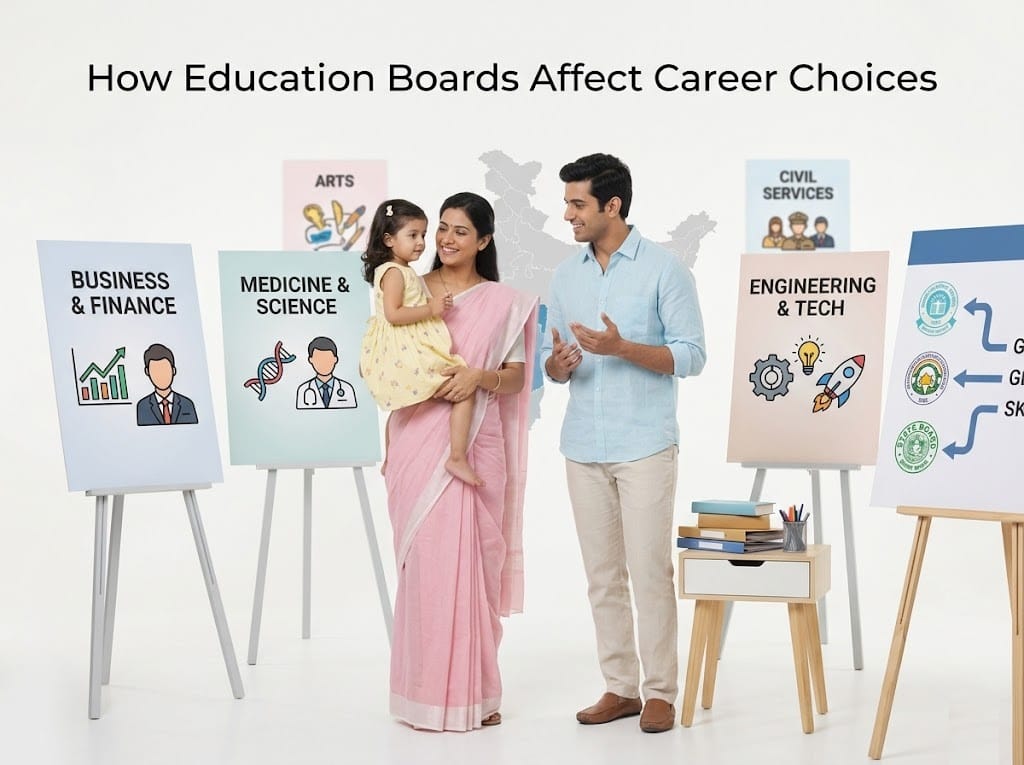
How Education Boards Affect Career Choices

How Education Boards Affect Career Choices

Choosing a school education board is one of the most important decisions parents make for their children. While many families focus on school reputation, fees, and location, the curriculum followed by the school can also influence academic development, learning style, higher education opportunities, and future career paths.

In India and around the world, students study under different education systems such as CBSE, ICSE, ISC, State Boards, International Baccalaureate (IB), and Cambridge. Each curriculum has its own teaching methods, assessment patterns, subject choices, and learning outcomes.

A common question among parents is whether the education board can affect a student’s future career. The answer is yes, but perhaps not in the way many people think. The board itself does not determine success, but it can shape academic strengths, skill development, and preparation for specific goals.

Why Education Boards Matter

Education boards create the framework through which students learn. They determine:

    • Subjects offered
    • Examination methods
    • Assessment standards
    • Teaching approaches
    • Skill development opportunities
    • Academic flexibility

The knowledge and skills gained during school years often influence future academic and professional choices.

According to the World Economic Forum, critical thinking, problem-solving, communication, and adaptability are among the most valuable skills for future careers. Different education boards emphasize these skills in different ways.

Understanding CBSE, ICSE, ISC, State Boards, IB and Cambridge Curriculums  

Understanding Major Education Boards

CBSE (Central Board of Secondary Education)

CBSE is one of the most widely followed education boards in India. More than 30,000 schools in India and abroad are affiliated with CBSE.

The curriculum focuses on:

    • Mathematics and Science
    • Conceptual understanding
    • Structured learning
    • National-level competitive examinations

Students preparing for entrance exams such as JEE, NEET, CUET, and NDA often find the CBSE curriculum aligned with exam syllabi.

Career Areas Commonly Pursued by CBSE Students

    • Engineering
    • Medicine
    • Defence Services
    • Government Examinations
    • Technology
    • Data Science

ICSE and ISC

ICSE is conducted for Class 10, while ISC covers Classes 11 and 12.

The curriculum places strong emphasis on:

    • English language proficiency
    • Analytical thinking
    • Project-based learning
    • Balanced subject exposure

Students often develop strong writing, research, and communication skills.

Career Areas Commonly Pursued by ICSE and ISC Students

    • Law
    • Journalism
    • Literature
    • Management
    • Social Sciences
    • Liberal Arts

How to Choose the Right School Board for Your Child

How State Boards Influence Career Choices

State Boards serve millions of students across India and are designed according to regional educational requirements.

Many state boards provide:

    • Affordable education
    • Regional language learning
    • Localized curriculum
    • Strong preparation for state-level examinations

Several successful doctors, engineers, civil servants, entrepreneurs, and scientists have graduated from State Board schools.

Advantages for Certain Career Paths

Students aiming for:

    • State Public Service Commissions
    • State Government Jobs
    • Regional Professional Colleges
    • Local University Admissions

may benefit from familiarity with state-specific educational systems.

The Growing Popularity of International Curriculums

International Baccalaureate (IB)

IB is known for encouraging inquiry-based learning and global perspectives.

Students are encouraged to:

    • Think independently
    • Conduct research
    • Participate in community projects
    • Develop international awareness

The IB Diploma Programme is recognized by universities in more than 150 countries.

Careers Often Linked with IB Graduates

    • International Business
    • Global Studies
    • Research
    • Economics
    • International Relations
    • Entrepreneurship

Common Academic Challenges Students Face in Different Boards

Cambridge Curriculum

The Cambridge pathway includes Primary, Lower Secondary, IGCSE, and International AS & A Levels.

The curriculum emphasizes:

    • Critical thinking
    • Independent learning
    • Subject specialization
    • International academic standards

Cambridge qualifications are accepted by universities worldwide.

Career Areas Commonly Pursued by Cambridge Students

    • Finance
    • Computer Science
    • Design
    • Business Management
    • International Education
    • Scientific Research

Does One Board Guarantee Career Success?

A common misconception is that one board automatically leads to better career outcomes.

Research consistently shows that long-term success depends more on:

    • Student interest
    • Academic effort
    • Quality teaching
    • Learning habits
    • Family support
    • Skill development

A study published by the Organisation for Economic Co-operation and Development (OECD) found that problem-solving ability, adaptability, and lifelong learning skills are stronger indicators of future success than examination scores alone.

The education board provides a foundation, but personal commitment plays a much larger role.

How Subject Choices Matter More Than the Board

In many cases, subject selection has a greater impact on career opportunities than the curriculum itself.

For example:

Engineering Aspirants

Students usually require strong foundations in:

    • Physics
    • Chemistry
    • Mathematics

Medical Aspirants

Students need:

    • Biology
    • Chemistry
    • Physics

Future Lawyers

Students benefit from:

    • English
    • Political Science
    • History
    • Sociology

Business and Finance Careers

Useful subjects include:

    • Economics
    • Accountancy
    • Mathematics
    • Business Studies

Regardless of the board, choosing subjects aligned with career goals is essential.

Understanding Different Grading Systems Across Education Boards

Skills Employers Value Today

The modern job market is changing rapidly.

According to LinkedIn’s workplace studies and employer surveys, organizations increasingly look for candidates with:

Communication Skills

The ability to express ideas clearly remains valuable across industries.

Critical Thinking

Employers seek individuals who can analyze information and make informed decisions.

Digital Literacy

Technology is now part of almost every profession.

Collaboration

Teamwork is essential in workplaces around the world.

Adaptability

Many professionals will change careers multiple times during their working lives.

Students should focus on developing these abilities alongside academic achievement.

Factors Parents Should Consider When Choosing a Board

Child’s Learning Style

Some students thrive in structured environments, while others perform better with inquiry-based learning.

Career Aspirations

Long-term goals can help guide curriculum choices.

Higher Education Plans

Students planning to study abroad may prefer international curriculums, while those targeting Indian competitive examinations often benefit from nationally aligned syllabi.

Availability of Academic Support

Access to experienced teachers, learning resources, and subject experts can significantly influence outcomes.

Why Personalized Tuition Improves Performance Across All Education Boards

Real-World Examples

An aspiring engineer preparing for JEE may find the CBSE curriculum closely aligned with entrance examination requirements.

A student interested in international university admissions may appreciate the research and analytical focus of IB or Cambridge.

A student preparing for regional government examinations may benefit from a State Board curriculum.

At the same time, successful professionals emerge from every education system. India has produced entrepreneurs, scientists, doctors, judges, civil servants, and business leaders from CBSE, ICSE, ISC, State Boards, IB, and Cambridge backgrounds.

My Thoughts

Education boards influence how students learn, think, and prepare for future opportunities. They can shape academic strengths and learning experiences, but they do not determine career success on their own.

The most important factors remain curiosity, discipline, skill development, quality guidance, and consistent effort. Parents should focus on finding the right educational environment that matches their child’s abilities, interests, and future aspirations.

For students who need additional academic support, a private tutor can provide personalized attention that is difficult to achieve in a classroom setting. One-to-one guidance helps identify learning gaps, improve confidence, strengthen subject knowledge, and develop effective study habits. Experienced tutors can also adapt lessons to the requirements of CBSE, ICSE, ISC, State Boards, IB, and Cambridge curriculums, helping students achieve their academic and career goals more effectively.

Looking for expert tutors?

Find Verified Tutors on IndiaTutor.in

About the Author

Nidhi Mehta is the founder of IndiaTutor.in and a professional online educator with over 11 years of teaching experience. She specializes in tutoring Classes 1 to 6 across core academic subjects, with a strong focus on concept clarity and foundational skill-building. Her teaching approach is based on personalized, one-to-one learning that helps students develop long-term academic confidence and understanding.
Visit her profile    Visit About Us Page

How Chemistry Builds Careers Beyond Medicine and Engineering

How Chemistry Builds Careers Beyond Medicine and Engineering

For many students, Chemistry is often viewed as a subject mainly useful for becoming a doctor, pharmacist, or engineer. While these are popular career choices, Chemistry opens doors to a much wider range of professions across industries such as healthcare, environmental science, food production, cosmetics, energy, research, manufacturing, and technology.

Chemistry is known as the “central science” because it connects physics, biology, environmental science, and engineering. It helps us understand how substances interact, transform, and affect the world around us. From developing life-saving medicines to creating sustainable fuels and improving food safety, Chemistry plays a crucial role in modern society.

Students who enjoy understanding how things work at a molecular level can find exciting and rewarding career opportunities beyond traditional professional paths.

Why Chemistry Remains an Important Subject

Chemistry influences nearly every aspect of daily life. Medicines, fertilizers, cleaning products, cosmetics, batteries, plastics, paints, and even drinking water treatment depend on chemical knowledge.

According to industry reports, the global chemical industry generates annual revenues exceeding $5 trillion. The sector supports millions of jobs worldwide and continues to grow due to increasing demand for healthcare products, sustainable materials, renewable energy solutions, and advanced manufacturing.

This means students with strong Chemistry knowledge can contribute to solving real-world challenges while building stable and rewarding careers.

Best Study Techniques for Learning Chemical Reactions Faster

How Chemistry Skills Are Valuable Across Industries

Studying Chemistry develops several transferable skills that employers value.

Analytical Thinking

Students learn to analyze data, identify patterns, and solve complex problems systematically.

Attention to Detail

Chemical experiments require precision, accuracy, and careful observation.

Research and Investigation

Chemistry teaches students how to design experiments, collect evidence, and draw conclusions.

Mathematical Application

Many Chemistry concepts involve calculations, data interpretation, and quantitative reasoning.

Critical Decision-Making

Students learn how scientific evidence supports informed decisions.

These abilities are useful in many industries, even outside laboratory environments.

How to Learn Chemical Equations Without Memorizing Everything

Career Opportunities Beyond Medicine and Engineering

Chemical Scientist

Chemical scientists conduct research to develop new materials, products, and technologies. They work in research institutions, government laboratories, universities, and private companies.

Their work may include developing better batteries, improving industrial processes, or creating environmentally friendly materials.

Environmental Scientist

Environmental scientists use Chemistry to study pollution, water quality, waste management, and climate-related issues.

Governments and private organizations increasingly hire professionals who can help reduce environmental impact and support sustainability initiatives.

Food Scientist

Food scientists ensure food products are safe, nutritious, and high quality.

They analyze ingredients, improve shelf life, develop new products, and monitor food safety standards.

The food processing industry continues to expand globally, creating strong demand for professionals with Chemistry backgrounds.

Cosmetic Chemist

Cosmetic chemists develop skincare products, shampoos, perfumes, makeup products, and personal care formulations.

This career combines science with creativity. Professionals test ingredients, improve product performance, and ensure safety standards are met.

Many global beauty brands invest heavily in research and product innovation.

Pharmaceutical Research Professional

While becoming a doctor is one option, Chemistry graduates can also work in pharmaceutical research and development.

These professionals help discover new drugs, improve existing treatments, and conduct clinical research.

According to industry estimates, developing a new medicine often requires years of scientific research involving large teams of chemists, biologists, and healthcare experts.

Forensic Scientist

Forensic scientists apply Chemistry to criminal investigations.

They analyze evidence such as toxic substances, drugs, fibers, paints, and biological samples to support law enforcement agencies.

Television shows have increased awareness of this profession, but the real work involves extensive scientific analysis and laboratory testing.

Materials Scientist

Materials scientists study metals, polymers, ceramics, composites, and advanced materials.

Their work contributes to industries such as electronics, aerospace, automotive manufacturing, renewable energy, and consumer products.

Modern technologies including smartphones, electric vehicles, and solar panels rely on advanced materials developed through chemical research.

Quality Control and Quality Assurance Specialist

Manufacturing companies depend on quality professionals to ensure products meet safety and performance standards.

Industries including pharmaceuticals, food processing, chemicals, cosmetics, and consumer goods hire Chemistry graduates for these roles.

Agricultural Scientist

Agricultural science combines Chemistry with crop production and soil management.

Professionals develop fertilizers, improve soil health, analyze nutrient levels, and support sustainable farming practices.

As food demand increases globally, agricultural innovation becomes increasingly important.

Patent Analyst

Students with scientific knowledge and strong communication skills may work as patent analysts.

They evaluate inventions, review scientific documentation, and help protect intellectual property rights.

This career blends science, law, and business.

Step-by-Step Guide to Scoring Full Marks in Chemistry Numericals

Emerging Fields Where Chemistry Is Creating New Opportunities

Renewable Energy

The transition toward clean energy is creating demand for professionals who understand batteries, hydrogen fuel systems, and energy storage technologies.

Chemistry plays a major role in improving solar panels, fuel cells, and next-generation energy solutions.

Nanotechnology

Nanotechnology involves working with materials at extremely small scales.

Researchers use Chemistry to create advanced medical devices, electronics, coatings, and materials with unique properties.

Biotechnology

Biotechnology combines Chemistry and Biology to develop innovative healthcare and agricultural solutions.

Applications include genetic research, diagnostics, vaccines, and biopharmaceutical products.

Sustainable Manufacturing

Companies worldwide are investing in greener production methods.

Chemists help reduce waste, improve resource efficiency, and develop environmentally friendly alternatives to traditional materials.

Can Chemistry Lead to Entrepreneurship?

Absolutely.

Many successful businesses have been built around chemical knowledge.

Examples include:

Manufacturing Businesses

Entrepreneurs develop products such as detergents, paints, cleaning agents, adhesives, fertilizers, and industrial chemicals.

Cosmetic Brands

Many skincare and beauty companies were founded by individuals with scientific backgrounds.

Food Innovation Startups

Chemistry knowledge can support product development, food preservation, and quality enhancement.

Environmental Solutions

Businesses focused on recycling, water treatment, and sustainable materials often require chemical expertise.

Students interested in business can combine scientific knowledge with entrepreneurship to create innovative ventures.

Why Students Fear Chemistry and How Parents Can Help

Educational Pathways After Studying Chemistry

Students can pursue several educational routes depending on their interests.

After Class 12

    • B.Sc. Chemistry
    • B.Sc. Environmental Science
    • B.Sc. Biotechnology
    • B.Pharm
    • Food Technology
    • Agricultural Science
    • Industrial Chemistry

Postgraduate Options

    • M.Sc. Chemistry
    • M.Sc. Analytical Chemistry
    • M.Sc. Environmental Chemistry
    • M.Sc. Materials Science
    • M.Sc. Biochemistry
    • M.Sc. Nanotechnology

Higher education often opens opportunities in research, teaching, product development, and leadership positions.

Why Students Should Not Ignore Chemistry

Some students view Chemistry only as an examination subject. However, understanding Chemistry develops scientific literacy and practical problem-solving abilities that remain valuable throughout life.

Industries continuously seek professionals who can analyze information, innovate, and improve products and processes. Chemistry provides a strong foundation for these capabilities.

Even students who eventually move into business, management, education, law, or entrepreneurship benefit from the analytical mindset developed through studying scientific subjects.

How to Choose the Right Chemistry Tutor for CBSE Students

My Thoughts

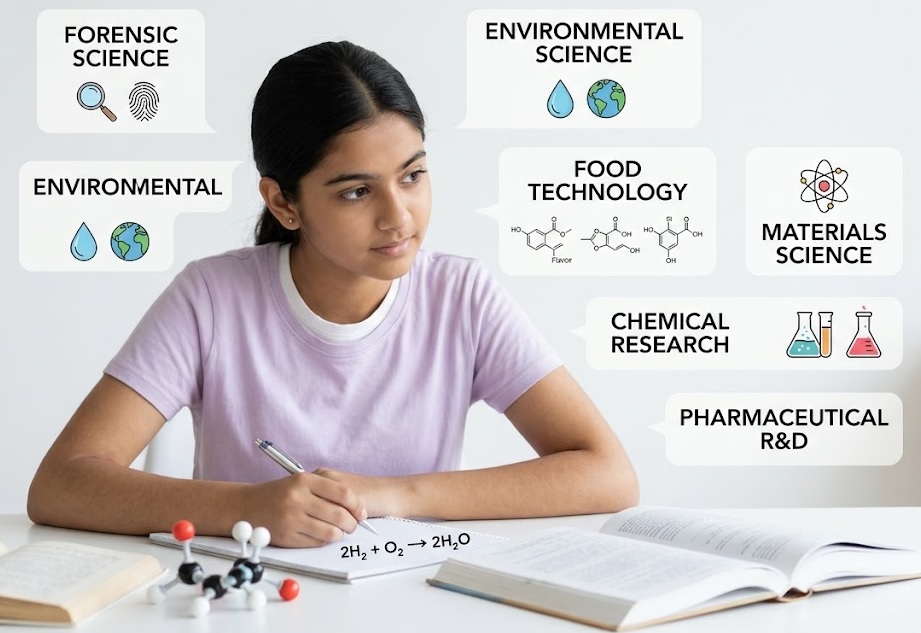
Chemistry is much more than a pathway to medicine or engineering. It supports careers in environmental protection, food science, cosmetics, pharmaceuticals, forensic investigation, renewable energy, materials development, agriculture, research, and entrepreneurship.

Students who build strong Chemistry fundamentals today can access a wide range of opportunities in the future. The subject encourages curiosity, develops critical thinking, and prepares learners to solve real-world challenges.

For students struggling with concepts, reactions, equations, or numerical problems, a private Chemistry tutor can provide personalized guidance, targeted practice, and individual attention. One-to-one support often helps students strengthen weak areas, improve confidence, and develop effective study habits. With the right mentorship, Chemistry can become more understandable, enjoyable, and rewarding.

Looking for expert Chemistry tutors?

Find Chemistry Tutors on IndiaTutor.in

About the Author

Nidhi Mehta is the founder of IndiaTutor.in and a professional online educator with over 11 years of teaching experience. She specializes in tutoring Classes 1 to 6 across core academic subjects, with a strong focus on concept clarity and foundational skill-building. Her teaching approach is based on personalized, one-to-one learning that helps students develop long-term academic confidence and understanding.

Visit her profile    Visit About Us Page

error: Content is protected !!

Found this helpful? Share it in 2 seconds!

Link copied to clipboard