
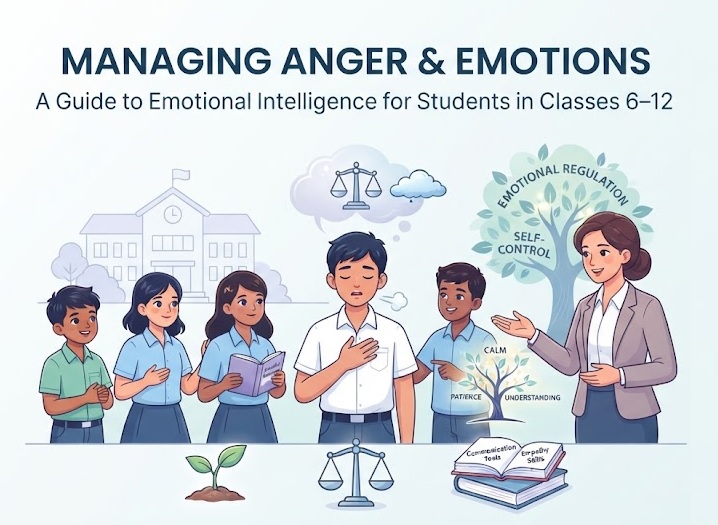
Managing Anger & Emotions

Managing Anger and Emotions

Every student experiences emotions every day. You may feel happy after scoring good marks, excited before a school trip, nervous before an exam, or angry when someone treats you unfairly. Emotions are a natural part of life, and they help us understand ourselves and the world around us.

Among all emotions, anger is one of the most misunderstood. Many people believe anger is bad, but that is not true. Anger is a normal human emotion. What matters is how we manage it. Learning to control anger and express emotions in a healthy way is an important life skill that helps students succeed in school, build better friendships, and enjoy happier lives.

This guide explains everything students in Classes 6 to 12 need to know about managing anger and emotions in simple language.

What Are Emotions?

Emotions are feelings that help us respond to different situations. They influence our thoughts, decisions, and actions.

Some common emotions include:

    • Happiness
    • Sadness
    • Anger
    • Fear
    • Excitement
    • Surprise
    • Disappointment
    • Worry
    • Pride
    • Love

Every emotion has a purpose. Feeling sad after losing something important or feeling nervous before an exam is completely normal.

There are no “good” or “bad” emotions. There are only healthy and unhealthy ways of expressing them.

What Is Anger?

Anger is your body’s natural response when you feel threatened, hurt, ignored, embarrassed, or treated unfairly.

For example, you may feel angry if:

    • Someone bullies you.
    • A friend breaks your trust.
    • You lose an important match.
    • Your parents misunderstand you.
    • Someone insults you online.
    • You are blamed for something you did not do.

Feeling angry does not make you a bad person. Everyone gets angry sometimes.

The real challenge is learning how to respond without hurting yourself or others.

Why Do Students Become Angry?

School life brings many challenges. Some common reasons include:

Academic Pressure

Homework, exams, competition, and high expectations can create stress.

Bullying

Being teased, excluded, or physically bullied often leads to frustration and anger.

Peer Pressure

Trying to fit in with friends or facing social rejection can affect emotions.

Family Problems

Arguments at home, financial stress, divorce, or lack of communication may make students feel upset.

Social Media

Negative comments, cyberbullying, unrealistic comparisons, and online conflicts can increase emotional stress.

Lack of Sleep

Students who do not get enough sleep often become more irritable and impatient.

What Happens Inside Your Body When You Get Angry?

Anger affects both the brain and the body.

When you become angry:

    • Your heart beats faster.
    • Your breathing speeds up.
    • Blood pressure increases.
    • Muscles become tense.
    • Stress hormones are released.
    • Clear thinking becomes more difficult.

Your brain prepares your body for a “fight or flight” response.

This is useful during real danger but not during everyday disagreements at school or home.

Signs That Anger Is Getting Out of Control

Everyone feels angry sometimes, but frequent or intense anger may become a problem.

Watch for these warning signs:

    • Shouting frequently
    • Fighting with classmates
    • Breaking things
    • Throwing objects
    • Using hurtful words
    • Holding grudges
    • Feeling angry most of the day
    • Hurting yourself
    • Thinking about hurting others

If these signs continue, it is important to seek help.

Why Managing Anger Is Important

Learning emotional control helps students in many ways.

Students who manage anger well often:

    • Make better decisions
    • Have stronger friendships
    • Perform better in school
    • Solve problems calmly
    • Feel more confident
    • Handle stress more effectively
    • Avoid unnecessary conflicts

Managing emotions is one of the most valuable life skills you can develop.

Healthy Ways to Manage Anger

Stop Before You React

Take a moment before speaking or acting.

A few seconds of thinking can prevent many problems.

Take Deep Breaths

Slow, deep breathing helps calm both your body and your mind.

Breathe in through your nose and slowly breathe out through your mouth.

Repeat several times.

Count Slowly

Counting from one to ten gives your brain time to think before reacting.

Walk Away

If an argument is becoming worse, politely leave the situation and return when you feel calmer.

Walking away is not weakness. It is self-control.

Drink Water

Something as simple as drinking water can help you slow down and relax.

Exercise

Physical activity reduces stress hormones and improves your mood.

Sports, walking, cycling, dancing, or yoga can all help.

Listen to Music

Soft, calming music helps many students relax after a stressful day.

Write Your Feelings

Keeping a journal allows you to express emotions without hurting anyone.

Writing often makes problems feel smaller.

Learn to Express Your Feelings

Instead of shouting or blaming others, use respectful language.

Try saying:

“I feel upset.”

“I didn’t like what happened.”

“I need some time to calm down.”

“I would like to talk about this.”

These simple sentences reduce misunderstandings and encourage healthy communication.

Think Before You Speak

Words can leave lasting emotional wounds.

Before speaking, ask yourself:

    • Is it true?
    • Is it necessary?
    • Is it kind?
    • Will it make the situation better?

Sometimes choosing silence is the wisest decision.

The Importance of Self-Control

Self-control means choosing your actions instead of letting emotions control you.

Strong people are not those who shout the loudest.

Strong people remain calm even during difficult situations.

Every time you stay calm, you strengthen your self-control.

Helping a Friend Who Is Angry

If someone you know is angry:

    • Stay calm.
    • Listen without interrupting.
    • Do not make fun of them.
    • Give them space if needed.
    • Encourage them to speak to a trusted adult.
    • Get immediate help if they talk about hurting themselves or someone else.

Sometimes simply listening is the greatest help you can offer.

How Sleep, Food, and Exercise Affect Emotions

Your body and mind work together.

Poor health habits often make emotions harder to control.

Healthy habits include:

    • Sleeping 8 to 10 hours each night
    • Eating balanced meals
    • Drinking enough water
    • Exercising regularly
    • Spending less time on screens
    • Taking short breaks while studying

Looking after your body helps your brain manage emotions better.

How Social Media Can Increase Anger

Social media can be fun, but it can also create unnecessary stress.

Students may become angry because of:

    • Online arguments
    • Negative comments
    • Cyberbullying
    • Comparing themselves with others
    • False information
    • Excessive screen time

If social media is affecting your emotions, take regular breaks and avoid responding when you are angry.

What Science Says About Emotions

Research from organizations such as the World Health Organization (WHO) and UNICEF highlights the importance of helping children and teenagers develop emotional and social skills.

Studies show that students with strong emotional skills often:

    • Build healthier friendships
    • Solve problems more effectively
    • Perform better academically
    • Experience less stress
    • Make safer decisions

Neuroscience also shows that the part of the brain responsible for planning, decision-making, and self-control continues developing throughout the teenage years. This means emotional control is a skill that improves with practice.

When Should You Ask for Help?

Sometimes anger becomes difficult to manage alone.

Talk to a trusted adult if:

    • You feel angry every day.
    • You often fight with others.
    • You break things when angry.
    • You hurt yourself.
    • You think about hurting others.
    • Anger is affecting your studies or friendships.

You can speak to:

    • Parents
    • Teachers
    • School counsellors
    • Relatives
    • Trusted family friends

Asking for help is a sign of courage and maturity.

Daily Habits That Help You Stay Calm

Small habits make a big difference.

Try to:

    • Smile more often.
    • Sleep well.
    • Eat healthy food.
    • Exercise every day.
    • Practice gratitude.
    • Read books.
    • Spend time outdoors.
    • Talk openly about your feelings.
    • Limit unnecessary screen time.
    • Be kind to yourself and others.

These habits improve both physical and emotional health.

Remember This Every Day

Before reacting, ask yourself:

“Will this matter one week from now?”

Many situations that feel huge today become much less important with time.

Choosing patience today can save you from regret tomorrow.

My Thoughts

Anger is a normal emotion, but it should never control your actions. Every student has the ability to learn patience, kindness, self-control, and emotional intelligence. These skills are just as important as mathematics, science, or languages because they help you succeed in every part of life.

You will not become calm overnight, and that is perfectly okay. Every time you pause before reacting, take a deep breath, speak respectfully, or ask for help, you are becoming stronger.

Remember, the strongest people are not those who never get angry. They are the ones who know how to manage their emotions wisely, solve problems peacefully, and treat others with respect.

Learning to manage your anger today will help you become a happier student, a better friend, and a more confident adult tomorrow.

Related Topics

Bullying & Cyberbullying

Smoking, Vaping, Alcohol & Drugs

Mental Health, Anxiety & Depression

Internet Safety & Social Media Safety

Self-Esteem, Confidence & Body Image

Exam Stress & Time Management

Peer Pressure

Online Gaming & Smartphone Addiction 

About the Author

Nidhi Mehta is the founder of IndiaTutor.in and a professional online educator with over 11 years of teaching experience. She specializes in tutoring Classes 1 to 6 across core academic subjects, with a strong focus on concept clarity and foundational skill-building. Her teaching approach is based on personalized, one-to-one learning that helps students develop long-term academic confidence and understanding.

Visit her profile    Visit About Us Page

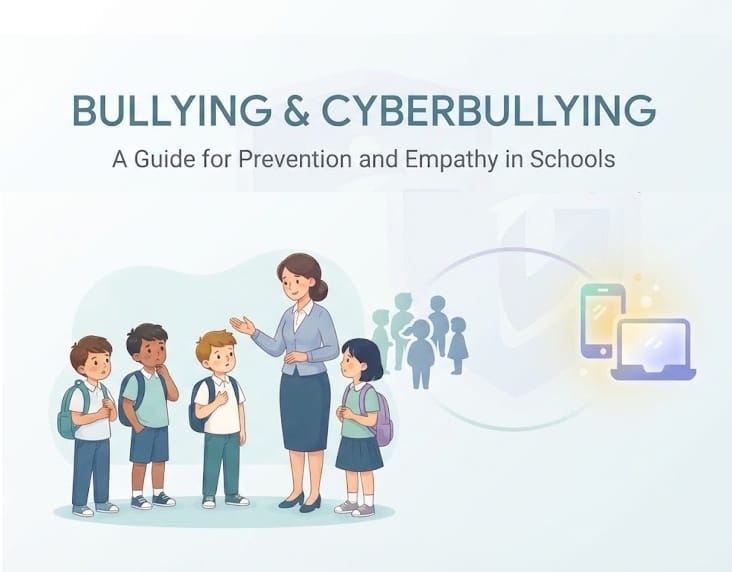
Bullying and Cyberbullying

Bullying and CyberBullying

Bullying and cyberbullying have become some of the biggest challenges facing school students today. While schools are places where children learn, make friends, and build confidence, they can also become places where some students experience repeated harassment, exclusion, or intimidation.

With smartphones, social media, gaming platforms, and messaging apps becoming part of everyday life, bullying no longer ends when the school bell rings. Many children continue to face hurtful messages, embarrassing photos, fake accounts, and online threats even after reaching home.

Understanding what bullying is, why it happens, and how to stop it is the first step toward creating a safer environment for every child.

What Is Bullying?

Bullying is repeated unwanted behavior intended to hurt, frighten, embarrass, or control another person. It usually involves an imbalance of power, where the person bullying believes they have more strength, popularity, or influence than the victim.

Bullying is different from a normal disagreement between friends. Arguments happen occasionally, but bullying is repeated and intentional.

Children who are bullied often feel unsafe, anxious, lonely, and afraid to attend school.

What Is Cyberbullying?

Cyberbullying is bullying that takes place through digital devices such as mobile phones, computers, tablets, gaming platforms, social media, or messaging applications.

Examples include:

    • Sending abusive or threatening messages
    • Posting embarrassing photos or videos without permission
    • Spreading false rumours online
    • Creating fake social media profiles
    • Excluding someone from online groups
    • Sharing private information without consent
    • Posting insulting comments repeatedly

Unlike traditional bullying, cyberbullying can happen at any time and may reach a very large audience within minutes.

Why Is Bullying Becoming More Common?

Several factors contribute to bullying.

Peer Pressure

Some children bully others to impress friends or gain popularity.

Lack of Empathy

Children who struggle to understand another person’s feelings may be more likely to bully.

Social Media

Online platforms make it easier for hurtful messages and rumours to spread quickly.

Desire for Power

Some students use bullying to feel important or control others.

Family or Personal Problems

Research suggests that children experiencing difficulties at home or emotional stress may sometimes express their frustration by bullying classmates.

Types of Bullying

Physical Bullying

Physical bullying involves hurting another student through actions such as pushing, kicking, hitting, damaging belongings, or blocking someone’s path.

Verbal Bullying

This includes insults, teasing, name-calling, mocking appearance, religion, language, disability, or family background.

Social Bullying

Also called relational bullying, this involves excluding someone from a group, spreading rumours, or damaging friendships.

Cyberbullying

This includes online harassment through texts, emails, social media, gaming platforms, or messaging apps.

Warning Signs That a Child May Be Bullied

Parents and teachers should watch for changes such as:

    • Suddenly refusing to attend school
    • Frequent headaches or stomach aches
    • Loss of confidence
    • Mood swings
    • Poor concentration
    • Falling academic performance
    • Damaged belongings
    • Changes in eating or sleeping habits
    • Avoiding friends
    • Becoming unusually quiet after using a phone or computer

One sign alone may not indicate bullying, but several together deserve attention.

Warning Signs That a Child May Be Bullying Others

Sometimes children who bully also need guidance and support.

Possible signs include:

    • Frequently getting into fights
    • Showing little empathy
    • Wanting to dominate others
    • Blaming classmates for problems
    • Bringing home items that do not belong to them
    • Becoming aggressive when corrected

Helping these children develop empathy and positive behaviour is important.

Facts and Statistics About Bullying

Bullying affects millions of children worldwide.

According to the United Nations Educational, Scientific and Cultural Organization (UNESCO), nearly one in three students globally reports being bullied by peers at school.

The World Health Organization has also reported that bullying remains a major public health concern among adolescents because of its impact on emotional well-being, mental health, and academic performance.

Research published by UNICEF shows that many young people have experienced online bullying, with social media becoming one of the most common places where harassment occurs.

Studies consistently show that students who experience bullying are more likely to develop anxiety, depression, lower self-esteem, and poorer academic outcomes than their peers.

Real-Life Examples

A student may be repeatedly laughed at because of their accent.

Another child may be excluded from every class group activity.

Someone’s photograph may be edited and shared online to embarrass them.

A student may receive anonymous threatening messages every evening.

Although these situations look different, they all have one thing in common—they cause emotional harm.

How Bullying Affects Students

Emotional Impact

Children may experience fear, sadness, loneliness, embarrassment, anger, or hopelessness.

Academic Impact

Many students find it difficult to concentrate in class, participate in activities, or complete homework.

Physical Impact

Stress may lead to headaches, stomach pain, sleep problems, and fatigue.

Social Impact

Victims often avoid school events, sports, or friendships because they no longer feel safe.

How Students Can Respond to Bullying

If someone is bullying you:

    • Stay calm whenever possible.
    • Walk away from unsafe situations.
    • Do not respond with violence.
    • Save screenshots of online abuse.
    • Block and report abusive accounts.
    • Tell a trusted adult immediately.
    • Keep evidence of repeated incidents.
    • Stay with supportive friends.
    • Remember that bullying is never your fault.

Speaking up early often prevents bullying from becoming worse.

What Should Parents Do?

Parents play an important role in protecting children.

Listen Carefully

Allow your child to explain what happened without interrupting.

Stay Calm

Avoid reacting with anger before understanding the complete situation.

Document Incidents

Keep records of messages, emails, screenshots, or written complaints.

Inform the School

Work together with teachers and school administrators to resolve the issue.

Encourage Confidence

Support children through positive conversations, hobbies, and healthy friendships.

How Schools Can Prevent Bullying

Schools can create safer environments through:

Clear Anti-Bullying Policies

Every student should understand that bullying is unacceptable.

Awareness Programs

Regular workshops help students understand kindness, empathy, and respect.

Teacher Training

Teachers should know how to identify and respond to bullying effectively.

Anonymous Reporting Systems

Students should have safe ways to report incidents without fear.

Digital Safety Education

Teaching responsible online behavior helps reduce cyberbullying.

Responsible Digital Behavior

Students should remember a simple rule:

Never post, share, or send anything online that could hurt, embarrass, or humiliate another person.

Before posting something, ask yourself:

    • Is it true?
    • Is it kind?
    • Is it necessary?
    • Would I say this face-to-face?

If the answer is no, it is better not to post it.

Building a Culture of Kindness

Every student can help reduce bullying.

Invite classmates to join games.

Stand up respectfully for someone being bullied.

Avoid spreading rumors.

Use kind words.

Include students who feel left out.

Celebrate differences instead of making fun of them.

Small acts of kindness create safer schools for everyone.

When Professional Help Is Needed

If bullying causes severe anxiety, depression, panic attacks, self-isolation, or major behavioral changes, parents should seek support from qualified school counselors, psychologists, or mental health professionals without delay.

Early intervention can make a significant difference in a child’s recovery.

My Thoughts

Bullying and cyberbullying can affect any student, regardless of age, background, or academic performance. However, they are preventable when students, parents, teachers, and schools work together.

Respect, empathy, and responsible digital behavior create classrooms where every child feels safe to learn and grow. By encouraging open communication, acting early, and supporting one another, we can build schools where kindness is stronger than bullying.

Related Topics

Smoking, Vaping, Alcohol & Drugs

Mental Health, Anxiety & Depression

Internet Safety & Social Media Safety

Self-Esteem, Confidence & Body Image

Exam Stress & Time Management

Peer Pressure

Respect, Kindness & Inclusion

Online Gaming & Smartphone Addiction 

Managing Anger & Emotions

About the Author

Nidhi Mehta is the founder of IndiaTutor.in and a professional online educator with over 11 years of teaching experience. She specializes in tutoring Classes 1 to 6 across core academic subjects, with a strong focus on concept clarity and foundational skill-building. Her teaching approach is based on personalized, one-to-one learning that helps students develop long-term academic confidence and understanding.

Visit her profile    Visit About Us Page

Understanding CBSE, ICSE, ISC, State Boards, IB and Cambridge Curriculums

Understanding CBSE, ICSE, ISC, State Boards, IB and Cambridge Curriculums

Choosing the right school curriculum is one of the most important decisions parents make for their child’s education. Every curriculum follows a different teaching approach, assessment style, and learning philosophy. While all aim to build knowledge and skills, they prepare students in different ways for higher education and future careers.

In India, the most common school curriculums include CBSE, ICSE, ISC, State Boards, the International Baccalaureate (IB), and Cambridge. Understanding how each one works can help parents select the best fit for their child’s learning style, academic goals, and future plans.

According to the Ministry of Education, India has more than 1.5 million schools serving over 250 million students, making it one of the world’s largest education systems. Students today have more curriculum choices than ever before, making informed decisions increasingly important.

How Education Boards Affect Career Choices

Why Understanding Different School Curriculums Matters

Every child learns differently. Some students enjoy structured learning, while others perform better through projects, research, discussions, and practical activities. The curriculum influences:

    • Subjects offered
    • Teaching methods
    • Examination pattern
    • Grading system
    • Homework expectations
    • Critical thinking development
    • College and career opportunities

Choosing the right curriculum is not about finding the “best” one. It is about finding the one that best matches a student’s strengths, interests, and long-term goals.

What is CBSE?

The Central Board of Secondary Education (CBSE) is one of India’s largest national education boards. Thousands of schools across India and many international schools abroad follow the CBSE curriculum.

Key Features of CBSE

    • Uniform curriculum across affiliated schools
    • Strong emphasis on Mathematics and Science
    • NCERT textbooks form the academic foundation
    • Regular syllabus updates
    • Focus on conceptual understanding
    • Widely accepted across Indian colleges and universities

Who Benefits Most from CBSE?

CBSE is often preferred by families whose children may relocate frequently because the curriculum remains consistent across affiliated schools.

It is also a popular choice for students preparing for competitive examinations such as engineering and medical entrance tests because these exams are largely based on NCERT concepts.

What is ICSE?

The Indian Certificate of Secondary Education (ICSE) is conducted by the Council for the Indian School Certificate Examinations (CISCE).

ICSE is known for its balanced curriculum that gives equal importance to languages, sciences, mathematics, social sciences, arts, and practical learning.

Key Features of ICSE

    • Strong focus on English language skills
    • Detailed subject content
    • Project work and internal assessments
    • Application-based learning
    • Broad subject choices

Students often develop strong communication, analytical thinking, and writing skills through the ICSE curriculum.

What is ISC?

The Indian School Certificate (ISC) is the senior secondary curriculum offered by CISCE for Classes 11 and 12.

Key Features of ISC

    • Flexible subject combinations
    • In-depth academic content
    • Strong emphasis on analytical writing
    • Extensive practical and project work
    • Preparation for university education

Students can choose combinations across Science, Commerce, Humanities, and other disciplines depending on their career aspirations.

How to Choose the Right School Board for Your Child

Understanding State Boards

Every Indian state has its own education board designed according to regional educational priorities and state-level requirements.

Examples include boards in Maharashtra, Tamil Nadu, Karnataka, Uttar Pradesh, Rajasthan, Gujarat, West Bengal, Kerala, Punjab, and many other states.

Key Features of State Boards

    • Regional language options
    • Affordable education
    • Curriculum aligned with state universities
    • Focus on local history and culture
    • State-level examination system

Many students successfully qualify for engineering, medical, civil services, and government examinations after studying in State Board schools.

The curriculum and assessment methods may vary from one state to another.

What is the International Baccalaureate (IB)?

The International Baccalaureate (IB) is an internationally recognized education framework followed by schools in more than 160 countries.

Rather than emphasizing memorization, IB encourages students to become independent thinkers, researchers, and effective communicators.

Main IB Programmes

Primary Years Programme (PYP)

Designed for younger learners with inquiry-based education.

Middle Years Programme (MYP)

Encourages interdisciplinary learning and practical application.

Diploma Programme (DP)

A rigorous programme for students aged 16 to 19 that is widely respected by universities worldwide.

Key Features of IB

    • Inquiry-based learning
    • Research projects
    • International perspective
    • Creativity, Activity and Service (CAS)
    • Critical thinking
    • Independent learning

Many universities around the world value the research and analytical skills developed through the IB Diploma Programme.

Common Academic Challenges Students Face in Different Boards

What is Cambridge Curriculum?

The Cambridge curriculum is developed by Cambridge Assessment International Education and is followed by schools in more than 160 countries.

It provides a flexible learning pathway from primary education through advanced secondary education.

Cambridge Learning Stages

Cambridge Primary

Builds strong foundations in literacy, numeracy, and science.

Cambridge Lower Secondary

Develops subject knowledge and problem-solving skills.

Cambridge IGCSE

Typically taken by students aged 14 to 16, Cambridge IGCSE is one of the world’s most recognized international qualifications.

Students can choose from a wide range of subjects according to their interests.

Cambridge International AS & A Level

These advanced qualifications prepare students for university education across the world.

Key Features of Cambridge

    • Flexible subject selection
    • Global recognition
    • Conceptual learning
    • Practical assessments
    • Research-based assignments
    • Development of independent learning skills

Cambridge qualifications are accepted by universities in many countries.

Understanding Different Grading Systems Across Education Boards

Comparing the Major School Curriculums

Learning Style

CBSE focuses on conceptual clarity.

ICSE provides detailed subject knowledge.

ISC promotes deeper academic understanding.

State Boards vary depending on the state.

IB emphasizes inquiry and research.

Cambridge encourages flexible and application-oriented learning.

Assessment

CBSE combines theory with competency-based questions.

ICSE includes written examinations along with project work.

ISC places strong emphasis on analytical writing and practical assessments.

State Boards follow their respective examination systems.

IB evaluates students using coursework, projects, presentations, and examinations.

Cambridge uses a combination of written papers, coursework, and practical assessments depending on the subject.

Best for Higher Education

All these curriculums provide pathways to higher education.

The right choice depends on where a student intends to study and the learning environment that suits them best.

Students aiming for Indian competitive examinations often find CBSE helpful because of its alignment with NCERT.

Students planning to study overseas may benefit from IB or Cambridge qualifications, as these are widely recognized internationally.

Which Curriculum is the Hardest?

There is no universally hardest curriculum.

Difficulty depends on several factors:

    • Learning style
    • Interest in subjects
    • Quality of teaching
    • Study habits
    • Time management
    • Academic support

A curriculum that challenges one student may be ideal for another.

Why Personalized Tuition Improves Performance Across All Education Boards

Common Misconceptions

Higher Fees Mean Better Education

School quality depends on teaching standards, student support, and learning environment, not only on curriculum or fees.

One Curriculum Guarantees Success

Academic success depends on consistent effort, curiosity, discipline, and guidance rather than the curriculum alone.

Students Cannot Switch Curriculums

Many students successfully transition between curriculums with proper planning and academic support.

How Parents Can Choose the Right Curriculum

Before selecting a curriculum, consider:

    • Your child’s interests
    • Learning preferences
    • Future career plans
    • College aspirations
    • Language comfort
    • School teaching quality
    • Availability of academic support

Visiting schools, interacting with teachers, and understanding the curriculum structure can help parents make a confident decision.

Frequently Asked Questions

Which curriculum is best for engineering and medical entrance exams?

Many students preparing for national competitive examinations prefer CBSE because of its close alignment with NCERT textbooks.

Is ICSE better than CBSE?

Neither is universally better. Both have different strengths and suit different learners.

Is IB accepted in India?

Yes. Universities across India and around the world recognize IB qualifications, subject to their admission requirements.

Is Cambridge accepted by Indian universities?

Yes. Cambridge qualifications are accepted by many Indian universities as well as institutions across the globe, provided students meet the respective eligibility criteria.

Can students move from one curriculum to another?

Yes. Many schools admit transfer students, although some additional academic preparation may be required depending on syllabus differences.

My Thoughts

Every curriculum offers valuable learning opportunities. The best choice depends on a student’s goals, interests, strengths, and preferred learning style. Rather than searching for the “perfect” board, focus on finding a school and curriculum that encourage curiosity, confidence, and consistent academic growth.

No matter which curriculum a student follows, there may be times when extra academic support becomes valuable. A private tutor provides individual attention, explains difficult concepts at the student’s pace, strengthens confidence, and fills learning gaps that may not be addressed in a busy classroom. Personalised tuition also helps students prepare effectively for school assessments, board examinations, and competitive tests while developing better study habits and independent learning skills.

Find Verified Tutors on IndiaTutor.in

About the Author

Nidhi Mehta is the founder of IndiaTutor.in and a professional online educator with over 11 years of teaching experience. She specializes in tutoring Classes 1 to 6 across core academic subjects, with a strong focus on concept clarity and foundational skill-building. Her teaching approach is based on personalized, one-to-one learning that helps students develop long-term academic confidence and understanding.

Visit her profile    Visit About Us Page

Why Smart Parents Choose Verified Tutors Instead of Random Ads

IndiaTutor

Finding the right tutor can have a lasting impact on a child’s academic progress, confidence, and study habits. Today, parents are exposed to thousands of advertisements on social media, classifieds, messaging groups, and local listing platforms. While these ads may promise excellent results, many families are becoming more cautious about whom they trust with their child’s education.

This is why an increasing number of parents prefer verified tutors over unknown individuals found through random advertisements.

What Is a Verified Tutor?

A verified tutor is an educator whose profile, qualifications, teaching experience, and identity have been reviewed before being listed on a tutoring platform.

Verification may include:

    • Educational qualifications
    • Teaching experience
    • Subject expertise
    • Professional profile information
    • Identity verification
    • References or student feedback

This additional layer of transparency helps parents make informed decisions.

Why Random Tutor Ads Can Be Risky

Limited Background Information

Many advertisements provide only a name, phone number, and a few claims about experience. Parents often have no reliable way to confirm whether the information is accurate.

Without proper verification, it becomes difficult to evaluate:

    • Academic qualifications
    • Teaching skills
    • Experience level
    • Subject specialization
    • Track record with students

No Standardized Information

One tutor may highlight qualifications while another focuses on fees. This makes meaningful comparison difficult.

Parents frequently spend hours contacting multiple tutors simply to gather basic information before making a decision.

Higher Chances of Mismatched Expectations

A tutor may be excellent at a subject but may not be suitable for a particular learning style, age group, curriculum, or academic goal.

When information is incomplete, finding the right fit becomes largely a matter of guesswork.

Why Verification Matters More Than Ever

Parents Are Investing More in Academic Support

A recent government survey found that approximately 33% of Indian students receive some form of private coaching or tutoring support outside regular school hours. This demonstrates how important supplementary learning has become for modern families.

As investment in education grows, parents naturally want greater confidence in their tutor selection process.

Quality Tutoring Produces Measurable Results

Research analyzing dozens of tutoring programs found that tutoring consistently delivers significant improvements in student learning outcomes. The study identified tutoring as one of the most effective educational interventions available.

However, results depend heavily on tutor quality, experience, and the ability to personalize instruction.

Benefits of Choosing a Verified Tutor

Better Trust and Transparency

Verified profiles provide parents with detailed information before making contact.

This often includes:

    • Subjects taught
    • Academic background
    • Years of experience
    • Teaching approach
    • Student levels served
    • Mode of instruction

Transparency helps families make decisions with greater confidence.

Easier Comparison

Instead of relying on marketing claims, parents can compare tutors using consistent information.

This makes it easier to shortlist professionals based on actual requirements rather than promotional messages.

Improved Learning Experience

Students learn differently. Some need concept clarity, while others require exam preparation, homework support, or confidence building.

Research shows that personalized tutoring can substantially improve academic performance because instruction is adapted to individual needs.

Greater Accountability

When tutors maintain professional profiles, they are more likely to present accurate information and maintain educational standards.

Accountability creates a better experience for both students and parents.

Why Trusted Tutor Platforms Are the Future of Tuition Jobs

What Smart Parents Look for Before Hiring a Tutor

Subject Expertise

Strong subject knowledge remains the foundation of effective teaching.

Parents should look for tutors who specialize in the subjects their child needs help with.

Relevant Experience

Teaching a Class 3 student requires different skills than preparing a Class 12 student for board examinations.

Experience with the appropriate age group matters.

Communication Skills

The best educators simplify complex concepts and create a comfortable learning environment.

Students are more likely to ask questions when they feel understood and supported.

Consistency

Regular sessions, progress tracking, and structured lesson planning often contribute to better outcomes.

Professional Profile

A detailed tutor profile demonstrates seriousness and commitment to teaching.

10 Things Indian Parents Must Ask Before Hiring an Online Tutor

How Online Tutor Directories Are Changing Parent Decisions

Modern parents increasingly prefer platforms that allow them to:

This approach saves time and reduces uncertainty.

Instead of responding to random advertisements, families can make decisions based on verified information and specific learning needs.

Why Verification Also Benefits Tutors

Builds Credibility

A verified profile helps tutors showcase their qualifications and teaching experience professionally.

Increases Visibility

Parents searching for subject-specific support are more likely to contact tutors with complete profiles.

Creates Trust Faster

Trust is often the deciding factor when parents choose between multiple educators offering similar services.

Verification helps establish that trust from the beginning.

The Future of Tutor Selection

Education is becoming increasingly personalized. Parents no longer choose tutors solely based on proximity or advertisements. They want transparency, qualifications, experience, and confidence in their decision.

Verified tutor profiles make that process easier, safer, and more effective.

As awareness grows, the shift from random advertisements to trusted tutor directories is likely to continue.

Best Online Teacher Platforms in India – What Every Parent Should Know

My Thoughts

Choosing a tutor is one of the most important educational decisions a parent can make. Verified tutors provide greater transparency, stronger credibility, and a more informed selection process. For families seeking academic support, verification offers peace of mind before the first lesson even begins.

Parents can explore verified tutor profiles on IndiaTutor.in and connect directly with educators who match their child’s academic needs. Tutors can register on IndiaTutor.in to showcase their expertise, increase visibility, and receive direct enquiries from students and parents without paying commissions.

Register your Tutor Profile on IndiaTutor.in

About the Author

Nidhi Mehta is the founder of IndiaTutor.in and a professional online educator with over 11 years of teaching experience. She specializes in tutoring Classes 1 to 6 across core academic subjects, with a strong focus on concept clarity and foundational skill-building. Her teaching approach is based on personalized, one-to-one learning that helps students develop long-term academic confidence and understanding.

Visit her profile    Visit About Us Page

error: Content is protected !!

Found this helpful? Share it in 2 seconds!

Link copied to clipboard